Navigating the world of medical codes can feel like learning a new language. If you’re a healthcare professional, student, or a patient reviewing records, you might have encountered the need to find the ICD-9 code for hip pain. While the healthcare industry has transitioned to ICD-10, understanding ICD-9 remains crucial for handling older medical records, certain insurance claims, and historical data analysis.
This guide is designed to be your definitive resource. We’ll provide clear, accurate information about the specific ICD-9 code, explain its context, and offer practical insights to ensure you have a thorough and reliable understanding.
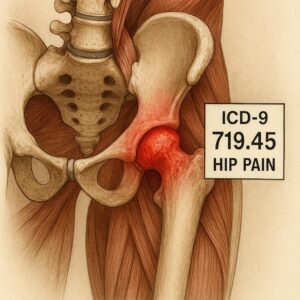
ICD-9 Code for Hip Pain
The Specific ICD-9 Code for Hip Pain
The direct and most commonly used ICD-9-CM (International Classification of Diseases, 9th Revision, Clinical Modification) code for generalized hip pain is:
719.45 – Pain in joint, pelvic region and thigh
This code falls under a broader category that requires careful attention to detail for accurate application.
Breaking Down the Code Structure
To fully grasp code 719.45, it’s helpful to understand its hierarchy within the ICD-9 system:
-
719: This is the parent category for “Other and unspecified disorders of joint.”
-
.4: This fourth digit specifies “Pain in joint.” It indicates that the pain is the primary reason for the encounter and isn’t attributed to a more specific diagnosis like arthritis or injury at this time.
-
.5: This fifth digit is crucial. It designates the anatomical site as the “pelvic region and thigh,” which encompasses the hip joint.
Important Note: “ICD-9 codes are a historical record-keeping standard. For all current medical billing and diagnostic reporting in the United States after October 1, 2015, the ICD-10-CM system is mandatory. This article serves educational and reference purposes for legacy data.”
Proper Application and Documentation of Code 719.45
Using 719.45 correctly is essential for clear communication and accurate record-keeping. It is a symptom code, meaning it describes the patient’s complaint rather than a definitive underlying disease.
When to Use 719.45
This code is appropriate in several clinical scenarios:
-
Initial Encounters: When a patient presents with hip pain and the physician is in the process of ordering tests (like X-rays or MRIs) to determine the cause.
-
Unspecified Etiology: When the initial workup does not immediately reveal a specific cause like osteoarthritis, bursitis, or fracture.
-
Chronic Pain Management: For ongoing management of hip pain where the root cause may be multifactorial or not fully defined.
-
Post-Procedural Pain: While more specific codes often exist, it can sometimes be used for pain following a procedure if it is the dominant, unspecified issue.
Essential Documentation Requirements
Clear documentation in the medical record is the foundation of accurate coding. To support the use of 719.45, the clinician’s notes should include:
-
Location: Precisely “right hip,” “left hip,” or “bilateral hips.”
-
Quality & Character: Descriptors such as aching, sharp, throbbing, or stabbing.
-
Severity: Often indicated on a pain scale (e.g., 7/10).
-
Timing: Onset, duration (acute vs. chronic), and frequency.
-
Context: What aggravates or alleviates the pain (e.g., weight-bearing, movement, rest).
-
Associated Symptoms: Mention of stiffness, clicking, locking, or radiation of pain.
-
Physical Exam Findings: Noted tenderness, range of motion limitations, or gait abnormalities.
Without this detail, the code may be questioned during audits.
Related and Differentiating ICD-9 Codes
Hip pain rarely exists in a vacuum. It is vital to differentiate 719.45 from codes that describe a cause of the pain. Using the most specific code available is a core principle of medical coding.
Common Specific Diagnoses for Hip Pain (ICD-9)
If a definitive diagnosis is made, these codes should be used instead of 719.45:
| ICD-9 Code | Diagnosis | Description / Key Differentiator |
|---|---|---|
| 715.15 | Osteoarthritis of the hip, localized | Used when degenerative “wear-and-tear” arthritis is confirmed radiographically. |
| 726.5 | Trochanteric bursitis | Pain specifically localized to the outer point of the hip (greater trochanter). |
| 718.75 | Arthralgia of the pelvic region and thigh | This is a tricky one. “Arthralgia” is essentially synonymous with joint pain. In practice, 719.45 was more commonly utilized. |
| 820.xx | Fracture of neck of femur | A specific traumatic injury code series (e.g., 820.8 for unspecified fracture). |
| 843.9 | Sprain and strain of hip and thigh | For soft tissue injuries of ligaments or muscles around the hip. |
Laterality: A Critical Component
A major limitation of ICD-9 was its general lack of inherent laterality specificity. Code 719.45 does not indicate if the pain is in the right or left hip. This information had to be conveyed elsewhere in the claim form or documentation. This was a significant driver for the increased specificity required in ICD-10.
The Transition to ICD-10: A Side-by-Side Comparison
The shift to ICD-10-CM on October 1, 2015, revolutionized diagnostic coding with a massive expansion in specificity. The equivalent code for hip pain in ICD-10 is fundamentally different and more descriptive.
ICD-9 vs. ICD-10 for Hip Pain
| Feature | ICD-9-CM (719.45) | ICD-10-CM (M25.55-) |
|---|---|---|
| Code Structure | 3-5 digits, less specific. | 3-7 characters, highly specific. |
| Laterality | Not specified in the code. | Mandatory 6th character: 1=Right hip, 2=Left hip. |
| Specificity | “Pain in joint, pelvic region and thigh.” | “Pain in joint, hip.” Requires laterality. |
| Additional Detail | Limited capacity for associated details. | Can add laterality and, in some cases, episode of care (acute vs. chronic) via other codes. |
The direct ICD-10-CM equivalents are:
-
M25.551 – Pain in right hip
-
M25.552 – Pain in left hip
This simple comparison highlights why ICD-10 is considered a superior system for clinical accuracy and data analytics.
Practical Implications: Billing, Audits, and Records
Understanding the correct application of these codes has real-world consequences.
-
Billing and Reimbursement: Using an unspecified symptom code like 719.45 when a more definitive code (like 715.15 for osteoarthritis) is supported by documentation can lead to claim denials or downcoding. Payers expect the highest level of specificity documented.
-
Medical Audits: Auditors review records to ensure codes match the physician’s documentation. Vague notes that only state “hip pain” will only support 719.45, which may be seen as insufficient if a detailed history and exam were performed.
-
Historical Medical Records: When reviewing old charts, you will see ICD-9 codes. Knowing that 719.45 represents unspecified hip pain prompts you to look deeper into the narrative notes to find the potential cause or laterality.
A Helpful Coding Checklist for Hip Pain Encounters
To ensure accuracy, follow this mental checklist when coding or documenting a hip pain encounter:
-
Identify Specific Diagnosis: Did imaging or exam reveal OA, bursitis, tendinitis, or a fracture? If YES, use that specific code (e.g., 715.15).
-
Determine Laterality: Always document right, left, or bilateral.
-
Assess Specificity: If no definitive diagnosis is confirmed, the symptom code (719.45 for ICD-9, M25.55- for ICD-10) is appropriate.
-
Review Documentation: Does the physician’s note contain all elements (location, severity, timing, etc.) to support the chosen code?
-
Consult Guidelines: When in doubt, refer to the official ICD-9-CM (or ICD-10-CM) coding guidelines and the AHA’s *Coding Clinic for ICD-9-CM*.
Conclusion
The ICD-9 code for hip pain, 719.45, served as a essential tool for classifying a common musculoskeletal complaint within a historical framework. Its proper use hinged on understanding it as a symptom code and differentiating it from more definitive diagnostic codes. The transition to ICD-10-CM, with codes like M25.551 and M25.552, underscored the healthcare industry’s move toward greater specificity, particularly in denoting laterality, leading to improved patient care and data integrity.
Frequently Asked Questions (FAQ)
Q: Can I still use ICD-9 codes for billing today?
A: No. As of October 1, 2015, all HIPAA-covered entities in the U.S. must use ICD-10-CM for diagnostic coding on claims. ICD-9 is obsolete for current billing.
Q: Why would I need to know about ICD-9 codes now?
A: Knowledge of ICD-9 is necessary for managing and interpreting medical records created before October 2015, researching historical health data, processing older insurance claims, or understanding the evolution of medical classification.
Q: What is the biggest difference between the ICD-9 and ICD-10 code for hip pain?
A: The most significant difference is laterality. ICD-9’s 719.45 does not specify right or left. ICD-10’s M25.55- requires a 6th character to specify right hip (1) or left hip (2), making it instantly more clinically precise.
Q: Is “arthralgia” code 718.75 the same as “pain in joint” 719.45 for the hip?
A: Practically, yes. Both refer to joint pain. In the ICD-9 era, 719.45 was more frequently used and listed for this specific scenario. The distinction was minimal and often based on coder or payer preference.
Additional Resources
For those seeking to delve deeper into official coding guidelines and updates, we recommend visiting the Centers for Disease Control and Prevention (CDC) ICD-10-CM page for the latest information on the current coding system: CDC ICD-10-CM Official Guidelines.
Author: The Medical Coding Guides Team
Date: January 28, 2026
Disclaimer: This article is for informational purposes only and is not a substitute for professional medical coding advice, clinical guidance, or official code sets. Always consult the most current, official coding manuals and payer-specific guidelines for accurate billing and documentation.