If you’re searching for the ICD-9 code for hypercholesterolemia, you’re likely dealing with older medical records, historical data analysis, or perhaps a specific administrative requirement. While the ICD-9 system is no longer in active use for billing in the United States, understanding its codes remains crucial for certain tasks.
In this comprehensive guide, we will provide a clear answer, explore its context, and explain why this knowledge is part of a larger, evolving story in medical documentation. Our goal is to give you a reliable, in-depth reference that clarifies not just the “what,” but the “why” and “what now.”
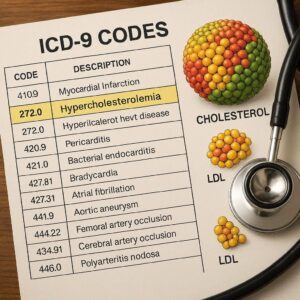
ICD-9 Code for Hypercholesterolemia
Understanding the Legacy: ICD-9-CM Code 272.0
The ICD-9-CM (International Classification of Diseases, 9th Revision, Clinical Modification) code for pure hypercholesterolemia is 272.0.
This code was specifically designated for classifying and recording diagnoses of high cholesterol that is not mixed with other lipid disorders. It was a critical component of patient charts, insurance claims, and population health statistics for decades.
A Closer Look at Code 272.0
This code resided within a broader category:
-
Category 272: Disorders of Lipoid Metabolism. This category covered various conditions related to fat and cholesterol processing.
-
Subcode 272.0: Pure Hypercholesterolemia. This was the precise code for isolated high cholesterol.
It’s important to note that ICD-9-CM had limited specificity. Code 272.0 was often a catch-all for elevated cholesterol, whether it was due to dietary habits, genetic predisposition (like familial hypercholesterolemia), or other secondary causes. The system lacked the granularity to easily distinguish between these different etiologies.
Related ICD-9 Codes in the 272 Series
For a complete picture, here are related codes that a coder might have considered alongside 272.0:
| ICD-9 Code | Description | Clinical Context |
|---|---|---|
| 272.0 | Pure Hypercholesterolemia | Primary code for high cholesterol. |
| 272.1 | Pure Hyperglyceridemia | High triglycerides only. |
| 272.2 | Mixed Hyperlipidemia | High cholesterol AND high triglycerides. |
| 272.3 | Hyperchylomicronemia | A specific, rarer disorder of fat particles. |
| 272.4 | Other and Unspecified Hyperlipidemia | Used when the type wasn’t specified. |
As a leading medical coding expert, Sarah Jones, CPC, notes: *“ICD-9 code 272.0 was workhorse for decades. Its simplicity was both its strength and its weakness—it standardized reporting but often painted patient conditions with too broad a brush.”*
The Historical Context: Why ICD-9 Matters (and Why It Was Replaced)
The ICD-9-CM system was implemented in the United States in 1979 and served as the backbone of medical diagnosis coding until October 1, 2015. On that date, the healthcare system underwent a massive transition to ICD-10-CM.
Key Reasons for the Transition from ICD-9 to ICD-10:
-
Lack of Specificity: ICD-9 had about 13,000 diagnosis codes. It often couldn’t capture details crucial for modern care, like which artery was affected or the cause of a condition.
-
Outdated Terminology: Medical science advanced far beyond the 1970s framework. ICD-9 couldn’t adequately describe new procedures or diagnoses.
-
Inadequate for Modern Needs: It was ill-suited for quality reporting, precision medicine, and detailed health analytics.
Important Note for Readers: If you are currently submitting insurance claims for medical services in the U.S., you must use ICD-10-CM codes. Using an ICD-9 code like 272.0 on a current claim will result in an immediate rejection. The information here is primarily for historical understanding, data conversion projects, or researching older records.
The Modern Equivalent: ICD-10-CM Codes for Hypercholesterolemia
This is where the story becomes much more detailed and clinically rich. ICD-10-CM didn’t just create a direct equivalent for 272.0; it exploded the single code into a detailed array of options that tell a fuller patient story.
The core ICD-10-CM category is E78.0 – Pure hypercholesterolemia. However, this is just the starting point.
Detailed Breakdown of ICD-10-CM Hypercholesterolemia Codes
ICD-10-CM requires a higher level of clinical detail. The coder must know not just that the patient has high cholesterol, but potentially the cause and type.
Primary Codes for Hypercholesterolemia:
-
E78.0: Pure hypercholesterolemia. The most direct successor to ICD-9’s 272.0.
-
E78.1: Pure hyperglyceridemia. (Equivalent to ICD-9 272.1).
-
E78.2: Mixed hyperlipidemia. (Equivalent to ICD-9 272.2).
-
E78.5: Hyperlipidemia, unspecified. A less specific option.
The Critical Difference: Familial vs. Other
ICD-10-CM makes a vital distinction through the use of additional characters (a 5th or 6th digit):
-
E78.00: Pure hypercholesterolemia, unspecified. Used when the provider doesn’t specify a familial (genetic) form.
-
E78.01: Familial hypercholesterolemia. This is a crucial specificity for identifying patients with inherited, often more severe, forms of high cholesterol.
A Practical Conversion Table: ICD-9 to ICD-10
When converting old records, this table serves as a guide:
| Legacy ICD-9 Code | Most Direct ICD-10-CM Equivalent | Important Considerations for Conversion |
|---|---|---|
| 272.0 | E78.0 | This is the baseline conversion. However, you must check the medical record. |
| 272.0 | E78.00 | Use if the old record has no mention of a familial (genetic) history. |
| 272.0 | E78.01 | Use if the old record specifically indicates familial hypercholesterolemia. |
| 272.1 | E78.1 | Conversion for high triglycerides. |
| 272.2 | E78.2 | Conversion for mixed hyperlipidemia. |
The Importance of Accurate Coding: Beyond the Number
Why does this evolution from a simple 272.0 to a detailed E78.01 matter so much? Accurate diagnosis coding impacts virtually every aspect of healthcare.
-
Precise Patient Care: A code for familial hypercholesterolemia (E78.01) alerts all future providers to a potentially serious genetic condition, influencing screening for family members and aggressiveness of treatment.
-
Insurance Reimbursement: Correct codes ensure claims are processed smoothly and that providers are reimbursed appropriately for managing complex versus simple conditions.
-
Public Health and Research: Detailed ICD-10 data allows researchers to track the prevalence of specific cholesterol disorders, measure outcomes of new medications, and identify at-risk populations with far greater accuracy than ICD-9 ever allowed.
-
Healthcare Analytics: Hospitals and health systems use this coded data to analyze treatment patterns, forecast resource needs, and improve the quality of care.
Navigating Old Records and Data
If your task involves handling records that still contain the ICD-9 code 272.0, here is a practical checklist:
-
Do not use it for current billing.
-
For data analysis: Be aware that “272.0” represents a broader, less specific group of patients than modern codes.
-
For record conversion: Never automatically convert all “272.0” entries to “E78.00.” A manual review by a knowledgeable coder is ideal to apply the most accurate ICD-10 code based on the clinical notes.
-
For historical research: Clearly footnote that your data is based on ICD-9 taxonomy, which has inherent limitations in specificity compared to current standards.
Conclusion
The search for the ICD-9 code for hypercholesterolemia leads to a clear answer—272.0—but also opens a window into the evolution of medical documentation. This legacy code, once essential, has been superseded by the precise and powerful ICD-10-CM system, most notably by codes like E78.00 and E78.01. Understanding this transition is key to accurate historical analysis, proper record-keeping, and appreciating how modern coding leads to better, more informed patient care.
Frequently Asked Questions (FAQ)
Q: Can I still use ICD-9 code 272.0 on insurance claims?
A: No. As of October 1, 2015, all HIPAA-covered entities in the United States must use ICD-10-CM codes for diagnosis reporting. Using ICD-9 will result in claim denial.
Q: What is the most common ICD-10 code for high cholesterol now?
A: E78.5 (Hyperlipidemia, unspecified) is often used for a general diagnosis of high cholesterol. However, if the provider documents “pure hypercholesterolemia,” then E78.0 (with appropriate 5th/6th digit) is more accurate.
Q: How do I code for a patient with both high cholesterol and high triglycerides?
A: You would use E78.2 (Mixed hyperlipidemia). This is a specific code for that combined condition.
Q: Why is the distinction between “familial” and “unspecified” hypercholesterolemia so important?
A: Familial hypercholesterolemia (E78.01) is a genetic disorder that leads to very high cholesterol from birth and a significantly increased risk of early heart disease. Identifying it correctly triggers different clinical management, family screening, and treatment pathways.
Q: Where can I find official coding guidelines?
A: The Centers for Medicare & Medicaid Services (CMS) and the National Center for Health Statistics (NCHS) publish the official ICD-10-CM guidelines and code sets.
Additional Resources
For the most authoritative and up-to-date information on diagnosis coding, please visit the official Centers for Disease Control and Prevention (CDC) ICD-10-CM page: https://www.cdc.gov/nchs/icd/icd-10-cm.htm
Disclaimer: This article is for informational and educational purposes only. It is not intended as medical coding advice. Medical coding is complex and dependent on specific patient documentation. Always consult the official ICD-10-CM coding manuals, current guidelines, and a certified professional coder for definitive coding decisions.
Author: The Web Writer Team
Date: January 29, 2026