If you’re navigating the world of medical billing, patient records, or simply trying to understand an old medical document, you might have come across the term “ICD-9 code for impacted cerumen.” While the healthcare industry has largely transitioned to ICD-10, understanding ICD-9 codes remains crucial for dealing with historical records, certain insurance claims, and specific administrative contexts. This comprehensive guide will demystify the ICD-9 code for earwax blockage, explain its context, and provide you with the knowledge to handle this information accurately and confidently.
Think of this as your one-stop resource. We’ll move beyond just listing a code number. We’ll explore what the code means, why it was used, how it fits into the larger coding system, and what you need to know today. Whether you’re a medical professional, a student, a coder, or a curious patient, this guide is designed to give you clear, reliable, and actionable information.
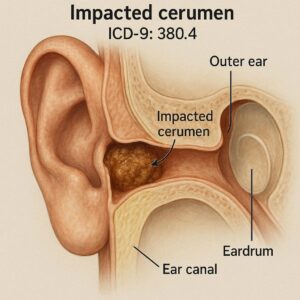
ICD-9 Code for Impacted Cerumen
Understanding the Basics: What is Impacted Cerumen?
Before we dive into codes, let’s ensure we’re all on the same page about the medical condition itself.
Impacted cerumen is the medical term for a buildup of earwax that has become hardened and blocked in the ear canal. Cerumen, or earwax, is a natural substance produced by glands in your ear. It plays a vital role in trapping dust, debris, and small particles, and it helps protect and lubricate the ear canal. Normally, this wax migrates out of the ear on its own, aided by jaw movements like chewing.
However, sometimes this self-cleaning process fails. Wax can accumulate, harden, and cause a blockage. This is what we call “impacted” cerumen. It’s a common issue, affecting about 10% of children and 5% of adults.
Common Symptoms of Impacted Cerumen:
-
Earache or a feeling of fullness in the ear
-
Partial hearing loss (that often comes on gradually)
-
Tinnitus (ringing or buzzing in the ear)
-
Itching, odor, or discharge from the ear
-
Dizziness (in rare cases)
People often try to clean their ears with cotton swabs, which is ironically the leading cause of impaction, as it pushes the wax deeper into the canal.
The World of Medical Coding: ICD-9 vs. ICD-10
To understand a specific ICD-9 code, you need a little background on the system itself.
ICD stands for the International Classification of Diseases. It’s a global standard, maintained by the World Health Organization (WHO), for diagnosing and classifying diseases and health conditions. Medical providers and coders use these codes to:
-
Document a patient’s diagnosis.
-
Justify medical necessity for procedures and tests.
-
Submit claims to health insurance companies for payment.
The Transition from ICD-9 to ICD-10
For decades, the United States used the ICD-9-CM (Clinical Modification) system. It contained roughly 13,000 codes. However, it became outdated and lacked the specificity needed for modern medicine.
On October 1, 2015, the U.S. healthcare system officially transitioned to ICD-10-CM, a much more detailed system with over 68,000 codes. This allows for greater precision in describing a patient’s condition, including laterality (which ear), cause, and other factors.
Why does ICD-9 still matter?
-
Historical Records: Patient charts and older insurance claims will still reference ICD-9 codes.
-
Certain Data Analysis: Research or epidemiological studies covering periods before 2015 rely on ICD-9 data.
-
Understanding Context: Knowing the old system helps clarify the logic and increased detail of the new ICD-10 system.
The Specific ICD-9 Code for Impacted Cerumen
Here is the precise information you are looking for.
The ICD-9-CM code for Impacted Cerumen is 380.4.
Let’s break down what this code signifies within the ICD-9 structure.
Code Structure and Hierarchy:
-
380: This is the parent category. In ICD-9, code range 380-389 is dedicated to “Diseases of the ear and mastoid process.”
-
380.4: This is the specific subcategory for “Impacted cerumen.”
It’s a straightforward, non-billable code. This means it was used as-is to indicate the primary diagnosis of an earwax blockage. Unlike ICD-10, the ICD-9 code did not specify whether the impaction was in the left ear, right ear, or both.
Important Note: Code 380.4 only applied to the condition of impacted cerumen itself. It did not cover the removal procedure. The removal (like irrigation or curettage) had its own set of codes in the CPT (Current Procedural Terminology) system, such as 69210 (Removal impacted cerumen requiring instrumentation, unilateral).
ICD-9 vs. ICD-10 for Impacted Cerumen
This table highlights the key differences and demonstrates the increased specificity of the newer system.
| Feature | ICD-9-CM (380.4) | ICD-10-CM (H61.2-) |
|---|---|---|
| Code | 380.4 | H61.2- |
| Description | Impacted cerumen | Impacted cerumen |
| Specificity | Low. One code for all cases. | High. Requires a 5th or 6th character to specify laterality. |
| Laterality | Not specified. | Must be specified: H61.21 – Impacted cerumen, right ear H61.22 – Impacted cerumen, left ear H61.23 – Impacted cerumen, bilateral |
| Category | Diseases of the ear and mastoid process (380-389) | Diseases of the external ear (H60-H62) |
| Additional Info | Could be used with a supplementary E code to indicate cause (e.g., E849.0 – Home), but this was rarely used. | Can be combined with other codes for related conditions (e.g., otitis externa). |
As you can see, ICD-10 requires the coder to be precise about which ear is affected, leading to more accurate medical records and billing.
Common Scenarios and Coding Applications (Historical Context)
How was the ICD-9 code 380.4 actually used in a medical setting? Let’s walk through a typical scenario from the pre-2015 era.
Scenario: A 45-year-old patient visits their primary care physician complaining of muffled hearing and a feeling of fullness in their right ear for the past two weeks. The physician performs an otoscopic examination and observes a significant, hardened plug of cerumen completely occluding the right ear canal.
-
Assessment: The physician diagnoses the patient with impacted cerumen in the right ear.
-
Procedure: The physician performs cerumen removal using irrigation and instrumentation.
-
Documentation & Billing:
-
Diagnosis Code: The coder would assign ICD-9-CM 380.4 (Impacted cerumen) on the claim form.
-
Procedure Code: The coder would also assign CPT 69210 (Removal impacted cerumen requiring instrumentation, unilateral) to represent the work done.
-
Linking: The claim links procedure 69210 to diagnosis 380.4, showing the insurance company that the removal was medically necessary due to the impaction.
-
Why Specificity Matters: A Cautionary Tale
The lack of laterality in ICD-9 code 380.4 could sometimes lead to confusion or claims issues. If a patient had a history of impaction in the left ear documented under 380.4, and later presented with the same issue in the right ear, the record lacked clarity. With ICD-10’s specific codes (H61.21, H61.22, H61.23), this ambiguity is completely eliminated, creating a cleaner, more precise patient history.
Helpful Lists for Context and Understanding
Related and Similar ICD-9 Codes (Differential Diagnoses)
A coder or clinician had to ensure 380.4 was the correct choice and not a similar condition. Here are nearby codes they would consider:
-
380.0 – Perichondritis of pinna: Inflammation of the outer ear cartilage.
-
380.1 – Infective otitis externa: Swimmer’s ear (an infection).
-
380.2 – Other otitis externa: Eczema or dermatitis of the ear canal.
-
380.3 – Noninfectious disorders of pinna: Like a benign cyst.
-
380.5 – Acquired stenosis of external ear canal: Narrowing of the canal, which can cause cerumen impaction.
-
388.2 – Other abnormal auditory perception: This includes tinnitus, which is a symptom of impaction, not the diagnosis itself.
Step-by-Step: How to Look Up an Old ICD-9 Code (for Reference)
While you won’t use ICD-9 for current billing, you might need to look one up for records. Here’s how:
-
Identify the main term: “Cerumen.”
-
Locate the ICD-9-CM Index to Diseases (a book or digital version).
-
Under “Cerumen,” find the sub-term “impacted.”
-
It will direct you to the numeric code 380.4.
-
Crucial Step: Always verify the code in the ICD-9-CM Tabular List (Volume 1). Turn to category 380, then find 380.4 to confirm the description and check for any instructional notes (e.g., “excludes” notes).
Important Notes for Readers
“Accuracy in medical coding is not just about numbers—it’s about accurately telling the story of a patient’s care. Moving from ICD-9’s 380.4 to ICD-10’s specific codes is like upgrading from a sketch to a detailed portrait.”
— A sentiment commonly echoed by professional medical coders.
-
For Patients: If you see “380.4” on an old bill or record, it simply means you were diagnosed with a blocked earwax issue. It does not indicate a severe disease.
-
For Students & New Coders: Use ICD-9 knowledge as a foundation for understanding coding principles. Focus your primary energy on mastering the current ICD-10-CM system.
-
For Healthcare Professionals: Ensure your practice management or electronic health record (EHR) system is updated to ICD-10. Using an outdated ICD-9 code on a current claim will result in an immediate rejection from any payer (Medicare, Medicaid, or private insurance).
-
Legal & Ethical Consideration: Never submit an ICD-9 code for services rendered after October 1, 2015. Doing so is non-compliant with federal regulations and can lead to claim denials, audits, and potential penalties.
The Modern Equivalent: ICD-10 Codes for Impacted Cerumen
Since ICD-9 is obsolete for current use, it’s vital to know its modern counterparts.
As shown in the table earlier, the ICD-10-CM codes fall under category H61.2- Impacted cerumen. The complete, valid codes are:
-
H61.21 – Impacted cerumen, right ear
-
H61.22 – Impacted cerumen, left ear
-
H61.23 – Impacted cerumen, bilateral
Coding Example in ICD-10:
A patient presents with impacted cerumen in the left ear causing discomfort and mild hearing loss. The physician removes it.
-
Diagnosis Code: H61.22
-
Procedure Code: 69210 (linked to H61.22)
The increased specificity is clear and now mandatory.
Frequently Asked Questions (FAQ)
Q1: Can I still use the ICD-9 code 380.4 today?
A: No. For any medical service provided on or after October 1, 2015, you must use ICD-10-CM codes. Using ICD-9 will result in claim rejection.
Q2: I found “380.4” on an old medical bill. What should I do?
A: Nothing. It is a historical record of your diagnosis at that time. If you have questions about the old service, you can contact the provider’s billing office, but the code itself is simply a snapshot of the past.
Q3: What is the ICD-10 code for bilateral impacted cerumen?
A: The correct code is H61.23. It is crucial to use this specific code rather than listing both H61.21 and H61.22 for a single encounter where both ears are treated for the same condition.
Q4: Why was the code system changed?
A: ICD-9 ran out of space for new diagnoses and lacked detail. ICD-10 provides greater specificity, improves the accuracy of health statistics, supports better patient care tracking, and aligns the U.S. with most other countries.
Q5: Is impacted cerumen (380.4 or H61.2-) considered a disease?
A: In medical coding terms, yes, it is classified as a “disease of the external ear.” It is a common, treatable condition and not typically a sign of serious illness.
Conclusion
Understanding the ICD-9 code for impacted cerumen (380.4) provides a window into the history of medical coding and underscores the importance of precise clinical documentation. While this code served its purpose for decades, the transition to ICD-10-CM codes like H61.21, H61.22, and H61.23 represents a significant advancement in healthcare data. This shift allows for more accurate patient records, clearer communication, and better overall health outcomes. Whether you’re reviewing old files or learning coding fundamentals, knowing both systems enriches your comprehension of how healthcare documentation evolves to improve care.
Additional Resource
For the most authoritative and up-to-date information on all ICD-10-CM codes, including official guidelines and updates, visit the Centers for Disease Control and Prevention (CDC) ICD-10-CM page: https://www.cdc.gov/nchs/icd/icd10cm.htm
Disclaimer: This article is for informational and educational purposes only. It is not a substitute for professional medical coding advice, clinical guidance, or official coding resources. Always consult the current, official ICD-10-CM code set and guidelines for accurate medical coding and billing. The author and publisher are not responsible for any errors or consequences arising from the use of this information.
Author: Professional Medical Writing Team
Date: FEBRUARY 03, 2026