If you’re researching medical codes, you’re likely navigating the complex world of healthcare billing, medical records, or personal insurance claims. Understanding the “ICD-9 code for IBS” is more than a historical footnote; it’s key to deciphering older medical documents and grasping how diagnostic coding shapes patient care. This guide will serve as your definitive resource, breaking down everything you need to know about this specific code, its context, and its modern equivalent in clear, accessible language.
We’ll explore not just the code itself, but the entire system it belongs to, why it changed, and what that means for you. Whether you’re a patient, a medical student, or a healthcare professional brushing up on coding history, this article provides the depth and clarity you need.
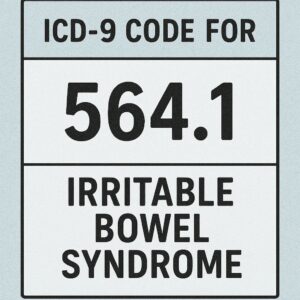
ICD-9 Code for Irritable Bowel Syndrome
What is the ICD-9 Coding System?
Before we zero in on the specific code for IBS, it’s crucial to understand the system it came from. ICD-9 stands for the International Classification of Diseases, 9th Revision. Managed by the World Health Organization (WHO), it was a global standard for diagnosing and classifying diseases, symptoms, and medical procedures.
Think of ICD-9 as a massive, universal dictionary for medicine. Instead of writing out long descriptions like “recurrent abdominal pain with altered bowel habits,” a doctor or coder could use a precise numeric code. This served several vital purposes:
-
Standardization: It created a common language for healthcare providers, researchers, and insurers worldwide.
-
Billing and Reimbursement: Insurance companies (payers) used these codes to determine what services to pay for.
-
Tracking and Epidemiology: Public health officials used aggregated code data to track disease outbreaks, study health trends, and allocate resources.
However, the ICD-9 system, implemented in the United States in 1979, eventually showed its age. It ran out of space for new codes, lacked clinical detail, and couldn’t keep pace with modern medicine.
A key point to remember: “ICD-9-CM” is what you’ll most often see in a U.S. context. The “CM” stands for “Clinical Modification,” which was the American adaptation of the base ICD-9 system, containing more detail for clinical and billing use.
The Transition from ICD-9 to ICD-10
On October 1, 2015, the United States underwent a monumental shift in healthcare administration by moving from ICD-9-CM to ICD-10-CM (for diagnoses). This wasn’t just an update; it was a complete overhaul.
| Feature | ICD-9-CM | ICD-10-CM |
|---|---|---|
| Code Format | Mostly 3-5 digits, numeric | 3-7 characters, alphanumeric |
| Number of Codes | ~13,000 | ~68,000 |
| Specificity | Limited, often vague | Highly detailed, describing etiology, severity, and location |
| Example for IBS | 564.1 (one code for all IBS) | Multiple codes based on type (e.g., K58.0, K58.9) |
This transition means that while the ICD-9 code for IBS is still relevant for older records, any diagnosis or billing after October 2015 should use an ICD-10 code.
The Specific ICD-9 Code for Irritable Bowel Syndrome
Within the ICD-9-CM universe, Irritable Bowel Syndrome had one primary, catch-all code.
The ICD-9 code for IBS is 564.1.
Let’s break down what this number means within the ICD-9 hierarchy:
-
564: This is the parent category. In ICD-9, codes 564.* fall under “Other functional disorders of the intestine.” This category housed conditions where the bowel function was abnormal without a clear structural or biochemical cause.
-
.1: This extension pinpoints the specific diagnosis. Code 564.1 is explicitly defined as “Irritable bowel syndrome.”
Other related disorders in the 564 category included 564.0 (Constipation) and 564.7 (Megacolon), but 564.1 was reserved solely for IBS.
Important Note for Readers: If you are reviewing a medical record or bill from before October 2015 and see 564.1, it is specifically documenting a diagnosis of Irritable Bowel Syndrome. You will not find this code used in current medical practice for new diagnoses.
Why Knowing the Correct Code Matters
You might wonder why a patient or even a general practitioner needs to understand these alphanumeric details. The accuracy of diagnostic codes has real-world implications that extend far beyond a clinician’s notepad.
-
Insurance Claims and Reimbursement: This is the most direct impact for patients. An incorrect or unspecific code can lead to an insurance claim being denied or delayed. If a coder used a code for “abdominal pain” instead of the specific 564.1 for IBS, an insurer might question the medical necessity of prescribed tests or treatments.
-
Accuracy of Medical Records: Your lifelong medical record tells a story. Precise coding ensures that any future provider who reviews your history quickly understands your confirmed conditions. This is critical for continuity of care, especially in emergencies or when seeing a new specialist.
-
Clinical Research and Drug Development: Epidemiological studies rely on aggregated, anonymized coding data to answer questions like “How many people have IBS?” or “What are the most common comorbidities?” Accurate coding at the point of care fuels this research, influencing where healthcare resources and research dollars are directed.
“Accurate diagnostic coding is the backbone of modern healthcare data. It’s what allows us to move from anecdote to evidence, tracking disease patterns and measuring the effectiveness of treatments on a large scale.” – A sentiment commonly echoed in health informatics.
Common Pitfalls and Confusions with IBS Coding
Even with a single code like 564.1, confusion could arise. Here are scenarios patients often encounter:
-
IBS with Constipation (IBS-C) vs. IBS with Diarrhea (IBS-D): In ICD-9, both were coded as 564.1. The system lacked the granularity to distinguish between these major subtypes, which often require different treatment approaches.
-
IBS vs. Other Functional GI Disorders: Conditions like functional dyspepsia or functional abdominal pain syndrome are distinct from IBS. A less-specific code might have been used incorrectly, muddying the diagnostic picture.
-
The “Rule-Out” Dilemma: Sometimes a provider would list “rule out IBS” while testing for other conditions. The proper coding practice was to code the presenting symptoms (like abdominal pain, 789.0) until a definitive diagnosis was made. However, errors occurred.
The Modern Equivalent: ICD-10 Codes for IBS
The shift to ICD-10-CM resolved the lack of specificity in ICD-9. Today, IBS is coded under chapter “K58 – Irritable bowel syndrome.” The codes are far more descriptive.
Primary ICD-10 Codes for IBS:
-
K58.0 – Irritable bowel syndrome with diarrhea (IBS-D)
-
K58.1 – Irritable bowel syndrome with constipation (IBS-C)
-
K58.2 – Mixed irritable bowel syndrome (IBS-M)
-
K58.8 – Other irritable bowel syndrome
-
K58.9 – Irritable bowel syndrome without diarrhea (This is used when the subtype is not specified, essentially the closest to the old 564.1)
This specificity allows for better tracking of patient populations, more targeted treatment plans, and clearer clinical trial criteria.
Comparative Table: ICD-9 vs. ICD-10 for IBS
| Aspect | ICD-9 Code 564.1 | ICD-10 Codes (K58 series) |
|---|---|---|
| Specificity | Low. One code for all IBS. | High. Separate codes for IBS-D, IBS-C, IBS-M. |
| Code Structure | Simple numeric. | Alphanumeric, providing a category and subclass. |
| Clinical Usefulness | Limited for treatment planning. | Directly informs treatment based on subtype. |
| Billing & Data | Made analysis of IBS subtypes impossible. | Enables precise analysis of epidemiology and resource use for each subtype. |
Navigating Medical Records and Bills
As a patient, you have a right to understand your medical information. Here’s a practical list for dealing with codes related to IBS:
-
Check the Date: Is the document from before or after October 1, 2015? This tells you instantly whether to look for ICD-9 (564.1) or ICD-10 (K58.x).
-
Review Explanation of Benefits (EOBs): When you get an EOB from your insurer, look for the diagnosis codes. If you were treated for IBS but see a code for “abdominal pain” (R10.9 in ICD-10) or something else, it may warrant a query.
-
Ask Questions: Don’t hesitate to ask your provider’s billing office: “Can you confirm the diagnosis code used for my last visit for IBS management?” They should be able to tell you.
-
Keep a Personal Health Record: Note down your confirmed diagnoses and their corresponding codes (both the old and new if applicable). This is incredibly helpful when seeing new providers or switching insurance.
A Helpful List: Common Related Symptoms & Their Old ICD-9 Codes
-
787.91 – Diarrhea
-
787.01 – Nausea with vomiting
-
789.00 – Abdominal pain, unspecified site
-
787.3 – Flatulence, gas pain
-
564.0 – Constipation
These codes would often be listed alongside 564.1 to paint a fuller picture of the patient’s presentation.
Conclusion
Understanding the ICD-9 code for IBS (564.1) provides a window into the history of medical classification and its evolution toward greater precision with ICD-10 codes like K58.0. This knowledge empowers you to better navigate your medical history, ensure accurate billing, and appreciate how detailed coding improves healthcare research and personalizes treatment for conditions like Irritable Bowel Syndrome.
Frequently Asked Questions (FAQ)
Q: I saw 564.1 on an old medical bill. Does that mean I have a formal IBS diagnosis?
A: Yes, code 564.1 was specifically and solely for Irritable Bowel Syndrome. Its use indicates your provider documented IBS as a diagnosis at that time.
Q: Can a doctor still use the ICD-9 code 564.1 today?
A: No. For any services performed on or after October 1, 2015, providers in the U.S. are required by law to use ICD-10-CM codes for diagnosis. Using ICD-9 would result in claim denials.
Q: My doctor says I have IBS-M (mixed). What is the correct ICD-10 code?
A: The correct code would be K58.2 – Mixed irritable bowel syndrome. This level of detail is a key advantage of the ICD-10 system over the generic ICD-9 code 564.1.
Q: Why does the specific IBS subtype code matter for my insurance?
A: Different subtypes may involve different treatment protocols, medications, and testing. Accurate coding helps justify the medical necessity of the specific care your provider recommends, reducing the chance of claim issues.
Q: Where can I find an official list of these codes?
A: The authoritative source is the Centers for Medicare & Medicaid Services (CMS). They publish the full ICD-10-CM code sets annually.
Additional Resources
-
Centers for Disease Control and Prevention (CDC) – ICD-10 Page: Provides official information and tools related to the ICD-10 transition and code sets. https://www.cdc.gov/nchs/icd/icd-10-cm.htm
-
The American College of Gastroenterology (ACG): Offers patient-centered resources and clinical guidelines on the diagnosis and management of IBS. https://gi.org/
-
International Foundation for Gastrointestinal Disorders (IFFGD): A reputable non-profit providing in-depth education and support for patients with functional GI disorders like IBS. https://iffgd.org/
Disclaimer: This article is for informational and educational purposes only. It is not a substitute for professional medical advice, diagnosis, or treatment. Always seek the advice of your physician or other qualified health provider with any questions you may have regarding a medical condition or coding for billing purposes.
Author: The Professional Web Writer Team
Date: January 31, 2026