If you’re navigating old medical records, handling historical billing data, or simply trying to understand a diagnosis from before 2015, you’ve likely encountered the term “ICD-9 code for IHD.” The International Classification of Diseases, 9th Revision (ICD-9) was the diagnostic coding standard used in the United States for decades until its retirement on October 1, 2015.
While ICD-10 has fully replaced it for current clinical and billing purposes, knowledge of ICD-9 codes remains crucial. It’s the key to unlocking decades of medical history, research data, and legacy documentation. This comprehensive guide will demystify the ICD-9 coding system for Ischemic Heart Disease, providing you with a clear, accurate, and lasting reference.
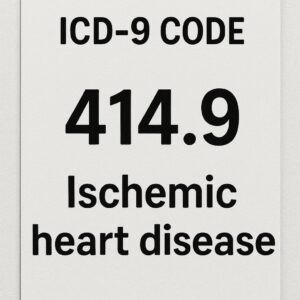
ICD-9 Code for Ischemic Heart Disease
What is Ischemic Heart Disease (IHD)?
Before we dive into codes, let’s clarify the condition itself. Ischemic Heart Disease, also commonly known as Coronary Artery Disease (CAD), is a condition where the heart muscle doesn’t get enough oxygen-rich blood. This ischemia (lack of blood flow) is almost always caused by a narrowing or blockage of the coronary arteries, usually due to a buildup of plaque—a process called atherosclerosis.
Think of your coronary arteries as the vital fuel lines for your heart’s engine. When these lines get clogged, the engine can’t run properly. This can lead to symptoms like chest pain (angina), shortness of breath, and, in severe cases, a heart attack (myocardial infarction) or heart failure.
“Ischemic heart disease represents a spectrum, from stable, predictable chest pain to the sudden, catastrophic event of a heart attack. Accurate coding has always been essential to track this public health burden,” notes a retrospective analysis on cardiovascular coding transitions.
The ICD-9 Coding System: A Brief Overview
The ICD-9-CM (Clinical Modification) system used in the U.S. consisted of three to five-digit codes. The structure was hierarchical:
-
First three digits: The “category” (e.g., 410 for Acute Myocardial Infarction).
-
Fourth digit: A subcategory providing more specificity (e.g., 410.1 for an MI of the inferior wall).
-
Fifth digit: Often used for even greater detail, such as the episode of care (e.g., initial encounter vs. subsequent encounter).
This system, while functional for its time, had significant limitations in specificity compared to the modern ICD-10-CM, which uses up to seven alphanumeric characters.
The Core ICD-9 Codes for Ischemic Heart Disease
Ischemic Heart Disease was primarily classified under code range 410-414 in ICD-9-CM. Here is the complete breakdown.
ICD-9 Code 410: Acute Myocardial Infarction (Heart Attack)
This category covers the actual event of a heart attack, where blood flow to a part of the heart is blocked, causing tissue death. Fourth and fifth digits were critical here.
Common Subcodes:
-
410.0: Acute myocardial infarction of anterior wall
-
410.1: Acute myocardial infarction of inferior wall
-
410.7: Subendocardial infarction (often referred to as a non-ST elevation myocardial infarction or NSTEMI)
-
410.9: Acute myocardial infarction, unspecified site
The fifth digit indicated the episode of care:
-
0: Episode of care unspecified
-
1: Initial episode of care
-
2: Subsequent episode of care
Example: 410.11 would translate to “Acute myocardial infarction of inferior wall, initial episode of care.”
ICD-9 Code 411: Other Acute and Subacute Forms of Ischemic Heart Disease
This was a category for ischemic events that were not classified as a full heart attack.
Key Codes:
-
411.1: Intermediate coronary syndrome (Unstable angina)
-
411.81: Acute coronary occlusion without myocardial infarction (a blockage that didn’t cause tissue death)
ICD-9 Code 412: Old Myocardial Infarction
This simple code was used to indicate a past, healed heart attack. It had no further subdivisions. It was a crucial code for denoting a patient’s history, which impacts risk assessment for future events.
ICD-9 Code 413: Angina Pectoris
This category covered chest pain due to heart ischemia.
Key Codes:
-
413.0: Angina decubitus (pain occurring while lying down)
-
413.1: Prinzmetal angina (vasospastic angina)
-
413.9: Other and unspecified angina pectoris (typically used for stable angina)
ICD-9 Code 414: Other Forms of Chronic Ischemic Heart Disease
This was a broad category for chronic conditions.
Key Codes:
-
414.0: Coronary atherosclerosis (the underlying plaque buildup)
-
414.00: Coronary atherosclerosis of unspecified type of vessel, native or graft
-
414.01: Coronary atherosclerosis of native coronary artery
-
414.02: Coronary atherosclerosis of autologous vein bypass graft
-
414.03: Coronary atherosclerosis of nonautologous biological bypass graft
-
414.04: Coronary atherosclerosis of artery bypass graft
-
414.05: Coronary atherosclerosis of unspecified type of bypass graft
-
414.1: Aneurysm of heart (which can be a complication of an MI)
-
414.8: Other specified forms of chronic IHD
-
414.9: Chronic ischemic heart disease, unspecified
Important Note for Readers: When reviewing old charts, pay close attention to the fourth and fifth digits. A code of 414.0 alone lacks the specificity required even by ICD-9 standards; the more detailed codes like 414.01 were preferred for accurate documentation.
Comparative Table: ICD-9 vs. ICD-10 for IHD
The transition to ICD-10-CM in 2015 brought a massive increase in specificity. The table below illustrates the fundamental differences in structure and detail.
| Feature | ICD-9-CM (Legacy) | ICD-10-CM (Current) |
|---|---|---|
| Code Format | 3-5 digits, numeric | 3-7 characters, alphanumeric |
| Primary IHD Range | 410-414 | I20-I25 |
| Specificity | Limited. Location, laterality, and etiology often unclear. | Highly detailed. Includes specifics like type of angina, vessel involved, and cause (e.g., atherosclerosis vs. vasospasm). |
| Example: Unstable Angina | 411.1 (Intermediate coronary syndrome) | I20.0 (Unstable angina) |
| Example: MI of Inferior Wall | 410.1x (Required a 5th digit for episode) | I21.11 (ST elevation MI of inferior wall) or I21.4 (Non-ST elevation MI). Laterality and type are built-in. |
| Atherosclerosis Specificity | 414.0x series specified graft/native vessel. | I25.10 (Athscl native coronary art w/o angina) – Also specifies with/without angina. |
Why Knowing ICD-9 Codes for IHD Still Matters
You might wonder why we’re discussing a retired system. Here are several practical reasons:
-
Historical Medical Record Review: Researchers, epidemiologists, and clinicians often analyze trends over decades. Understanding ICD-9 is essential to interpret this data correctly.
-
Handling Legacy Billing and Legal Cases: Disputes or audits involving care provided before October 2015 require an understanding of the coding system in use at that time.
-
Understanding a Personal or Family Medical History: Older patient summaries or printed records will use ICD-9 codes. Knowing that code
412means “old heart attack” can clarify a health history. -
Appreciating the Evolution of Medicine: The shift from ICD-9’s limited codes to ICD-10’s detailed system reflects advances in medical knowledge and the need for precision in treatment and research.
Mapping from ICD-9 to ICD-10 for IHD
There is no simple one-to-one conversion. The Centers for Medicare & Medicaid Services (CMS) and the CDC provided General Equivalence Mappings (GEMs), but they are complex. A single ICD-9 code often maps to multiple, more specific ICD-10 codes.
Example Mapping:
-
ICD-9
414.01(Coronary atherosclerosis of native coronary artery) could map to several ICD-10 codes depending on clinical details:-
I25.110(Athscl native coronary artery with unstable angina pectoris) -
I25.118(Athscl native coronary artery with other forms of angina pectoris) -
I25.119(Athscl native coronary artery with unspecified angina pectoris)
-
This demonstrates why simply “converting” an old code for current use is insufficient; a clinical review is necessary to choose the correct, specific ICD-10 code.
Common Pitfalls and How to Avoid Them
When dealing with historical ICD-9 IHD codes, watch out for these issues:
-
Lack of Specificity: Codes like
414.9(Chronic IHD, unspecified) were overused. In a modern context, this provides little useful information. -
Misinterpreting
412: Code412(Old MI) was for a healed, past infarction. It was not used for a patient currently experiencing an acute MI or its direct sequelae. -
Ignoring the 5th Digit for MI: For code
410, the fifth digit for episode of care was a billing and statistical necessity. Its absence could lead to claim denials in that era.
Pro Tip: Always contextually interpret an ICD-9 code with the full clinical documentation from that time. The code alone tells only part of the story.
Conclusion
The journey from ICD-9 to ICD-10 for coding Ischemic Heart Disease marks a significant leap in medical precision. While the legacy codes 410 through 414 are no longer in active use, they are vital keys to our medical past. Understanding this system empowers you to accurately decipher historical records, appreciate the evolution of cardiovascular care, and ensure continuity in long-term health data. In the world of medicine, knowing where we’ve been is just as important as knowing where we are.
Frequently Asked Questions (FAQ)
Q: Can I use an ICD-9 code on a medical claim today?
A: No. As of October 1, 2015, all HIPAA-covered entities (like doctors and hospitals) in the U.S. are required to use ICD-10-CM for diagnosis coding. Claims submitted with ICD-9 codes will be rejected.
Q: I found code 410.9 on an old record. What does it mean?
A: ICD-9 code 410.9 stood for “Acute myocardial infarction, unspecified site.” It was used when a heart attack was diagnosed, but its precise location in the heart was not specified in the documentation available to the coder.
Q: What is the main ICD-10 code range for IHD?
A: Ischemic Heart Disease is primarily found in Chapter I20-I25 of ICD-10-CM: I20 (Angina pectoris), I21 (Acute myocardial infarction), I22 (Subsequent MI), I23 (Complications following MI), I24 (Other acute IHD), and I25 (Chronic IHD).
Q: Why was ICD-9 replaced?
A: ICD-9 was replaced due to its limited capacity for detail. It ran out of space for new codes, lacked clinical specificity for modern medicine, and hindered accurate payment models and public health tracking. ICD-10’s granularity supports better patient care, research, and healthcare administration.
Additional Resources
For authoritative information on code sets and mappings, please refer to these official sources:
-
Centers for Disease Control and Prevention (CDC) ICD-10 Page: https://www.cdc.gov/nchs/icd/icd10.htm
-
CMS ICD-10 Provider Resources: https://www.cms.gov/medicare/coding-billing/icd-10-codes
Disclaimer: This article is intended for educational and historical reference purposes only. It does not constitute medical or coding advice. For accurate diagnosis, treatment, and current medical coding, always consult with a qualified healthcare professional and refer to the latest official ICD-10-CM coding manuals and guidelines.
Author: The Editorial Team
Date: January 31, 2026