If you’re searching for the “ICD-9 code for J02,” you’ve encountered a common point of confusion in medical coding. You’re likely looking at a modern medical document or bill that references “J02,” but need to understand what this would have been in the older coding system. This search highlights a crucial transition in healthcare documentation.
The simple answer is that “J02” itself is not and never was an ICD-9 code. “J02” is an ICD-10 code. To find its counterpart, we need to look back at the ICD-9-CM system, which was replaced in the United States on October 1, 2015.
This article will serve as your comprehensive guide. We’ll clarify the transition, provide the accurate historical ICD-9 codes for conditions now labeled J02, and explain why understanding this difference matters for your medical records or professional work.
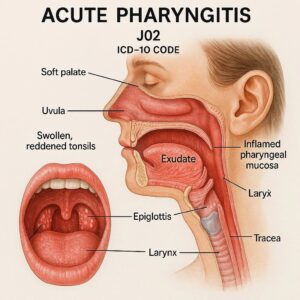
ICD-9 Code for J02
Table of Contents
ToggleThe ICD-9 vs. ICD-10 Transition: Why “J02” Doesn’t Exist in ICD-9
First, let’s demystify the core issue. ICD codes are the international standard for classifying diseases and health problems. The United States used a clinical modification of the 9th Revision (ICD-9-CM) for decades before mandating a switch to the 10th Revision (ICD-10-CM).
Key Difference in Structure:
-
ICD-9-CM Codes: Are mostly numeric, 3 to 5 digits long (e.g., 462, 034.0).
-
ICD-10-CM Codes: Are alphanumeric, always starting with a letter, and are 3 to 7 characters long (e.g., J02.0, J02.9).
The letter “J” specifically designates “Diseases of the respiratory system” in ICD-10. Therefore, any code starting with “J” is inherently an ICD-10 code. There is no direct “translation” of J02 into a single ICD-9 code; instead, we map it to the equivalent condition in the older system.
What Does J02 Represent in ICD-10?
In the ICD-10-CM system, J02 stands for Acute pharyngitis. This is the medical term for a sudden inflammation of the pharynx, or the back of the throat. We commonly call it a sore throat. ICD-10 breaks this down with greater specificity:
-
J02.0: Streptococcal pharyngitis (Strep throat)
-
J02.8: Acute pharyngitis due to other specified organisms
-
J02.9: Acute pharyngitis, unspecified (when the cause isn’t identified as bacterial or viral specifically)
This level of detail is a hallmark of ICD-10, offering much more granularity than ICD-9 ever could.
Mapping J02 to Its Correct ICD-9-CM Equivalents
When professionals need to bridge records from the ICD-10 era back to the ICD-9 era (for historical analysis or legacy system queries), they use General Equivalence Mappings (GEMs). Here is the accurate mapping for the codes under the J02 umbrella.
Comparative Table: ICD-10 to ICD-9 Code Mapping for Acute Pharyngitis
| ICD-10-CM Code & Description | Approximate ICD-9-CM Code & Description | Notes on the Mapping |
|---|---|---|
| J02.0 – Streptococcal pharyngitis | 034.0 – Streptococcal sore throat | This is a direct clinical match for Strep throat caused by Group A Streptococcus. |
| J02.8 – Acute pharyngitis due to other specified organisms | 462 – Acute pharyngitis | ICD-9 did not commonly specify the organism for non-streptococcal cases in this category. Code 462 was a broader catch-all. |
| J02.9 – Acute pharyngitis, unspecified | 462 – Acute pharyngitis | The most common mapping. The unspecified nature of J02.9 aligns with the general code 462 in ICD-9. |
Important Note for Readers: The code 462 was the primary, general code for a routine sore throat (acute pharyngitis) in the ICD-9-CM manual. If you have a medical record from before October 2015 simply diagnosing a sore throat, it is highly likely coded as 462.
Why the Mapping Isn’t Always 1-to-1
As you can see, multiple ICD-10 codes (J02.8 and J02.9) map back to a single ICD-9 code (462). This demonstrates a key reason for the change to ICD-10:
“The shift from ICD-9 to ICD-10 was a leap from a system designed for tallying mortality and basic morbidity to one capable of capturing the clinical nuance required for modern patient care, quality measurement, and biomedical research.” – Health Informatics Perspective
ICD-9 had about 13,000 diagnosis codes. ICD-10 has over 68,000. This expansion allows for precise detail about laterality, severity, cause, and manifestation of disease.
Practical Implications: Who Needs This Information and Why?
You might wonder why this historical mapping is still relevant today. Here are the key groups who benefit from this knowledge:
1. Patients and Medical Bill Reviewers:
You’re reviewing an old medical bill (pre-2015) or trying to understand a historical diagnosis in your records. Seeing code 462 means you were diagnosed with a general acute sore throat. Seeing code 034.0 indicates a confirmed case of Strep throat. This can help clarify past medical history.
2. Healthcare Providers and Coders:
-
Data Analysis: Comparing disease rates (like Strep throat incidence) over time requires mapping current ICD-10 data to historical ICD-9 data.
-
Legacy System Access: Some older records or research databases may still be indexed by ICD-9 codes.
-
Coding Audits: Understanding the mapping is essential for audits of records that span the transition date.
3. Medical Researchers and Historians:
Long-term studies on respiratory illness trends rely on accurate cross-walking of code sets to ensure data consistency across decades.
Helpful List: Common Symptoms of Acute Pharyngitis (ICD-9 462 / ICD-10 J02)
To connect the codes to real-world experience, here are the typical symptoms this diagnosis represents:
-
Pain or scratchiness in the throat
-
Pain that worsens with swallowing or talking
-
Difficulty swallowing
-
Swollen, red tonsils (sometimes with white patches or pus)
-
Hoarse or muffled voice
-
Swollen, tender glands (lymph nodes) in your neck
Navigating Medical Records Across the Coding Transition
If you are dealing with records from before and after October 1, 2015, here is a practical guide:
-
Identify the Date of Service: This is the most critical step. Dates before October 1, 2015 = ICD-9-CM. Dates on or after October 1, 2015 = ICD-10-CM.
-
Understand the Code Structure: Remember, numeric codes (3-5 digits) are ICD-9. Alphanumeric codes starting with a letter (like J02.9) are ICD-10.
-
Use Trusted Resources: For official mappings, refer to the Centers for Medicare & Medicaid Services (CMS) GEMs files or current professional coding manuals from the American Health Information Management Association (AHIMA) or the American Academy of Professional Coders (AAPC).
Important Note: Never guess a code. The mappings provided here are for educational insight. Official coding for reimbursement or clinical decision-making must always use the current code set (ICD-10-CM, and soon ICD-11) with the guidance of a qualified professional.
The Future: Beyond ICD-10
The evolution continues. The World Health Organization (WHO) has already released ICD-11, which began official use in January 2022. The United States will begin a lengthy transition process to ICD-11-CM in the future. This system offers even more structural and digital functionality, ensuring that medical coding keeps pace with advancements in medicine and technology.
Summary of Key Takeaways
-
“J02” is an ICD-10 code, specifically for Acute pharyngitis.
-
There is no single “ICD-9 code for J02.” It maps to different codes based on specificity.
-
The general ICD-9 code for a sore throat was 462.
-
The ICD-9 code for Strep throat was 034.0.
-
The transition to ICD-10 allowed for vastly more detailed and clinically rich patient records.
Conclusion
Searching for the “ICD-9 code for J02” reveals the evolving language of healthcare. J02 is a modern ICD-10 code for acute pharyngitis, with no direct predecessor. Its historical equivalents are ICD-9 codes 462 for general cases and 034.0 for streptococcal cases. Understanding this mapping is key to interpreting older medical records and appreciating the increased precision that modern medical coding provides for patient care and research.
Frequently Asked Questions (FAQ)
Q1: I have an old bill with code 462. What does that mean?
A1: Code 462 in the ICD-9-CM system means you were diagnosed with “Acute pharyngitis,” or a common sore throat, during that visit.
Q2: Why did the coding system change from ICD-9 to ICD-10?
A2: The system changed to allow for much greater detail and specificity in diagnosing conditions. ICD-10 codes can describe the cause, location, and severity of an illness much more precisely, which improves patient care, public health tracking, and medical research.
Q3: My doctor today says I have Strep throat. What is the current code for that?
A3: In the currently used ICD-10-CM system, a diagnosis of Streptococcal pharyngitis (Strep throat) is coded as J02.0.
Q4: Are ICD-9 codes still used anywhere?
A4: In the United States, ICD-9-CM is no longer used for any healthcare services provided on or after October 1, 2015. It is only relevant for accessing or analyzing historical records from before that date.
Additional Resources
For the most authoritative and up-to-date information on diagnosis codes, please visit the official code set pages from the Centers for Disease Control and Prevention (CDC):
-
ICD-10-CM Official Guidelines: https://www.cdc.gov/nchs/icd/icd10cm.htm
-
ICD-9-CM Archive (for historical reference): https://www.cdc.gov/nchs/icd/icd9cm.htm
Author: The Health Coding Team
Date: FEBRUARY 05, 2026
Disclaimer: This article is for informational purposes only and is not a substitute for professional medical coding advice, diagnosis, or treatment. Always consult official coding manuals (ICD-9-CM, ICD-10-CM) and qualified coding professionals for accurate code assignment.