If you’re searching for the “icd 9 code for j20,” you’ve landed in the right place. Whether you’re a healthcare professional reviewing old records, a student diving into medical coding, or a patient trying to understand a past bill, navigating medical codes can be confusing. This comprehensive guide is designed to be your definitive resource. We’ll clarify the historical code you’re looking for, explain its modern equivalent, and provide a deep understanding of the system behind these critical diagnostic tools.
Understanding these codes is more than an academic exercise; it’s about grasping the language of healthcare administration, billing, and patient care history. Let’s untangle this together.
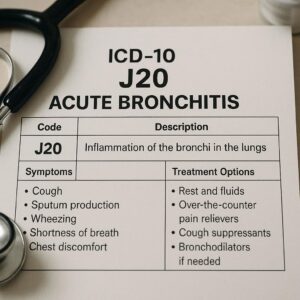
icd 9 code for j20
The Short Answer: What Was the ICD-9 Code for J20?
First, a crucial point of clarification: “J20” is itself an ICD-10 code. Therefore, searching for the “ICD-9 code for J20” is asking for the older, equivalent code that was used before October 1, 2015, when ICD-10 was implemented in the United States.
The ICD-9-CM code that corresponds to the general category of Acute Bronchitis (which is what J20 represents in ICD-10) was 466.0.
Important Note: ICD-9 code 466.0 was a less specific “catch-all” code. The modern ICD-10 system (J20) offers significantly more detail, with separate codes for bronchitis caused by different organisms.
Understanding the Systems: ICD-9 vs. ICD-10
To truly understand the code transition, we must look at the two classification systems.
What is the ICD?
The International Classification of Diseases (ICD) is a global standard, maintained by the World Health Organization (WHO), for diagnosing and classifying all diseases, health conditions, and causes of death. In the U.S., the Centers for Medicare & Medicaid Services (CMS) and the National Center for Health Statistics (NCHS) adapt it for clinical use (becoming ICD-9-CM or ICD-10-CM).
Its primary purposes are:
-
Billing and Reimbursement: Insurance companies require specific ICD codes to process claims.
-
Epidemiology and Public Health: Tracking disease outbreaks, mortality rates, and health trends.
-
Clinical Care: Documenting patient diagnoses in electronic health records (EHRs).
-
Research: Enabling studies on disease patterns and treatment outcomes.
The Legacy System: ICD-9-CM (Volumes 1 & 2)
In Use: Approximately 1979 – September 30, 2015
Code Structure: Primarily 3-5 characters, all numeric (e.g., 466.0)
Detail: Limited specificity. It had about 13,000 codes and was running out of space for new diseases and procedures.
Example for Bronchitis:
-
466.0 – Acute Bronchitis. This single code covered acute bronchitis regardless of the suspected cause (viral, bacterial, unspecified).
The Modern Standard: ICD-10-CM
Implemented: October 1, 2015 (U.S. mandatory transition)
Code Structure: 3-7 characters, alphanumeric (e.g., J20.9). This allows for massive expansion.
-
1st Character: Alphabetic (e.g., ‘J’ for Diseases of the Respiratory System).
-
2nd-3rd Characters: Numeric, categorizing the disease.
-
4th-6th Characters: Provide detail about etiology, severity, anatomy.
-
7th Character: Often used for episode of care (e.g., initial encounter, subsequent encounter).
Detail: Highly specific. It contains over 68,000 codes, allowing for precise documentation.
Example for Bronchitis: -
J20.9 – Acute bronchitis, unspecified is just one option. The J20 category includes codes for bronchitis due to specific pathogens like rhinovirus (J20.6), coxsackievirus (J20.3), or Mycoplasma pneumoniae (J20.0).
Comparative Table: ICD-9 vs. ICD-10 for Bronchitis
This table clearly illustrates the shift in specificity.
| Feature | ICD-9-CM (Historical) | ICD-10-CM (Current) |
|---|---|---|
| Primary Code | 466.0 – Acute Bronchitis | J20.9 – Acute bronchitis, unspecified |
| Code Type | Numeric (3-5 digits) | Alphanumeric (3-7 characters) |
| Specificity | Low. One code for all simple acute bronchitis. | High. An entire category (J20) for different causes. |
| Number of Codes | 1 primary code for the condition. | At least 10 distinct codes under the J20 category. |
| Clinical Detail | Does not convey causative agent. | Can specify the suspected or confirmed infectious agent. |
| Example Use Case | Patient presents with cough and fever. Coded as 466.0. | Patient presents with cough and fever. If the physician documents “likely rhinovirus,” it can be coded as J20.6. |
Deep Dive into ICD-10 Code J20: Acute Bronchitis
Since J20 is the modern, active code, understanding its structure is essential for accurate coding today.
Category: J20 is under the broader chapter “J00-J99: Diseases of the Respiratory System.”
Code Details:
-
Parent Code: J20
-
Code Title: Acute bronchitis
-
Includes: Bronchitis: NOS, acute and subacute, fibrinous, membranous, pneumococcal, purulent, septic, viral.
-
Excludes1: Bronchitis caused by chemicals, dusts, gases, fumes, vapors (coded under J68.0), allergic bronchitis NOS (J45.909), chronic bronchitis (J41.-), and others. This highlights the importance of correct diagnosis.
The Complete J20 Code Set
Here is the full list of codes under J20, demonstrating the granularity of ICD-10.
-
J20.0 – Acute bronchitis due to Mycoplasma pneumoniae
-
J20.1 – Acute bronchitis due to Haemophilus influenzae
-
J20.2 – Acute bronchitis due to streptococcus
-
J20.3 – Acute bronchitis due to coxsackievirus
-
J20.4 – Acute bronchitis due to parainfluenza virus
-
J20.5 – Acute bronchitis due to respiratory syncytial virus
-
J20.6 – Acute bronchitis due to rhinovirus
-
J20.7 – Acute bronchitis due to echovirus
-
J20.8 – Acute bronchitis due to other specified organisms
-
J20.9 – Acute bronchitis, unspecified
Coding Tip for Professionals: Accurate coding under J20 depends entirely on the physician’s documentation in the patient’s medical record. If no organism is specified, J20.9 is the default and correct code. Never assume a cause.
Why the Transition from ICD-9 to ICD-10 Matters
The move from ICD-9 (466.0) to ICD-10 (J20.x) wasn’t just bureaucratic. It was a necessary leap forward for modern medicine.
-
Improved Patient Care: More specific data in EHRs helps with treatment planning, drug interaction alerts, and identifying patient risk factors.
-
Enhanced Public Health Tracking: With ICD-10, health agencies can track outbreaks of bronchitis caused by specific viruses (like RSV or rhinovirus) with precision, enabling better resource allocation and public warnings.
-
Accurate Reimbursement: Specific codes reduce billing errors and claim denials. They ensure providers are reimbursed appropriately for the complexity of care provided.
-
Support for Research: The rich data from ICD-10 codes fuels clinical research, outcome studies, and the development of new treatments by providing clearer patient population definitions.
Practical Scenarios: Coding Acute Bronchitis
Let’s see how this works in practice for a medical coder.
Scenario 1: The Unspecific Case
-
Patient Presentation: A 25-year-old with a 4-day history of productive cough, low-grade fever, and malaise. No tests are run.
-
Physician Documentation: “Acute bronchitis.”
-
Correct ICD-10 Code: J20.9 (Acute bronchitis, unspecified). This is the equivalent of the old ICD-9 466.0.
Scenario 2: The Specific Viral Case
-
Patient Presentation: An infant with wheezing, cough, and fever during winter. A nasal swab is positive.
-
Physician Documentation: “Acute bronchiolitis/ bronchitis due to confirmed RSV infection.”
-
Correct ICD-10 Code: J20.5 (Acute bronchitis due to respiratory syncytial virus). ICD-9 had no equivalent specific code.
Scenario 3: Bronchitis Due to Chemical Exposure
-
Patient Presentation: A factory worker with acute onset cough and shortness of breath after a chemical spill.
-
Physician Documentation: “Acute chemical bronchitis due to chlorine gas inhalation.”
-
Correct ICD-10 Code: J68.0 (Bronchitis and pneumonitis due to chemicals, gases, fumes, and vapors). This is a critical difference—it is excluded from J20 and coded elsewhere.
Frequently Asked Questions (FAQ)
Q1: Can I still use ICD-9 codes for billing or medical records today?
A: No. As of October 1, 2015, all HIPAA-covered entities in the United States (healthcare providers, insurers, clearinghouses) are required by federal law to use ICD-10-CM for diagnosis coding. ICD-9 is obsolete for current billing.
Q2: Why would I need to look up an old ICD-9 code?
A: There are valid reasons: reviewing or analyzing historical patient records from before 2015, working with old clinical research data, handling legacy insurance claims or audits, or for academic/historical understanding.
Q3: Is there a simple “crosswalk” or converter between ICD-9 and ICD-10?
A: While general equivalence mappings (GEMs) exist, they are not always one-to-one. As we saw with 466.0 mapping to the entire J20 category, ICD-10 is more detailed. Relying on a simple automated converter can lead to errors. Understanding the clinical context is key.
Q4: My old medical bill shows 466.0. What does that mean for me now?
A: It simply means you were diagnosed with acute bronchitis at that time. For any ongoing or new conditions, your current provider will use ICD-10 codes.
Q5: What code is used for chronic bronchitis?
A: Chronic bronchitis is coded in a different category in both systems. In ICD-10, it falls under J41 (Simple and mucopurulent chronic bronchitis) and J42 (Unspecified chronic bronchitis). It is explicitly excluded from the J20 (acute) category.
Additional Resources
For those seeking authoritative information, we recommend the following:
-
Centers for Disease Control and Prevention (CDC) ICD-10 Page: Provides official tools, guidelines, and updates. https://www.cdc.gov/nchs/icd/icd-10-cm.htm
-
World Health Organization (WHO) ICD Website: The international home of the classification system. https://www.who.int/standards/classifications/classification-of-diseases
Conclusion
The search for the “icd 9 code for j20” bridges two eras of medical documentation. The historical answer is 466.0, but the modern reality is the detailed ICD-10 J20 category. This transition from a generic numeric code to a specific alphanumeric system reflects the evolution of healthcare towards precision, better data, and ultimately, improved patient outcomes. Understanding this difference is crucial for accurate historical review and current practice.
Disclaimer: This article is for informational and educational purposes only. It is not a substitute for professional medical coding advice, clinical guidance, or official coding manuals. Medical coders must always consult the current, official ICD-10-CM code set and guidelines for accurate coding.
Author: The WebMD Writing Team
Date: FEBRUARY 05, 2026