If you’re a medical coder, healthcare provider, or a curious patient reviewing an old medical bill, you might find yourself searching for the ICD-9 code for jaw pain. While the ICD-9 system is now retired, understanding its codes remains crucial for historical records and context. This guide will provide you with the precise code, explain its nuances, and, most importantly, bridge the gap to the modern ICD-10 system used today. We’ll explore what the code means, why jaw pain is complex to diagnose, and how proper coding leads to better patient care.
Let’s start with the direct answer you’re looking for.
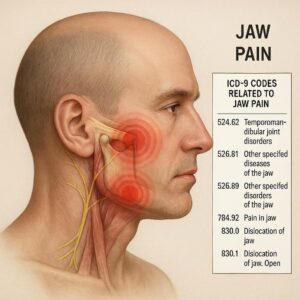
ICD-9 Code for Jaw Pain
The Specific ICD-9 Code for Jaw Pain
In the International Classification of Diseases, Ninth Revision (ICD-9), the code for generalized jaw pain is:
784.92 – Jaw Pain
This code falls under the broader category of “Symptoms, signs, and ill-defined conditions” related to the head and neck. It’s crucial to understand that 784.92 is a nonspecific code. It serves as a starting point when a practitioner has identified pain in the jaw region but has not yet determined the exact underlying cause.
Important Note: The ICD-9-CM system was officially replaced by ICD-10-CM in the United States on October 1, 2015. While you may encounter ICD-9 codes on older records, all current medical coding must use ICD-10.
Why Jaw Pain Coding Isn’t Always Straightforward
Jaw pain is a symptom, not a disease. Simply using 784.92 is often insufficient because effective treatment depends on identifying the root cause. The jaw is a complex area involving joints, muscles, teeth, nerves, and bones. Pain could stem from any of these structures or even be referred pain from another location, such as the heart.
A coder or clinician must dig deeper. Was the final diagnosis a temporomandibular joint disorder (TMJ)? A dental abscess? Trigeminal neuralgia? Or something else? Each of these conditions has its own, more precise code.
Transitioning from ICD-9 to ICD-10 for Jaw Pain
The transition to ICD-10 brought a significant increase in specificity. The single ICD-9 code 784.92 maps to a range of more detailed codes in ICD-10. This allows for a much clearer picture of the patient’s condition.
The primary ICD-10-CM code for jaw pain is:
R68.84 – Jaw Pain
Again, similar to its ICD-9 predecessor, R68.84 is a symptom code. It’s used when a more specific diagnosis isn’t available. However, ICD-10 provides codes for virtually every conceivable cause of that pain.
Comparative Table: ICD-9 vs. ICD-10 for Common Jaw Pain Diagnoses
| Condition / Symptom | ICD-9-CM Code | ICD-10-CM Code | Notes |
|---|---|---|---|
| General Jaw Pain (unspecified) | 784.92 | R68.84 | Used when the cause is not yet determined. |
| Temporomandibular Joint Disorders (TMJ) | 524.60 – 524.69 | M26.60 – M26.699 | ICD-10 offers extreme detail: right/left, arthralgia, disorders, etc. |
| Dental Abscess | 522.5 (Periapical) | K04.7 (Periapical abscess) | ICD-10 separates abscesses by specific location and origin. |
| Trigeminal Neuralgia | 350.1 | G50.0 | Code for intense nerve pain often felt in the jaw. |
| Arthritis of TMJ | 715.18 | M19.80 – M19.831 | Specifies primary, secondary, or post-traumatic arthritis. |
| Myofascial Pain (Muscle Pain) | 729.1 | M79.1 | Code for pain originating in the jaw muscles. |
This table illustrates a key point: accurate coding depends on an accurate clinical diagnosis. The code “for jaw pain” is just the beginning of the story.
Common Causes of Jaw Pain and Their Codes
To truly understand medical coding for jaw pain, we must explore the conditions behind the symptom. Here are the most frequent culprits.
1. Temporomandibular Joint Disorders (TMD/TMJ)
This is one of the most common causes. TMD involves the joint that connects your jawbone to your skull and the surrounding muscles.
-
ICD-9: Codes fell under 524.6x (e.g., 524.60 for unspecified temporomandibular joint disorders).
-
ICD-10: The coding is vastly more detailed in the M26.6- series.
-
M26.62: Arthralgia of temporomandibular joint.
-
M26.63: Articular disc disorder of temporomandibular joint.
-
M26.69: Other specified disorders of temporomandibular joint.
-
Laterality (right, left, bilateral) is specified with an additional digit.
-
2. Dental and Oral Health Issues
Problems with teeth and gums are a prime source of jaw pain.
-
Tooth Abscess/Infection (ICD-10: K04.7): An infection at the root of a tooth can cause severe, throbbing jaw pain.
-
Impacted Teeth (ICD-10: K01.0): Wisdom teeth that don’t erupt properly can press on other teeth and the jawbone.
-
Gum Disease (Periodontitis, ICD-10: K05.20-K05.6): Advanced infections can affect the supporting bone.
-
Tooth Grinding (Bruxism, ICD-10: F45.8 or G47.63): Chronic clenching and grinding, often during sleep, strains jaw muscles and joints.
3. Neuralgias and Nerve Pain
Nerve conditions can produce excruciating pain focused on the jaw.
-
Trigeminal Neuralgia (ICD-10: G50.0): Often described as sudden, electric-shock-like pain along the trigeminal nerve, which supplies sensation to the face and jaw.
-
Occipital Neuralgia (ICD-10: G54.81): While affecting the back of the head, pain can radiate forward.
4. Other Medical Conditions
Jaw pain can be a sign of systemic issues.
-
Cardiac Events: Pain from a heart attack or angina can radiate to the jaw, neck, or left arm. This is a medical emergency (ICD-10 codes in the I20-I25 range).
-
Arthritis: Osteoarthritis (M19.83) or rheumatoid arthritis (M06.98) can affect the TMJ.
-
Sinusitis (ICD-10: J01.90): Infection or inflammation in the sinuses, located close to the upper jaw, can cause pressure and pain.
-
Fibromyalgia (ICD-10: M79.7): This chronic condition involves widespread muscle pain, which can include the jaw muscles.
The Critical Importance of Accurate Jaw Pain Coding
Why does the right code matter so much? It goes far beyond paperwork.
-
Patient Care: Accurate coding creates a precise medical history. If a patient’s record shows a progression from R68.84 (jaw pain) to M26.62 (TMJ arthralgia), any future provider has a clear clinical story.
-
Treatment Authorization: Insurance companies use diagnosis codes to determine if a proposed treatment (like physical therapy for TMJ or a root canal for an abscess) is medically necessary. An incorrect or overly vague code can lead to claim denials.
-
Public Health and Research: Aggregated coded data helps researchers and health agencies spot trends, understand the prevalence of conditions like TMD, and allocate resources effectively.
-
Billing and Reimbursement: Providers are reimbursed based on the services rendered and the diagnoses treated. Specific coding ensures fair and legal reimbursement.
A Step-by-Step Guide for Coders and Patients
For Medical Coders:
-
Review the Documentation: Start with the physician’s or dentist’s final diagnostic statement in the medical record. Never code from the chief complaint (“jaw pain”) alone.
-
Identify the Specific Cause: Look for terms like “TMD,” “myofascial pain,” “abscess,” “trigeminal neuralgia,” or “osteoarthritis.”
-
Consult the ICD-10-CM Index and Tabular: Use the Alphabetic Index to find the code, then verify its completeness and any instructional notes in the Tabular List.
-
Code to the Highest Specificity: Use the most detailed code available. Specify laterality (right, left, bilateral) if documented.
-
Differentiate Symptoms vs. Diagnoses: If a definitive diagnosis is made, code that. Use a symptom code like R68.84 only if the cause remains unknown after investigation.
For Patients Understanding Their Records:
-
Look at the Diagnosis Codes: On your explanation of benefits (EOB) or medical bill, find the diagnosis code(s). They are typically listed next to or near each billed procedure.
-
Use Reliable Resources: Use the CDC’s ICD-10-CM browser or other official tools to look up what the code means (e.g., “What is M26.62?”).
-
Ask Questions: If the code doesn’t seem to match your condition (e.g., you were treated for a toothache but see a code for back pain), contact your provider’s billing office for clarification. Understanding your codes helps you advocate for your own care.
Frequently Asked Questions (FAQ)
Q1: I have an old medical record from 2014 with code 784.92. What does that mean now?
A1: It means you were diagnosed with generalized jaw pain at that time, without a specified cause like TMJ or a dental issue. For any current treatment, a healthcare provider will reassess you and assign a modern ICD-10 code based on today’s diagnosis.
Q2: Why did my dentist use a different code than my doctor for the same jaw pain?
A2: Different specialists may focus on different aspects of your condition. Your dentist may have coded for a dental abscess (K04.7), while your doctor, ruling out other causes, may have used a TMJ disorder code (M26.62). Both can be correct and reflect their specific findings.
Q3: Can stress really cause jaw pain that needs a medical code?
A3: Absolutely. Stress is a major contributor to bruxism (teeth grinding, G47.63) and myofascial pain syndrome (M79.1). These are legitimate, codable diagnoses that stem from stress-related muscle tension.
Q4: Is there one “best” code for TMJ?
A4: No. “TMJ” is a broad term. The “best” code is the one that most accurately describes your specific disorder—whether it’s joint pain (arthralgia, M26.62), a displaced disc (M26.63), or another specified problem (M26.69). Precision is key.
Conclusion
Finding the ICD-9 code for jaw pain (784.92) is a simple answer to a complex question. True understanding requires looking past the symptom to the underlying cause, a practice that the modern ICD-10 system fully supports with its detailed and specific codes. Whether you’re navigating medical records, processing insurance claims, or seeking treatment, accurate diagnosis coding is the linchpin connecting patient symptoms to effective care and understanding.
Additional Resource:
For the official, searchable database of all ICD-10-CM codes, visit the Centers for Disease Control and Prevention (CDC) website: CDC ICD-10-CM Browser.
Disclaimer: This article is for informational and educational purposes only. It is not a substitute for professional medical coding advice, clinical diagnosis, or treatment. Always consult with a qualified healthcare provider for any health concerns and with a certified medical coder for coding-specific questions. Code assignment must always be based on provider documentation and official coding guidelines.
Author: The Professional Web Writer Team
Date: FEBRUARY 04, 2026