If you’re dealing with medical records, insurance forms, or historical health data related to a curved spine, you’ve likely encountered the term “ICD-9 code for scoliosis.” While this coding system has been replaced, understanding it remains crucial for navigating older records and appreciating the evolution of medical classification.
This guide will provide a deep, clear, and practical exploration of the ICD-9 coding for scoliosis. We’ll demystify the specific codes, explain their structure, and discuss why they still matter today. More importantly, we’ll connect this historical knowledge to the current ICD-10 system, giving you a complete and useful reference.
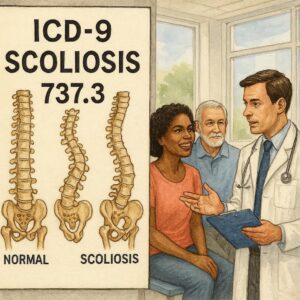
ICD-9 Code for Scoliosis
What is the ICD-9 Code for Scoliosis?
The core ICD-9-CM (International Classification of Diseases, 9th Revision, Clinical Modification) code for scoliosis is 737. However, this is just the starting point. ICD-9 used a system of additional digits to provide more detail, making the full code more specific.
The correct, complete ICD-9 code category for scoliosis is 737.xx. This “xx” represents two additional digits that specify the type and cause of the spinal curvature. This level of detail was essential for diagnosis, treatment planning, and insurance billing.
A note on historical use: It’s vital to remember that the ICD-9-CM system was officially retired in the United States on October 1, 2015, replaced by ICD-10-CM. You will only encounter ICD-9 codes in older medical records or when processing historical data. All current medical coding uses ICD-10.
Breaking Down the 737.xx Code Structure
Let’s look at how this code was organized. The fifth digit (the second “x” in 737.xx) was the key to specifying the scoliosis type.
ICD-9 Code 737.3x – Curvature of Spine (Including Scoliosis)
| ICD-9 Code | Description | Clinical Context |
|---|---|---|
| 737.30 | Scoliosis (and kyphoscoliosis), unspecified | Used when the specific type of scoliosis was not documented or was idiopathic. This was a common “catch-all” code. |
| 737.31 | Resolving infantile idiopathic scoliosis | For curvatures in infants that were observed to be correcting themselves without intervention. |
| 737.32 | Progressive infantile idiopathic scoliosis | For curvatures in infants that were worsening over time, requiring monitoring or treatment. |
| 737.33 | Scoliosis due to radiation | A rare cause, used for deformities directly linked to radiation therapy. |
| 737.34 | Thoracogenic scoliosis | Resulting from disease or surgery in the chest cavity. |
| 737.39 | Other kyphoscoliosis and scoliosis | A code for types that didn’t fit the other categories, such as certain forms of neuromuscular or congenital scoliosis not specified elsewhere. |
Important Note for Readers: If you are reviewing an old record with just “737.3” listed, it is incomplete. The fifth digit was mandatory for accurate coding. The unspecified code (737.30) was often used as a default.
Why Knowing the Old ICD-9 Code Still Matters
You might wonder why we bother with an outdated system. The reasons are practical and important:
-
Medical Records Legacy: Millions of patient records spanning decades are coded in ICD-9. Understanding these codes is necessary for interpreting a patient’s full medical history, especially when prior spinal issues are relevant to current care.
-
Research and Data Analysis: Long-term studies on scoliosis progression, treatment outcomes, and epidemiology often use data coded in ICD-9. Researchers must understand this system to work with historical datasets accurately.
-
Insurance and Legal Reviews: Old insurance claims or legal cases may hinge on diagnoses coded in ICD-9. Correct interpretation can be critical.
-
Understanding Coding Evolution: Seeing the simplicity of ICD-9 (737.30) compared to the detail of ICD-10 helps medical professionals and administrators appreciate the increased specificity of modern coding, which improves patient care and data quality.
The Crucial Shift: From ICD-9 to ICD-10 for Scoliosis
The transition to ICD-10-CM on October 1, 2015, represented a massive leap in detail. The code for scoliosis expanded dramatically to allow for much more precise descriptions of the condition’s cause, location, and type.
The generic ICD-10 code for scoliosis is M41. But under this category, there are dozens of specific codes.
ICD-9 to ICD-10 Code Comparison for Common Scoliosis Types
| Condition Description | Old ICD-9 Code | Modern ICD-10 Code | Why the Change Matters |
|---|---|---|---|
| Unspecified Idiopathic Scoliosis | 737.30 | M41.20 (Other idiopathic scoliosis, site unspecified) | ICD-10 requires laterality (left/right) and often location (cervical, thoracic, lumbar). |
| Adolescent Idiopathic Scoliosis | 737.30 | M41.12- (Adolescent idiopathic scoliosis, with specific 5th/6th chars for location) | ICD-10 specifically identifies the adolescent form, which is the most common. |
| Congenital Scoliosis | 737.39 (or a code from 754.2) | Q67.5 (Congenital deformity of spine) or Q76.3 (Congenital scoliosis) | ICD-10 separates congenital causes into their own chapter (Q codes), providing clearer etiology. |
| Scoliosis due to Neuromuscular Disease (e.g., Cerebral Palsy) | 737.39 | M41.4- (Neuromuscular scoliosis) | ICD-10 creates a distinct category for this common cause, linked to the underlying condition (e.g., G80 for Cerebral Palsy). |
As you can see, the modern system moves from a handful of options to a highly granular structure. This specificity helps in:
-
Better Treatment Planning: Clearly distinguishing between a neuromuscular curve and an idiopathic one guides therapy.
-
Accurate Reimbursement: Insurance companies can understand the complexity of the diagnosis.
-
Superior Public Health Data: Health agencies get a clearer picture of scoliosis prevalence and causes.
Key Differences Between ICD-9 and ICD-10 for Scoliosis Coding
Understanding these differences is the key to navigating both systems.
-
Code Length: ICD-9 used 3-5 digits. ICD-10 uses 3-7 alphanumeric characters (letters and numbers).
-
Specificity: ICD-9 was often vague. ICD-10 mandates detail on laterality (right-sided, left-sided), etiology (cause), and often the specific vertebra involved.
-
Chapter Organization: In ICD-9, most scoliosis codes were in Chapter 13 (Musculoskeletal). In ICD-10, they are still in Chapter 13 (M codes), but congenital forms are precisely separated into Chapter 17 (Q codes).
Practical Guide: How to Find and Verify Scoliosis Codes
Whether you’re a patient, a coder, or a healthcare professional, here’s a reliable approach:
For Historical ICD-9 Codes:
-
Confirm the date of the record (pre-October 2015).
-
Look for the code 737.3x. Identify the fifth digit from the physician’s documentation.
-
Use a legacy ICD-9 manual or a reputable online archive to verify the description.
For Current ICD-10 Coding:
-
Start with the M41 category.
-
Use the physician’s detailed note to determine:
-
The type (idiopathic, neuromuscular, etc.).
-
The cause (if known).
-
The location (thoracic, lumbar, thoracolumbar).
-
The laterality.
-
-
Consult the official ICD-10-CM manual or a trusted encoder tool to build the complete 7-character code.
A Helpful List: Information Needed for Accurate Scoliosis Coding Today
To code scoliosis in the ICD-10 era, the medical documentation should clearly state:
-
Confirming Diagnosis: “Scoliosis” must be explicitly stated.
-
Type: Idiopathic (infantile, juvenile, adolescent, adult), neuromuscular, congenital, etc.
-
Etiology: If secondary, the underlying disease (e.g., Marfan syndrome, muscular dystrophy).
-
Location: The region of the primary curvature (cervical, thoracic, lumbar).
-
Laterality: The direction of the convexity of the curve (right-sided, left-sided).
-
Manifestation: If it’s a complication of another condition, that must be linked.
Common Scenarios and Their Codes: A Historical and Modern View
Let’s walk through some real-world examples.
Scenario 1: A 14-year-old presents with a right thoracic curve. No underlying cause is found.
-
ICD-9 (Old Record): 737.30 (Scoliosis, unspecified)
-
ICD-10 (Current): M41.124 (Adolescent idiopathic scoliosis, thoracic region, right-sided)
Scenario 2: An adult with long-standing Cerebral Palsy develops a progressive spinal curvature.
-
ICD-9 (Old Record): 737.39 (Other kyphoscoliosis and scoliosis) plus 343.9 (Cerebral Palsy)
-
ICD-10 (Current): M41.4 (Neuromuscular scoliosis) plus G80.9 (Cerebral Palsy, unspecified)
Scenario 3: A newborn is diagnosed with a vertebral malformation causing a spinal curve.
-
ICD-9 (Old Record): 754.2 (Congenital musculoskeletal deformity of spine)
-
ICD-10 (Current): Q76.3 (Congenital scoliosis due to congenital bony malformation)
Conclusion
The ICD-9 code for scoliosis, centered on 737.30, served as a functional but limited tool for its time. Its true value now lies in unlocking historical medical data. The transition to ICD-10’s detailed system, with codes like M41.12-, reflects a commitment to precision in diagnosis, treatment, and health data analytics. Understanding both systems is key to managing comprehensive patient care and appreciating the advancements in medical documentation.
Frequently Asked Questions (FAQ)
Q1: Can I still use the ICD-9 code 737.30 on insurance claims?
A: No. As of October 1, 2015, all HIPAA-covered entities (like doctors and hospitals) in the United States must use ICD-10-CM codes for billing and reporting. Using ICD-9 will result in claim rejection.
Q2: I have an old record that just says “737.3.” What does that mean?
A: The code is incomplete. A fifth digit was required. Without the medical note, it’s impossible to know the specific type. It was likely coded as 737.30 (unspecified) or may have been a documentation error.
Q3: Is there a single ICD-10 code that directly replaces 737.30?
A: Not exactly. The closest equivalent for an unspecified idiopathic scoliosis would be M41.20 (Other idiopathic scoliosis, site unspecified). However, coders are urged to be as specific as the documentation allows.
Q4: Why did coding become so much more complicated with ICD-10?
A: The complexity aims for greater accuracy. More specific codes lead to better understanding of patient conditions, more appropriate treatment pathways, improved tracking of public health trends, and fairer reimbursement for the complexity of care provided.
Additional Resources
For those seeking authoritative sources on medical coding:
-
The Centers for Medicare & Medicaid Services (CMS) ICD-10 Website: Provides official guidelines, code sets, and updates.
-
The National Center for Health Statistics (NCHS): The U.S. government agency responsible for maintaining the ICD-10-CM system.
-
The American Health Information Management Association (AHIMA): A professional organization for medical coders with extensive educational resources.
-
The American Academy of Orthopaedic Surgeons (AAOS): Provides clinical resources on scoliosis diagnosis and treatment, which inform proper coding.
Disclaimer: This article is for informational and educational purposes only. It is not a substitute for professional medical coding advice, clinical guidance, or the official ICD coding manuals. Medical coding is complex and regulated. Always consult the most current official ICD-10-CM coding guidelines, your facility’s coding policies, and a certified professional coder for accurate diagnosis coding. The author and publisher are not responsible for any errors, omissions, or consequences resulting from the use of this information.
Date: January 02, 2025
Author: The Web Health Writer Team