If you’re searching for the ICD-9 code for a Urinary Tract Infection (UTI), you’ve come to the right place. This article provides a comprehensive, reliable, and detailed exploration of the now-historic ICD-9-CM coding system as it pertains to UTIs. Understanding these codes is crucial for medical professionals handling older records, for historical data analysis, or for anyone seeking to understand the evolution of medical classification.
However, it is vitally important to state upfront: The ICD-9-CM code set was officially replaced by ICD-10-CM in the United States on October 1, 2015. While this guide serves as an authoritative reference for the old system, all current medical coding, billing, and clinical documentation must use ICD-10-CM.
Our goal is to give you a clear, accurate, and useful resource. We’ll break down the specific codes, explain their nuances, and help you navigate the transition to the modern system. Let’s begin by understanding what ICD-9 codes were and why they matter in context.
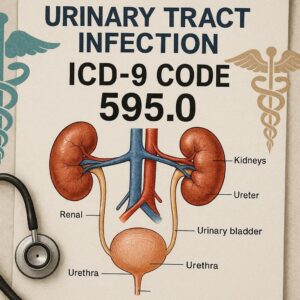
ICD-9 Code for UTI
Understanding the ICD-9-CM Coding System
The International Classification of Diseases, 9th Revision, Clinical Modification (ICD-9-CM) was the standard system used in the United States for decades to code diagnoses, symptoms, and procedures. It served as the backbone of medical billing, epidemiology, and health records management.
“ICD-9-CM was the language of healthcare data for a generation. It allowed for the systematic recording of diseases, but its structure eventually limited the detail needed for modern medicine.” – Health Data Management Review
The system was organized numerically. Codes for diseases were typically three to five digits long, with the initial digits representing the broad category of illness. The coding structure was simpler than today’s standards, which was both its strength and its ultimate weakness.
Why Transition to ICD-10-CM?
The shift to ICD-10-CM was not arbitrary. ICD-9-CM had significant limitations:
-
Lack of Specificity: Codes often grouped clinically distinct conditions.
-
Outdated Terminology: It did not reflect advances in medical knowledge and technology.
-
Structural Exhaustion: The system had literally run out of space to add new codes meaningfully.
For conditions like UTIs, this lack of specificity could obscure important clinical details, such as the precise anatomical site or the causative organism, which are critical for treatment and public health tracking.
The Primary ICD-9 Code for Urinary Tract Infection
In the ICD-9-CM system, the fundamental code for a urinary tract infection was:
599.0 – Urinary tract infection, site not specified
This code was a catch-all for UTIs when a more specific location (like the bladder or kidney) was not identified or documented. Let’s examine what this code encompassed and its critical importance in accurate coding.
Breakdown of Code 599.0
-
Category 599: This broader category was “Other disorders of urethra and urinary tract.”
-
.0: This fourth digit specified “Urinary tract infection, site not specified.”
The use of this code underscored a key principle in medical coding: specificity is paramount. If a physician’s documentation did not specify whether the infection was a cystitis (bladder) or pyelonephritis (kidney), the coder was forced to use this less specific code. This could potentially impact the perceived severity of the case and, historically, the reimbursement level.
Documentation Requirements for 599.0
To properly assign code 599.0, medical records needed to support the diagnosis. Key elements included:
-
Physician’s statement of diagnosis (e.g., “UTI”).
-
Supporting clinical indicators, such as patient symptoms (dysuria, frequency, urgency).
-
Relevant laboratory findings, notably a positive urinalysis (e.g., positive leukocyte esterase, nitrites) or urine culture.
Important Note: Simply having bacteria present in a urine culture (bacteriuria) without symptoms did not typically justify a UTI diagnosis code. Asymptomatic bacteriuria often has its own distinct coding implications.
Specific UTI Types and Their ICD-9 Codes
While 599.0 was the general code, ICD-9-CM provided more specific codes for infections at defined anatomical sites. Using the most specific code possible was a fundamental rule.
Cystitis (Bladder Infection)
Cystitis, the most common type of UTI, had its own set of codes based on its cause or nature.
| ICD-9 Code | Description | Clinical Context |
|---|---|---|
| 595.0 | Acute cystitis | Used for sudden-onset bladder infections. |
| 595.1 | Chronic interstitial cystitis | A distinct, non-infectious chronic pain syndrome. Crucially, this is NOT a typical bacterial UTI. |
| 595.2 | Other chronic cystitis | For persistent or recurring bacterial cystitis. |
| 595.3 | Trigonitis | Inflammation specifically of the trigone of the bladder. |
| 595.4 | Cystitis in diseases classified elsewhere | Used when cystitis is a manifestation of a broader disease (e.g., schistosomiasis). |
| 595.8 | Other specified types of cystitis | E.g., radiation cystitis, chemical cystitis. |
| 595.9 | Cystitis, unspecified | When the documentation states “cystitis” without further detail. |
Pyelonephritis (Kidney Infection)
Kidney infections, being more serious, had a separate category.
| ICD-9 Code | Description | Clinical Context |
|---|---|---|
| 590.0 | Chronic pyelonephritis | A long-standing kidney infection, often with scarring. |
| 590.1 | Acute pyelonephritis | A sudden, severe kidney infection. This is a more severe diagnosis than simple cystitis. |
| 590.8 | Pyelonephritis, unspecified | Used when the documentation does not specify acute or chronic. |
| 590.9 | Infections of kidney, unspecified | A less specific term for kidney infection. |
Urethritis (Urethral Infection)
Infections or inflammation of the urethra were categorized separately, often linked to sexually transmitted infections.
| ICD-9 Code | Description |
|---|---|
| 597.0 | Urethral abscess |
| 598.0 | Urethritis due to gonorrhea |
| 598.9 | Urethritis, unspecified |
Special Considerations and Related Codes
Certain patient populations and complicating factors required distinct codes.
Catheter-Associated UTI (CAUTI):
This common healthcare-associated infection was coded as 996.64 – Infection and inflammatory reaction due to indwelling urinary catheter. Code 599.0 was typically not used as a primary code in this scenario; 996.64 took precedence, often followed by a code for the specific infection (e.g., 599.0 or 590.1).
UTI in Pregnancy:
UTIs during pregnancy were considered a complication of pregnancy and were found in Chapter 11 of ICD-9-CM:
-
646.6 – Infections of genitourinary tract in pregnancy. A fifth digit was required to specify the trimester.
Asymptomatic Bacteriuria:
The presence of significant bacteria in the urine without symptoms was coded as 791.9 – Nonspecific finding on examination of urine.
The Critical Transition: From ICD-9 to ICD-10-CM for UTI
As of October 1, 2015, the U.S. healthcare system mandated the use of ICD-10-CM. This transition represented a monumental shift from approximately 14,000 ICD-9 codes to over 68,000 ICD-10 codes. For UTI coding, this meant a dramatic increase in specificity.
Why ICD-10-CM is a Superior System for UTI Coding
-
Anatomical Specificity: ICD-10 clearly distinguishes between cystitis and pyelonephritis, and further specifies laterality (left, right, bilateral).
-
Causative Agent: Many codes allow for the identification of the infectious organism (e.g., E. coli, Klebsiella).
-
Association Factors: There are specific codes for UTIs related to catheters, pregnancy, and other conditions.
-
Reinfection vs. Relapse: The structure allows for greater clarity in coding recurrent infections.
Comparative Table: ICD-9 vs. ICD-10 for Common UTI Diagnoses
| Diagnosis | ICD-9-CM Code | ICD-10-CM Code (Example) | Key Difference |
|---|---|---|---|
| Unspecified UTI | 599.0 | N39.0 | ICD-10 code is more specific to the urinary tract. |
| Acute Cystitis | 595.0 | N30.00 (Acute cystitis without hematuria) | ICD-10 specifies the presence or absence of hematuria. |
| Acute Pyelonephritis | 590.1 | N10 (Acute pyelonephritis) | ICD-10 requires a separate code for the organism if known (e.g., B96.20 for E. coli). |
| UTI due to Catheter | 996.64 | T83.511A (Infec/react d/t indwell urinary catheter, init) | ICD-10 uses a combination of codes for the device complication and the specific infection. |
| UTI in Pregnancy | 646.6x | O23.40 (Infect of kidney in preg, unsp trimester) | ICD-10 has separate codes for bladder vs. kidney infection in pregnancy. |
This table illustrates that while ICD-9 provided a basic label, ICD-10-CM paints a detailed clinical picture. This detail improves patient care coordination, quality tracking, and epidemiological research.
Common Pitfalls and Best Practices in Historical UTI Coding (ICD-9)
Even when dealing with historical ICD-9 data, understanding common errors helps ensure accurate analysis.
Frequent Coding Errors
-
Using 599.0 for Cystitis or Pyelonephritis: If the documentation specified “cystitis,” the correct code was 595.9, not 599.0. This was a common mistake that reduced data specificity.
-
Miscoding Interstitial Cystitis (595.1): Coding this chronic pain syndrome as a bacterial UTI was a significant clinical and coding error.
-
Incorrect Sequencing for CAUTI: Failing to list the device complication code (996.64) as the primary diagnosis for a catheter-associated infection.
-
Overlooking Pregnancy Codes: Using 599.0 for a pregnant patient instead of the appropriate 646.6x code.
Best Practices for Handling ICD-9 UTI Data
-
Always Code to the Highest Specificity: Never default to 599.0 if the record supports a more precise code like 595.0 or 590.1.
-
Link Codes to Documentation: The medical record must clearly support the chosen code.
-
Understand Code Exclusions: For example, code 595.1 (interstitial cystitis) explicitly excluded “infectious cystitis.”
-
Use Combination Codes When Needed: For conditions like CAUTI, multiple codes were often required to tell the full story.
Conclusion
Navigating the ICD-9 code for UTI requires an understanding of its core code, 599.0, and the more specific codes for cystitis, pyelonephritis, and special circumstances. While this system served its purpose historically, its replacement by ICD-10-CM has ushered in an era of greater precision in diagnosing and tracking urinary tract infections. For accurate current practice, mastery of ICD-10-CM is essential, but knowledge of ICD-9 remains valuable for interpreting decades of past medical data.
Frequently Asked Questions (FAQ)
Q1: Can I still use ICD-9 codes for billing today?
A: No. As of October 1, 2015, all HIPAA-covered entities in the United States must use ICD-10-CM for diagnosis coding on all claims. Using ICD-9 will result in claim denial.
Q2: What is the most common ICD-10 code for a simple UTI?
A: For an uncomplicated, unspecified UTI, the most common code is N39.0 (Urinary tract infection, site not specified). However, more specific codes (e.g., N30.00 for acute cystitis) are strongly preferred if the documentation supports them.
Q3: How do I code a recurrent UTI in ICD-10?
A: ICD-10 has a specific code for recurrent UTIs: N39.0. Crucially, you would also use a code from the Z87.44 (Personal history of diseases of the genitourinary system) category to indicate the history of recurrence.
Q4: What was the biggest drawback of using ICD-9 for UTIs?
A: The lack of specificity. It was often impossible to distinguish between a simple bladder infection and a serious kidney infection in the coded data, or to identify the causative organism, which hindered clinical decision support and public health surveillance.
Q5: Where can I find official coding guidelines?
A: The Centers for Medicare & Medicaid Services (CMS) and the National Center for Health Statistics (NCHS) publish the official ICD-10-CM guidelines and code sets. For ICD-9 historical reference, these agencies maintain archives.
Additional Resources
-
Centers for Disease Control and Prevention (CDC) ICD-10-CM Page: Provides official tools, guidelines, and updates.
-
American Health Information Management Association (AHIMA): Offers professional resources, training, and articles on accurate clinical coding.
-
ICD10data.com: A free, easy-to-use online tool for looking up and comparing ICD-10 codes.
Disclaimer
This article is intended for informational and educational purposes only. It provides historical context regarding the ICD-9-CM coding system. It does not constitute medical advice or official coding guidance. For current medical coding, billing, and clinical decision-making, healthcare providers and coders must consult the latest official ICD-10-CM code sets and guidelines published by the CMS and NCHS. The author and publisher are not responsible for any coding or billing decisions made based on this historical reference material.
Date: January 02, 2025
Author: The Web Health Archives Team