If you’re searching for the ICD-9 code for abdominal pain, you’ve likely encountered a piece of medical history. While this coding system is no longer the standard, understanding it remains crucial for dealing with older medical records, historical data analysis, and certain legacy administrative processes. This guide will provide a comprehensive, honest, and detailed look at the ICD-9 codes related to abdominal pain, explaining not just the “what,” but the critical “why” and “what now.”
We’ll navigate the structure of ICD-9, break down the specific codes for different types of abdominal pain, and place it all in the context of today’s medical coding landscape. Our goal is to make this complex topic accessible, whether you’re a medical student reviewing old charts, a healthcare administrator handling legacy systems, or a patient curious about the codes on an old bill.
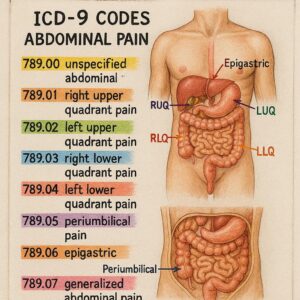
ICD-9 Codes for Abdominal Pain
Understanding the ICD-9 Coding System: A Foundation
Before we dive into the specific codes for abdominal pain, it’s essential to grasp what ICD-9 was and how it functioned. The International Classification of Diseases, 9th Revision (ICD-9), was a global system for coding diagnoses, symptoms, and procedures. Used in the United States from 1979 until October 1, 2015, it served as the backbone for medical billing, epidemiological tracking, and health records for over three decades.
The system was numeric and typically 3 to 5 digits long. The first three digits represented the core category of the disease or condition. A fourth or fifth digit provided greater specificity regarding location, severity, or other clinical details. This hierarchical structure allowed for both broad groupings and detailed classifications.
A Quick Note: As of October 1, 2015, the U.S. healthcare system officially transitioned to ICD-10-CM (Clinical Modification) for diagnosis coding. ICD-9 is considered obsolete for current patient encounters. However, knowledge of ICD-9 is still relevant for retroactive review, research on historical data, and understanding older documentation.
Why Knowing “Old” Codes Still Matters
You might wonder why we’re discussing a retired system. The reasons are practical and important:
-
Historical Medical Records: Millions of patient records from before 2015 use ICD-9 codes. Understanding them is key for continuity of care, legal reviews, or long-term health studies.
-
Research and Epidemiology: Studies tracking disease trends over decades must reconcile data from both the ICD-9 and ICD-10 eras.
-
Billing and Appeals: Resolving older insurance claims or denials sometimes requires navigating the coding rules that were in place at the time of service.
-
Learning Curve: Understanding the limitations of ICD-9 helps appreciate the expanded detail and clinical granularity of ICD-10.
The Core ICD-9 Code for Abdominal Pain: 789.0
In the ICD-9 system, the general and most commonly used code for abdominal pain was 789.0. This code resided within a larger chapter focused on symptoms, signs, and ill-defined conditions.
-
Chapter: 16. Symptoms, Signs, and Ill-Defined Conditions (780-799)
-
Category: 789. Other symptoms involving abdomen and pelvis
-
Subcategory: 789.0 Abdominal pain
The code 789.0 was a “bucket” code used when a more precise diagnosis (like appendicitis or a specific ulcer) wasn’t yet established. It indicated the patient’s primary complaint was pain located in the abdominal region, without specification of its exact nature or confirmed cause.
The Importance of the Fourth Digit: Specifying Location
The true utility of ICD-9 for abdominal pain came from the mandatory fourth digit. This digit specified the quadrant or region of the abdomen where the pain was localized, which is a critical piece of diagnostic information.
ICD-9 Code Structure for Abdominal Pain (789.0x):
-
789.00 – Abdominal pain, unspecified site: Used when the pain was generalized or not localized to a specific quadrant.
-
789.01 – Abdominal pain, right upper quadrant: Pain localized under the right rib cage.
-
789.02 – Abdominal pain, left upper quadrant: Pain localized under the left rib cage.
-
789.03 – Abdominal pain, right lower quadrant: Pain in the area near the appendix (e.g., McBurney’s point).
-
789.04 – Abdominal pain, left lower quadrant: Pain in the descending colon/sigmoid region.
-
789.05 – Abdominal pain, periumbilic: Pain specifically around the navel.
-
789.06 – Abdominal pain, epigastric: Pain in the upper central abdomen, below the sternum.
-
789.07 – Abdominal pain, generalized: Pain affecting most or all of the abdominal area.
-
789.09 – Abdominal pain, other specified site: For other localizations, such as suprapubic pain.
This table summarizes the ICD-9 codes for abdominal pain by location:
| ICD-9 Code | Description | Common Clinical Associations |
|---|---|---|
| 789.00 | Abdominal pain, unspecified site | Non-specific pain, early presentation |
| 789.01 | Right Upper Quadrant (RUQ) pain | Gallbladder disease (cholecystitis), hepatitis |
| 789.02 | Left Upper Quadrant (LUQ) pain | Splenic issues, gastritis |
| 789.03 | Right Lower Quadrant (RLQ) pain | Appendicitis, ovarian cyst (right) |
| 789.04 | Left Lower Quadrant (LLQ) pain | Diverticulitis, ovarian cyst (left) |
| 789.05 | Periumbilical pain | Early appendicitis, small bowel disorders |
| 789.06 | Epigastric pain | Peptic ulcer disease, gastritis, pancreatitis |
| 789.07 | Generalized abdominal pain | Peritonitis, gastroenteritis, bowel obstruction |
| 789.09 | Other specified site | Suprapubic pain (e.g., bladder-related) |
Beyond the General Code: Other Relevant ICD-9 Categories
Abdominal pain is a symptom of countless conditions. Therefore, once a diagnosis was confirmed, the code would change from a symptom code (789.0x) to a code for the specific disease. Here are other major ICD-9 categories where abdominal pain is a key feature.
1. Gastrointestinal Disorders (ICD-9 520-579)
This large chapter contained codes for definitive diagnoses that cause abdominal pain.
-
535.x – Gastritis and duodenitis: Inflammation of the stomach or duodenum lining.
-
540.x – Acute appendicitis: The code for a confirmed inflamed appendix.
-
550.x – Inguinal hernia: Hernias, which can cause pain and discomfort.
-
558.x – Other noninfectious gastroenteritis and colitis: Including issues like irritable bowel syndrome.
2. Genitourinary Disorders (ICD-9 580-629)
Pain originating from the urinary or reproductive systems can present as abdominal pain.
-
590.x – Infections of kidney: Pyelonephritis often causes flank pain that can radiate.
-
614.x – Inflammatory disease of female pelvic organs: Pelvic Inflammatory Disease (PID).
-
625.x – Pain and other symptoms associated with female genital organs: Includes dysmenorrhea (painful periods).
3. Ill-Defined Conditions (ICD-9 780-799)
Besides 789.0, this chapter had other relevant symptom codes.
-
787.0 – Nausea and vomiting: Often accompanies abdominal pain.
-
787.9 – Other symptoms involving digestive system: A catch-all for other GI symptoms.
Comparative Table: Symptom vs. Diagnosis Coding in ICD-9
| Scenario | Initial Encounter Coding (Symptom) | Follow-up/Confirmed Diagnosis Coding |
|---|---|---|
| Patient presents with severe RLQ pain, suspecting appendicitis. | 789.03 (Abdominal pain, RLQ) | 540.9 (Acute appendicitis, unspecified) |
| Patient with burning epigastric pain, pending endoscopy. | 789.06 (Abdominal pain, epigastric) | 533.90 (Peptic ulcer, unspecified, without obstruction) |
| Woman with diffuse lower abdominal pain and fever. | 789.07 (Abdominal pain, generalized) or 789.09 | 614.9 (Unspecified inflammatory disease of female pelvis) |
The Transition from ICD-9 to ICD-10: A Major Evolution
The shift from ICD-9 to ICD-10-CM on October 1, 2015, was one of the most significant changes in modern healthcare administration. For abdominal pain, the difference is stark and reflects advances in medical specificity.
Key Differences for Abdominal Pain Coding:
-
Increased Specificity: ICD-10 has over 70 codes for abdominal pain, compared to 9 in ICD-9.
-
Laterality: ICD-10 specifies right vs. left for certain types of pain (e.g., lower quadrant).
-
Acuity: Many codes distinguish between acute (sudden) and chronic (long-lasting) pain.
-
Associated Factors: Codes can indicate if pain is related to menstruation (dysmenorrhea) or is postoperative.
-
Alphanumeric System: ICD-10 codes are alphanumeric and can be up to 7 characters long.
ICD-9 to ICD-10 Crosswalk Example:
-
ICD-9: 789.04 (Abdominal pain, left lower quadrant)
-
Possible ICD-10 Equivalents:
-
R10.32 Left lower quadrant pain
-
R10.812 Right lower quadrant pain (showing laterality specificity)
-
R10.84 Generalized abdominal pain
-
Important Note for Readers: If you are coding a current patient encounter, you must use ICD-10-CM codes. Using an ICD-9 code today would result in a billing rejection. This article serves as a historical reference and educational tool.
Practical Application: How ICD-9 Codes Were Used
Let’s walk through a realistic example to see how these codes functioned in a clinical workflow before 2015.
Scenario: A 28-year-old female presents to the Emergency Department with a 12-hour history of worsening pain that started around her navel and has now settled in her right lower quadrant. She has nausea and a low-grade fever.
-
Triage/Initial Assessment: The nurse documents the chief complaint. For initial administrative coding, the code would be 789.03 (Abdominal pain, RLQ) and 787.01 (Nausea with vomiting).
-
Physician Evaluation & Testing: The doctor suspects acute appendicitis. Blood tests and a CT scan are ordered.
-
Confirmed Diagnosis: The CT scan confirms acute appendicitis without perforation.
-
Final Coding for Billing & Records: The diagnostic code is updated from the symptom code to the definitive disease code: 540.9 (Acute appendicitis without peritonitis). The procedure code for the appendectomy would also be assigned from the ICD-9 procedure volume (Volume 3).
This flow from symptom to specific diagnosis was central to the ICD-9 system’s design.
Common Pitfalls and Challenges with ICD-9 Abdominal Pain Codes
Even when it was active, using ICD-9 for abdominal pain had challenges that the medical community recognized:
-
Lack of Specificity: The 9 codes were often not detailed enough to capture the full clinical picture, which could impact the quality of data used for public health tracking.
-
Over-reliance on “Unspecified”: Coders frequently had to use 789.00 (unspecified site) when documentation was poor, leading to non-specific data.
-
No Distinction for Acuity: ICD-9 did not differentiate between acute, chronic, or recurrent abdominal pain within the 789.0x series. This clinical nuance was missing.
-
Limited Etiology Links: The codes did not easily link the symptom to potential underlying causes without switching to a completely different chapter.
These limitations were a primary driver for the development of the much more detailed ICD-10 system.
The Legacy and Importance of Accurate Documentation
The core principle that underpinned ICD-9 coding remains vital today: accurate and detailed clinical documentation. Whether using ICD-9 in the past or ICD-10 now, the code is only as good as the provider’s note.
For a coder to accurately assign 789.0x, the medical record needed to clearly state:
-
The patient’s complaint of pain.
-
The precise location (e.g., “pain in the right lower quadrant”).
-
The duration and character if possible (e.g., “sharp, constant pain for 6 hours”).
-
Any associated symptoms (nausea, fever, diarrhea).
Poor documentation inevitably led to the use of unspecified codes, which could affect reimbursement and the value of health data.
A Helpful List for Documenting Abdominal Pain
Providers documenting abdominal pain should aim to describe the OLD CARTS mnemonic, which aids in diagnosis and supports accurate coding:
-
Onset: When and how did it start?
-
Location: Precisely where is the pain? Does it radiate?
-
Duration: How long has it been present?
-
Character: Sharp, dull, cramping, burning?
-
Aggravating/Alleviating factors: What makes it worse or better?
-
Radiation: Does the pain move anywhere?
-
Timing: Constant or intermittent?
-
Severity: On a scale of 1-10.
Conclusion
Navigating the ICD-9 code for abdominal pain, primarily 789.0 with its location-specific fourth digits, provides a window into the historical practice of medical classification. While this system has been replaced by the far more granular ICD-10-CM, its legacy persists in millions of archived records and remains a foundational piece of medical administrative history. Understanding this transition underscores the healthcare industry’s ongoing pursuit of precision, not just in clinical care, but in the data that drives research, policy, and billing.
Frequently Asked Questions (FAQ)
Q: Can I still use ICD-9 codes for medical billing today?
A: No. As of October 1, 2015, all HIPAA-covered entities in the United States are required to use ICD-10-CM for diagnosis coding. Using ICD-9 will result in claim denials.
Q: I found an old medical bill with code 789.00. What does that mean?
A: It means your diagnosis for that encounter was documented as “abdominal pain, unspecified site.” It was a general code used before a more specific cause of the pain was confirmed or if the documentation did not note a specific location.
Q: Why did the healthcare system switch from ICD-9 to ICD-10?
A: The switch was made because ICD-9 was outdated, lacked the specificity needed for modern medicine, and was running out of space for new codes. ICD-10 allows for more detailed clinical data, which improves patient care, public health tracking, and reimbursement accuracy.
Q: Is there a simple “crosswalk” to convert an ICD-9 code to ICD-10?
A: There are general equivalency mappings (GEMs) published by the CDC and CMS, but they are not always one-to-one. The increased specificity of ICD-10 often means one ICD-9 code maps to several possible ICD-10 codes. The correct choice depends on detailed clinical documentation.
Q: Where can I find the official, current ICD-10 codes?
A: The Centers for Disease Control and Prevention (CDC) maintains the official ICD-10-CM index and tabular list on its website. Commercial coding books and software are also updated annually with changes.
Additional Resource
For those needing to work with historical ICD-9 data or understand the transition, the Centers for Medicare & Medicaid Services (CMS) website maintains an archive of code sets and provides the General Equivalence Mappings (GEMs) files. These documents are invaluable for researchers, analysts, and healthcare administrators working with data spanning the 2015 transition date.
Disclaimer: *This article, written on December 30, 2025, is for informational and educational purposes only. It is based on historical coding practices and is not a substitute for current, official coding guidelines or professional medical coding advice. For coding current patient encounters, always refer to the latest official ICD-10-CM guidelines and code sets. The author and publisher are not responsible for any errors, omissions, or for any outcomes related to the use of this historical information.*