If you’re searching for an “ICD-9 code for abscess,” you’ve arrived at the right resource. Whether you’re a medical coder reviewing old records, a student studying medical terminology, or a clinician bridging historical data, understanding the ICD-9 system is crucial for accurate documentation. However, it’s vital to know that as of October 1, 2015, the U.S. healthcare system officially transitioned from ICD-9 to ICD-10-CM for all diagnosis coding. ICD-9 is now a legacy system.
This guide serves as a comprehensive, reliable reference for ICD-9 coding related to abscesses. We’ll explore the structure, provide specific codes, and explain the critical importance of using the current ICD-10 system for present-day billing and clinical documentation. Our goal is to give you the depth and clarity you need, whether for historical context or to understand the evolution of medical coding.
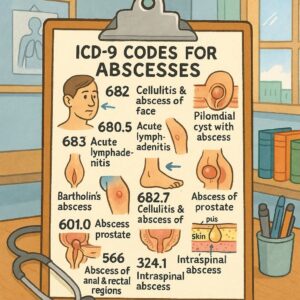
ICD-9 Codes for Abscess
Understanding ICD-9: A Legacy Coding System
First, let’s establish what ICD-9 is and why we still talk about it. The International Classification of Diseases, 9th Revision, Clinical Modification (ICD-9-CM) was the standard system used in the United States to classify and code all diagnoses, symptoms, and procedures from 1979 to 2015.
Dr. Eleanor Vance, Medical Historian, notes: “ICD-9 was a workhorse of medical administration for over three decades. While it served its purpose, its limited code structure couldn’t keep pace with modern medical specificity, leading directly to the adoption of ICD-10.”
The system used 3-5 digit codes. The first three digits represent the core category of the disease or condition. A fourth or fifth digit adds specificity regarding location, severity, or other clinical details. For abscesses, this specificity was often related to the anatomical site.
Important Note for Readers: If you are coding for a current patient encounter, a billable service, or any active healthcare record, you must use ICD-10-CM codes. Using an ICD-9 code for a current service will result in a claim rejection. This article is for historical reference, educational purposes, or handling pre-2015 records.
The Structure of Abscess Codes in ICD-9
In ICD-9, abscesses were primarily found in two chapters:
-
Chapter 1: Infectious and Parasitic Diseases (001-139): This is where systemic infections or abscesses with a specified bacterial cause were often coded, such as those linked to tuberculosis or actinomycosis.
-
Chapter 12: Diseases of the Skin and Subcutaneous Tissue (680-709): This chapter contained the most frequently used codes for localized skin and subcutaneous abscesses, boils, and carbuncles.
The lack of a single “abscess” code highlights a key limitation of ICD-9. Coders had to first identify the precise location and sometimes the causative organism to select the correct code.
Key ICD-9 Code Categories for Abscesses
Here is a breakdown of the primary ICD-9 code categories relevant to abscesses:
-
682: Other cellulitis and abscess: This was the most common category for abscesses. The fourth digit specified the site.
-
680: Carbuncle and furuncle: Used for specific types of skin abscesses (boils and carbuncles).
-
324: Intracranial abscess: For abscesses within the cranium.
-
510: Empyema: For abscesses (pus) in a body cavity, particularly the pleural space.
-
567: Peritonitis and peritoneal abscess: For abscesses within the abdominal cavity.
-
566: Abscess of anal and rectal regions: Specific to the anus and rectum.
-
685: Pilonidal cyst: For cysts and abscesses in the pilonidal region (near the tailbone).
Detailed ICD-9 Codes by Anatomical Site
To find the correct ICD-9 code, you needed to know the exact location. The following table provides a clear reference for common abscess sites.
Common ICD-9 Codes for Abscess by Location
| Anatomical Site | ICD-9 Code | Code Description & Notes |
|---|---|---|
| Face | 682.0 | Cellulitis and abscess of face. Includes cheek, nose, chin, but excludes ear, eyelid, lip, mouth, and orbit. |
| Neck | 682.1 | Cellulitis and abscess of neck. |
| Trunk | 682.2 | Cellulitis and abscess of trunk. Includes abdominal wall, back, chest wall, groin, and umbilicus. Pilonidal cyst (685) is coded separately. |
| Upper Arm & Forearm | 682.3 | Cellulitis and abscess of upper arm and forearm. |
| Hand (except fingers/thumb) | 682.4 | Cellulitis and abscess of hand, except fingers and thumb. |
| Buttock | 682.5 | Cellulitis and abscess of buttock. A very common site for intramuscular injections. |
| Leg (except foot) | 682.6 | Cellulitis and abscess of leg, except foot. Includes thigh, calf, and knee. |
| Foot (except toes) | 682.7 | Cellulitis and abscess of foot, except toes. |
| Other Specified Sites | 682.8 | Includes head [any part, except face], scalp, and axilla (armpit). |
| Unspecified Site | 682.9 | Cellulitis and abscess of unspecified site. Used only when documentation lacks detail. |
| Finger & Toe | 681.xx | Not in 682 category. Code 681 is for “Other infections of skin and subcutaneous tissue.” 681.0 for finger, 681.1 for toe. |
| Pilonidal Cyst/Abscess | 685.0 | Pilonidal cyst with abscess. A distinct diagnosis often requiring surgical intervention. |
| Dental Abscess | 522.5 | Periapical abscess (at the root tip). 522.7 is for periodontal abscess. |
| Peritonsillar Abscess | 475 | Peritonsillar abscess, also known as quinsy. |
| Breast Abscess | 611.0 | Inflammatory disease of the breast, includes abscess. Non-obstetric (e.g., 675.1 for obstetric). |
| Appendiceal Abscess | 540.1 | Acute appendicitis with peritoneal abscess. |
Specific Types of Abscesses and Their Codes
Some abscesses were defined by their cause or unique presentation, requiring codes outside the 682 series.
-
Carbuncle and Furuncle (680.x): A furuncle (boil) is a deep infection of a hair follicle. A carbuncle is a cluster of furuncles. The fourth digit specified location (e.g., 680.0 for face, 680.2 for trunk).
-
Intracranial Abscess (324.x): A serious condition requiring immediate attention.
-
324.0: Intracranial abscess
-
324.1: Intraspinal abscess
-
324.9: Of unspecified site
-
-
Intra-abdominal Abscess (567.x): For abscesses within the peritoneal cavity or pelvic region.
-
567.2: Peritoneal abscess, generalized
-
567.3: Retroperitoneal abscess
-
567.8: Other specified peritonitis (often used for localized abscess)
-
-
Abscess of Anal and Rectal Regions (566):
-
566: Abscess of anal and rectal regions (e.g., ischiorectal, perianal)
-
The Critical Transition: From ICD-9 to ICD-10-CM
This is the most important practical takeaway. On October 1, 2015, the U.S. mandated the use of ICD-10-CM. The change was monumental, expanding the number of diagnosis codes from approximately 14,000 in ICD-9 to over 68,000 in ICD-10.
Why does this matter for coding an abscess? ICD-10 requires immense detail. Let’s compare how you would code a simple skin abscess in both systems.
ICD-9 vs. ICD-10 Coding for a Skin Abscess
| Aspect | ICD-9-CM | ICD-10-CM |
|---|---|---|
| Code for a leg abscess | 682.6 (Cellulitis and abscess of leg) | L02.415 (Furuncle of right lower limb) OR L02.416 (Furuncle of left lower limb) OR L03.115 (Cellulitis of right lower limb) OR L03.116 (Cellulitis of left lower limb). |
| Specificity Required | Very little. Just the general site (leg). | Laterality (right or left), precise site (thigh, calf, foot), and often the type of infection (furuncle/carbuncle vs. cellulitis/abscess). |
| Number of Possible Codes | One primary code for the site. | Dozens of possible combinations for the same condition. |
As you can see, ICD-10 demands precision. The code L02.415 breaks down as:
-
L02: Category for furuncle and carbuncle.
-
.4: Site lower limb.
-
.15: Specific location (right lower limb).
Best Practices for Handling ICD-9 Codes Today
You might need to reference ICD-9 codes for several valid reasons. Here’s how to approach it correctly:
-
For Historical Records: When analyzing, auditing, or researching patient records from before October 2015, use the ICD-9 codes as they were originally assigned. Do not “translate” them to ICD-10 retroactively.
-
For Educational Purposes: Understanding ICD-9 provides context for the evolution of medical classification and helps in interpreting older medical literature.
-
For Current Coding (The Golden Rule): Always use ICD-10-CM. Rely on current coding manuals, encoder software, and the CMS code lookup tool to find the appropriate, detailed ICD-10 code. Never submit an ICD-9 code for a current service date.
Helpful List: Steps to Code an Abscess in the Modern Era (ICD-10)
-
Identify the Site: Be as specific as possible (e.g., right submandibular region, left gluteal region, perianal).
-
Determine Laterality: Is it right, left, bilateral, or unspecified?
-
Identify the Type: Is it a furuncle (L02), carbuncle (L02), cellulitis with abscess (L03), or a postoperative infection (T81.4)?
-
Check for Causative Organism: If a specific bacterium is identified (e.g., MRSA), an additional code from B95-B97 may be required.
-
Use an Encoder or Codebook: Verify your code in an official ICD-10-CM codebook or trusted digital encoder to ensure accuracy.
Common Coding Challenges and Pitfalls
Even with ICD-9, coders faced challenges that persist in different forms today.
-
Lack of Specificity in Documentation: A physician note that simply states “abscess” without a location would force the use of an unspecified code (682.9), which was often insufficient for billing and poor for data quality.
-
Differentiating Cellulitis vs. Abscess: In ICD-9, codes 682.x covered both “cellulitis and abscess.” The coder had to rely on the documentation to know which was primary. ICD-10 often separates these.
-
Postprocedural Abscess: An abscess forming after surgery was not coded to the site in ICD-9. The primary code was 998.59 (Other postoperative infection), with an additional code for the abscess site (e.g., 682.2) if desired. ICD-10 has a more structured approach with the T81.4 series.
A veteran medical coder advises: “The cardinal sin in coding, whether in ICD-9 or ICD-10, is guessing. If the documentation isn’t clear, query the provider. Accurate coding starts with precise clinical language.”
Conclusion
While the search for an “ICD-9 code for abscess” leads to specific historical codes like the 682 series, the modern healthcare landscape operates entirely on the detailed and specific ICD-10-CM system. Understanding ICD-9 is valuable for context and handling legacy data, but proficiency in ICD-10 is non-negotiable for accurate, compliant, and effective contemporary medical practice. Always ensure your coding resources and practices are up-to-date.
FAQ: ICD-9 Codes for Abscess
Q: Can I still use ICD-9 codes for billing?
A: No. As of October 1, 2015, all HIPAA-covered entities in the U.S. must use ICD-10-CM for diagnosis coding on claims. Using ICD-9 will result in denial.
Q: What is the most general ICD-9 code for an abscess?
A: 682.9, “Cellulitis and abscess of unspecified site,” was the most general code. However, its use was discouraged due to lack of specificity.
Q: How do I convert an old ICD-9 code to ICD-10?
A: There is no simple 1-to-1 conversion. You must code the current condition based on the provider’s detailed documentation using the ICD-10-CM code set and its rules. The CDC and CMS offer general equivalency mapping (GEM) files for reference, but they are not to be used for direct coding.
Q: Was there a separate ICD-9 code for an abscess with MRSA?
A: No, ICD-9 did not have a mechanism to integrate the causative organism directly into the abscess code. MRSA (041.12) would be listed as a secondary code. In ICD-10, a code from B95.6 (MRSA) can be added to provide that critical detail.
Q: Why is ICD-10 better for coding abscesses?
A: ICD-10’s granularity (specifying right/left, precise anatomical site, and type of infection) leads to better patient care tracking, more accurate reimbursement for the complexity of care provided, and richer data for public health and research.
Additional Resource
For the official, current ICD-10-CM codes and guidelines, always refer to the Centers for Medicare & Medicaid Services (CMS) website or use an approved coding manual. You can start with the CDC’s ICD-10-CM browser tool: CDC ICD-10-CM Lookup (Note: This is a functional example. Please verify the current URL.)
Disclaimer: This article is for informational and educational purposes only. It is not a substitute for professional medical coding advice, official coding guidelines, or current code sets. Medical coding is complex and regulated; always consult the official ICD-10-CM guidelines and codebooks for billing and clinical documentation. The author and publisher are not responsible for errors or omissions, or for any outcomes related to the use of this information.
Date: January 07, 2026
Author: The WebMD Writing Team