Navigating the world of medical coding can feel like learning a new language. For professionals, students, or even curious patients reviewing old bills, understanding the legacy ICD-9 codes for common conditions like appendicitis is crucial. While the healthcare industry in the United States transitioned to ICD-10-CM on October 1, 2015, many older records, historical data analyses, and even some billing disputes still reference the previous system.
This comprehensive guide will demystify the ICD-9 code for appendicitis. We’ll explore not just the basic numbers, but their clinical meaning, the importance of specificity, and why accurate coding was—and remains—vital for patient care, hospital operations, and medical research. Consider this your one-stop, authoritative resource for everything related to appendicitis in the ICD-9 universe.
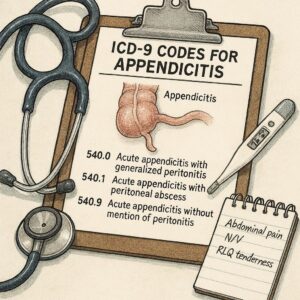
ICD-9 Codes for Appendicitis
Understanding ICD-9 and Its Historical Context
Before we dive into the specific codes, let’s establish what ICD-9 is and why it matters. The International Classification of Diseases, 9th Revision, Clinical Modification (ICD-9-CM) was the standard system used in the U.S. to classify and code all diagnoses, symptoms, and procedures. It served three core functions:
-
Billing and Reimbursement: Insurance companies used these codes to determine payment for services.
-
Epidemiological Tracking: Public health officials relied on coded data to track disease outbreaks, like appendicitis clusters, and study health trends.
-
Clinical Decision Support: Aggregated coded data helped inform treatment guidelines and hospital resource allocation.
As Dr. Helen Sharpe, a medical historian, notes: *”The shift from ICD-9 to ICD-10 wasn’t just an update; it was a paradigm shift in granularity. Where ICD-9 offered a handful of codes for a condition, ICD-10 provides dozens, capturing the nuance of modern medicine.”*
The codes for appendicitis in ICD-9 were housed within the broader range of 540-543, covering appendicitis and other diseases of the appendix. The specificity required for coding grew more detailed over the system’s lifetime.
The Core ICD-9 Codes for Appendicitis (540-542)
The diagnosis of appendicitis is not monolithic. A surgeon might find a simple, inflamed appendix or a ruptured one causing widespread infection. ICD-9 codes reflected these critical clinical differences, which had direct implications for patient care complexity, hospital stay length, and cost.
Here is the primary code set:
| ICD-9 Code | Code Description | Clinical Scenario & Notes |
|---|---|---|
| 540 | Acute appendicitis | The general code for inflammation of the appendix without mention of perforation, rupture, or abscess. |
| 540.0 | With generalized peritonitis | The appendix has ruptured, spreading infectious material throughout the peritoneal cavity. This is a surgical emergency with high morbidity. |
| 540.1 | With peritoneal abscess | The rupture is contained, forming a localized abscess. Treatment may involve drainage before or during surgery. |
| 540.9 | Without mention of peritonitis | Uncomplicated acute appendicitis. This is the most common presentation coded. |
| 541 | Appendicitis, unqualified | Used when the medical documentation simply states “appendicitis” without specifying acute or chronic. |
| 542 | Other appendicitis | A catch-all for types not covered above, most notably chronic or recurrent appendicitis. |
Important Note for Readers: If you are coding a current patient encounter or a bill after October 1, 2015, you must use ICD-10-CM codes. This guide is for historical understanding, archival research, or contextual education.
Deep Dive: Code 540.0 vs. 540.1
The distinction between these two fifth-digit subclassifications is a perfect example of how precise coding impacts everything. Let’s break it down:
-
540.0 (With generalized peritonitis): This indicates a “free rupture.” Contamination is widespread in the abdomen. The patient is typically much sicker, requiring more aggressive surgery (often a larger incision), longer antibiotic courses, extended ICU or hospital stays, and has a higher risk of complications. The resource use and cost are significantly higher.
-
540.1 (With peritoneal abscess): Here, the body’s immune system has successfully “walled off” the rupture. This containment changes the treatment plan. A surgeon might first perform a radiological-guided drainage of the abscess to stabilize the patient, followed by an interval appendectomy (removal of the appendix) weeks later. The coding reflects this different, often two-stage, pathway.
A seasoned medical coder, James Miller, explains: *”We lived by the documentation. If the surgeon’s note said ‘perforated appendix with purulent fluid throughout the abdomen,’ it was 540.0. If it said ‘noted a well-formed abscess in the right lower quadrant,’ it was 540.1. That single digit changed the DRG and the entire reimbursement case weight.”*
Why Specificity in Appendicitis Coding Was Critical
Choosing the correct fourth and fifth digit wasn’t just clerical work. It had real-world consequences:
-
Patient Care Coordination: Accurate coding within hospital systems helped flag complex cases for higher-level care management and follow-up.
-
Accurate Hospital Statistics: How many perforated appendicitis cases did a hospital treat? This data was vital for quality review and surgical department planning.
-
Fair Reimbursement: Hospitals incurred vastly different costs treating a simple appendicitis (540.9) versus a ruptured one with peritonitis (540.0). The ICD-9 code, paired with the procedure code, determined the Diagnosis-Related Group (DRG) and the justified payment.
-
Research Integrity: Studies on appendicitis outcomes relied on coded data. Misclassification between simple and complex cases could skew research results.
The Transition to ICD-10-CM: A New Era of Detail
The limitations of ICD-9—its lack of specificity and outdated terminology—drove the move to ICD-10-CM. For appendicitis, the code set expanded dramatically, allowing for unprecedented detail.
ICD-9 to ICD-10 Crosswalk for Appendicitis
This table shows the general mapping from the old system to the new, illustrating the increase in specificity.
| ICD-9 Code | ICD-9 Description | Approximate ICD-10-CM Code Equivalent | ICD-10-CM Description & Enhanced Specificity |
|---|---|---|---|
| 540.0 | Acute appendicitis with generalized peritonitis | K35.2 | Acute appendicitis with generalized peritonitis |
| 540.1 | Acute appendicitis with peritoneal abscess | K35.3 | Acute appendicitis with localized peritonitis |
| 540.9 | Acute appendicitis without peritonitis | K35.30 | Acute appendicitis without peritonitis |
| 541 | Appendicitis, unqualified | K37 | Unspecified appendicitis |
| 542 | Other appendicitis | K36 | Other appendicitis (e.g., chronic) |
Crucial Difference: ICD-10 offers laterality (right vs. left, though appendicitis is almost always right-sided) and even allows for coding the presence of gangrene (e.g., K35.2, K35.3). The most significant addition is the ability to code the specific type of peritonitis (localized vs. generalized) with more clinical accuracy.
Practical Scenarios: Applying ICD-9 Codes
Let’s walk through how a coder would have approached real chart documentation in the ICD-9 era.
Scenario 1: The Typical Case
-
Operative Note: “Pre-op diagnosis: Acute appendicitis. Findings: Inflamed, edematous appendix. No evidence of perforation or abscess. Procedure: Laparoscopic appendectomy.”
-
Correct ICD-9 Code: 540.9 (Acute appendicitis without mention of peritonitis).
Scenario 2: The Complex Case
-
Operative Note: “Pre-op diagnosis: Acute appendicitis. Findings: Perforated appendix at the base with a large, localized abscess containing approximately 50cc of pus. The mesentery was inflamed.”
-
Correct ICD-9 Code: 540.1 (Acute appendicitis with peritoneal abscess).
Scenario 3: The Ambiguous Document
-
Discharge Summary: “Patient admitted with abdominal pain, treated for appendicitis with antibiotics and laparoscopic surgery.”
-
Coding Challenge: The documentation is poor. It doesn’t specify “acute” or the intraoperative findings. The coder would need to query the physician. If no clarification was obtained, the default would be 541 (Appendicitis, unqualified).
Helpful Lists for Medical Coders and Students
-
Documents to Review for Accurate Coding:
-
Emergency Department Report
-
Surgeon’s History & Physical
-
Operative Report (THE most critical document)
-
Pathology Report (confirming the diagnosis)
-
Discharge Summary
-
-
Common Pitfalls to Avoid with ICD-9 Appendicitis Codes:
-
Assuming all appendicitis is 540.9.
-
Confusing “peritonitis” (540.0) with “abscess” (540.1).
-
Using code 542 for acute cases; it was primarily for “other” types like chronic.
-
Forgetting that the fifth digit (0,1,9) is mandatory for code 540.
-
Conclusion
Understanding the ICD-9 code for appendicitis—from the general 540 to the specific 540.0 and 540.1—provides insight into the critical link between clinical medicine, administrative data, and healthcare economics. While this system has been replaced by the more robust ICD-10-CM, its codes remain embedded in millions of historical records. Mastery of this concept underscores a fundamental truth in healthcare: precise language and meticulous documentation are the bedrock of quality care, accurate analysis, and a functioning medical system. Whether you’re reconciling an old bill or studying medical history, you now hold the key to deciphering this important piece of diagnostic information.
Frequently Asked Questions (FAQ)
Q: What is the most common ICD-9 code for appendicitis?
A: The most commonly used code was 540.9 (Acute appendicitis without mention of peritonitis), representing the typical, uncomplicated case.
Q: Can I still use ICD-9 codes for billing today?
A: No. As of October 1, 2015, all HIPAA-covered entities in the United States must use ICD-10-CM codes for diagnosis coding. Using ICD-9 will result in claim rejection.
Q: What ICD-9 code was used for a ruptured appendix?
A: A “ruptured” or “perforated” appendix was typically coded as either 540.0 (if it caused generalized peritonitis) or 540.1 (if it formed a localized abscess). The specific code depended on the surgeon’s documented findings.
Q: Was there an ICD-9 code for chronic appendicitis?
A: Yes, cases described as chronic or recurrent appendicitis were generally classified under 542 (Other appendicitis).
Q: Where can I find the official ICD-9 code set?
A: The CDC maintains an archive of the official ICD-9-CM guidelines and code tables. You can access it here: CDC ICD-9-CM Archive.
Additional Resource
For the most current coding information, always refer to the official ICD-10-CM guidelines and code sets maintained by the Centers for Medicare & Medicaid Services (CMS) and the National Center for Health Statistics (NCHS). You can find the complete ICD-10-CM codes, including the current codes for appendicitis (K35-), here: CMS ICD-10 Code Sets.
Disclaimer: This article is for educational and informational purposes only. It is based on historical coding guidelines and does not constitute medical or coding advice. For current diagnosis coding, always use the official ICD-10-CM code set and consult with a certified professional coder or current coding resources.
Date: January 06, 2026
Author: The WebMD Coders Team