If you’ve ever dealt with medical billing, insurance claims, or your own health records, you’ve likely encountered the term “ICD-9 code.” For millions who experience back pain, these cryptic numbers are more than just administrative jargon—they are the key to accurate medical records, proper insurance reimbursement, and understanding your own diagnosis. This guide will demystify the ICD-9 coding system specifically for back pain, providing you with a comprehensive, reliable resource.
Even though the healthcare system in the United States transitioned to ICD-10 in October 2015, understanding ICD-9 codes remains crucial. Many historical patient records are still coded in ICD-9, and a solid grasp of the old system illuminates the logic and increased specificity of the new one. Whether you’re a patient reviewing an old bill, a medical student, or a professional needing a historical reference, this article is your essential guide.
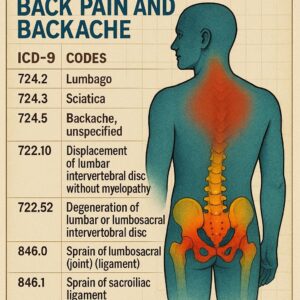
ICD-9 Codes for Back Pain or Backache
What is the ICD-9 Coding System?
The International Classification of Diseases, 9th Revision, Clinical Modification (ICD-9-CM) was the standard system used for over three decades in the U.S. to classify and code all diagnoses, symptoms, and procedures. Think of it as a universal medical shorthand. Its primary purposes were:
-
Standardization: Ensuring all healthcare providers use the same language for diseases.
-
Billing and Reimbursement: Insurance companies use these codes to determine what they will pay for.
-
Epidemiology and Research: Tracking the incidence and prevalence of diseases across populations.
For back pain, one of the most common human ailments, having the correct ICD-9 code was vital. An inaccurate code could lead to claim denials, skewed health data, and an incomplete picture of a patient’s medical history.
The Specific ICD-9 Code for General Back Pain
When a healthcare provider diagnosed a patient with non-specific back pain—meaning the pain wasn’t immediately attributed to a diagnosed herniated disc, spinal stenosis, or other definitive condition—they typically used one primary code.
The most general and commonly used ICD-9 code for backache was 724.5 – Backache, unspecified.
This code acted as a broad category. It was the starting point for coding back pain when a more precise diagnosis wasn’t established or documented. However, the 724 series (Other and unspecified disorders of the back) contained several more specific codes that providers were encouraged to use whenever possible.
Breakdown of Key ICD-9 Codes in the 724 Series
The following table outlines the primary ICD-9 codes related to back pain, moving from general to more specific.
| ICD-9 Code | Code Description | Clinical Context & Notes |
|---|---|---|
| 724.5 | Backache, unspecified | The “catch-all” code for generalized back pain without a specified cause. Often used for initial visits or when detailed imaging/assessment is pending. |
| 724.2 | Lumbago | An older, synonymous term for pain in the lumbar (lower back) region. In practice, it was often used interchangeably with 724.5. |
| 724.1 | Pain in thoracic spine | Specifically for pain in the upper and mid-back (the thoracic region). Less common than low back pain. |
| 724.3 | Sciatica | Used for pain radiating down the leg along the sciatic nerve pathway, indicating likely nerve root involvement. |
| 724.6 | Disorders of the sacrum | For pain localized to the sacral region (the triangular bone at the base of the spine). |
| 724.8 | Other symptoms referable to back | A miscellaneous category for other back-related symptoms not captured elsewhere. |
| 724.9 | Other unspecified back disorders | A very non-specific code used when no other code was applicable. |
Important Note for Readers: The use of unspecified codes (like 724.5 and 724.9) was sometimes necessary, but it often led to insurance scrutiny. Best practices encouraged using the most specific code supported by the physician’s documentation. For example, if the doctor noted “low back pain with radiation to the right leg,” the more appropriate code would have been 724.3 (Sciatica) or a code for a specific disc disorder, not the generic 724.5.
Why Specificity in Coding Matters (Beyond the Obvious Code)
While 724.5 was the direct answer to “what is the ICD-9 code for back pain?”, the real-world application was far more nuanced. Back pain is a symptom, not a disease. The ICD-9 system allowed—and providers were urged—to code the underlying cause if it was known.
This means a patient’s back pain might have been coded elsewhere in the ICD-9 manual, leading to more accurate treatment and billing. Consider these common scenarios:
-
Pain from a Herniated Disc: A patient with low back pain and leg numbness caused by a herniated lumbar disc would not be coded as 724.5. Instead, they would receive a code from the 722 series (Intervertebral disc disorders), such as 722.10 (Displacement of lumbar intervertebral disc without myelopathy).
-
Pain from Spinal Arthritis (Spondylosis): Degenerative arthritis of the spine would be coded from the 721 series (Spondylosis and allied disorders), e.g., 721.3 (Lumbosacral spondylosis without myelopathy).
-
Pain from an Injury: Back pain resulting from a recent fall or trauma would be coded from the 846-847 series (Sprains and strains of sacroiliac region and other back muscles). For example, 847.2 (Lumbar sprain).
The journey from symptom to precise code looked like this:
Patient Complaint: “My lower back hurts.”
Physician Assessment: Exam, history, possibly an MRI.
Specific Diagnosis: “Lumbar spinal stenosis with neurogenic claudication.”
ICD-9 Code: 724.02 (Spinal stenosis of lumbar region).
The critical takeaway: “Backache, unspecified (724.5)” was often a temporary or default code. The goal of medical coding was always to arrive at the most precise diagnosis and its corresponding code.
The Transition from ICD-9 to ICD-10: A Quantum Leap in Specificity
On October 1, 2015, the U.S. healthcare system mandated a shift from ICD-9-CM to ICD-10-CM. This was not a simple update; it was a massive expansion designed to capture vastly more clinical detail.
ICD-9: Approximately 13,000 codes.
ICD-10: Approximately 68,000 codes.
For back pain, this meant the end of vague codes like 724.5. In ICD-10, providers must specify details that were previously unrecorded in the code itself.
Comparing the Old and New: ICD-9 vs. ICD-10 for Back Pain
| Coding Aspect | ICD-9-CM (Old System) | ICD-10-CM (Current System) |
|---|---|---|
| General Low Back Pain | 724.2 (Lumbago) or 724.5 (Backache) | M54.50 (Low back pain, unspecified) |
| Specificity | Low. Few codes for location or etiology. | Extremely High. Requires laterality, acuity, and often precise cause. |
| Laterality | Rarely specified. | Almost always required (e.g., right, left, bilateral). |
| Example of a Specific Code | 724.3 (Sciatica) | M54.31 (Sciatica, right side) M54.32 (Sciatica, left side) M54.41 (Lumbago with sciatica, right side) |
| Chapter Focus | Primarily in Chapter 13 (Musculoskeletal). | More detailed organization within Chapter 13 (M codes). |
As you can see, the generic ICD-9 code 724.5 translates most directly to a family of codes in ICD-10 starting with M54.5- (Low back pain), but even the “unspecified” code in ICD-10 is more descriptive.
Practical Implications for Patients and Professionals
For Patients Understanding Old Records or Bills
If you are reviewing an old medical bill or record and see ICD-9 code 724.5, it simply means your doctor diagnosed you with generalized back pain at that time. It does not indicate the severity or cause. To better understand your history, look at the physician’s notes associated with that visit, which may describe the suspected cause (e.g., muscle strain, degenerative changes).
For Medical Coders and Historians
When dealing with records pre-dating October 2015, familiarity with the 724 series is essential. Remember that coding guidelines emphasized moving from unspecified (724.5) to specified codes (e.g., 722.10, 721.3, 847.2) as more clinical information became available. Accurate historical analysis depends on understanding this hierarchy.
The Importance of Documentation
Then and now, the golden rule is: The code must reflect the documentation. A physician’s detailed note is what allows a coder to move from a non-specific backache code to a precise one. This linkage between clinical care and administrative data is the backbone of effective healthcare operations.
Conclusion
The ICD-9 code 724.5 served as the primary identifier for unspecified backache for a generation, acting as a crucial, if broad, tool for medical classification and billing. However, its true context lies within a larger system that valued increasing specificity, guiding providers from a general symptom to a precise diagnosis. The transition to ICD-10 has rendered ICD-9 obsolete for current billing, but understanding it remains key to interpreting decades of medical data and appreciating the evolution of medical coding toward greater detail and accuracy in patient care.
Frequently Asked Questions (FAQ)
Q: I have an old medical bill with ICD-9 code 724.5. What does that mean?
A: It means your provider billed for a visit primarily related to back pain where a more specific cause (like a herniated disc or spinal stenosis) was not diagnosed or documented at that time. It was the standard code for generalized backache.
Q: Are ICD-9 codes still used anywhere today?
A: For medical billing and official health records in the U.S., no. ICD-10 replaced ICD-9 as of October 1, 2015. However, they are still relevant for reviewing historical records, research on older data, and understanding coding evolution.
Q: What is the direct ICD-10 equivalent of ICD-9 code 724.5?
A: The closest equivalent is M54.50 (Low back pain, unspecified). However, ICD-10 offers many more specific alternatives based on location, laterality, and cause, so a direct 1-to-1 translation isn’t always perfect.
Q: Why did my doctor use a more specific code than 724.5 for my back pain?
A: This is good practice! If your doctor identified signs of sciatica, a specific disc problem, or an injury, using a more precise code (like 724.3 for sciatica or 847.2 for a lumbar sprain) creates a more accurate medical record and helps justify the medical necessity of treatments to insurance companies.
Q: Where can I find the official, complete list of old ICD-9 codes?
A: The U.S. Centers for Medicare & Medicaid Services (CMS) maintains an official archive. You can find the full ICD-9-CM manual via the CDC’s National Center for Health Statistics website or through major medical coding publishers.
Additional Resources
-
Centers for Disease Control and Prevention (CDC) – ICD-10-CM Official Guidelines: https://www.cdc.gov/nchs/icd/icd10cm.htm (While focused on ICD-10, this is the authoritative source for current coding practice and rationale).
-
American Medical Association (AMA) CPT & Coding Resources: Provides education and tools on the procedural coding that works alongside ICD diagnosis codes.
Disclaimer: This article is for informational and educational purposes only. It is not a substitute for professional medical coding advice, clinical guidance, or official coding manuals. Medical coding is complex and governed by official guidelines. For accurate coding, always consult the current ICD-10-CM official guidelines and rely on the documented physician diagnosis. For medical concerns, always consult a qualified healthcare provider.
Date: January 12, 2026
Author: The Web Health Writer Team