Navigating the world of medical coding can feel like learning a new language. For decades, the International Classification of Diseases, 9th Revision (ICD-9) was the primary lexicon used by healthcare providers, billers, and researchers in the United States to communicate diagnoses. While the healthcare industry has transitioned to ICD-10, understanding ICD-9 remains crucial for working with historical records, certain legacy systems, and older medical literature. This guide provides a thorough, original, and reliable reference for the ICD-9 coding of bacterial infections.
We’ll break down the system’s structure, explore key codes, and explain the logic behind accurate coding. Whether you’re a student, a medical professional reviewing old charts, or simply curious about how diagnoses were formally classified, this article will serve as your essential manual.
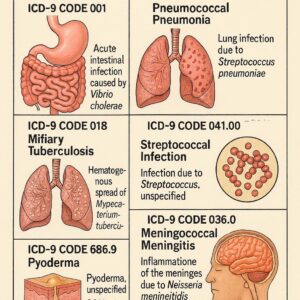
ICD-9 Codes for Bacterial Infections
Understanding the ICD-9 System: A Foundation
Before we dive into specific codes for bacteria, it’s vital to grasp how the ICD-9 manual is organized. Think of it not as a simple list, but as a detailed map of human disease.
The Core Structure:
The ICD-9-CM (Clinical Modification) used in the U.S. was divided into three volumes. For diagnosis coding, we primarily used Volumes 1 and 2.
-
Volume 1: The Tabular List. This is the numeric listing of codes divided into chapters based on etiology (cause) or body system. This is where you find the official codes and their descriptions.
-
Volume 2: The Alphabetic Index. This is your starting point. You look up a term like “pneumonia, bacterial” and it refers you to the correct numeric code(s) in Volume 1.
-
Volume 3: Procedures. This covered surgical and diagnostic procedures (for inpatient use).
A critical rule was always coding from the Tabular List after consulting the Index. The Index is a guide, but the Tabular List contains vital notes, inclusions, and exclusions that define the code’s proper use.
The Logic of the Code:
ICD-9 codes were 3 to 5 digits long. The first three digits represent the core category.
-
Example:
041is the category for “Bacterial infection in conditions classified elsewhere and of unspecified site.”
The fourth and fifth digits provide specificity regarding anatomy, severity, or other clinical details. -
Example:
041.0is for “Streptococcus,” while041.00is for “Streptococcus, unspecified.”
Where to Find Bacterial Infection Codes in ICD-9
Bacterial infections were not housed in a single chapter. They were scattered logically throughout the manual based on the site of the infection or the primary disease process. This is a key concept in ICD-9: location often drove the code.
Primary Chapters for Bacterial Infections:
-
Chapter 1: Infectious and Parasitic Diseases (Codes 001-139): This was the home for systemic infections and those not confined to a single organ system. Here you’d find codes for tuberculosis (
010-018), sepsis (038), and “Bacterial infection in conditions classified elsewhere” (041). -
Body System Chapters: Infections specific to an organ were coded in the chapter for that system.
-
Pneumonia? See Chapter 8: Diseases of the Respiratory System (460-519). Code
481for pneumococcal pneumonia. -
Cystitis (bladder infection)? See Chapter 10: Diseases of the Genitourinary System (580-629). Code
595.0for acute cystitis. -
Cellulitis of the skin? See Chapter 12: Diseases of the Skin and Subcutaneous Tissue (680-709). Code
682.9for cellulitis of unspecified site.
-
Key ICD-9 Code Categories for Common Bacterial Pathogens
The 041 category was uniquely important. It was used as a secondary code to specify the bacterium when the primary code described the condition’s site. It was never used alone to simply state “has a staph infection.”
Common Codes in Category 041:
-
041.0– Streptococcus -
041.1– Staphylococcus -
041.2– Pneumococcus (Streptococcus pneumoniae) -
041.3– Klebsiella pneumoniae -
041.4– Escherichia coli [E. coli] -
041.5– Haemophilus influenzae -
041.6– Pseudomonas -
041.7– Meningococcus -
041.8– Other specified bacterial infections (e.g.,041.83for Clostridium difficile) -
041.9– Bacterial infection, unspecified
Coding Principle: “The code
041is supplemental. Its primary purpose is to provide etiological specificity to a condition that is already classified by site. Always lead with the code for the manifestation.” – This reflects standard ICD-9 coding guidance.
Practical Coding Scenarios: From Diagnosis to Code
Let’s walk through real-world examples to see how this logic was applied.
Scenario 1: Streptococcal Pharyngitis (Strep Throat)
-
Diagnosis: Strep throat.
-
Alphabetic Index Lookup: “Pharyngitis, streptococcal” directs you to
034.0. -
Tabular List Verification: Code
034.0is “Streptococcal sore throat” under “Other streptococcal diseases and scarlet fever.” This is a complete code. You would not add041.0because the organism is already specified in the primary code (034.0).
Scenario 2: Escherichia coli Urinary Tract Infection
-
Diagnosis: UTI due to E. coli.
-
Alphabetic Index Lookup: “Infection, urinary (tract) NEC” directs you to
599.0. -
Tabular List Verification: Code
599.0is “Urinary tract infection, site not specified.” -
Adding Specificity: To specify the bacterium, you would add a secondary code from
041. In this case,041.4for E. coli. -
Final Code Pair:
599.0(Primary) +041.4(Secondary)
Scenario 3: Postoperative Staphylococcal Wound Infection
-
Diagnosis: Infection of abdominal surgical incision due to Staphylococcus aureus.
-
Alphabetic Index Lookup: “Infection, wound, postoperative” directs you to
998.59(Other postoperative infection). -
Tabular List Verification: Code
998.59is appropriate. -
Adding Specificity: Add
041.11for Staphylococcus aureus as a secondary code. -
Final Code Pair:
998.59+041.11
Comparative Table: ICD-9 vs. ICD-10 for Bacterial Infections
| Feature | ICD-9-CM | ICD-10-CM |
|---|---|---|
| Code Format | 3-5 digits, mostly numeric | 3-7 characters, alphanumeric |
| Specificity | Limited. Often lacked detail on laterality, severity, or etiology within a single code. | High. Captures laterality (left/right), etiology, severity, and other clinical details integrally. |
| Sepsis Coding | Single code for sepsis (038.xx) based on organism. Severity and organ dysfunction less clearly defined. |
Requires multiple codes: a code for the underlying infection (e.g., A41.9 for sepsis), plus codes for acute organ dysfunction (R65.2- for severe sepsis). |
| Example: Pneumococcal Pneumonia | 481 (Lobar pneumonia, pneumococcal) – one code. |
J13 (Pneumonia due to Streptococcus pneumoniae) – more direct etiology linkage. |
| Volume | ~13,000 codes | ~68,000 codes |
Critical Notes on Specific Conditions
Sepsis (038.x): This was a major category. The fourth digit specified the organism: .0 for staphylococcal, .1 for pneumococcal, .4 for E. coli, etc. Sepsis was often under-coded in ICD-9, with providers using the infection site code (like 599.0 for UTI) without adding the sepsis code when it was present.
“Unspecified” Codes: Codes like 041.9 (Bacterial infection, unspecified) or 682.9 (Cellulitis, unspecified site) were necessary when documentation lacked detail. However, their overuse was discouraged as it hindered data quality.
The Importance of Documentation: The golden rule was: If it isn’t documented, it can’t be coded. The physician’s note was the source of all truth for the coder. Phrases like “likely bacterial” would only support an “unspecified” code, not a specific organism.
Important Note for Readers: This article is a historical and educational guide. All medical coding for healthcare transactions in the U.S. after October 1, 2015, must use ICD-10-CM. Always consult current, official coding manuals and guidelines for active practice.
The Transition to ICD-10 and Why It Matters
The move from ICD-9 to ICD-10 on October 1, 2015, was not just an update; it was a revolution in healthcare data. ICD-9, developed in the 1970s, was outdated. It ran out of space for new diseases, lacked clinical detail, and provided poor data for modern healthcare analytics.
Key Improvements in ICD-10 for Bacterial Infections:
-
Laterality: Codes specify right, left, or bilateral.
-
Combination Codes: A single code can now describe both the disease and its cause (e.g.,
A41.01for Sepsis due to Methicillin susceptible Staphylococcus aureus). -
Severity and Specificity: Distinctions for initial encounters, subsequent encounters, and sequelae are built-in.
-
Detailed Anatomy: Much finer anatomical sites are available.
Example of Enhanced Detail:
-
ICD-9:
682.6– Cellulitis of leg, unspecified. -
ICD-10:
L03.115– Cellulitis of right lower limb. This is still broad, but you can get more specific with additional codes for the organism if known.
Conclusion
Understanding the ICD-9 coding system for bacterial infections requires appreciating its structure, where the site of infection often took precedence, and how supplemental codes like those in category 041 added crucial etiological detail. While now a legacy system, ICD-9 knowledge is invaluable for interpreting decades of medical data. The transition to ICD-10 addressed its limitations, providing the granularity needed for today’s complex healthcare, reimbursement, and research landscapes.
Frequently Asked Questions (FAQ)
Q: Can I still use ICD-9 codes for billing today?
A: No. As of October 1, 2015, all HIPAA-covered entities in the U.S. must use ICD-10-CM for diagnosis coding on claims. Using ICD-9 will result in claim denial.
Q: I have an old medical record with just an ICD-9 code. How do I find out what it means?
A: Use a reliable, archived ICD-9 reference (like the PDFs available from the CDC’s website). Look up the code in the Tabular List. Remember that a 3-digit code may represent a broad category, and you may need to see the full 5-digit code for precision.
Q: Why was the code 041.9 (unspecified bacterial infection) used so often?
A: It was commonly used when a physician diagnosed a bacterial infection (e.g., based on clinical presentation or gram stain) but did not order a culture to identify the specific organism, or the culture results were pending/negative. Coding reflects documentation.
Q: Is there a direct crosswalk from ICD-9 to ICD-10?
A: Not a simple one-to-one conversion. The systems are structurally different. While general equivalence mappings (GEMs) exist, they are complex guides. Translating a code often requires clinical knowledge of the case to choose the correct, more specific ICD-10 code.
Q: Where can I find the official ICD-10 guidelines now?
A: The Centers for Medicare & Medicaid Services (CMS) and the National Center for Health Statistics (NCHS) publish the official ICD-10-CM guidelines annually. These are the definitive source for current coding rules.
Additional Resources
For those interested in exploring official source documents and current guidelines, please visit:
-
The CDC’s ICD-9-CM Archive Page: Provides access to historical files and manuals.
-
The CMS ICD-10-CM Official Guidelines: The essential rulebook for current diagnosis coding.
Disclaimer: This article, authored on January 09, 2026, is intended for educational and historical reference purposes only. It does not constitute medical or coding advice. For actual medical coding, always refer to the most current, official ICD-10-CM guidelines and code sets published by U.S. government agencies. The examples provided are illustrative and based on the structure and logic of the legacy ICD-9 system.