Navigating the world of medical billing and coding can feel like learning a foreign language. If you’re a healthcare provider, medical coder, biller, or even a curious patient trying to understand an old document, you might be searching for the ICD-9 code for blurred vision. While the healthcare industry has transitioned to a newer system, understanding ICD-9 remains crucial for historical records and specific billing contexts.
This guide is designed to be your definitive, one-stop resource. We’ll demystify the ICD-9 coding system, pinpoint the exact codes for blurred vision and related symptoms, and explain the critical importance of proper coding. Our goal is to provide you with clear, accurate, and actionable information that bridges the gap between clinical observation and administrative accuracy.
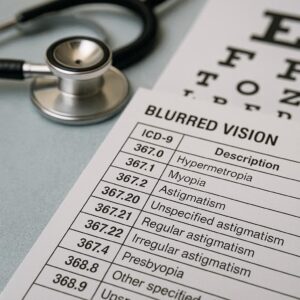
ICD-9 Codes for Blurred Vision
What is the ICD-9 Coding System?
Before we dive into the specific code, let’s establish a foundational understanding.
ICD-9 stands for the International Classification of Diseases, 9th Revision, Clinical Modification. It was a standardized system used by healthcare providers and facilities in the United States to classify and code all diagnoses, symptoms, and procedures. Think of it as a universal dictionary that translates medical descriptions into specific alphanumeric codes. This system served several vital functions:
-
Billing and Reimbursement: Insurance companies (payers) used these codes to determine what they would pay for a patient’s care.
-
Tracking Health Statistics: Public health organizations used aggregated code data to track disease outbreaks, mortality rates, and the prevalence of conditions.
-
Clinical Documentation: Codes provided a shorthand for communicating a patient’s condition in their medical record.
It’s essential to note that as of October 1, 2015, the U.S. healthcare system officially transitioned to ICD-10-CM (for diagnoses) and ICD-10-PCS (for procedures). ICD-10 is vastly more detailed and specific. However, ICD-9 codes are still relevant for:
-
Processing older medical records or claims.
-
Certain research involving historical data.
-
Understanding the coding framework that shaped modern practices.
The Specific ICD-9 Code for Blurred Vision
The direct answer to your search is that the most common and general ICD-9 code for blurred vision is:
368.8 – Other specified disorders of vision
This code is found in Chapter 6 of ICD-9-CM, which covers “Diseases of the Nervous System and Sense Organs,” more specifically under category 368, “Visual disturbances.”
Why 368.8 and Not a More Specific Code?
In the ICD-9 system, blurred vision was often categorized as a symptom rather than a disease itself. Code 368.8 served as a catch-all for visual disturbances that didn’t have a more precise code. The descriptor “Other specified disorders” includes symptoms like:
-
Blurred vision (blurring)
-
Generalized visual disturbance
-
Sudden visual loss (if not otherwise specified)
This lack of specificity was a known limitation of ICD-9 and was a primary driver for the move to ICD-10, where “blurred vision” has its own dedicated code.
Important Context and Related ICD-9 Codes
Blurred vision is rarely an isolated finding. It is typically a symptom of an underlying condition. Therefore, proper coding in the ICD-9 era often involved using multiple codes or selecting a code for the root cause. The choice of code depended heavily on the clinician’s documentation.
Common Underlying Conditions and Their ICD-9 Codes
Here is a comparative table of conditions that frequently present with blurred vision and their corresponding ICD-9 codes.
| Underlying Condition | ICD-9 Code | ICD-9 Description | Notes |
|---|---|---|---|
| Refractive Errors | 367.xx | Refractive errors | A common, often non-pathological cause. |
| 367.1 | Myopia (nearsightedness) | ||
| 367.4 | Presbyopia (age-related farsightedness) | ||
| Cataracts | 366.xx | Cataract | Clouding of the eye’s lens, a leading cause of vision impairment. |
| 366.12 | Senile cataract, nuclear sclerosis | ||
| Diabetic Retinopathy | 250.5x | Diabetes with ophthalmic manifestations | A serious complication of diabetes. The 5th digit specifies type and control of diabetes. |
| 362.01 | Background diabetic retinopathy | Often used in conjunction with a 250.5x code. | |
| Glaucoma | 365.xx | Glaucoma | Increased intraocular pressure damaging the optic nerve. |
| 365.11 | Primary open-angle glaucoma | ||
| Macular Degeneration | 362.5x | Degeneration of macula and posterior pole | |
| 362.50 | Macular degeneration (senile), unspecified | ||
| Migraine with Aura | 346.0x | Migraine with aura | Blurred vision can be part of the visual aura. |
| Conjunctivitis (Pink Eye) | 372.xx | Disorders of conjunctiva | Can cause blurred vision due to discharge. |
| Dry Eye Syndrome | 375.15 | Tear film insufficiency, unspecified | Poor tear quality can lead to intermittent blurring. |
Comparison: ICD-9 vs. ICD-10 for Blurred Vision
This table highlights the significant increase in specificity between the two systems.
| Feature | ICD-9-CM | ICD-10-CM |
|---|---|---|
| Primary Code for Symptom | 368.8 – Other specified disorders of vision | H53.8 – Other visual disturbances |
| Specific Code for Blurred Vision | Not available; included under 368.8 | H53.8X – Other visual disturbances H53.8X9 – Other visual disturbances, unspecified eye Note: There is no single “blurred vision” code, but it falls under this category with greater detail. |
| Specificity | Low. One code covered many vague visual symptoms. | High. Laterality (left, right, bilateral) and encounter type (initial, subsequent) must be specified. |
| Number of Codes | ~13,000 | ~68,000 |
| Example for Diabetic Blurred Vision | 250.50 (Diabetes II with ophthalmic manif, uncontr) + 368.8 | E11.319 (Type 2 diabetes with unspecified diabetic retinopathy without macular edema) + H53.8X9 (Other visual disturbances, unspecified eye) |
Important Note from a Coding Expert: “In ICD-9, the mantra was often ‘code to the highest specificity.’ For blurred vision, if the provider did not document a definitive cause, 368.8 was appropriate. However, if the cause was known—like uncontrolled diabetes—the diabetes code with the ophthalmic manifestation took precedence as the primary diagnosis. The blurred vision code might be added as a secondary code if it was a focus of treatment.”
How to Properly Use the ICD-9 Code for Blurred Vision
Using the correct code was a multi-step process based on the medical record.
-
Review the Clinical Documentation: The coder would first read the physician’s or clinician’s notes from the patient encounter.
-
Identify the Principal Diagnosis: Determine the main reason for the visit. Was the visit specifically for the complaint of blurred vision? Or was blurred vision noted during a visit for diabetes management?
-
Apply Coding Guidelines: Follow official ICD-9-CM coding conventions, including:
-
The Alphabetic Index: Look up “Blurring, vision” to be directed to code 368.8.
-
The Tabular List: Verify the code in the numerical list to ensure it’s the best choice and check for any instructional notes (e.g., “code first underlying disease”).
-
-
Sequence the Codes: List the most significant diagnosis code first (primary), followed by additional codes for co-existing conditions or other symptoms.
A Practical Coding Scenario (Historical)
-
Patient Presentation: A 65-year-old patient presents complaining of gradually worsening, painless blurred vision in both eyes over the past year. The ophthalmologist documents a diagnosis of “bilateral senile nuclear cataracts.”
-
ICD-9 Coding: The coder would not use 368.8 for blurred vision. Instead, they would assign:
-
366.12 – Senile cataract, nuclear sclerosis
-
The blurred vision is a symptom inherent to the cataract, so coding the definitive condition is sufficient and more accurate.
-
The Transition to ICD-10 and Its Impact
The shift from ICD-9 to ICD-10 was monumental. For visual disturbances, the change meant moving from a handful of vague codes to a detailed, granular system.
-
Specificity: ICD-10 requires specifying laterality (left, right, bilateral), which is crucial for eye conditions.
-
Combination Codes: ICD-10 often uses single codes to represent both a disease and a related manifestation (e.g., a single code for Type 2 diabetes with diabetic retinopathy).
-
Current Practice: Today, for a patient presenting with blurred vision where no cause is yet determined, the appropriate ICD-10 code would be H53.8X9 (Other visual disturbances, unspecified eye).
FAQ: Frequently Asked Questions
Q1: Can I still use ICD-9 codes for billing today?
A: No. For all healthcare services provided on or after October 1, 2015, the use of ICD-10-CM codes is mandatory for diagnosis coding in the United States. Using ICD-9 will result in claim denials.
Q2: I have an old medical bill from 2014 with code 368.8. What does it mean?
A: It means your diagnosis for that encounter was documented as “blurred vision” or another unspecified visual disturbance. The provider did not specify a cause like cataracts or diabetes on that claim.
Q3: Is there a single ICD-10 code that means “blurred vision”?
A: Not exactly. “Blurred vision” is classified under the broader category “Other visual disturbances” (H53.8-). You must add a digit to specify which eye is affected. The most general is H53.8X9 for an unspecified eye.
Q4: Why is coding accuracy so important?
A: Accurate coding ensures proper reimbursement for providers, maintains compliant medical records, and generates reliable public health data. Incorrect coding can lead to claim denials, audits, fines, and skewed health statistics.
Q5: Where can I find official coding resources?
A: The Centers for Medicare & Medicaid Services (CMS) and the National Center for Health Statistics (NCHS) are the official U.S. government sources for ICD code sets and guidelines.
Conclusion
Finding the ICD-9 code for blurred vision leads us to 368.8, a code that encapsulated a range of vague visual symptoms within a less detailed system. Its historical use underscores the critical link between precise clinical documentation and accurate administrative coding. While ICD-9 has been replaced by the more robust ICD-10, understanding its structure remains valuable for interpreting past records and appreciating the evolution of medical data management, which ultimately aims to improve patient care and health outcomes.
Additional Resources
For the most current and official information on diagnosis coding, please visit:
-
The Centers for Disease Control and Prevention (CDC) ICD-10 Page: https://www.cdc.gov/nchs/icd/icd-10-cm.htm (This resource provides comprehensive information on the current ICD-10-CM system, including guidelines, updates, and reference materials.)
Disclaimer: This article is for informational and educational purposes only. It is not a substitute for professional medical coding advice. Medical coding is complex and governed by official guidelines. For accurate coding, always consult the current, official ICD-10-CM code set and applicable payer policies. The information reflects knowledge as of the date of publication (January 11, 2026) regarding historical ICD-9 practices.