Navigating the world of medical coding can be daunting, especially when dealing with critical conditions like a Cerebrovascular Accident (CVA), commonly known as a stroke. For decades, the ICD-9 code for CVA was the standard language used by healthcare providers, insurance companies, and researchers to document, bill for, and study these life-altering events. While the healthcare system has transitioned to the more detailed ICD-10 system, understanding ICD-9 codes remains crucial for interpreting historical data, handling older medical records, and grasping the evolution of medical classification.
This comprehensive guide is designed to be your ultimate reference. We will demystify the specific ICD-9 codes used for different types of stroke, explain their structure and clinical context, and provide a clear roadmap on how this information has evolved. Whether you’re a medical coder reviewing an old chart, a healthcare student, a researcher analyzing longitudinal data, or a patient curious about your own medical history, this article will provide the clear, accurate, and in-depth information you need.
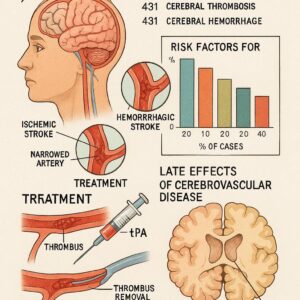
ICD-9 Codes for Cerebrovascular Accident
Understanding the ICD-9 Coding System
Before we dive into the specific codes, it’s essential to understand what ICD-9 was and why it matters.
ICD stands for the International Classification of Diseases. It’s a system created and maintained by the World Health Organization (WHO) to standardize how diseases, symptoms, abnormal findings, and external causes of injury are categorized. The “9” refers to the ninth revision of this system, which was in widespread use in the United States from 1979 until October 1, 2015.
Think of ICD codes as a universal medical shorthand. Instead of writing out “acute ischemic stroke affecting the right middle cerebral artery,” a coder could assign a specific numeric code. This allowed for:
-
Efficient Billing and Reimbursement: Insurance companies use these codes to process claims.
-
Epidemiological Tracking: Public health officials can track the incidence and prevalence of diseases like stroke across populations.
-
Clinical Research: Researchers rely on coded data to study treatment outcomes, risk factors, and healthcare trends.
-
Quality Measurement: Hospitals use this data to monitor care quality and patient safety.
The transition to ICD-10-CM (Clinical Modification) in 2015 was a significant leap forward. ICD-10 offers far greater specificity, with codes that can indicate laterality (left vs. right), severity, etiology, and much more. However, a vast amount of valuable medical and research data is still encoded in ICD-9, making familiarity with it a necessary skill.
The Core ICD-9 Code for Cerebrovascular Accident
In the ICD-9-CM system, diseases of the circulatory system are found in Chapter 7, covering codes 390-459. Within this chapter, cerebrovascular diseases are specifically categorized under codes 430-438.
The most fundamental ICD 9 code for CVA is 436. This code has a precise and important definition:
ICD-9-CM Code 436: Acute, but ill-defined, cerebrovascular disease.
This includes terms such as:
-
Cerebrovascular accident (CVA) NOS (Not Otherwise Specified)
-
Stroke NOS
Why “Ill-Defined”?
Code 436 was a catch-all category. It was used when a physician diagnosed a stroke but the specific type (ischemic vs. hemorrhagic) had not yet been determined by diagnostic imaging (like a CT or MRI scan), or when the documentation in the medical record was not specific enough to assign a more precise code. It represented the initial, acute event.
Important Note: “Using code 436 was always intended to be a temporary measure. It signaled that more diagnostic work was needed to pinpoint the exact nature of the cerebrovascular event for proper long-term management and coding.” – Common principle in clinical documentation improvement.
However, stroke care and coding demand precision. Therefore, ICD-9 provided a series of more specific codes to classify the stroke once its type and location were identified.
Detailed Breakdown: ICD-9 Codes for Specific Stroke Types
The following table provides a clear comparison of the major ICD-9 codes related to stroke, moving from the general to the specific.
Comparative Table: Key ICD-9 Codes for Cerebrovascular Events
| ICD-9 Code | Code Description | Clinical Meaning & Common Terms | Typical Use Case |
|---|---|---|---|
| 436 | Acute, but ill-defined, cerebrovascular disease | The classic “CVA” or “Stroke” diagnosis when type is unknown. | Patient presents with stroke symptoms; initial diagnosis before CT/MRI results. |
| 433 | Occlusion and stenosis of precerebral arteries | Ischemic strokes or TIAs caused by blockages in the neck arteries (carotid, vertebral). | Patient with carotid artery stenosis who has a stroke. Often used with a 4th digit for specificity. |
| 434 | Occlusion of cerebral arteries | Ischemic strokes caused by blockages in the brain arteries themselves. | The most common code for confirmed ischemic infarcts (e.g., MCA occlusion). Used with a 4th digit. |
| 430 | Subarachnoid hemorrhage | Bleeding into the space surrounding the brain, often from a ruptured aneurysm. | Patient with “thunderclap” headache and blood seen in subarachnoid space on CT. |
| 431 | Intracerebral hemorrhage | Bleeding directly into the brain tissue (parenchymal hemorrhage). | Patient with hypertension who has a deep brain bleed (e.g., in the basal ganglia). |
| 435 | Transient cerebral ischemia | Transient Ischemic Attack (TIA) or “mini-stroke,” where symptoms resolve within 24 hours. | Patient with temporary neurological deficits that fully resolve, often a warning sign. |
Deep Dive into the Most Common Codes
Let’s explore the two most frequently used categories for specific stroke diagnosis: codes for ischemic stroke and codes for hemorrhagic stroke.
Ischemic Stroke Codes (Blockages)
Ischemic strokes, caused by a clot blocking blood flow to the brain, accounted for about 87% of all strokes. ICD-9 captured this through two main code series, which required a 4th digit for further detail.
1. ICD-9 Code Series 433: Precerebral Artery Occlusion
This series deals with blockages in the arteries before they enter the skull (the neck arteries).
-
433.0X: Occlusion and stenosis of the basilar artery.
-
433.1X: Occlusion and stenosis of the carotid artery.
-
433.2X: Occlusion and stenosis of the vertebral artery.
-
433.3X: Occlusion and stenosis of multiple and bilateral precerebral arteries.
-
433.8X: Occlusion and stenosis of other specified precerebral artery.
-
433.9X: Occlusion and stenosis of unspecified precerebral artery.
The 5th Digit (X): A critical component! This digit indicated whether the occlusion was with or without cerebral infarction (brain tissue death).
-
.0: Without mention of cerebral infarction (often used for asymptomatic stenosis or TIA).
-
.1: With cerebral infarction (meaning the blockage did cause a stroke).
Example: 433.11 means “Occlusion and stenosis of carotid artery with cerebral infarction.”
2. ICD-9 Code Series 434: Cerebral Artery Occlusion
This series is for blockages in the arteries inside the brain.
-
434.0X: Cerebral thrombosis (a clot forms locally in the brain artery).
-
434.1X: Cerebral embolism (a clot travels from elsewhere, like the heart, to the brain).
-
434.9X: Cerebral artery occlusion, unspecified (the most commonly used code for ischemic stroke when the exact mechanism isn’t specified).
The 5th Digit (X): Functioned the same as in the 433 series.
-
.0: Without mention of cerebral infarction.
-
.1: With cerebral infarction.
Example: 434.91 means “Cerebral artery occlusion, unspecified, with cerebral infarction.” This was arguably the single most common specific code for a diagnosed ischemic stroke.
Hemorrhagic Stroke Codes (Bleeds)
Hemorrhagic strokes are less common but often more deadly. ICD-9 had distinct codes for the two primary types.
ICD-9 Code 430: Subarachnoid Hemorrhage (SAH)
This code signifies bleeding into the subarachnoid space, the area between the brain and the thin tissues that cover it. It is most frequently caused by the rupture of a cerebral aneurysm or an arteriovenous malformation (AVM). No 4th digit was typically used; 430 stood alone.
ICD-9 Code 431: Intracerebral Hemorrhage (ICH)
This code indicates bleeding directly into the brain parenchyma (the functional tissue). Chronic hypertension is the most common cause, leading to bleeding in areas like the basal ganglia, thalamus, pons, or cerebellum. Like code 430, 431 was generally used without a 4th digit.
Late Effects of Cerebrovascular Disease: ICD-9 Code 438
A crucial and often-used code in post-stroke care is ICD-9 Code 438. This code is for the late effects of cerebrovascular disease, meaning the residual neurologic deficits that persist after the acute stroke phase has ended (typically after 6 months to 1 year).
Code 438 is a “category code” and must be used with a 4th digit to specify the nature of the late effect. It is often used in conjunction with the history of a more specific stroke code.
Common 4th Digit Sub-categories for 438:
-
438.0: Cognitive deficits
-
438.1: Speech and language deficits (e.g., aphasia)
-
438.2: Hemiplegia/hemiparesis (paralysis/weakness on one side)
-
438.3: Monoplegia of upper/lower limb
-
438.4: Dysphagia (difficulty swallowing)
-
438.5: Facial weakness or droop
-
438.6: Ataxia (loss of coordination)
-
438.7: Vertigo
-
438.8: Other late effects (including fatigue, sensory loss, etc.)
-
438.9: Unspecified late effect
Example: A patient who had an ischemic stroke (434.91) two years ago and now has persistent right-sided weakness and expressive aphasia would have codes 438.21 (Late effects of CVA, hemiplegia) and 438.11 (Late effects of CVA, speech/language deficit) assigned for ongoing treatment and therapy.
The Transition from ICD-9 to ICD-10 for CVA
The shift to ICD-10-CM on October 1, 2015, was a paradigm shift in stroke coding. The vague “ill-defined” code 436 was eliminated. Instead, ICD-10 requires a much higher level of clinical specificity from the outset.
How ICD-10 Improves Upon ICD-9 for Stroke:
-
Specificity: ICD-10 has separate code families for ischemic stroke (I63), intracerebral hemorrhage (I61), subarachnoid hemorrhage (I60), and other types.
-
Laterality: Codes specify whether the stroke affected the right, left, or bilateral arteries (e.g., left MCA infarction).
-
Etiology: For ischemic strokes, codes can indicate the specific vessel (e.g., right middle cerebral artery) and the type of occlusion (e.g., embolism, thrombosis).
-
Severity: NIH Stroke Scale scores can be incorporated for ischemic strokes.
-
Episode of Care: Codes indicate whether this is an initial encounter, subsequent encounter, or sequelae.
ICD-9 to ICD-10 Crosswalk Examples:
-
ICD-9 436 maps to a range of unspecified ICD-10 codes like I63.9 (Cerebral infarction, unspecified) or I64 (Stroke, not specified as hemorrhage or infarction), but their use is heavily discouraged without clinical detail.
-
ICD-9 434.91 (Unspecified cerebral artery occlusion with infarction) could map to something like I63.50 (Cerebral infarction due to unspecified occlusion or stenosis of unspecified cerebral artery).
-
ICD-9 431 (Intracerebral hemorrhage) could map to a precise code like I61.1 (Nontraumatic intracerebral hemorrhage in hemisphere, cortical).
Practical Application: Coding a Stroke Case in ICD-9
Let’s walk through a hypothetical patient case to see how these codes were applied.
Scenario: Mr. Johnson, a 68-year-old male with a history of hypertension and atrial fibrillation, is brought to the ER with sudden onset of left-sided facial droop, arm weakness, and slurred speech. A non-contrast CT head is performed immediately.
Step 1: Initial Encounter (in ER)
The CT scan shows no evidence of bleeding but does not yet show a clear infarct. The physician’s diagnosis is “Acute CVA, likely ischemic.” The appropriate code is 436 (Acute, ill-defined cerebrovascular disease).
Step 2: Subsequent Diagnosis
Mr. Johnson undergoes an MRI which confirms an acute infarct in the territory of the right Middle Cerebral Artery (MCA). The final diagnosis is “Acute ischemic stroke due to right MCA occlusion, likely cardioembolic from AFib.”
The appropriate ICD-9 code is 434.91 (Cerebral artery occlusion, unspecified, with cerebral infarction). Note: While we know it’s the right MCA, ICD-9 did not have a code to specify laterality, a key limitation.
Step 3: Discharge and Follow-up
Six months later, Mr. Johnson has residual left-sided hemiparesis and requires physical therapy. For this follow-up visit, the primary code would be 438.21 (Late effects of CVA, hemiplegia/hemiparesis). The original stroke code (434.91) might also be listed to provide the full history.
The Importance of Accurate Historical Coding and Data
Understanding ICD-9 codes is not just an academic exercise. It has real-world implications:
-
Research Continuity: Long-term stroke studies spanning the 2015 transition must be able to harmonize ICD-9 and ICD-10 data to track trends accurately.
-
Retrospective Reviews: Hospitals analyzing stroke care quality over time need to interpret old data correctly.
-
Legal and Insurance Reviews: Old medical records coded in ICD-9 may be reviewed for disability claims or legal cases.
-
Patient History: A patient’s past medical history listed as “CVA (436)” tells a clinician that the type of stroke may not have been fully characterized, prompting further questions or investigation.
Conclusion
The journey to understand the ICD 9 code for CVA takes us from the general code 436 to the specific branches for ischemic (433, 434) and hemorrhagic (430, 431) strokes, and finally to the long-term management code for sequelae (438). While the ICD-10 system has brought welcome precision to modern stroke classification, the ICD-9 framework remains the key to unlocking decades of vital healthcare data. By mastering this “medical language of the past,” professionals ensure continuity of care, accuracy in research, and a deeper understanding of stroke’s history and impact.
Frequently Asked Questions (FAQ)
Q1: Can I still use ICD-9 codes for billing today?
A: No. As of October 1, 2015, all HIPAA-covered entities in the United States (healthcare providers, insurers, etc.) are required to use ICD-10-CM codes for diagnosis coding on claims. Using ICD-9 will result in claim rejection.
Q2: I have an old medical record that just says “CVA (436).” What does that really mean?
A: It means you were diagnosed with a stroke, but the specific type (ischemic or hemorrhagic) was not confirmed or documented at that time based on the available information. To understand your complete stroke history, you may need to consult the full medical record to see if later tests (like an MRI) provided a more specific diagnosis.
Q3: What is the main difference between code 434.91 and 436?
A: Code 434.91 specifies that the stroke was caused by a blocked brain artery and that it resulted in cerebral infarction (tissue death). Code 436 is a non-specific placeholder used when the type of stroke and its exact cause are unknown or undocumented. 434.91 is a more clinically precise diagnosis.
Q4: Why is the code for “Late Effects” (438) so important?
A: Stroke recovery is a long-term process. Code 438 allows healthcare systems to accurately track and bill for the ongoing rehabilitation, therapy, and management of chronic stroke-related disabilities long after the initial acute event is over. It shifts the focus from the acute injury to the chronic condition.
Q5: Where can I find the official, full list of old ICD-9 codes?
A: The U.S. Centers for Medicare & Medicaid Services (CMS) maintains an official archive of the ICD-9-CM code set. You can find it on the CMS website or through trusted medical coding resources like the American Health Information Management Association (AHIMA).
Additional Resources
For those seeking to delve deeper into medical coding and stroke classification, here are valuable resources:
-
Centers for Disease Control and Prevention (CDC) – Stroke Division: Provides clinical guidelines and public health data on stroke.
-
American Heart Association/American Stroke Association (AHA/ASA): Offers detailed clinical definitions and classification tools for stroke, including the TOAST (Trial of Org 10172 in Acute Stroke Treatment) classification system, which is often reflected in modern ICD-10 coding.
-
American Health Information Management Association (AHIMA): The premier association for health information professionals, offering educational materials on coding standards and transitions.
-
National Institute of Neurological Disorders and Stroke (NINDS): Provides in-depth scientific and patient-oriented information on stroke types and pathophysiology.
Disclaimer: This article is intended for informational and educational purposes only. It is not a substitute for professional medical coding advice, clinical guidance, or treatment. Medical coding is a complex field governed by official guidelines that are frequently updated. For accurate coding of any medical condition, always consult the most current official code sets (ICD-10-CM as of 2015) and applicable coding guidelines, and rely on the expertise of certified medical coders and clinical documentation specialists. The author and publisher disclaim any liability for errors or omissions or for any outcomes related to the use of this information.
Date: January 03, 2025
Author: The Web Health Writer Team