In the world of medical documentation and billing, precision is paramount. For decades, the International Classification of Diseases, 9th Revision (ICD-9) served as the universal language for coding diagnoses and procedures. While it has been officially replaced in the United States by ICD-10, understanding ICD-9 codes remains crucial for historical record review, certain research studies, and grasping the foundations of medical coding.
This guide provides a deep dive into the ICD 9 code for DVT. We will explore the specific codes, their structure, and the essential details needed to apply them accurately. Whether you’re a healthcare professional, a medical coder, a student, or a patient researching your own records, this article serves as your definitive reference.
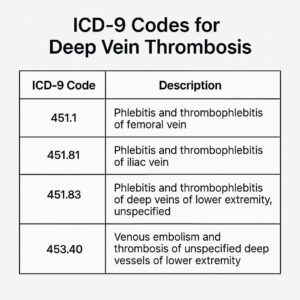
ICD-9 Codes for Deep Vein Thrombosis
Understanding the ICD-9 Coding System for Circulatory Diseases
Before we pinpoint the specific codes for DVT, it’s helpful to understand where they live within the ICD-9 framework. The ICD-9-CM (Clinical Modification) is divided into three volumes. Diagnoses, like DVT, are found in Volumes 1 and 2.
-
Volume 1 is the tabular list of diseases, organized numerically by code.
-
Volume 2 is the alphabetical index used to locate codes.
All diseases of the circulatory system fall under Chapter 7 of ICD-9-CM, covering codes 390-459. Within this chapter, you’ll find a specific sub-category for “Diseases of Veins and Lymphatics, and Other Diseases of Circulatory System,” which ranges from codes 451-459. This is our primary area of focus.
As one expert in medical records noted:
“ICD-9, though now a legacy system, taught a generation of coders the importance of anatomical specificity. A code wasn’t just for ‘leg pain’—it forced you to ask which vein, in which limb, and due to what cause.”
The Primary ICD-9 Code for Deep Vein Thrombosis: 453.4x
The foundational ICD-9 code for Deep Vein Thrombosis is 453.4. This code is not a complete descriptor on its own; it requires a fourth and sometimes a fifth digit to specify the exact location of the blood clot. This structure highlights a key limitation of ICD-9—less specificity compared to its successor, ICD-10.
The code series 453.4 belongs to the broader category: 453 – Other venous embolism and thrombosis. This category excludes pulmonary embolism (415.1x), which has its own distinct code, though the conditions are often related.
Breaking Down the 453.4x Series
Here is a detailed look at the specific codes within the 453.4 series for DVT:
-
453.40 – Venous embolism and thrombosis of unspecified deep vessels of lower extremity
This code is used when a DVT is confirmed in the leg, but the medical documentation does not specify whether it is in the proximal (thigh/pelvis) or distal (calf) veins. -
453.41 – Venous embolism and thrombosis of deep vessels of proximal lower extremity
This code is used for clots in the deep veins of the thigh, groin, or pelvis (e.g., femoral, popliteal, or iliac veins). These are typically considered higher-risk DVTs. -
453.42 – Venous embolism and thrombosis of deep vessels of distal lower extremity
This code applies to clots located in the deep veins of the calf (e.g., tibial or peroneal veins). -
453.5x – Venous embolism and thrombosis of other specified veins
While 453.4 covers the lower extremities, DVT can occur elsewhere. The 453.5 series is used for these instances, again requiring a fifth digit.-
453.50 – Of unspecified site
-
453.51 – Of axillary veins (armpit/shoulder)
-
453.52 – Of subclavian veins (collarbone area)
-
453.53 – Of internal jugular veins (neck)
-
453.54 – Of other thoracic veins
-
453.55 – Of renal veins (kidney)
-
453.6x – Of intracranial venous sinuses
-
453.7x – Of veins of the abdomen and pelvis (e.g., portal vein thrombosis)
-
453.8 – Of other specified veins
-
453.9 – Of unspecified site
-
Important Note for Readers: The choice of code depends entirely on the physician’s documentation in the patient’s medical record. Coders cannot assume location; they must code based on what is explicitly stated.
Comparative Table: ICD-9 vs. ICD-10 for Common DVT Scenarios
This table illustrates the shift in specificity from ICD-9 to ICD-10-CM.
| Clinical Scenario | ICD-9 Code | ICD-10-CM Code | Key Difference |
|---|---|---|---|
| DVT of left femoral vein | 453.41 | I82.411 | ICD-10 specifies laterality (left) and which deep vein (femoral). |
| Acute DVT of right calf | 453.42 | I82.421 | ICD-10 adds laterality (right) and acuity. |
| Chronic DVT of unspecified leg | 453.40 | I82.402 | ICD-10 differentiates between acute, chronic, and acute-on-chronic. |
| Upper extremity DVT (subclavian) | 453.52 | I82.A21 | ICD-10 has a dedicated, more granular chapter for venous embolism/thrombosis. |
| Postpartum DVT | 671.4x (Chapter 11) | O87.1 (Chapter 15) | ICD-9 mixed obstetric codes with standard codes; ICD-10 consolidates all pregnancy-related conditions. |
Essential Coding Considerations and Conventions in ICD-9
Coding DVT is rarely as simple as picking one code. You must follow ICD-9’s official coding guidelines to ensure accuracy.
1. Laterality (Left vs. Right)
Unlike ICD-10, most ICD-9 codes for DVT do not specify laterality. Codes like 453.41 do not distinguish between a left or right leg. This lack of specificity was a major driver for the transition to ICD-10. If laterality is crucial for a record, it was often captured elsewhere in the chart or via a supplementary V-code (e.g., V83.89 – Personal history of other venous thrombosis).
2. Acute vs. Chronic DVT
ICD-9 does not have distinct codes to differentiate between an acute, new clot and a chronic, older clot that has scarred the vein (post-thrombotic syndrome). This clinical distinction is critically important for treatment but was not directly encoded in the diagnosis code itself. The acuity would be inferred from the patient’s visit reason and clinical notes.
3. Coding for Pregnancy-Related DVT
A crucial rule in ICD-9 is that conditions complicating pregnancy, childbirth, or the puerperium are not coded from Chapter 7 (the 453 series). Instead, they are coded from Chapter 11, “Complications of Pregnancy, Childbirth, and the Puerperium” (codes 630-679).
-
The relevant code for Deep phlebothrombosis (DVT) in the puerperium is 671.4x.
-
Again, this requires a fourth digit for location (e.g., 671.42 – Deep phlebothrombosis, postpartum).
-
A fifth digit further specifies the current episode of care.
4. Manifestation Coding and Underlying Causes
Often, DVT is not a random event; it is a manifestation of an underlying condition. ICD-9 guidelines often require you to code first the underlying disease.
Example Scenario: A patient with active pancreatic cancer (code 157.9) develops a DVT. This is likely a Trousseau’s syndrome, where the cancer causes hypercoagulability.
-
Correct Coding: 157.9 (Malignant neoplasm of pancreas) is sequenced first, followed by 453.41 (DVT of proximal lower extremity).
-
Rationale: This tells the full story: the cancer is the underlying cause, and the DVT is a resulting complication.
Common underlying causes that should be coded first include:
-
Malignancy (140-209 series)
-
Pregnancy (671.4x series, as noted)
-
Specific hereditary coagulation defects (e.g., Factor V Leiden, 289.81)
Helpful Lists for Accurate ICD-9 DVT Coding
Steps to Find the Correct ICD-9 Code for DVT
-
Consult the Alphabetic Index (Volume 2): Look up “Thrombosis,” “Thrombophlebitis,” or “Embolism” and then navigate to the “deep veins” subterm.
-
Verify in the Tabular List (Volume 1): Always confirm the code in the numerical list. This is where you check for includes, excludes, and mandatory additional digit instructions.
-
Determine Location: Does the documentation specify proximal (thigh/pelvis) or distal (calf) lower extremity? If not, you must use 453.40.
-
Check for Underlying Cause: Is the DVT secondary to cancer, pregnancy, or another condition? If yes, code that condition first.
-
Review for Complications: Is there a documented pulmonary embolism (415.19) or post-thrombotic syndrome (459.1x)? These require separate codes.
Common “Excludes” Notes to Remember
ICD-9 is filled with “Excludes” notes that prevent double-coding or miscoding. Key ones for DVT:
-
Category 453 Excludes: venous embolism and thrombosis complicating pregnancy (671.4x) and that with abortion or ectopic pregnancy (639.6x).
-
Code 453.4 Excludes: phlebitis and thrombophlebitis of lower extremities (451.1x). This is an important distinction—superficial vein clots are coded differently.
The Transition from ICD-9 to ICD-10-CM
As of October 1, 2015, the U.S. healthcare system mandated the use of ICD-10-CM. This was not a simple update but a complete overhaul. The code for a basic DVT expanded dramatically in specificity.
-
ICD-9: 453.41 (Venous embolism and thrombosis of deep vessels of proximal lower extremity).
-
ICD-10: I82.4_ _ (Acute embolism and thrombosis of deep veins of lower extremity). This base code requires a minimum of two additional digits to specify laterality (left, right, bilateral) and acuity (acute, chronic, acute on chronic). Further extensions can specify the exact vein (e.g., femoral, popliteal).
Why does this matter today? Historical patient records, research data predating 2015, and some legacy insurance claims are all documented in ICD-9. Understanding this system is essential for interpreting that data accurately. Furthermore, the logical structure learned from ICD-9—location, etiology, manifestation—is the bedrock of all medical coding, including ICD-10.
Conclusion
Navigating the ICD 9 code for DVT centers on the 453.4x series, demanding careful attention to the documented location of the clot and any underlying causative conditions. While this legacy system offered less granularity than modern ICD-10, its disciplined structure emphasized the core principles of accurate clinical documentation. Mastering these historical codes remains a valuable skill for interpreting older records and understanding the evolution of medical classification, ensuring continuity and clarity in patient care across time.
Frequently Asked Questions (FAQ)
Q: Can I still use ICD-9 codes for billing today?
A: No. As of October 1, 2015, all HIPAA-covered entities in the United States must use ICD-10-CM for diagnosis coding on claims. Using ICD-9 will result in claim denial.
Q: I found “453.8” on my old medical bill. What does it mean?
A: ICD-9 code 453.8 stood for “Venous embolism and thrombosis of other specified veins.” This was a catch-all code for DVTs occurring in veins not specifically listed elsewhere, such as in the superficial femoral vein or other unique sites, when the documentation didn’t align with a more specific code.
Q: How do I code for a history of DVT in ICD-9?
A: For a personal history of DVT where the condition no longer exists and is not being treated, you would use a V-code from the Supplementary Classification section: V12.51 – Personal history of venous thrombosis and embolism. This is crucial for indicating risk factors without duplicating an active diagnosis.
Q: Was pulmonary embolism (PE) included in the DVT codes?
A: No. Pulmonary embolism has its own distinct code in ICD-9: 415.1x (Pulmonary embolism and infarction). However, if a patient has both a DVT and a PE, both codes should be reported, with the PE often sequenced first as it is typically the more acute, life-threatening condition.
Additional Resource
For the official guidelines and complete code set, the Centers for Medicare & Medicaid Services (CMS) maintains an archive of the ICD-9-CM Manual. You can access it via the CDC’s ICD-9-CM Archive page. This is the definitive source for historical coding reference.
Disclaimer: This article is for educational and informational purposes only. It is not a substitute for professional medical coding advice, clinical guidance, or the official ICD-9-CM coding guidelines. Medical coding is complex and regulated. Always consult the current official coding manuals, payer-specific policies, and a certified professional coder for accurate code assignment. The author and publisher disclaim any liability for errors or omissions or for any outcomes related to the use of this information.
Date: January 13, 2026
Author: The Professional Medical Writing Team