If you’re navigating older medical records, insurance claims, or historical health data, you’ve likely encountered the term “ICD-9 code.” For conditions like dementia, these codes are crucial for understanding diagnoses, treatment histories, and billing. While the healthcare world has largely moved on to ICD-10, a firm grasp of ICD-9 remains essential for patients, caregivers, and professionals dealing with documents from before October 2015.
This guide will serve as your definitive resource. We’ll explore the ICD-9 coding system, break down the specific codes used for various types of dementia, and explain why this knowledge still matters today. Our goal is to demystify these alphanumeric sequences and turn them from confusing jargon into clear, actionable information.
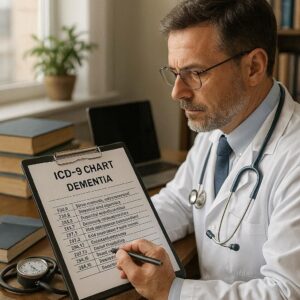
ICD-9 Codes for Dementia
Understanding the ICD-9 Coding System
Before we dive into the specific codes for dementia, let’s establish what ICD-9 is and why it was created.
What is ICD-9?
ICD-9 stands for the International Classification of Diseases, 9th Revision. It was a global system, maintained by the World Health Organization (WHO), used to classify diseases and a wide variety of signs, symptoms, abnormal findings, and external causes of injury. In the United States, a clinical modification of it—called ICD-9-CM—was used for diagnostic coding in healthcare settings.
“The ICD is the foundation for the identification of health trends and statistics globally. It is the international standard for reporting diseases and health conditions,” notes the World Health Organization.
For over three decades, ICD-9-CM was the lingua franca of medical diagnosis in the U.S. Every condition, from a common cold to a complex neurological disorder like Alzheimer’s disease, had a corresponding code. These codes were used universally for:
-
Medical Billing and Insurance Reimbursement: Insurance companies require a diagnostic code to process claims.
-
Epidemiological Tracking: Public health officials use aggregated codes to track disease outbreaks and prevalence.
-
Clinical Research: Researchers rely on coded data to study disease patterns and treatment outcomes.
-
Maintaining Patient Records: Codes provide a standardized shorthand for a patient’s medical history.
The Structure of an ICD-9 Code
An ICD-9-CM code is typically 3 to 5 digits long. The structure is hierarchical:
-
The first three digits represent the general category of the disease (e.g., “290” for Dementias).
-
The fourth and fifth digits provide greater specificity, detailing the subtype, etiology, or manifestation.
For example, the code 290.0 breaks down as:
-
290: Senile and presenile organic psychotic conditions (the dementia category).
-
290.0: Senile dementia, uncomplicated.
This structure allowed for some detail, but it was notoriously limited compared to modern systems, often leading to “code crowding” and a lack of clinical precision.
Why Did We Move to ICD-10?
The transition from ICD-9-CM to ICD-10-CM in the United States on October 1, 2015, was a monumental shift. ICD-9, developed in the 1970s, simply ran out of space and could not accurately describe 21st-century medicine.
Key Limitations of ICD-9:
-
Limited Specificity: Codes often could not describe laterality (left vs. right), severity, or anatomical detail.
-
Outdated Terminology: It did not reflect modern medical advancements and terminology.
-
Insufficient Codes: With only ~13,000 codes, many new diseases and procedures had no unique identifier.
ICD-10-CM, with over 68,000 codes, offers dramatic improvements in specificity, which leads to better patient care, more accurate billing, and richer data for research.
Navigating the ICD-9 Codes for Dementia
Dementia, being a complex syndrome with multiple causes, was represented across several categories in ICD-9. The primary home was within the “290” series, but related codes existed elsewhere. Understanding this spread is key to accurate interpretation.
The Primary Category: 290 – Dementias
This category, officially titled “Senile and presenile organic psychotic conditions,” housed the most commonly used dementia codes. It is subdivided as follows:
Primary ICD-9 Dementia Codes (290 Series)
| ICD-9 Code | Code Description | Clinical Meaning & Notes |
|---|---|---|
| 290.0 | Senile dementia, uncomplicated | Used for age-related dementia without additional psychotic features like delusions or hallucinations. Often a catch-all for unspecified senile dementia. |
| 290.1 | Presenile dementia | Dementia diagnosed in individuals under the age of 65. This code was often used for early-onset Alzheimer’s disease before more specific testing became common. |
| 290.2 | Senile dementia with delusional features | Dementia accompanied by fixed, false beliefs (e.g., paranoia about theft or infidelity). |
| 290.3 | Senile dementia with depressive features | Dementia where a major depressive disorder is a prominent concurrent feature. |
| 290.4 | Arteriosclerotic dementia | This is an older term for what is now generally called Vascular Dementia. It links the cognitive decline to cerebrovascular disease. |
| 290.8 | Other specified senile psychotic conditions | A less common code for other senile organic mental disorders. |
| 290.9 | Unspecified senile psychotic condition | A nonspecific code used when the type of senile dementia couldn’t be determined. |
Alzheimer’s Disease: Code 331.0
Crucially, Alzheimer’s disease had its own distinct code outside the 290 series. As understanding of the disease evolved, it was reclassified as a primary disease of the nervous system.
-
331.0: Alzheimer’s disease. This code was used for all types of Alzheimer’s, regardless of age of onset (senile or presenile). However, to fully capture the dementia syndrome it causes, medical coders would often use a dual-coding approach:
-
331.0 for the underlying disease (Alzheimer’s).
-
294.1* for the manifested dementia (Dementia in conditions classified elsewhere).
-
This practice highlights a critical point in ICD-9: a patient’s record often contained multiple codes to paint a complete clinical picture.
Other Relevant ICD-9 Codes for Cognitive Disorders
Dementia symptoms can arise from numerous other conditions. ICD-9 had codes to capture these nuances.
Other Relevant ICD-9 Cognitive Disorder Codes
| ICD-9 Code | Category/Description | Relevance to Dementia |
|---|---|---|
| 294.0 | Amnestic disorder (amnestic syndrome) | For prominent memory impairment without the full spectrum of dementia (e.g., from thiamine deficiency in Wernicke-Korsakoff syndrome). |
| 294.1* | Dementia in conditions classified elsewhere | A critically important code. Used to indicate that a dementia syndrome is present as a symptom of a primary physical disease already coded elsewhere (e.g., with 331.0 for Alzheimer’s, 331.1 for Frontotemporal dementia, or 042 for HIV). |
| 294.8 | Other persistent mental disorders due to conditions classified elsewhere | Could be used for other specified organic brain syndromes. |
| 294.9 | Unspecified persistent mental disorder due to condition classified elsewhere | A nonspecific code for organic mental dysfunction. |
| 331.1 | Frontotemporal dementia (Pick’s disease) | The specific code for this less common type of dementia. |
| 331.2 | Senile degeneration of the brain | A general code for age-related brain atrophy, sometimes used when a specific dementia type wasn’t confirmed. |
| 797 | Senility without mention of psychosis | A vague code for general age-related mental decline, lacking the specificity required for a true dementia diagnosis. |
**294.1 is a manifestation code and was typically used as a secondary code.*
From ICD-9 to ICD-10: A Side-by-Side Comparison
The transition to ICD-10 brought a new level of clarity. Let’s compare how some common dementia diagnoses are represented in both systems.
Table 3: ICD-9 to ICD-10 Code Conversion for Common Dementias
| Diagnosis | ICD-9 Code | ICD-10-CM Code | Key Improvement in ICD-10 |
|---|---|---|---|
| Alzheimer’s Disease | 331.0 | G30.9 (Alzheimer’s disease, unspecified) | ICD-10 offers specific codes for early-onset (G30.0) and late-onset (G30.1) Alzheimer’s. |
| Dementia in Alzheimer’s | 331.0 + 294.1* | F02.80 (Dementia in other diseases classified elsewhere without behavioral disturbance) or F02.81 (…with behavioral disturbance) | ICD-10 explicitly codes for the presence or absence of behavioral/psychological symptoms (BPSD), which is crucial for care planning. |
| Vascular Dementia | 290.4 | F01.50 (Vascular dementia without behavioral disturbance) or F01.51 (…with behavioral disturbance) | Again, specifies behavioral disturbance. Uncomplicated vascular dementia is F01.50. |
| Unspecified Dementia | 290.9 / 294.9 | F03.90 (Unspecified dementia without behavioral disturbance) or F03.91 (…with behavioral disturbance) | Provides greater specificity regarding symptoms. |
| Frontotemporal Dementia | 331.1 | G31.09 (Other frontotemporal dementia) | ICD-10 has more specific codes for behavioral variant (F02.81 under G31.09) and language variants. |
| Lewy Body Dementia | 331.82 (in ICD-9-CM’s final years) | G31.83 (Dementia with Lewy bodies) | Lewy Body Dementia received its own distinct code in ICD-10, whereas it was often lumped under “other” codes in ICD-9. |
Important Note for Readers: “If you are reviewing a medical record or bill with an ICD-9 code dated before October 2015, it is a historical document. For current diagnosis, treatment, and billing, all healthcare providers in the U.S. now use ICD-10-CM. Always consult with a healthcare provider or medical coder for the interpretation of specific personal health codes.”
Why Understanding ICD-9 Codes Still Matters
You might wonder why we’re focusing on a “retired” system. The reasons are practical and ongoing.
-
Accessing Historical Medical Records: Patients with long-term conditions like dementia often have decades of records coded in ICD-9. Understanding these codes is key to tracing the full history of the diagnosis and care.
-
Decoding Old Insurance Claims: Disputes or inquiries about past services require an understanding of the codes used at the time.
-
Conducting Longitudinal Research: Studies that track disease trends over time must be able to interpret data coded in both ICD-9 and ICD-10, requiring “crosswalk” knowledge.
-
Personal and Family Health History: Building an accurate family health history sometimes involves obtaining and interpreting old records.
Practical Scenarios
-
Scenario 1: A family finds an old diagnosis sheet from 2012 listing “331.0 & 294.1.” They now know this signifies Alzheimer’s disease with resulting dementia.
-
Scenario 2: A researcher sees a spike in “290.4” codes in 2010 data. They understand this refers to vascular dementia, allowing them to analyze trends related to cardiovascular health.
-
Scenario 3: A caregiver is helping a parent apply for a long-term care benefit and needs to provide proof of a dementia diagnosis dating back to 2008. The physician’s notes use code “290.0.”
Beyond the Code: The Human Element of a Dementia Diagnosis
While codes are essential for administration, they are a stark shorthand for a deeply human experience. A diagnosis of dementia is life-altering for the individual and their family. The code “290.0” or “331.0” is the starting point for a journey that involves:
-
Comprehensive Care Planning: Beyond the code lies the need for a care team—neurologists, geriatricians, psychiatrists, social workers, and therapists.
-
Legal and Financial Planning: Early diagnosis allows time for establishing powers of attorney, advance directives, and managing finances.
-
Support Systems: Connecting with support groups (like the Alzheimer’s Association) and community resources is paramount.
-
Focus on Quality of Life: Treatment focuses on managing symptoms, maintaining function, and ensuring safety and dignity.
The code is the key that unlocks access to these critical services and supports, making its accurate use and understanding all the more vital.
Conclusion
Navigating the world of ICD-9 codes for dementia, from the broad category 290 to the specific 331.0 for Alzheimer’s, provides essential insight into past medical records and the evolution of diagnostic classification. While the modern precision of ICD-10 has replaced this system, understanding these legacy codes remains a valuable skill for interpreting health history, facilitating research, and managing long-term care. Remember, these codes represent not just a diagnosis, but a person’s health journey—a journey that requires compassion, support, and informed care every step of the way.
Frequently Asked Questions (FAQ)
Q1: I have an old medical bill with code “290.0.” What does that mean?
A1: Code 290.0 stands for “Senile dementia, uncomplicated.” In older records, this was a common code used for a diagnosis of dementia in an older adult without noted psychotic features like hallucinations or severe agitation. It was often used as a general diagnosis before more specific testing.
Q2: What is the main difference between ICD-9 code 290.4 and ICD-10 codes for vascular dementia?
A2: ICD-9 code 290.4, “Arteriosclerotic dementia,” was a single, nonspecific code. ICD-10 codes (like F01.50) not only specify vascular dementia but also add a fifth digit to indicate whether behavioral disturbances (like aggression or wandering) are present, providing much more clinical detail for caregivers and care plans.
Q3: Why did my father’s old record have two codes: 331.0 and 294.1?
A3: This was standard practice for many conditions. 331.0 identified the underlying disease (Alzheimer’s). 294.1 was added to specify that the Alzheimer’s disease was currently manifesting with clinically significant dementia. This dual-coding gave a fuller picture of his condition.
Q4: Can I still use ICD-9 codes for a new dementia diagnosis today?
A4: No. As of October 1, 2015, all healthcare providers in the United States are required to use ICD-10-CM for diagnostic coding on claims and records. Using an ICD-9 code for a new diagnosis or current billing would result in claim rejection.
Q5: Where can I find an official “crosswalk” or translation between ICD-9 and ICD-10 codes?
A5: The Centers for Medicare & Medicaid Services (CMS) and the National Center for Health Statistics (NCHS) provide official General Equivalence Mappings (GEMs). However, these mappings can be complex. For personal health matters, it’s best to ask your doctor’s office or medical records department for assistance.
Additional Resources
-
Alzheimer’s Association (www.alz.org): The leading voluntary health organization in Alzheimer’s care, support, and research. Offers a 24/7 Helpline (1.800.272.3900).
-
National Institute on Aging (NIA) – Alzheimer’s and Related Dementias: (www.nia.nih.gov/health/alzheimers) Authoritative, research-based information on causes, symptoms, diagnosis, and treatment.
-
Centers for Disease Control and Prevention (CDC) – ICD-10: (www.cdc.gov/nchs/icd/icd10cm.htm) The official U.S. government resource for ICD-10-CM guidelines and updates.
-
Family Caregiver Alliance (www.caregiver.org): Provides support, education, and resources for families and friends caring for adults with chronic, disabling health conditions like dementia.
Disclaimer: This article is for informational and educational purposes only. It is not intended as medical advice, coding advice, or a substitute for professional clinical or coding consultation. Medical coding is complex and governed by official guidelines. Always rely on qualified healthcare providers for diagnoses and treatment, and certified medical coders for accurate coding. Code information is based on historical ICD-9-CM guidelines. For current coding, always refer to the latest official ICD-10-CM manuals and guidance from CMS and NCHS.
Date: January 03, 2025
Author: The Web Health Writer Team