If you’re searching for the “ICD-9 code for edema,” you’re likely dealing with older medical records, a specific historical research project, or perhaps completing a form that still references this retired system. You’ve come to the right place. This comprehensive guide will not only provide the specific code you need but will also place it within the crucial context of modern medical coding.
It is vital to understand that the International Classification of Diseases, 9th Revision (ICD-9) was officially replaced by ICD-10 in the United States on October 1, 2015. While ICD-9 codes are no longer used for current billing or clinical documentation, they remain important for accessing and interpreting historical patient data or older research.
In this article, we’ll explore the ICD-9 coding for edema in detail, translate it to the current ICD-10 system, and provide you with the knowledge to navigate these terms accurately and effectively.
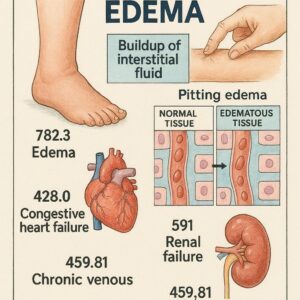
ICD-9 Codes for Edema
Table of Contents
ToggleUnderstanding Edema and Its Classification
Before we dive into codes, let’s establish a clear understanding of the condition itself. Edema, in simple terms, is swelling caused by excess fluid trapped in your body’s tissues. It can occur anywhere but is most noticeable in the hands, arms, feet, ankles, and legs.
Edema is not a disease but a symptom of an underlying condition. This is a critical concept in medical coding. The coding process always aims to capture the root cause. Think of edema as an alarm bell; the code job is to identify why the alarm is ringing.
Common causes include:
-
Heart failure
-
Kidney disease or kidney damage
-
Liver cirrhosis
-
Chronic venous insufficiency
-
Side effects of certain medications
-
Pregnancy
-
Allergic reactions
The location, severity, and underlying cause of the edema directly influence which medical code is assigned.
The Primary ICD-9 Code for Edema: 782.3
The most general ICD-9 code used for edema is 782.3.
Within the ICD-9 system, this code fell under the following hierarchy:
-
Chapter 16: Symptoms, Signs, and Ill-Defined Conditions (780-799)
-
Subcategory 782: Symptoms involving skin and other integumentary tissues
-
Code 782.3: Edema
This code was typically used when the swelling was documented, but a more specific underlying cause had not yet been determined, or when the edema itself was the primary focus of a visit. However, coders were always instructed to code the known cause first if it was established.
When Specificity Was Possible: Other Relevant ICD-9 Codes
While 782.3 was the catch-all, the ICD-9 system had more specific codes for edema in certain locations or with known etiologies. Here is a comparative table of common ICD-9 codes related to swelling:
| ICD-9 Code | Code Description | Typical Use Case |
|---|---|---|
| 782.3 | Edema | Generalized or localized swelling where the cause is unspecified or not the focus. |
| 458.0 | Orthostatic hypotension | Could be used with edema in some contexts, but primarily for low blood pressure. |
| 729.81 | Swelling of limb | Used specifically for arm or leg swelling when “edema” wasn’t the term used. |
| 784.2 | Swelling, mass, or lump in head and neck | For facial, neck, or throat swelling. |
| 786.09 | Other dyspnea and respiratory abnormalities | Sometimes linked with pulmonary edema (fluid in lungs), but 518.4 was more specific. |
| 518.4 | Acute edema of lung, unspecified (Non-cardiac pulmonary edema) | The primary code for pulmonary edema when not specified as cardiac. |
| 428.1 | Acute left heart failure | The underlying cause for cardiogenic pulmonary edema. |
As Dr. Helen Carter, a medical coding auditor, often reminded her students: “ICD-9 code 782.3 was a placeholder. The heart of accurate coding has always been, and will always be, etiologic specificity. Your job is to tell the patient’s story through numbers.”
The Critical Transition: From ICD-9 to ICD-10 for Edema
This is the most important section for anyone dealing with current medical records. The transition from ICD-9 to ICD-10 was not a simple one-to-one code change; it was a massive expansion in specificity. ICD-9 had about 13,000 codes. ICD-10 has over 68,000.
The generic ICD-9 code 782.3 (Edema) does not have a single direct counterpart in ICD-10. Instead, it maps to a range of highly specific codes based on location, laterality (left, right, bilateral), and underlying cause.
ICD-9 to ICD-10 Crosswalk for Edema
The table below illustrates how the old system translates to the new, emphasizing the increased detail required.
| ICD-9 Code & Concept | Corresponding ICD-10 Chapter/Family | Example ICD-10 Codes & Their Specificity |
|---|---|---|
| 782.3 – Edema | R60 – Edema, not elsewhere classified | R60.0 – Localized edema R60.1 – Generalized edema R60.9 – Edema, unspecified |
| Edema of Limb | ||
| 729.81 – Swelling of limb | R60.0 – Localized edema | R60.01 – Localized edema, right ankle/foot R60.02 – Localized edema, left ankle/foot R60.03 – Localized edema, upper limb |
| Pulmonary Edema | ||
| 518.4 – Acute edema of lung | J81 – Pulmonary edema | J81.0 – Acute pulmonary edema J81.1 – Chronic pulmonary edema |
| Edema due to Heart Failure | ||
| 428.1 – Acute left heart failure | I50.1 – Left ventricular failure | I50.1 – Often the cause code, with J81.0 as a manifestation. |
Important Note for Readers: If you are coding a current patient encounter, you must use ICD-10-CM codes. Using an ICD-9 code on a claim form today will result in an immediate rejection. This guide to ICD-9 is primarily for historical reference and education.
How to Approach Coding for Edema: A Step-by-Step Guide
Whether you’re reviewing an old chart with ICD-9 or coding a new case with ICD-10, the clinical thought process is similar.
-
Identify the Documentation: Locate the provider’s note. Key terms are “edema,” “swelling,” “pitting edema,” “peripheral edema,” “anasarca” (severe, generalized edema).
-
Determine the Location: Is it the ankle? Both legs? The face? The lungs? Location drives specificity.
-
Establish the Cause: This is the most critical step. Search for a linked diagnosis.
-
Is it due to Congestive Heart Failure (CHF)? Code the CHF.
-
Is it Lymphedema post-mastectomy? Code the lymphedema and the history of cancer.
-
Is it Dependent edema from venous insufficiency? Code the venous insufficiency.
-
Is the cause unknown or idiopathic? Then you would use a symptom code like R60.9.
-
-
Follow Coding Guidelines: Always code the underlying cause first. Use additional codes for the edema if it is not integral to the disease process. For example, edema is a inherent part of CHF, so you might not code it separately unless specifically instructed. However, edema caused by kidney disease would require both codes.
-
Choose the Correct Code Set: Confirm you are using ICD-9 (for pre-2015 records) or ICD-10 (for all current work).
Practical Reference Tables
Common Conditions Associated with Edema and Their Codes
| Condition | ICD-9 Code (Historical) | ICD-10-CM Code (Current) |
|---|---|---|
| Congestive Heart Failure | 428.0 | I50.9 (or more specific I50.2-, I50.4-, etc.) |
| Chronic Kidney Disease, Stage 3 | 585.3 | N18.3 |
| Cirrhosis of Liver | 571.5 | K74.60 |
| Chronic Venous Insufficiency | 459.81 | I87.2 |
| Lymphedema | 457.0 | I89.0 (or I97.2 post-procedural) |
| Idiopathic Edema | 782.3 | R60.9 |
Edema Location & Corresponding Modern ICD-10 Codes
| Location of Edema | ICD-10-CM Code |
|---|---|
| Unspecified Edema | R60.9 |
| Generalized Edema (Anasarca) | R60.1 |
| Localized Edema, Unspecified | R60.0 |
| Right Lower Limb | R60.01 (Ankle/Foot) |
| Left Lower Limb | R60.02 (Ankle/Foot) |
| Bilateral Lower Limbs | R60.03 (Ankle/Foot) |
| Upper Limb | R60.03 |
| Periodontal Edema | K05.10 (Gingivitis) |
| Edema of Larynx | J38.4 |
Conclusion
Finding the ICD-9 code for edema, historically 782.3, is just the starting point for accurate medical documentation. The essential principle, unchanged in the transition to ICD-10, is that edema is a symptom demanding identification of its underlying cause for precise coding. Always prioritize using the modern, specific ICD-10-CM system for current practice, reserving ICD-9 knowledge for interpreting the valuable story within past medical records.
Frequently Asked Questions (FAQ)
Q: Can I still use ICD-9 code 782.3 on insurance claims?
A: No. As of October 1, 2015, all healthcare providers covered by the Health Insurance Portability and Accountability Act (HIPAA) must use ICD-10-CM codes for diagnosis reporting. Using an ICD-9 code will result in claim denial.
Q: What is the direct ICD-10 code for the old ICD-9 code 782.3?
A: There isn’t one direct match. ICD-9 782.3 maps to a category: R60 – Edema, not elsewhere classified. You must choose a more specific code from this category, such as R60.0 (localized), R60.1 (generalized), or R60.9 (unspecified).
Q: Why is the ICD-10 system so much more complicated?
A: The complexity brings greater specificity, which leads to improved tracking of public health trends, more accurate reimbursement for the complexity of care provided, and enhanced detail for clinical research.
Q: Where can I find the most up-to-date official ICD-10 codes?
A: The authoritative source in the United States is the Centers for Disease Control and Prevention (CDC) National Center for Health Statistics (NCHS) website, which publishes the ICD-10-CM guidelines and indexes.
Additional Resource
For the official coding guidelines and the complete ICD-10-CM index, visit the CDC NCHS ICD-10-CM page: https://www.cdc.gov/nchs/icd/icd-10-cm.htm
Disclaimer: *This article is for informational and educational purposes only. It is not a substitute for professional medical coding advice, clinical guidance, or the official ICD-10-CM coding guidelines. Medical coding is complex and regulated. Always consult the current, official ICD-10-CM code set and accompanying guidelines for accurate coding and billing. The author and publisher disclaim any liability for errors or omissions or for outcomes resulting from the use of this information. Last Updated: January 17, 2026.*