If you’re searching for the ICD-9 code for a finger injury, you’re likely dealing with medical records, insurance forms, or billing questions that require precise documentation. While the ICD-9 coding system was officially replaced by ICD-10 in 2015, understanding its structure remains crucial for historical data, certain legal cases, or simply comprehending old medical documents.
This comprehensive guide is designed to be your ultimate reference. We’ll demystify the ICD-9 system for finger injuries, provide you with the exact codes you need, and explain the critical details that ensure accuracy. More importantly, we’ll bridge the gap to the current ICD-10 system, giving you a complete and practical understanding of diagnostic coding for hand and finger trauma.
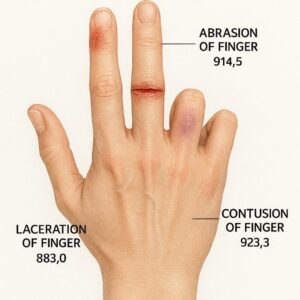
ICD-9 Codes for Finger Injury
Understanding the ICD-9 Coding System: A Brief Overview
First, let’s establish what ICD-9 codes are. ICD-9 stands for the International Classification of Diseases, 9th Revision. It was a standardized system used by healthcare providers and billers to translate medical diagnoses, symptoms, and procedures into alphanumeric codes. These codes were essential for:
-
Medical Billing and Insurance Reimbursement: Submitting claims to health insurance companies.
-
Tracking Health Statistics: Monitoring the incidence and prevalence of diseases and injuries.
-
Medical Record Keeping: Creating a concise, standardized summary of a patient’s condition.
As one medical coder aptly put it, “ICD-9 codes were the universal language of diagnosis, turning complex medical narratives into a structured data point for the entire healthcare system.”
While it’s a legacy system, its logic forms the foundation for modern coding.
Why ICD-9 Knowledge Still Matters Today
You might wonder why we’re discussing a retired system. Here are a few realistic scenarios:
-
You are a researcher analyzing health data from before October 2015.
-
You are involved in a worker’s compensation or personal injury case related to an old injury.
-
You are reviewing your own medical history from several years ago.
-
You are a student learning the evolution of medical documentation.
Knowing how to navigate ICD-9 provides context and clarity for these situations.
Locating the Correct ICD-9 Code for a Finger Injury
In ICD-9, injuries are primarily found in Chapter 17: “Injury and Poisoning,” which covers codes 800-999. Finger injuries are a subset of this category.
The most general ICD-9 code for an unspecified finger injury is 959.4 – Finger injury, unspecified.
However, this code is rarely sufficient for accurate documentation. Medical coding thrives on specificity. Using 959.4 is akin to saying “something is wrong with the finger” without providing any useful detail. For proper coding, you must identify the nature of the injury (e.g., fracture, laceration, dislocation) and its specific location.
The Essential Breakdown: Nature of Injury vs. Location
ICD-9 coding for injuries typically requires two key pieces of information, often represented by two different sets of codes:
-
The Nature of the Injury (The “What”): This describes the type of trauma. Is it a fracture, an open wound, a sprain, a contusion?
-
The Location of the Injury (The “Where”): This specifies the exact body part. Which finger? Which part of the finger (e.g., distal phalanx, proximal interphalangeal joint)?
For finger injuries, these are often combined into a single, more precise code within the injury chapters.
Comprehensive ICD-9 Code Tables for Common Finger Injuries
Below are detailed tables for the most common types of finger injuries as categorized under ICD-9.
Fractures of the Fingers (ICD-9 Codes 816.xx)
Fractures are broken bones. The codes become specific based on which finger(s) and which bone segment is affected.
| ICD-9 Code | Code Description | Clinical Example |
|---|---|---|
| 816.00 | Closed fracture of phalanx or phalanges of hand, unspecified | A broken finger bone with no open wound, unspecified finger. |
| 816.01 | Closed fracture of middle or proximal phalanx of finger | A break in the middle or bone closest to the hand of any finger, skin intact. |
| 816.02 | Closed fracture of distal phalanx of finger | A break in the fingertip bone (e.g., a “mallet finger”), skin intact. |
| 816.03 | Closed fracture of multiple phalanges of finger | Breaks in more than one bone segment of a single finger. |
| 816.10 | Open fracture of phalanx or phalanges of hand, unspecified | A broken finger bone where the bone penetrates the skin. |
| 816.11 | Open fracture of middle or proximal phalanx of finger | Open break in the middle or proximal phalanx. |
| 816.12 | Open fracture of distal phalanx of finger | Open break in the fingertip bone. |
| 816.13 | Open fracture of multiple phalanges of finger | Multiple open breaks in one finger. |
Important Note: These codes do not specify which finger (index, middle, ring, little, thumb). For that level of detail, supplementary documentation or the use of laterality (right vs. left) was required in the medical record.
Table 2: Open Wounds of the Fingers (ICD-9 Codes 883.xx)
Open wounds involve a break in the skin, such as lacerations (cuts), punctures, or avulsions.
| ICD-9 Code | Code Description | Clinical Example |
|---|---|---|
| 883.0 | Open wound of finger(s), without mention of complication | A simple cut on one or more fingers. |
| 883.1 | Open wound of finger(s), complicated | A deep cut with tendon, nerve, or other structural damage. |
| 883.2 | Open wound of finger(s), with tendon involvement | A laceration that severs or partially severs a flexor or extensor tendon. |
Table 3: Dislocations, Sprains, and Other Injuries
This category covers injuries to joints and soft tissues.
| ICD-9 Code | Code Description | Clinical Example |
|---|---|---|
| 834.xx | Dislocation of finger | A joint in the finger is forced out of its normal position (e.g., PIP joint dislocation). |
| 842.1x | Sprain and strain of finger | Stretching or tearing of ligaments (sprain) or muscles/tendons (strain) in the finger. |
| 923.3 | Contusion of finger | A bruise from blunt trauma, with no broken skin. |
| 885.0 | Traumatic amputation of thumb (complete) (partial) | Loss of the thumb due to injury. |
| 886.0 | Traumatic amputation of other finger(s) (complete) (partial) | Loss of one or more fingers (excluding thumb) due to injury. |
| 959.4 | Finger injury, unspecified | A general code used only when no more specific information is available. |
Critical Factors for Accurate ICD-9 Coding
To select the correct code from the tables above, you must answer these questions from the medical documentation:
-
What is the specific diagnosis? (e.g., “closed fracture of the distal phalanx”)
-
Which finger is affected? While the base codes often don’t specify, the medical record must. Coders would use modifiers or notes for “right” or “left” and the finger name.
-
Is it the right or left hand? Laterality (right vs. left) is a fundamental component.
-
Was the injury initial or subsequent? ICD-9 used “V” codes for follow-up care (e.g., V54.19 for aftercare for healing traumatic fracture). The initial injury code is for the first encounter.
A Helpful List: Common Clinical Terms for Finger Injuries
-
Phalanx (plural: Phalanges): The bones of the finger. Each finger has three (distal, middle, proximal), except the thumb which has two.
-
Distal Phalanx: The bone at the fingertip.
-
Proximal Phalanx: The bone closest to the hand.
-
PIP Joint: Proximal Interphalangeal Joint (the middle knuckle).
-
DIP Joint: Distal Interphalangeal Joint (the knuckle nearest the nail).
-
MCP Joint: Metacarpophalangeal Joint (the knuckle at the base of the finger).
The Modern Context: Transition from ICD-9 to ICD-10
On October 1, 2015, the U.S. healthcare system fully transitioned to ICD-10-CM. This system is exponentially more detailed and specific than ICD-9.
Key Differences Between ICD-9 and ICD-10 for Finger Injuries
| Feature | ICD-9-CM | ICD-10-CM |
|---|---|---|
| Code Format | Mostly 3-5 digits, numeric. (e.g., 816.02) | 3-7 characters, alphanumeric. (e.g., S62.632A) |
| Specificity | Limited. Often lacked laterality and precise anatomy. | Highly detailed. Requires laterality, exact finger, encounter type (initial, subsequent, sequelae). |
| Number of Codes | ~13,000 codes | ~68,000 codes |
| Example for a Common Injury | 816.02 – Closed fracture of distal phalanx of finger. | S62.632A – Displaced fracture of distal phalanx of left middle finger, initial encounter for closed fracture. |
ICD-10 Code Equivalents for Common Finger Injuries
While this article focuses on ICD-9, here is a quick reference for the modern equivalents to show the increased specificity:
-
Unspecified Finger Injury: ICD-9 959.4 → ICD-10 S69.93XA (Unspecified injury of unspecified wrist, hand and finger, initial encounter).
-
Closed Distal Phalanx Fracture: ICD-9 816.02 → ICD-10 S62.63XA (Fracture of distal phalanx of finger, initial encounter). This then expands to codes for each specific finger.
-
Finger Laceration: ICD-9 883.0 → ICD-10 S61.2XXA (Laceration with foreign body of unspecified finger without damage to nail, initial encounter). Again, this expands to specify finger and laterality.
The bottom line: If you are coding for a current medical encounter (post-2015), you must use ICD-10. ICD-9 codes are no longer accepted for billing or contemporary health data reporting.
Best Practices for Navigating Finger Injury Codes
Whether dealing with legacy ICD-9 or modern ICD-10, these principles ensure accuracy:
-
Always Consult the Official Documentation. Never guess a code. Use the physician’s diagnosis and clinical notes in the medical record.
-
Prioritize Specificity. Choose the code that provides the highest level of detail about the injury type and location.
-
Understand the Encounter Context. Is this the initial treatment for the injury, a follow-up visit, or care for a complication? The code must reflect this.
-
When in Doubt, Seek Professional Help. Medical coding is a specialized profession. For billing purposes, rely on a certified professional coder (CPC).
Conclusion
Finding the correct ICD-9 code for a finger injury starts with the general code 959.4 but demands diving into specific categories like 816.xx for fractures or 883.xx for open wounds for true accuracy. Although the ICD-9 system has been succeeded by the far more detailed ICD-10, understanding its structure remains valuable for interpreting historical medical data. The core principle of precise, specific documentation bridges both systems, ensuring clarity in patient care, billing, and health records.
Frequently Asked Questions (FAQ)
Q: Can I still use ICD-9 codes for medical billing today?
A: No. As of October 1, 2015, all HIPAA-covered entities in the United States are required to use ICD-10-CM codes for diagnosis coding on claims. Using ICD-9 will result in claim denials.
Q: Where can I find an official, complete list of ICD-9 codes?
A: The Centers for Medicare & Medicaid Services (CMS) maintains an archive of the official ICD-9-CM code sets. You can find it on the CMS website. However, for current coding, you must reference the ICD-10-CM manuals or databases.
Q: The ICD-9 code I found doesn’t specify left or right hand. How was that indicated?
A: In ICD-9, laterality (right vs. left) was often not built into the code itself. It was typically indicated elsewhere on the claim form or in the supporting medical documentation. This was a major limitation that ICD-10 solved by building laterality directly into almost all applicable codes.
Q: I have an old medical bill with an ICD-9 code. How can I understand what it means?
A: Use the tables in this article as a starting point. Look up the first three digits to identify the category (e.g., 816 = finger fracture), then the digits after the decimal for more detail. For a definitive answer, you can cross-reference the code with an archived ICD-9 manual or a reputable online medical code lookup tool that includes legacy codes.
Q: Is “finger” considered to include the thumb in ICD-9?
A: No. In medical coding, the thumb is almost always classified separately from the other four fingers. ICD-9 had distinct code ranges for thumb injuries (e.g., fractures under 815.xx, amputations under 885.0) versus injuries to the other fingers (e.g., 816.xx, 886.0).
Additional Resources
-
Centers for Disease Control and Prevention (CDC) ICD-10 Page: For the most up-to-date information on the current coding system. https://www.cdc.gov/nchs/icd/icd-10-cm.htm
-
American Academy of Professional Coders (AAPC): A leading organization for medical coding training, certification, and resources. https://www.aapc.com/
Disclaimer: This article is for informational and educational purposes only. It is not a substitute for professional medical coding advice, clinical guidance, or official coding resources. Always refer to the most current, official ICD-10-CM coding guidelines and the complete medical record for accurate diagnosis coding. For any specific medical or billing concerns, consult with a qualified healthcare provider or a certified professional coder.
Date: January 22, 2026
Author: The Medical Documentation Team at HealthCode Precision