If you’re navigating medical records, insurance claims, or historical health data, you might have encountered the term “ICD-9 code for food allergy.” While this coding system is no longer in active use, understanding it is crucial for deciphering older records and appreciating the evolution of medical classification. This guide will provide a thorough, clear, and reliable exploration of ICD-9 codes related to food allergies, offering essential context for patients, medical coders, and healthcare administrators.
We’ll delve into the specific codes, their meanings, and how the transition to ICD-10 created a more detailed and nuanced system for documenting these conditions. Our goal is to transform complex coding jargon into accessible information you can actually use.
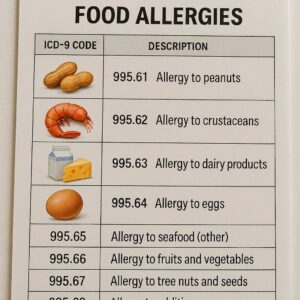
ICD-9 Codes for Food Allergy
Understanding the ICD-9 Coding System: A Historical Primer
Before we look at the specific codes, it’s important to understand what ICD-9 was and why it matters. The International Classification of Diseases, 9th Revision, Clinical Modification (ICD-9-CM) was the standard system used in the United States to classify and code all diagnoses, symptoms, and procedures for medical billing and statistical tracking from 1979 until October 1, 2015.
Think of it as a massive, standardized dictionary for diseases. Every conceivable health condition was assigned a unique numeric code, usually three to five digits long. This allowed for:
-
Uniform Billing: Insurance companies required these codes to process claims.
-
Epidemiological Tracking: Public health officials could track the prevalence of diseases like peanut allergies over time.
-
Medical Record Keeping: Codes provided a shorthand for complex conditions in patient charts.
However, by the 21st century, ICD-9 had become outdated. Its structure was limited, running out of space for new codes, and its descriptions were often vague. This lack of specificity is particularly evident in conditions like food allergies, where precise details about the allergen and reaction are critical for patient care.
“The transition from ICD-9 to ICD-10 was not merely an update; it was a necessary evolution from a system of broad categories to one capable of capturing the clinical detail required in modern medicine.” — National Center for Health Statistics
The Core ICD-9 Code for Food Allergy
Within the ICD-9-CM system, food allergies were primarily categorized under a code in the “Diseases of the Digestive System” chapter. The fundamental, parent code was:
V15.01 – Allergy to peanuts
Wait—peanuts? If you were looking for a general “food allergy” code, this might seem confusing. In ICD-9, there was no single, standalone code for a generic food allergy. Instead, the system used a series of codes beginning with V15.0, which fell under a larger category: “V15 – Other personal history presenting hazards to health.”
This is a critical point of understanding. In ICD-9, many specific food allergies were classified not as an active disease, but as a personal history of a condition that could influence current care. The structure was:
-
V15.0 – Other allergy, other than to medicinal agents
-
V15.01 – Allergy to peanuts
-
V15.02 – Allergy to milk products
-
V15.03 – Allergy to eggs
-
V15.04 – Allergy to seafood
-
V15.05 – Allergy to other foods
-
V15.06 – Allergy to insects
-
V15.07 – Allergy to latex
-
V15.08 – Allergy to radiographic dye
-
V15.09 – Other allergy, other than to medicinal agents
-
As you can see, V15.05 – Allergy to other foods served as the catch-all code for any food allergy not specifically listed (like tree nuts, wheat, soy, or shellfish, unless documented as “seafood”).
Important Note for Readers: If you are reviewing a medical record or bill with a V15.0x code, it typically indicates the patient has a history of that allergy. For an active allergic reaction (like anaphylaxis or hives from eating a food), different codes from the “Symptoms” or “Disease” chapters would be used in conjunction with the V code.
ICD-9 Codes for Active Allergic Reactions and Related Conditions
When a patient experienced an actual allergic reaction, coders had to use codes that described the manifestation of the allergy. Here’s how it worked in practice:
Scenario: A patient with a known peanut allergy (V15.01) accidentally ingests peanuts and develops acute urticaria (hives).
Coding: The coder would list:
-
708.0 – Allergic urticaria (the active condition).
-
V15.01 – Allergy to peanuts (the underlying cause/history).
Common ICD-9 codes used for acute allergic reactions included:
-
995.0 – Other anaphylactic shock (For severe, life-threatening reactions).
-
995.3 – Allergy, unspecified (A vague code used when details were lacking).
-
995.1 – Angioneurotic edema (For swelling, like in the lips or throat).
-
477.9 – Allergic rhinitis, cause unspecified (For nasal allergy symptoms triggered by food).
-
558.9 – Other and unspecified noninfectious gastroenteritis and colitis (Often used for gastrointestinal allergic symptoms like vomiting or diarrhea).
Comparative Table: ICD-9 vs. ICD-10 for Food Allergy Documentation
This table highlights the dramatic increase in specificity with the newer system.
| Aspect | ICD-9-CM (Pre-2015) | ICD-10-CM (Current) | Implication of Change |
|---|---|---|---|
| Code Structure | 3-5 digits, mostly numeric | 3-7 digits, alphanumeric | More room for expansion and detail. |
| General Food Allergy | V15.05 – Allergy to other foods (Vague) | Z91.01- – Food allergy status (More specific) | Better categorization of allergy as an ongoing health status. |
| Specific Allergen | Limited options (peanuts, milk, eggs, seafood, “other”). | Extensive options (e.g., Z91.010 for peanut, Z91.011 for milk, Z91.012 for eggs, Z91.013 for shellfish, etc.). | Precise identification of the trigger, crucial for safety and research. |
| Active Reaction | Separate, nonspecific codes (e.g., 995.0, 708.0). | Combination codes that link reaction AND cause (e.g., T78.01XA – Anaphylaxis due to peanuts). | Simplifies coding, improves accuracy of cause-and-effect tracking. |
| Manifestation | Required multiple codes to tell the full story. | Single codes often encapsulate allergy, reaction, and severity. | Creates a clearer, more efficient patient record. |
The Transition to ICD-10: Why Specificity Matters
On October 1, 2015, the U.S. healthcare system officially retired ICD-9-CM and adopted ICD-10-CM. This was a monumental shift that directly addressed the shortcomings of the old system, especially for conditions like food allergies.
In ICD-10, the coding philosophy changed. Instead of burying food allergies under “history of” codes, it created a dedicated category for them:
-
Z91.0 – Allergy status, other than to drugs and biological substances
-
Z91.01- – Food allergy status (With 4th and 5th digits specifying the food: peanut, shellfish, milk, etc.)
-
Z91.03- – Insect allergy status
-
Z91.04- – Allergy to latex
-
Z91.05- – Allergy to radiographic dye
-
Furthermore, for active reactions, ICD-10 introduced powerful combination codes in Chapter 19 (Injury, poisoning, and certain other consequences of external causes). For example:
-
T78.01XA – Anaphylactic reaction due to peanuts, initial encounter
-
T78.1XXA – Other adverse food reactions, not elsewhere classified, initial encounter
This specificity allows for dramatically better data. Public health agencies can now track peanut allergy ER visits separately from shellfish reactions. Researchers can identify trends with precision. Most importantly, a patient’s medical record instantly communicates the exact nature of their health risk.
Practical Guide for Patients and Professionals
For Patients Reviewing Old Records:
If you see a V15.0x code on an old bill or chart, you now know it refers to your documented allergy history. The “x” will be replaced by a digit:
-
V15.01 = History of peanut allergy.
-
V15.02 = History of milk allergy.
-
V15.05 = History of another food allergy (like wheat or tree nuts).
For Medical Coders and Billers:
-
Historical Context: You may still need to reference ICD-9 to process appeals or analyze old data. Understanding the V15.0 series is key.
-
Current Practice: ICD-9 is obsolete for current billing. Always use ICD-10-CM codes for any service performed on or after October 1, 2015. Using an old ICD-9 code will result in an immediate claim rejection.
-
Accuracy: The specificity of ICD-10 requires clear documentation from providers. Ensure the physician’s note specifies the exact food allergen (e.g., “almonds” not just “tree nuts”) and the nature of the reaction.
Helpful Lists: Common Food Allergens and Their Modern ICD-10 Codes
While ICD-9 had few specifics, here’s how the top allergens are precisely coded in today’s system (ICD-10-CM):
-
Peanuts: Z91.010
-
Milk/Dairy: Z91.011
-
Eggs: Z91.012
-
Shellfish: Z91.013 (with further specificity for crustaceans vs. mollusks)
-
Tree Nuts: Z91.018 (e.g., almonds, walnuts, cashews – documentation should specify)
-
Soy: Z91.018
-
Wheat: Z91.018
-
Sesame: Z91.018 (Note: Sesame is now a top allergen recognized by U.S. law)
-
Other Specific Foods: Z91.018
-
Unspecified Food Allergy: Z91.019
Conclusion
The search for an “ICD-9 code for food allergy” reveals a system that, while foundational, was overly simplistic, using generic “history of” codes like V15.05. The transition to ICD-10 marked a vital advancement, introducing precise codes for specific allergens and detailed reaction types. Understanding this evolution is key to interpreting past medical records and appreciating the improved safety and clarity in today’s patient care and health data analytics.
Frequently Asked Questions (FAQ)
Q: Can I still use ICD-9 codes for billing today?
A: No. As of October 1, 2015, all healthcare services provided in the United States must be billed using ICD-10-CM codes. Using ICD-9 will result in claim denial.
Q: I have an old medical bill with code V15.05. What does it mean?
A: Code V15.05 – Allergy to other foods indicates that you had a documented history of a food allergy (not to peanuts, milk, eggs, or seafood specifically) at the time of that service. It was used to inform your care.
Q: Why was there no single “food allergy” disease code in ICD-9?
A: The ICD-9 structure often classified chronic conditions or risk factors as “history of” codes (V codes) rather than active diseases. Its limited code space also prevented the creation of specific codes for each allergen.
Q: Where can I find the official, current ICD-10 codes?
A: The U.S. Centers for Medicare & Medicaid Services (CMS) and the Centers for Disease Control and Prevention (CDC) maintain the official ICD-10-CM code sets on their websites.
Additional Resources
-
CDC ICD-10-CM Official Guidelines: https://www.cdc.gov/nchs/icd/icd10cm.htm – The definitive source for current coding rules and updates.
-
American Academy of Allergy, Asthma & Immunology (AAAAI): https://www.aaaai.org/ – Provides excellent patient and professional resources on food allergies.
-
FARE (Food Allergy Research & Education): https://www.foodallergy.org/ – A leading advocacy group with resources for living with food allergies.
Disclaimer: This article is for informational and educational purposes only. It is not a substitute for professional medical coding advice or clinical guidance. Always consult with a qualified healthcare provider for medical decisions and a certified medical coder for billing and coding accuracy.