Navigating the world of medical coding can feel like learning a new language. If you’re looking for historical records, processing an old insurance claim, or simply trying to understand a past diagnosis, knowing the correct ICD-9 code is crucial. The transition to ICD-10 has made finding older codes more challenging, but we’re here to help.
This comprehensive guide will provide you with everything you need to know about the ICD-9 code for a foot sprain. We’ll cover the exact codes, their meanings, and how they translate into the modern ICD-10 system. Our goal is to give you a clear, reliable, and authoritative resource you can trust.
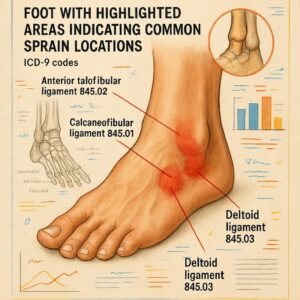
ICD-9 Codes for Foot Sprains
Understanding the ICD-9 Coding System
First, let’s set the stage. The International Classification of Diseases, 9th Revision (ICD-9) was the standard diagnostic coding system used in the United States for decades until it was officially replaced by ICD-10 on October 1, 2015. Despite this change, ICD-9 codes remain relevant for a variety of reasons.
Medical practices, insurance companies, and legal professionals often need to access and interpret old medical records that were created using the ICD-9 system. Understanding these codes is essential for processing historical claims, conducting research on past medical trends, or simply making sense of your own health history.
Key Insight: “While ICD-10 offers greater specificity, ICD-9 codes are the key to unlocking a vast archive of medical history. Accurate interpretation of these codes is a foundational skill in medical administration.” – Healthcare Data Specialist.
It’s important to approach this information with the understanding that for all current diagnostic and billing purposes, ICD-10 codes are mandatory. This guide serves as a bridge to the past, ensuring accuracy when dealing with legacy documents.
What Exactly is a Foot Sprain?
Before we dive into the codes, let’s ensure we’re clear on the medical condition itself. A sprain is an injury to the ligaments—the tough, fibrous bands of tissue that connect bones to each other and stabilize your joints.
A foot sprain specifically involves the stretching or tearing of these ligaments in the foot. This is distinct from a strain, which affects muscles or tendons. Common causes include twisting the foot, falling, or impact during sports. Symptoms typically involve pain, swelling, bruising, and difficulty bearing weight on the affected foot.
The Precise ICD-9 Code for Foot Sprain
In the ICD-9-CM (Clinical Modification), injuries are primarily categorized within Chapter 17: “Injury and Poisoning.” Sprains and strains of joints and adjacent muscles have their own dedicated subcategory.
The primary ICD-9 code category for a foot sprain is 845.
This three-digit code signifies “Sprains and strains of ankle and foot.” However, ICD-9 requires greater specificity through the use of additional digits. The full code is five digits long.
The complete, most commonly used ICD-9 codes for foot sprains are:
-
845.00 – Sprain of ankle, unspecified
-
845.01 – Sprain of ankle, deltoid ligament
-
845.02 – Sprain of ankle, calcaneofibular ligament
-
845.03 – Sprain of ankle, tibiofibular ligament
-
845.09 – Sprain of other specified sites of ankle
You’ll notice that most of these specify the ankle. In common medical terminology and in the ICD-9 structure, generalized “foot sprains” are often captured under the ankle sprain codes, especially if the injury involves the complex of ligaments stabilizing the ankle joint itself.
Breakdown of the ICD-9 Foot Sprain Codes
Let’s look at what each of these codes specifically refers to in a simple, comparative table.
| ICD-9 Code | Description | What It Means |
|---|---|---|
| 845.00 | Sprain of ankle, unspecified | Used when the medical documentation confirms an ankle sprain but does not specify the exact ligament injured. This was a frequently used code. |
| 845.01 | Sprain of ankle, deltoid ligament | A sprain of the strong, triangular ligament on the inner side (medial side) of the ankle. |
| 845.02 | Sprain of ankle, calcaneofibular ligament | A sprain of the ligament connecting the fibula (calf bone) to the calcaneus (heel bone) on the outer side of the ankle. |
| 845.03 | Sprain of ankle, tibiofibular ligament | A sprain of the ligaments that hold the tibia and fibula together at the ankle (the syndesmosis), often called a “high ankle sprain.” |
| 845.09 | Sprain of other specified sites of ankle | Used for an ankle sprain involving a ligament not named in codes 845.01-845.03, or for a less common specific site. |
Important Note for Readers: Code selection was always dependent on the physician’s specific documentation in the medical record. Coders could not assume a diagnosis; they had to match the doctor’s notes to the most accurate code. The “unspecified” code (845.00) was used only when more precise information was not available.
What About Sprains of the Foot Itself (Not the Ankle)?
The ICD-9 system also had codes for injuries to other parts of the foot. While less common than ankle sprain codes, you might encounter these in historical records:
-
845.10 – Sprain of foot, unspecified: For sprains of the foot’s arch, midfoot, or other structures where the specific site isn’t documented.
-
Specific codes under 845.1: These required further specification (e.g., 845.11 for a tarsometatarsal joint (Lisfranc) sprain), but were used far less frequently than the ankle sprain codes.
Transitioning from ICD-9 to ICD-10 for Foot Sprains
The shift to ICD-10-CM represented a massive expansion in specificity. Where ICD-9 had a handful of codes for foot and ankle sprains, ICD-10 has dozens. This allows for more precise tracking of injuries, treatments, and outcomes.
Here is a direct comparison of how the old ICD-9 codes map to the modern ICD-10-CM system.
| ICD-9 Code & Description | Approximate ICD-10-CM Equivalent & Description | Notes on the Change |
|---|---|---|
| 845.00 (Unspecified ankle sprain) | S93.409A (Sprain of unspecified ligament of unspecified ankle, initial encounter) | ICD-10 requires laterality (left/right) and encounter type (initial, subsequent, sequelae). |
| 845.01 (Deltoid ligament sprain) | S93.419A (Sprain of deltoid ligament of unspecified ankle, initial encounter) | Again, specificity for left/right is required for accurate coding in ICD-10. |
| 845.02 (Calcaneofibular ligament sprain) | S93.429A (Sprain of calcaneofibular ligament of unspecified ankle, initial encounter) | The structure is similar, but ICD-10 codes are longer and more detailed. |
| 845.03 (Tibiofibular ligament sprain/High ankle sprain) | S93.439A (Sprain of tibiofibular ligament of unspecified ankle, initial encounter) | High ankle sprains now have very specific codes under this category. |
| 845.10 (Unspecified foot sprain) | S93.309A (Sprain of unspecified ligament of unspecified foot, initial encounter) | Foot sprains are in a different part of the injury chapter in ICD-10 but follow the same specificity rules. |
This table illustrates a critical point: You cannot directly “convert” an ICD-9 code to ICD-10 without the original medical record. ICD-10 demands details that ICD-9 did not capture in the code itself. To find the correct ICD-10 code, a coder must go back to the diagnosis documentation.
How to Use This Information: Practical Scenarios
You might be wondering why this historical information matters. Let’s look at some real-world situations.
Scenario 1: Understanding an Old Medical Bill or Record.
You find an old Explanation of Benefits (EOB) from 2012 with the code “845.00.” You now know this indicates you were treated for an unspecified ankle sprain. This clarifies the history of your injury.
Scenario 2: Researching Your Medical History.
Compiling a timeline of your health events, you see “845.02” on a clinic note from 2010. This tells you precisely that you suffered a sprain of your calcaneofibular ligament, which is valuable information for any future foot or ankle issues you discuss with a doctor.
Scenario 3: Handling a Late or Re-opened Insurance Claim.
If an old claim is being processed or disputed, providing the correct ICD-9 code (like 845.01 for a deltoid ligament sprain) can be essential for the insurance company to reference their historical payment policies.
Helpful List: Where You Might Encounter an Old ICD-9 Code
-
Medical records from before October 2015.
-
Old insurance statements (EOBs) or claim forms.
-
Legal documents related to a personal injury case.
-
Historical research data or public health statistics.
-
Prior authorization documents in an archived patient file.
Important Disclaimer and Best Practices
Disclaimer: This article is for informational and educational purposes only. It is not a substitute for professional medical coding advice. While we strive for accuracy, code sets are complex and are officially maintained by the Centers for Disease Control and Prevention (CDC) and the Centers for Medicare & Medicaid Services (CMS). For definitive coding, always consult the current, official ICD-10-CM code set and guidelines, or work with a certified professional coder (CPC).
Best Practices to Remember:
-
ICD-9 is Historical: For any service after October 1, 2015, ICD-10 codes are legally required for billing and reporting in the U.S.
-
Specificity is Key: The more specific the medical documentation, the more accurate the code—this was true in ICD-9 and is absolutely critical in ICD-10.
-
Context Matters: A code alone doesn’t tell the whole story. It must be viewed alongside the patient’s full medical record.
-
When in Doubt, Ask a Professional: If you are handling coding for billing purposes, always rely on a trained, certified coder or the official resources.
Conclusion
Locating the correct ICD-9 code for a foot sprain, most commonly in the 845.00-845.09 range, provides a vital link to understanding past medical care. While the system has evolved into the more detailed ICD-10, these legacy codes remain the key to accurately interpreting decades of health data. By using this guide, you can confidently navigate historical records, ensuring clarity and precision whether for personal knowledge, administrative tasks, or historical research.
Frequently Asked Questions (FAQ)
Q: Can I still use ICD-9 codes for billing today?
A: No. As of October 1, 2015, all healthcare providers covered by the Health Insurance Portability and Accountability Act (HIPAA) are required to use ICD-10-CM codes for diagnosis reporting. Using ICD-9 will result in claim denials.
Q: I have an old bill with code 845.00. What does the “.00” mean?
A: In ICD-9, the digits after the decimal point provide greater specificity. “845” is the general category for ankle/foot sprains. “845.0” narrows it to ankle sprains. “845.00” further specifies it as an “unspecified” ankle sprain, meaning the exact ligament wasn’t documented.
Q: How do I find the ICD-10 equivalent for my old ICD-9 code?
A: There are general mapping tools called “GEMs” (General Equivalence Mappings), but they are guides, not direct converters. The only way to get the accurate ICD-10 code is to have a certified coder review the original medical documentation from the encounter, as ICD-10 requires details (like left vs. right foot) that the ICD-9 code may not contain.
Q: Are there ICD-9 codes for different severity levels (grade 1, 2, 3) of sprains?
A: No, the ICD-9 coding system did not specify the grade or severity of the sprain within the code itself. That clinical detail would be contained in the physician’s written notes, not the diagnostic code.
Q: Where can I find official, current coding information?
A: The official source for ICD-10-CM codes and guidelines is the Centers for Disease Control and Prevention (CDC) website. For complete code sets and official instructions for use, the CMS and the American Hospital Association (AHA) publish annual code books and guidelines.
Additional Resources
-
CDC ICD-10-CM Official Guidelines: https://www.cdc.gov/nchs/icd/icd-10-cm.htm – The primary source for current coding rules and updates.
-
American Academy of Professional Coders (AAPC): https://www.aapc.com/ – A leading organization for coder certification, training, and industry news.
-
National Center for Health Statistics (NCHS) ICD-9-CM Archive: – While not maintained for current use, historical archives and reference materials can sometimes be found through the NCHS site for research purposes.
Author: The Medical Coding Reference Team
Date: January 23, 2026