If you’re searching for information on the ICD-9 code for hearing loss, you’re likely dealing with medical records, insurance claims, or research data from a specific era in healthcare history. While the ICD-9-CM (International Classification of Diseases, 9th Revision, Clinical Modification) code set was officially retired in the United States in 2015, understanding it remains crucial for managing historical data, processing old claims, or conducting longitudinal studies.
This comprehensive guide will not only provide you with the precise ICD-9 codes you need but will also place them in context, explaining their structure, their modern equivalents, and how to work with them effectively today. Our goal is to make this complex topic clear, accessible, and genuinely useful.
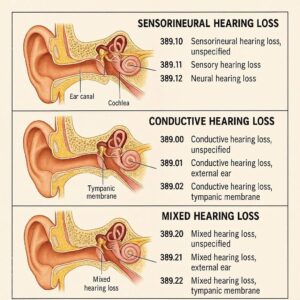
ICD-9 Codes for Hearing Loss
Understanding the ICD-9 Code System for Hearing Conditions
The ICD-9-CM was the standard system for diagnosing and classifying diseases in the U.S. for over three decades. For hearing loss, all relevant codes fell under a specific numeric range, providing a structured way for clinicians and coders to specify the type and cause of hearing impairment.
Unlike a single code, hearing loss in ICD-9 was categorized under a parent code with more specific sub-codes. This allowed for greater detail in medical documentation.
The Primary ICD-9 Code for Hearing Loss
The core category for hearing loss in ICD-9-CM was 389. This three-digit code represented “Hearing Loss.” However, to be used correctly for billing and records, a fourth or fifth digit was almost always required to specify the nature of the loss.
Key Insight: “While many remember ‘389.9’ as the go-to code, proper coding demanded more specificity. Using the unspecified code could lead to claim denials or insufficient data for research, as it didn’t communicate whether the loss was conductive, sensorineural, or mixed.” – Veteran Medical Coder
Breaking Down the ICD-9 389.xx Series
Here is a detailed breakdown of the ICD-9 codes within the 389 series. This table serves as your quick-reference guide.
ICD-9-CM Codes for Hearing Loss (Category 389)
| ICD-9 Code | Code Description | Clinical Meaning |
|---|---|---|
| 389.0 | Conductive hearing loss | Hearing loss caused by problems in the outer or middle ear that block sound conduction (e.g., earwax, fluid, otosclerosis). |
| 389.00 | Conductive hearing loss, unspecified | |
| 389.01 | Conductive hearing loss, external ear | |
| 389.02 | Conductive hearing loss, tympanic membrane | |
| 389.03 | Conductive hearing loss, middle ear | |
| 389.04 | Conductive hearing loss, inner ear | |
| 389.05 | Conductive hearing loss, unilateral | |
| 389.06 | Conductive hearing loss, bilateral | |
| 389.08 | Conductive hearing loss, combined types | |
| 389.1 | Sensorineural hearing loss | Hearing loss caused by damage to the inner ear (cochlea) or the nerve pathways to the brain (e.g., aging, noise exposure, disease). |
| 389.10 | Sensorineural hearing loss, unspecified | |
| 389.11 | Sensory hearing loss | Specifically refers to cochlear (hair cell) damage. |
| 389.12 | Neural hearing loss | Specifically refers to auditory nerve pathway damage. |
| 389.14 | Sensorineural hearing loss, unilateral | |
| 389.15 | Sensorineural hearing loss, bilateral | |
| 389.16 | Sensorineural hearing loss, asymmetrical | |
| 389.17 | Sensorineural hearing loss, sudden | |
| 389.18 | Sensorineural hearing loss, combined types | |
| 389.2 | Mixed conductive and sensorineural hearing loss | A combination of both types of hearing loss in the same ear. |
| 389.20 | Mixed hearing loss, unspecified | |
| 389.21 | Mixed hearing loss, unilateral | |
| 389.22 | Mixed hearing loss, bilateral | |
| 389.8 | Other specified forms of hearing loss | For rare or specific types not covered above. |
| 389.9 | Unspecified hearing loss | Used only when no specific information was available in the record. |
How to Interpret These Codes
-
Start with the first three digits (389): This tells you the condition is hearing loss.
-
The fourth digit (after the decimal) specifies the type: 0 for conductive, 1 for sensorineural, 2 for mixed.
-
The fifth digit adds further clinical detail: Such as laterality (unilateral/bilateral) or precise anatomical site.
Example: A diagnosis of age-related hearing loss in both ears would typically be coded as 389.15 (Sensorineural hearing loss, bilateral).
The Critical Transition: From ICD-9 to ICD-10-CM
On October 1, 2015, the U.S. healthcare system mandated a shift from ICD-9-CM to ICD-10-CM. This was not a simple update but a massive expansion in detail and specificity. Understanding this transition is essential for anyone working with records spanning that date.
Why the Change Mattered
ICD-9 had become outdated. It lacked the granularity needed for modern medicine, research, and billing. The ICD-10 system for hearing loss is vastly more detailed, accounting for laterality (which ear), etiology (cause), and severity in many cases.
Comparative Snapshot: ICD-9 vs. ICD-10 for Hearing Loss
| Feature | ICD-9-CM | ICD-10-CM |
|---|---|---|
| Code Structure | 3-5 digits, mostly numeric | 3-7 characters, alphanumeric |
| Primary Code for Hearing Loss | 389.xx | H90.xxx, H91.xxx, etc. |
| Laterality (Right/Left/Bilateral) | Included only in some 5th digits | A required component in most codes (e.g., H90.3- 1 for right ear) |
| Specificity | Moderate | Highly detailed, with codes for cause, type, and combination |
Navigating Historical Records and Modern Needs
You may need the old ICD-9 codes for several practical reasons today.
Common Scenarios Where ICD-9 Codes Are Still Relevant
-
Processing Old Insurance Claims: Appeals or reviews for services rendered before October 2015.
-
Handling Worker’s Compensation Cases: Long-term cases that originated in the ICD-9 era.
-
Conducting Long-Term Medical Research: Studies tracking patient outcomes over decades must reconcile data from both coding systems.
-
Auditing Historical Medical Charts: Understanding past diagnoses in a patient’s lifelong record.
-
Dealing with Legacy Software Systems: Some older systems or databases may still reference ICD-9 codes.
A Step-by-Step Approach for Current Use
-
Identify the Date of Service: This is the most critical step. For services before October 1, 2015, you will use ICD-9-CM.
-
Consult the Original Record: Find the physician’s detailed diagnosis. Was it sudden sensorineural loss? Chronic conductive loss from otitis media?
-
Match to the Specific Code: Use the table above to find the code that most accurately reflects the documentation (e.g., 389.17 for sudden sensorineural hearing loss).
-
For Modern Coding (Post-10/1/2015): You must use ICD-10-CM. A common equivalent for general sensorineural loss would be in the H90.3- H90.5 series (e.g., H90.3X2 for bilateral sensorineural hearing loss).
Important Note for Readers: Never guess or assume a code. If you are dealing with active medical billing or legal documentation, investing in an official ICD-9-CM code book (even a used copy from the final year, 2014) or a professional coding consultant is essential. Relying solely on internet tables can lead to serious errors.
Beyond the Code: A Holistic View of Hearing Health
While our focus has been on the technical aspects of coding, it’s vital to remember that these codes represent real health experiences. Hearing loss impacts communication, social connection, and quality of life. If you or someone you know is navigating a hearing loss diagnosis, seeking support from audiologists and otolaryngologists (ENT doctors) is the most important step. Modern treatments, from advanced hearing aids to cochlear implants, offer life-changing possibilities.
Key Takeaways in a Nutshell
-
The ICD-9 code for hearing loss is not a single number but a series under category 389.
-
389.0 is for conductive loss, 389.1 for sensorineural, and 389.2 for mixed hearing loss.
-
Fifth digits provided crucial detail about laterality and subtype.
-
The U.S. transitioned to ICD-10-CM on October 1, 2015, which uses a completely different, more detailed coding structure (like H90.xx).
-
ICD-9 codes remain vital for historical data, old claims, and research spanning the coding transition.
Conclusion
Navigating the world of medical codes can feel like deciphering an ancient language. However, understanding the ICD-9 code for hearing loss—the 389.xx series—provides a key to unlocking historical medical information and appreciating the evolution of healthcare documentation. While the system has been replaced by the more detailed ICD-10, its role in three decades of patient records ensures its continued relevance. By using this guide, you can approach these codes with confidence, ensuring accuracy whether you’re settling an old claim, compiling research data, or simply satisfying your curiosity about this important chapter in medical history.
Frequently Asked Questions (FAQ)
Q: Can I still use ICD-9 codes for billing today?
A: No. For any medical service provided on or after October 1, 2015, the use of ICD-10-CM codes is mandatory for billing and reporting in the United States. Using ICD-9 will result in claim rejection.
Q: What is the most direct ICD-10 equivalent for the old ICD-9 code 389.9 (Unspecified hearing loss)?
A: The closest equivalent would be H91.90 (Unspecified hearing loss, unspecified ear). However, coders are strongly encouraged to use more specific codes in ICD-10 whenever clinical information is available.
Q: I have an old record that just says “hearing loss.” Which ICD-9 code should I use?
A: With only that non-specific information, the appropriate code would be 389.9 (Unspecified hearing loss). This highlights the limitation of older records and the importance of detailed clinical documentation.
Q: Where can I find official, authoritative information on ICD codes?
A: The U.S. government centers responsible for these code sets are the best source. For current ICD-10 codes, visit the Centers for Disease Control and Prevention (CDC) ICD-10-CM page. For historical reference and general classification information, the World Health Organization (WHO) ICD resource page is the international authority.