Navigating the world of medical coding can feel like deciphering a complex language. For decades, the ICD-9-CM system was that language, used by healthcare providers and billers across the United States. Even though it has been replaced, understanding its codes, particularly for common conditions like high blood pressure, remains crucial for dealing with older medical records, historical data, and certain administrative processes.
This guide is your comprehensive resource for the ICD-9 code for hypertension. We’ll break down the system, explore the specific codes and their meanings, and explain why this knowledge is still relevant today. Our goal is to transform a seemingly dry subject into clear, actionable information for patients, medical students, billing specialists, and anyone looking to understand their health history.
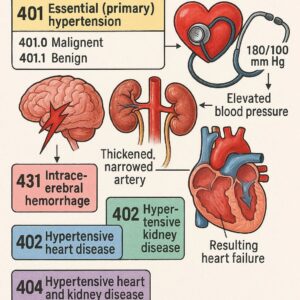
ICD-9 Codes for Hypertension
Understanding the ICD-9-CM System: A Brief Background
Before we dive into the specific codes, let’s set the stage. The International Classification of Diseases, 9th Revision, Clinical Modification (ICD-9-CM) was the official system for assigning codes to diagnoses and procedures in the U.S. from 1979 until October 1, 2015.
“ICD-9 served as the foundational lexicon for health statistics and billing for over three decades. Its structure, while limited compared to modern systems, created the framework for how we categorize disease.” – Health Information Management Perspective
Think of it as an older version of a software operating system. It worked well for its time, but as medicine advanced—with new discoveries, treatments, and a need for more detail—it became outdated. Its successor, ICD-10-CM, offers significantly more specificity and detail. However, millions of medical records are still archived under the ICD-9 system, making it essential knowledge.
Why Knowing ICD-9 Codes Still Matters
You might wonder why we’re discussing a retired system. Here are key reasons:
-
Historical Medical Records: Your personal health records prior to 2015 use these codes. Understanding them can help you interpret old diagnoses.
-
Research and Data Analysis: Long-term studies on hypertension trends rely on consistent data, some of which is coded in ICD-9.
-
Legal and Insurance Reviews: Past insurance claims or disability cases referencing older records will use this coding system.
-
Foundational Knowledge: Learning ICD-9 provides a simpler foundation for grasping the more complex structure of ICD-10.
Decoding Hypertension in ICD-9-CM: The 401 Series
In the ICD-9-CM universe, hypertension is categorized under code range 401-405. The primary, essential hypertension—high blood pressure without a known secondary cause—lives squarely in the 401 series.
This is not a single code. The system used a fifth-digit subclassifier to provide essential detail about the type of hypertension. This fifth digit is critical for accurate coding.
The Core ICD-9 Code for Essential Hypertension: 401
The base code 401 is titled “Essential hypertension.” However, this code alone is incomplete. It must be paired with a fifth digit to be valid for billing and precise record-keeping.
Here is the breakdown of the 401 code series:
| ICD-9 Code | Full Description | Clinical Meaning |
|---|---|---|
| 401.0 | Malignant hypertension | A rare, severe, and rapidly progressive form of high blood pressure that can lead to organ damage. This is a medical emergency. |
| 401.1 | Benign hypertension | The most common form, indicating persistent high blood pressure that is not immediately life-threatening but requires management. |
| 401.9 | Unspecified hypertension | Used when a provider documents “hypertension” but does not specify whether it is benign or malignant. This is often used in initial encounters. |
Important Note for Readers: The terms “benign” and “malignant” in this context are specific medical classifications from the ICD-9 era. “Benign” does not mean harmless—it means non-accelerated. All hypertension requires proper medical attention. “Malignant” denotes an urgent, dangerous state.
A Practical Coding Example
Let’s see how this worked in practice:
-
A patient sees their doctor for a routine checkup. Their blood pressure is consistently elevated at 150/95 mmHg over several visits. The doctor diagnoses “essential hypertension” and starts a treatment plan.
-
The medical coder reviews the chart. The doctor did not specify “malignant,” so the condition is considered chronic and manageable.
-
The correct, billable ICD-9 code assigned is 401.1, Benign hypertension.
Coding Tip: The unspecified code 401.9 was generally a last resort. Coders were trained to “code to the highest specificity.” If the documentation supported it, 401.0 or 401.1 were required.
Beyond the Basics: Other Hypertension-Related ICD-9 Codes
Hypertension often doesn’t exist in a vacuum. The ICD-9-CM system had dedicated codes for hypertension connected to other conditions.
Hypertensive Heart Disease (402 Series)
This category is for when high blood pressure directly affects the heart. Like the 401 series, it required a fifth digit (0 for malignant, 1 for benign, 9 for unspecified).
-
402.0x: Malignant hypertensive heart disease
-
402.1x: Benign hypertensive heart disease
-
402.9x: Unspecified hypertensive heart disease
Hypertensive Chronic Kidney Disease (403 Series)
This is for hypertension causing kidney damage or failure. This series also used the fifth-digit subclassifier.
-
403.0x: Malignant hypertensive chronic kidney disease
-
403.1x: Benign hypertensive chronic kidney disease
-
403.9x: Unspecified hypertensive chronic kidney disease
Hypertensive Heart and Kidney Disease (404 Series)
This complex category is for patients with both hypertensive heart and kidney disease. It used a fifth digit to indicate the stage of kidney disease and whether the hypertension was malignant or benign.
Secondary Hypertension (405 Series)
Unlike essential hypertension (cause unknown), secondary hypertension has a known cause, like kidney disease, tumors, or medication. Code 405 captured this, with fourth digits indicating if it was malignant (.0), benign (.1), or unspecified (.9).
The Transition from ICD-9 to ICD-10: A World of Difference
On October 1, 2015, the U.S. mandated the switch to ICD-10-CM. This was not a simple update; it was a massive expansion. The number of codes for hypertension exploded from a handful to over 100, allowing for incredible detail.
Comparison: ICD-9 vs. ICD-10 for Hypertension
| Feature | ICD-9-CM | ICD-10-CM |
|---|---|---|
| Code Structure | 3-5 digits, mostly numeric | 3-7 characters, alphanumeric |
| Primary HTN Codes | 3 codes (401.0, 401.1, 401.9) | Dozens of codes (I10, I11.-, I12.-, I13.-) |
| Specificity | Limited (Malignant/Benign/Unspecified) | Extremely High |
| Key Details Captured | Type (malignant/benign) | With/without heart failure, stage of CKD, with/without heart & kidney disease |
| Example Code | 401.1 (Benign hypertension) | I10 (Essential hypertension) |
The most striking difference is specificity. Where ICD-9 had 401.1, ICD-10 has a whole chapter. For instance:
-
I10: Essential (primary) hypertension.
-
I11.0: Hypertensive heart disease with heart failure.
-
I12.9: Hypertensive chronic kidney disease with stage 1-4 CKD, or unspecified.
-
I13.10: Hypertensive heart and chronic kidney disease without heart failure.
This shift means better data for public health, more precise treatment tracking, and clearer clinical pictures—but also a steeper learning curve for coding professionals.
Best Practices for Documenting and Coding Hypertension (in the ICD-9 Era)
Accurate coding always starts with clear clinical documentation. For historical accuracy or dealing with old records, these principles were key:
For Physicians/Providers:
-
Avoid “HTN” alone. Always specify “essential hypertension,” and note if it was considered benign or malignant.
-
Document related conditions. Clearly state if the hypertension is affecting the heart (e.g., “hypertensive heart disease”) or kidneys (“hypertension with CKD”).
-
Specify cause if known. If the high blood pressure is secondary to another condition, document that cause-and-effect relationship.
For Medical Coders:
-
Never assume. If the documentation just says “hypertension,” the correct code is 401.9.
-
Link conditions correctly. Only use codes from the 402-405 series if the provider’s documentation explicitly links the hypertension to the heart or kidney disease.
-
Consult the tabular list. Always verify the code and its required digits in the official ICD-9-CM manual.
Important Note: This information is for educational and historical understanding. All current medical coding and billing must use the ICD-10-CM system.
Frequently Asked Questions (FAQ)
Q: What is the most common ICD-9 code for hypertension?
A: The most commonly used code was 401.1, Benign essential hypertension, as it covered the vast majority of chronic, managed high blood pressure cases.
Q: I’m looking at an old bill/record with code 401.9. What does that mean?
A: Code 401.9 meant “Hypertension, unspecified.” This indicates that at the time of that visit, your provider diagnosed high blood pressure but did not document it as specifically “benign” or “malignant.” It was a common code for initial diagnoses.
Q: Can I still use ICD-9 codes for billing today?
A: No. As of October 1, 2015, all HIPAA-covered entities (like doctors’ offices and hospitals) in the U.S. are required to use ICD-10-CM for diagnosis coding. Using ICD-9 will result in claim denials.
Q: How do I find the modern ICD-10 code for my hypertension?
A: ICD-10 codes are assigned by your healthcare provider based on your specific condition. You can find the code on current Explanation of Benefits (EOB) forms from your insurance or recent medical bills. The most common is I10 for uncomplicated essential hypertension.
Q: Why is understanding old ICD-9 codes important for patients?
A: It empowers you to read and understand your own complete health history. If you’re reviewing records from before 2015, you’ll now know what those diagnosis codes mean, giving you a clearer picture of your long-term health journey.
Conclusion
Understanding the ICD-9 code for hypertension opens a window into the recent history of medical administration. While the system has evolved, its legacy lives on in countless records. The journey from the simple 401.1 to today’s specific I10 codes reflects medicine’s growing precision. Whether you’re deciphering an old record or satisfying historical curiosity, this knowledge bridges the gap between past practice and present understanding.
Additional Resource
For those interested in exploring the official documentation, the U.S. Centers for Disease Control and Prevention (CDC) maintains archives and information on ICD-9-CM and the current ICD-10-CM system. This is an authoritative source for understanding the structure and official guidelines of medical classification systems.
Disclaimer: This article is for informational and educational purposes only. It is based on historical coding data and does not constitute medical advice, coding advice, or legal guidance. Medical coding is a complex, regulated field. For accurate coding of current medical services, always consult the latest official ICD-10-CM guidelines and a certified professional coder. For medical concerns, always consult with a qualified healthcare provider.
Date: January 03, 2025
Author: The Web Health Archive Team