If you’re navigating old medical records, dealing with a longstanding insurance claim, or simply trying to understand a past diagnosis, you might have encountered the term “ICD-9 code for kidney stones.” While the healthcare world has moved on to the more detailed ICD-10 system, understanding ICD-9 remains crucial for historical data and certain administrative processes.
This guide will serve as your definitive, human-written reference. We’ll break down the specific codes, explain their logic, and help you understand what those five-digit numbers really mean. Think of this as translating a medical shorthand from a previous era—a skill that’s still valuable today.
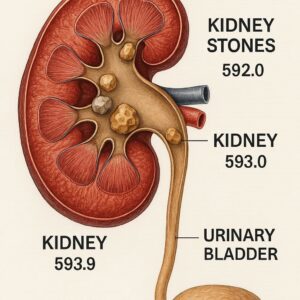
ICD-9 Codes for Kidney Stones
Understanding the ICD-9 Coding System: A Brief Background
Before we dive into the specific codes for kidney stones, let’s set the stage. The International Classification of Diseases, 9th Revision, Clinical Modification (ICD-9-CM) was the standard diagnostic coding system used in the United States from 1979 until October 1, 2015. On that date, the U.S. healthcare system officially transitioned to ICD-10-CM, which offers vastly greater detail and specificity.
Why It Still Matters: “While ICD-9 is a legacy system, millions of patient records, historical research data, and older insurance claims are still cataloged under its framework. Understanding it is key to interpreting that past medical narrative accurately.” – Medical Archival Specialist
However, you might still need ICD-9 codes for several reasons:
-
Analyzing historical health trends or old clinical studies.
-
Processing or appealing an older insurance claim.
-
Understanding your own medical history from before 2015.
-
Working with legacy software systems in certain contexts.
The system is structured numerically. Codes related to kidney stones fall under Chapter 10: Diseases of the Genitourinary System, which spans codes 580-629.
The Core ICD-9 Code for Kidney Stones
The fundamental ICD-9 code that serves as the umbrella for most kidney stone conditions is:
592.0 – Calculus of kidney
This is your starting point. The code 592 represents “Calculus of kidney and ureter,” and the fourth digit “.0” specifically pinpoints the stone as being located in the kidney. It’s used for diagnoses like nephrolithiasis, renal calculus, or a kidney stone without further specification regarding type or complication.
But here’s where the nuance begins. ICD-9 allowed for more specific coding through additional fifth digits. This is where you define the type of stone, which is critical for treatment and dietary understanding.
Breaking Down Kidney Stone Types with Fifth Digits
The code 592.0 is almost always followed by a fifth digit. This digit clarifies the chemical composition of the stone, which is determined through stone analysis if the stone is passed or retrieved.
Here is the complete breakdown:
| ICD-9 Code & Fifth Digit | Description | Common Name & Notes |
|---|---|---|
| 592.0 | Calculus of Kidney | Base code – requires a 5th digit |
| 592.00 | Calculus of kidney, unspecified | Used when the stone type is not analyzed or known. |
| 592.01 | Calculus of kidney, calcium oxalate | The most common type (about 70-80%). Often linked to dietary factors. |
| 592.02 | Calculus of kidney, cystine | Caused by a rare genetic disorder (cystinuria) that leads to excess cystine in urine. |
| 592.03 | Calculus of kidney, magnesium ammonium phosphate | Also known as struvite or infection stones. Often form as a complication of urinary tract infections. |
| 592.09 | Calculus of kidney, other | Captures less common types like uric acid stones (which are radiolucent and don’t show on X-rays), calcium phosphate, or drug-induced stones. |
Important Note for Readers: If you are looking at a record that only shows 592.0 without a fifth digit, it is technically incomplete per ICD-9 coding guidelines. The full, valid code must have five digits. In practice, 592.00 (unspecified) would be used if no further detail was available.
Related ICD-9 Codes for Stone Location and Complications
A kidney stone is often a moving target. It can form in the kidney and then travel, causing different symptoms and requiring different codes. Furthermore, stones can lead to serious complications. Here are the other essential ICD-9 codes in the “592” family.
When the Stone Moves: Ureteral Stones
If a stone passes from the kidney into the tube connecting it to the bladder (the ureter), the diagnosis and code change.
593.5 – Hydroureter
This code is used when a stone (or another obstruction) blocks the ureter, causing it to dilate with backed-up urine. It’s often a secondary code used alongside a primary stone code.
592.1 – Calculus of ureter
This is the direct code for a stone located in the ureter. Like the kidney code, it requires a fifth digit for stone type (e.g., 592.11 for a calcium oxalate stone in the ureter).
Recognizing and Coding Complications
Kidney stones are more than just pain; they can cause significant secondary issues. These complications have their own ICD-9 codes and are often listed alongside the primary stone code.
-
590.81 – Pyelitis and pyelonephritis, not specified as acute or chronic: This codes for a kidney infection, which can be caused by an obstructing stone.
-
584.9 – Acute kidney failure, unspecified: A serious complication if obstruction from a stone causes the kidney to stop filtering properly.
-
599.0 – Urinary tract infection, site not specified: A common co-diagnosis, especially with struvite stones.
-
788.0 – Renal colic: This code from the “Symptoms” chapter is used for the specific symptom of severe, intermittent flank pain caused by the stone’s movement. It is frequently used alongside the diagnostic code (592.xx).
A Practical Guide: Coding Scenarios in the Real World
Let’s translate these codes into realistic patient stories. This shows how coders used the ICD-9 system to paint a clinical picture.
Scenario 1: The First-Time Stone Former
John, 45, arrives at the ER with severe left flank pain radiating to his groin. A CT scan confirms a 4mm stone in his left kidney. He passes it at home a week later but does not retrieve it for analysis.
-
Primary Diagnosis: 592.00 (Calculus of kidney, unspecified)
-
Symptom Code: 788.0 (Renal colic)
-
Coding Rationale: Without stone analysis, the specific type is unknown, so the “unspecified” fifth digit (.00) is correct.
Scenario 2: The Recurrent Stone Former with History
Maria has a history of calcium oxalate stones. She presents with right-sided pain and hydronephrosis (swelling of the kidney) on ultrasound. A stone is visualized in her right ureter.
-
Primary Diagnosis: 592.11 (Calculus of ureter, calcium oxalate)
-
Secondary Diagnosis: 593.5 (Hydroureter)
-
Coding Rationale: Her history allows the coder to specify the stone type. The ureteral location and the resulting complication are both coded.
Scenario 3: The Complex Case with Infection
David presents with fever, chills, and flank pain. He is diagnosed with a large staghorn calculus (a stone that fills the renal pelvis) causing a severe kidney infection.
-
Primary Diagnosis: 592.03 (Calculus of kidney, magnesium ammonium phosphate [struvite])
-
Secondary Diagnosis: 590.81 (Pyelonephritis)
-
Coding Rationale: Staghorn calculi are strongly associated with struvite/infection stones. The resulting infection is a critical part of the medical picture and must be coded.
The Transition from ICD-9 to ICD-10: Why Specificity Matters
The shift to ICD-10-CM in 2015 was a monumental change, driven largely by the need for the specificity that ICD-9 lacked. Let’s compare how the same condition is represented.
| Aspect | ICD-9-CM (Legacy) | ICD-10-CM (Current) |
|---|---|---|
| Sample Code | 592.01 | N20.0 |
| Code Meaning | Calculus of kidney, calcium oxalate | Calculus of kidney |
| Specificity | Specifies stone type (calcium oxalate). | Does not specify stone type in the base code. |
| Laterality | Does not specify left or right kidney. | Must specify laterality: N20.01 (Right), N20.02 (Left), N20.03 (Bilateral). |
| Episode of Care | No ability to indicate if this is a new condition or a follow-up. | Can add a 7th character to show if it’s an initial encounter, subsequent encounter, or sequela. |
| Key Takeaway | Focused on stone composition. | Focused on anatomical location, laterality, and clinical context. |
As you can see, ICD-10 provides a different kind of detail. To code for stone type in ICD-10, you often use a secondary code from category Z87.442 (Personal history of urinary calculus) or note it in the clinical documentation. The systems have different philosophies, which is crucial to understand when converting or comparing data.
FAQ: Your Questions About ICD-9 and Kidney Stones, Answered
Q: I found “592.0” on an old medical bill. What kind of stone did I have?
A: The code 592.0 alone is incomplete. You would need the full five-digit code to know. If it was 592.00, the type was unspecified/unknown. If it was 592.01, you had a calcium oxalate stone. Check if there is another digit on a fuller version of the document.
Q: Can I use ICD-9 codes for a new doctor’s visit or insurance claim today?
A: No. As of October 1, 2015, all HIPAA-covered entities (healthcare providers, insurers, clearinghouses) in the U.S. are required to use ICD-10-CM for diagnosis coding. Using ICD-9 for current services would result in claim rejection.
Q: Why are there separate codes for kidney stones (592.0) and ureter stones (592.1)?
A: Because the location changes the clinical management. A stone in the kidney may be monitored, while a stone stuck in the ureter often requires more urgent intervention to relieve obstruction and pain.
Q: How do I find out what my specific stone type is?
A: The only definitive way is through a stone analysis. If you passed or had a stone removed, your doctor could have sent it to a lab. This result should be in your medical records. Knowing your stone type is vital for preventing future stones through dietary or medical changes.
Q: What is the most important thing to understand about these old codes?
A: That they are a snapshot of a broader, less specific system. An ICD-9 code can tell you “you had a kidney stone,” but to get the full picture—especially for prevention—you need the clinical notes and, ideally, a stone analysis report.
Conclusion
Navigating the world of ICD-9 codes for kidney stones demystifies a key part of medical history for many patients. The core code, 592.0, branches into precise classifications based on stone composition, while related codes capture the stone’s journey and complications. While modern healthcare now uses the more granular ICD-10 system, understanding this legacy framework remains essential for interpreting past records and appreciating the evolution of medical coding. Ultimately, these codes are more than administrative numbers; they are a bridge to understanding your personal health journey.
Additional Resource:
For the most current coding information, always refer to the Centers for Medicare & Medicaid Services (CMS) guide to ICD-10: https://www.cms.gov/medicare/coding-billing/icd-10-codes
Disclaimer: This article is for educational and informational purposes only. It is not a substitute for professional medical coding advice. Specific coding decisions must always be based on the complete patient record and the official coding guidelines in effect at the time of service. For current diagnostic coding, always use ICD-10-CM.
Author: The Medical Coding Team
Date: FEBRUARY 07, 2026