If you’re searching for the ICD-9 code for otitis, you’re likely navigating historical medical records, studying the evolution of healthcare coding, or wrapping up an older billing case. While the ICD-9-CM (International Classification of Diseases, 9th Revision, Clinical Modification) code set was officially retired in the United States on October 1, 2015, understanding its structure remains crucial for many professionals.
This guide will provide you with a complete, accurate, and detailed overview of how otitis media and externa were classified under the ICD-9 system. We’ll explore the specific codes, their meanings, and why this historical knowledge is still relevant today. Our goal is to make this complex topic clear and accessible, whether you’re a medical coder, a nursing student, a healthcare administrator, or simply curious.
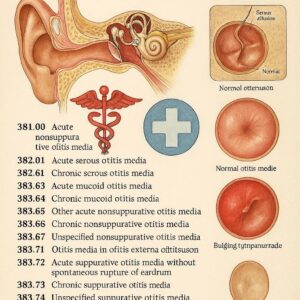
ICD-9 Codes for Otitis
What is ICD-9 and Why Does It Still Matter?
Before we dive into the specific codes, let’s establish some context. The ICD-9-CM was the standard system used in the U.S. for decades to classify diseases, symptoms, and medical procedures for billing, statistical tracking, and public health reporting.
“While ICD-10 provides greater specificity, a firm grasp of ICD-9 principles is like understanding Latin for a linguist—it forms the foundation of modern coding logic and helps in deciphering decades of historical health data.” — Senior Clinical Data Analyst
Even though ICD-10-CM has replaced it, ICD-9 knowledge is essential for:
-
Auditing and Research: Analyzing patient histories or clinical trends that span the 2015 transition date.
-
Legal and Disability Cases: Reviewing medical records from prior years.
-
Educational Understanding: Learning the progression and logic of medical coding systems.
Important Note for Readers: This article is for educational and historical reference. For all current diagnostic coding on claims submitted after October 1, 2015, you must use ICD-10-CM codes. Using ICD-9 on a current claim will result in immediate rejection.
Decoding the ICD-9 Chapter: Diseases of the Nervous System and Sense Organs
In the ICD-9-CM manual, conditions related to the ear and mastoid process are found in Chapter 6: Diseases of the Nervous System and Sense Organs. The specific code block for most ear disorders is 380-389.
For otitis, two core code categories are paramount:
-
381: Otitis media and related disorders
-
382: Suppurative and unspecified otitis media
The fifth digit provides the necessary specificity for accurate coding. Let’s break these down in detail.
ICD-9 Code 381: Non-Suppurative Otitis Media and Eustachian Tube Disorders
This category primarily covers inflammations of the middle ear that are not explicitly described as pus-forming (suppurative). It also includes issues with the Eustachian tube, which is critically involved in middle ear function.
Key Subcategories:
-
381.0: Acute nonsuppurative otitis media
-
381.00: Acute serous otitis media
-
381.01: Acute sanguinous otitis media
-
381.02: Acute mucoid otitis media
-
381.03: Other acute nonsuppurative otitis media
-
381.04: Acute nonsuppurative otitis media, not specified
-
-
381.1: Chronic serous otitis media
-
381.2: Chronic mucoid otitis media (Often associated with “glue ear”)
-
381.3: Other and unspecified chronic nonsuppurative otitis media
-
381.4: Nonsuppurative otitis media, not specified
-
381.5: Eustachian salpingitis (Inflammation of the Eustachian tube)
-
381.6: Obstruction of Eustachian tube
-
381.7: Patulous Eustachian tube (A tube that is abnormally open)
-
381.8: Other disorders of Eustachian tube
-
381.9: Unspecified disorder of Eustachian tube
Helpful List: Common Clinical Terms Mapped to ICD-9 Code 381
-
Serous Otitis Media (SOM): Fluid in the middle ear without active infection. Coded to 381.00 (acute) or 381.1 (chronic).
-
Otitis Media with Effusion (OME): The general term for middle ear fluid. Specificity (serous, mucoid) determines the exact code.
-
“Glue Ear”: A colloquial term for chronic mucoid otitis media (381.2).
-
Eustachian Tube Dysfunction (ETD): Could be coded to 381.6 (obstruction), 381.7 (patulous), or 381.9 (unspecified), depending on physician documentation.
ICD-9 Code 382: Suppurative and Unspecified Otitis Media
This category is for otitis media where pus is present or the documentation does not specify the nature of the fluid. This is where most acute bacterial ear infections were coded.
Key Subcategories:
-
382.0: Acute suppurative otitis media
-
382.00: Acute suppurative otitis media without spontaneous rupture of ear drum
-
382.01: Acute suppurative otitis media with spontaneous rupture of ear drum
-
-
382.1: Chronic tubotympanic suppurative otitis media (Often called “safe” chronic otitis, involving a central perforation)
-
382.2: Chronic atticoantral suppurative otitis media (Often called “unsafe” chronic otitis, involving the attic of the middle ear, potentially with cholesteatoma)
-
382.3: Unspecified chronic suppurative otitis media
-
382.4: Unspecified suppurative otitis media
-
382.9: Unspecified otitis media
Important Note: Code 382.9 was a frequently used “catch-all” for unspecified ear infections in clinical settings where documentation lacked detail. However, for proper billing and statistics, greater specificity was always encouraged.
Comparative Table: ICD-9 Codes for Common Otitis Media Diagnoses
| Clinical Diagnosis | Typical ICD-9 Code | Key Characteristics |
|---|---|---|
| Acute Bacterial Ear Infection | 382.00 or 382.01 | Rapid onset, purulent (pus-filled) fluid, pain, fever. Rupture of the eardrum determines the 5th digit. |
| Ear Infection with Fluid (No Pus) | 381.00 (Acute Serous) | Middle ear effusion that is clear or straw-colored, often following or preceding an upper respiratory infection. |
| “Glue Ear” (Chronic) | 381.2 | Thick, sticky mucoid fluid persisting in the middle ear for months, often affecting hearing. |
| Chronic Draining Ear | 382.1 (Tubotympanic) | Long-standing perforation with intermittent pus discharge, typically from the central part of the eardrum. |
| Unspecified Earache/Infection | 382.9 | Used when the physician’s documentation simply states “otitis media” without qualifying it as acute/chronic or suppurative/nonsuppurative. |
Beyond the Middle Ear: Other Relevant ICD-9 Codes for Otitis
While codes 381 and 382 cover the majority of cases, otitis can affect other parts of the ear. Here are other relevant ICD-9 codes you might encounter.
ICD-9 Code 380: Disorders of External Ear
This covers otitis externa, commonly known as “swimmer’s ear.”
-
380.10: Infective otitis externa, unspecified
-
380.11: Acute otitis externa
-
380.12: Chronic otitis externa
-
380.13: Other infective otitis externa (e.g., fungal)
-
380.14: Malignant otitis externa (A severe, invasive infection typically in diabetics or immunocompromised patients)
ICD-9 Code 383: Mastoiditis and Related Conditions
This covers complications where infection spreads from the middle ear to the mastoid bone.
-
383.0: Acute mastoiditis
-
383.1: Chronic mastoiditis
-
383.9: Unspecified mastoiditis
The Critical Transition: From ICD-9 to ICD-10-CM
The shift to ICD-10-CM wasn’t just an update; it was a massive expansion in specificity. Where ICD-9 had about 14,000 codes, ICD-10 has over 70,000. This allows for much more precise clinical documentation.
Side-by-Side Comparison: Otitis Coding Evolution
| Aspect | ICD-9-CM | ICD-10-CM |
|---|---|---|
| Code Structure | 3-5 digits, mostly numeric | 3-7 characters, alphanumeric |
| Laterality | Rarely specified. A single code covered unilateral, bilateral, or unspecified. | Almost always required. Distinct codes for left (L), right (R), bilateral (B), or unspecified. |
| Episode of Care | Limited specification. | Often specifies initial encounter, subsequent encounter, or sequelae. |
| Example: Acute Suppurative Otitis Media | 382.00 (Unspecified laterality) | H66.001 Acute suppurative otitis media without spontaneous rupture of ear drum, right ear H66.002 Left ear H66.003 Bilateral H66.004 Unspecified ear |
| Example: Chronic Serous Otitis Media | 381.10 | H65.20 Chronic serous otitis media, unspecified ear H65.21 Right ear H65.22 Left ear H65.23 Bilateral |
“The jump from ICD-9 to ICD-10 was like going from describing a car as ‘blue’ to specifying its make, model, year, trim package, and which fender was damaged. The detail is transformative for patient care and health analytics.” — Healthcare Informatics Specialist
Practical Application: How ICD-9 Codes Were Used
To truly understand these codes, let’s look at their real-world application in the pre-2015 era.
The Coding Process Flow:
-
Patient Encounter: A child presents with ear pain and fever. The physician examines them and documents: “Acute suppurative otitis media, right ear.”
-
Medical Coder’s Review: The coder reviews the chart, locating the diagnosis in the progress notes and assessment.
-
Code Assignment: The coder references the ICD-9 manual. The diagnosis maps to 382.0. They check the fifth digit: no mention of tympanic membrane rupture, so they assign 382.00 – Acute suppurative otitis media without spontaneous rupture of ear drum.
-
Claim Submission: The code 382.00 is placed on the health insurance claim form (the HCFA-1500 or its electronic equivalent) alongside the procedure code for the office visit.
-
Payment & Data Collection: The insurer uses the code to adjudicate payment. The code is also stored in databases for population health tracking.
Helpful List: Common Documentation Pitfalls with ICD-9 for Otitis
-
“OM”: Too vague. The coder would need to query for specificity (acute? chronic? with effusion?).
-
“Ear infection”: Even more vague. Would likely default to 382.9.
-
“Fluid in ears”: Could be 381.00, 381.1, or 381.4 depending on acuity and documentation.
-
Lack of Laterality: While not required in ICD-9, noting “right,” “left,” or “bilateral” was good practice and is critical for ICD-10.
Why Depth on a Retired System Matters
You might wonder why such a deep dive into an obsolete system is valuable. The reasons are multifaceted:
-
Continuity of Care: A patient’s lifelong medical record is a hybrid of ICD-9 and ICD-10. Understanding both is key to interpreting their full history.
-
Research Validity: Epidemiological studies tracking disease rates over time must account for the coding transition to avoid misinterpretation of data trends.
-
Legal and Forensic Medicine: Malpractice cases, disability determinations, and workers’ comp claims often rely on records from the ICD-9 era. Accurate interpretation is non-negotiable.
-
Foundational Learning: The logic and structure of ICD-9 provide a simpler framework for students before tackling the complexity of ICD-10.
Additional Resource: For the most authoritative historical reference, you can access the final 2014 version of the ICD-9-CM code set via the U.S. Centers for Disease Control and Prevention (CDC) archive. This serves as the definitive “frozen” version of the system.
Conclusion
Navigating the ICD-9 code for otitis requires understanding the specific categories 381 and 382, which distinguished between nonsuppurative and suppurative forms of middle ear disease. While this system was replaced by the more granular ICD-10-CM in 2015, proficiency in its codes remains essential for working with historical records, ensuring research accuracy, and grasping the foundations of medical classification. Always remember that for contemporary coding, ICD-10 is the mandatory standard, offering precise details like laterality that were absent in its predecessor.
Frequently Asked Questions (FAQ)
Q: What is the most general ICD-9 code for an ear infection?
A: The most general code is 382.9 – Unspecified otitis media. However, more specific codes were always preferred when documentation supported them.
Q: Was there a different ICD-9 code for left vs. right ear otitis?
A: No. Unlike ICD-10, ICD-9 did not typically specify laterality in the code itself. A single code like 382.00 covered acute suppurative otitis media regardless of whether it was in the left, right, or both ears. The medical record itself would note the side.
Q: I have an old medical bill from 2013 with code 381.00. What did I have?
A: Code 381.00 stands for “Acute serous otitis media.” This indicates you had a buildup of non-infected, clear or straw-colored fluid in your middle ear, likely causing fullness and hearing loss, often associated with a cold or allergy flare-up.
Q: Can I use ICD-9 codes on insurance claims today?
A: Absolutely not. All claims for services provided on or after October 1, 2015, must use ICD-10-CM codes. Using an ICD-9 code will result in an immediate rejection of the claim.
Q: How do I convert an old ICD-9 code to the current ICD-10 code?
A: There is no simple one-to-one conversion. You must start with the original physician diagnosis and then find the appropriate, more specific ICD-10 code based on that clinical information. General equivalence mappings (GEMs) exist as guides, but they are not authoritative for coding. Always code from the current clinical documentation using the ICD-10-CM manual.
Date: January 05, 2026
Author: The Medical Coding Resource Team