Navigating the world of medical billing and insurance can often feel like learning a new language. If you or a loved one has been scheduled for a Positron Emission Tomography (PET) scan, you might have heard the term “ICD-10 codes” thrown around, usually followed by a sigh from a medical biller. When Medicare is involved, getting these codes right isn’t just a formality—it is the key to unlocking coverage.
This guide is designed to be your friendly, straightforward companion through this process. We will walk through what Medicare requires, which specific ICD-10 codes are generally approved for PET scans, and how to make sure you are on the right track. We are here to replace confusion with clarity.
Medicare Approved ICD 10 Codes for PET Scans
Understanding the Basics: What is a PET Scan and Why Does Medicare Care About Codes?
Before we dive into the long lists of codes, let’s take a moment to understand the “why.” A PET scan is a powerful imaging test. Unlike an X-ray or CT scan that shows structure, a PET scan shows function. It reveals how your tissues and organs are working at a cellular level.
Doctors use PET scans primarily to:
-
Detect cancer.
-
Determine if cancer has spread (metastasis).
-
Check if cancer treatment is working.
-
Evaluate brain disorders (like Alzheimer’s or seizures).
-
Assess heart muscle function.
Because PET scans are sophisticated and expensive, Medicare, like most insurers, requires proof that the test is medically necessary. This is where ICD-10 codes come in.
ICD-10 stands for the International Classification of Diseases, 10th Revision. These are the specific codes that doctors use to diagnose you. When a provider orders a PET scan, they must attach a diagnosis code (the ICD-10 code) to the order. This code tells Medicare, “This patient has Condition X, and this specific test is required to manage it.”
The Golden Rule: Coverage vs. Approval
It is vital to understand the difference between what Medicare covers and what they approve.
-
Coverage: Medicare has determined that PET scans are a covered benefit for specific conditions listed in their National Coverage Determinations (NCDs).
-
Approval: For your specific scan to be approved, the ICD-10 code on the order must match one of the conditions listed in those coverage determinations.
If the code doesn’t match, or if the clinical information doesn’t support the need for the scan, Medicare may deny the claim, leaving you responsible for the full bill.
The Framework: How Medicare Decides on PET Scan Coverage
Medicare doesn’t just have a random list of codes. They operate under strict guidelines called National Coverage Determinations (NCDs) . For PET scans, the primary NCDs are 220.6 (for oncologic uses) and others for cardiac and neurologic indications.
These NCDs specify:
-
The Type of PET Scanner: Is it a conventional PET or a PET/CT? Is it using dedicated tracers like FDG (fluorodeoxyglucose) or newer amyloid agents?
-
The Clinical Scenario: Is this for initial diagnosis? Is it to see if treatment is working (treatment monitoring)? Is it to detect suspected recurrence?
-
The Diagnosis: This is where the ICD-10 codes come into play. The diagnosis must justify the specific clinical scenario.
Important Note: The landscape of PET scan coverage is constantly evolving. Medicare often expands coverage through “Coverage with Evidence Development” (CED) studies. This means they will cover a scan for a specific code if your data is entered into a registry or clinical study.
Medicare Approved ICD 10 Codes for Oncologic PET Scans
The vast majority of PET scans are performed for cancer. Medicare’s coverage for oncology is specific and categorized by how the scan will be used.
Initial Treatment Strategy (Diagnosis and Staging)
Medicare will generally cover a PET scan for most solid tumors when the patient has a new diagnosis and the scan is needed to determine the stage. This helps the doctor decide on the best treatment path (surgery, radiation, chemotherapy).
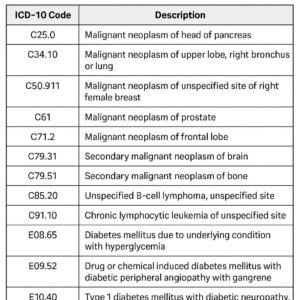
Commonly approved ICD-10 codes for initial staging include:
| ICD-10 Code | Description | Clinical Context |
|---|---|---|
| C34.90 | Malignant neoplasm of unspecified part of unspecified bronchus or lung | Lung cancer diagnosis, ruling out metastasis |
| C50.911 | Malignant neoplasm of unspecified site of right female breast | Breast cancer staging |
| C18.9 | Malignant neoplasm of colon, unspecified | Colorectal cancer staging |
| Malignant neoplasm of overlapping sites of rectum, anus, and anal canal | Rectal cancer staging | |
| C91.90 | Lymphoid leukemia, unspecified | Certain leukemias/lymphomas |
| C43.9 | Malignant melanoma of skin, unspecified | Melanoma staging (high-risk cases) |
| C22.0 | Liver cell carcinoma | Liver cancer assessment |
Important Context: For initial staging, the key is that the cancer diagnosis is either newly established or strongly suspected based on other imaging (like a suspicious mass on a CT scan). The code must be specific to the suspected or confirmed malignancy.
Subsequent Treatment Strategy (Monitoring Treatment Response)
This is one of the most common reasons for a PET scan. Doctors want to know if the chemotherapy or immunotherapy is working. Usually, a scan is done after a few cycles of treatment.
Medicare covers this when the change in management is dependent on the scan results. The codes are essentially the same as above (the cancer diagnosis codes), but the medical record must clearly state that this is for re-evaluation or restaging during or after treatment.
Detecting Suspected Recurrence
If a patient has finished treatment and their tumor markers start to rise, or they develop new symptoms, a doctor might order a PET scan to see if the cancer has returned.
ICD-10 codes for this scenario often fall under “personal history” codes combined with current findings. However, the primary diagnosis for the scan order is often the current suspicion.
| ICD-10 Code | Description | Clinical Context |
|---|---|---|
| Z85.3 | Personal history of malignant neoplasm of breast | This is a history code. It is often used as a secondary code. The primary code might be a symptom code like R93.8 (Abnormal findings on diagnostic imaging of other body structures) |
| Z85.820 | Personal history of malignant neoplasm of prostate | Used when rising PSA suggests recurrence, prompting a PET scan. |
| R97.20 | Elevated prostate specific antigen [PSA] | Specifically for prostate cancer recurrence suspicion. |
Reader Advisory: Using “history of” codes alone is rarely sufficient. Medicare expects to see a current sign, symptom, or rising biomarker that justifies the test. Always pair a history code with a current finding if possible.
Special Cases: Coverage with Evidence Development (CED)
For certain cancers and specific tracers, Medicare requires patients to be enrolled in approved clinical trials or registries. This is known as CED. This is common for:
-
Prostate Cancer (with PSMA-targeted PET agents): While now broadly covered, specific ICD-10 codes are required for patient eligibility, such as rising PSA after definitive treatment.
-
Amyloid PET (for Alzheimer’s): Covered only in CED studies or specific approved scenarios.
If your doctor orders one of these scans, you will likely need to sign an additional form agreeing to participate in a data registry.
Medicare Approved ICD 10 Codes for Neurologic PET Scans
Beyond cancer, PET scans play a crucial role in understanding the brain. Medicare coverage here is more restrictive but well-defined.
For Seizure Disorders (Epilepsy)
For patients with medically refractory seizures (seizures that don’t respond to medication), a PET scan can help locate the focus in the brain where seizures originate. This is critical if surgery is being considered.
Commonly approved codes include:
| ICD-10 Code | Description |
|---|---|
| G40.919 | Epilepsy, unspecified, not intractable, without status epilepticus |
| G40.011 | Localization-related (focal) (partial) idiopathic epilepsy and epileptic syndromes with seizures of localized onset, intractable |
| R56.9 | Unspecified convulsions |
The key factor here is “intractability.” The medical record must show that the seizures are not controlled by medication, justifying the need for a surgical workup.
For Alzheimer’s Disease and Dementia
This is a rapidly evolving area. There are two main types of PET scans for dementia:
-
FDG-PET: Looks at brain metabolism. In Alzheimer’s, specific patterns of reduced metabolism are visible.
-
Amyloid PET: Looks directly at the amyloid plaques in the brain, a hallmark of Alzheimer’s.
Medicare coverage differs significantly between the two.
FDG-PET for Dementia:
Covered for the differential diagnosis of frontotemporal dementia (FTD) versus Alzheimer’s disease, but only under specific provisions.
| ICD-10 Code | Description | Context |
|---|---|---|
| G31.09 | Other frontotemporal dementia | Used when distinguishing FTD from Alzheimer’s |
| G30.9 | Alzheimer’s disease, unspecified | Used to confirm diagnosis in complex cases |
| F03.90 | Unspecified dementia | Often used as a presenting diagnosis before differentiation |
Amyloid PET:
Coverage is currently limited to CED studies or specific coverage determinations for patients with unexplained cognitive decline.
Medicare Approved ICD 10 Codes for Cardiac PET Scans
Cardiac PET scans are excellent for assessing blood flow to the heart muscle. They are often used when a standard stress test is inconclusive or if the patient has specific risk factors.
These scans are typically covered for diagnosing coronary artery disease or assessing if a specific area of heart muscle is still viable (alive) and could benefit from a stent or bypass.
Common codes include:
| ICD-10 Code | Description | Clinical Context |
|---|---|---|
| I25.10 | Atherosclerotic heart disease of native coronary artery without angina pectoris | Assessing blockages and blood flow |
| I25.110 | Atherosclerotic heart disease of native coronary artery with unstable angina pectoris | Used in workup of chest pain |
| I25.5 | Ischemic cardiomyopathy | Checking for viable heart muscle (viability study) |
| R94.31 | Abnormal electrocardiogram [ECG] [EKG] | Non-specific finding needing further clarification |
Practical Steps to Ensure Your PET Scan is Covered
Knowing the codes is only half the battle. Here is how you, as a patient, can be proactive.
1. The “Advance Beneficiary Notice of Noncoverage” (ABN)
If your doctor’s office is unsure whether Medicare will cover your PET scan based on your diagnosis, they may ask you to sign an ABN. This is not a bad thing. It is a document that says, “If Medicare denies this, you agree to pay for it.”
-
What to do: If asked to sign an ABN, don’t panic. Ask the office, “Can you explain why you think Medicare might not cover this?” This opens a conversation. You can then ask if there is a more specific diagnosis code that fits your condition better.
2. The Role of Your Doctor’s Notes
Medicare auditors don’t just look at the codes; they read the doctor’s notes. The note must tell a story that matches the code.
-
If the code is for “suspected recurrence” of lung cancer, the note should say, “Patient with history of lung cancer now presents with new cough and rising tumor markers. PET scan ordered to evaluate for recurrent disease.”
-
This clinical narrative is just as important as the code itself.
3. Prior Authorization
Many Medicare Advantage plans, and sometimes Original Medicare for specific high-cost scans, require Prior Authorization. This means the doctor’s office must send the diagnosis code and clinical notes to Medicare before the scan is scheduled. They get a yay or nay in advance.
Never schedule a PET scan until you have confirmed with the provider’s billing department that prior authorization has been obtained (if required).
Common Reasons for Denial (And How to Avoid Them)
Let’s look at why claims get rejected. Understanding these pitfalls can help you have a more informed conversation with your healthcare team.
-
The Wrong Code: Using a generic “symptom” code when a specific cancer code is available. For example, using “Abdominal pain” (R10.9) for a known pancreatic cancer patient instead of the specific cancer code (C25.9).
-
Outdated Indication: Medicare updates its coverage policies. A code that was covered last year might be restricted this year, or vice versa.
-
Duplicate Testing: Ordering a PET scan when a recent PET/CT was done for the same indication without a significant change in the patient’s condition.
-
Missing Clinical Data: The doctor’s order is simply “PET scan” without the supporting diagnosis or medical necessity statement. The order must be robust.
Frequently Asked Questions (FAQ)
Q: What is the difference between a PET scan and a PET/CT scan?
A: Most modern machines are PET/CT scanners. They combine the functional images of the PET with the detailed structural images of a CT scan in one procedure. Medicare generally covers the combined scan under the same diagnosis codes as a PET scan alone, provided the medical necessity for the PET portion is met.
Q: Does Medicare cover PET scans for screening if I have a strong family history of cancer?
A: Generally, no. Medicare does not cover PET scans for preventive screening in asymptomatic individuals. They are covered for diagnostic purposes—meaning you have a sign, symptom, or known diagnosis.
Q: My doctor ordered a PET scan for “Malaise and fatigue” (R53.81). Will Medicare cover this?
A: It is highly unlikely. “Malaise and fatigue” is too vague to justify the medical necessity of a PET scan. The doctor would need to have a more specific suspected diagnosis, such as “suspected occult malignancy,” which is not a valid ICD-10 code. Instead, they would need to link it to a specific suspected cancer type or a specific abnormal finding from another test.
Q: What happens if my PET scan is denied?
A: You have the right to appeal. Your first step is to contact your doctor’s office. Often, the denial can be overturned with a “redetermination” if the doctor provides additional clinical information that supports the medical necessity. If you signed an ABN, the process is different, and you may be liable for the cost.
Q: Can I look up my specific ICD-10 code to see if it’s covered?
A: You can, but it can be confusing. The best resource is the Medicare Coverage Database on the CMS.gov website. You can search for “PET Scan” and look at the NCDs (220.6) and Local Coverage Determinations (LCDs) for your specific state or region, which often have attached billing articles with lists of covered codes.
Additional Resource
For the most up-to-date information directly from the source, please refer to the official Medicare.gov coverage database. You can search for local coverage determinations by state, which often provide the most granular detail on covered ICD-10 codes for your specific region.
Conclusion
Securing Medicare approval for a PET scan hinges on the precise match between your diagnosis and Medicare’s coverage policies. By understanding that ICD-10 codes are the language of medical necessity, you can better communicate with your provider and verify that your specific situation qualifies for coverage. This proactive approach helps avoid unexpected costs and ensures you receive the essential diagnostic care you need.
Disclaimer: This article is for informational purposes only and does not constitute legal or medical advice. Medicare policies are subject to change and vary by locale. You should always consult with your healthcare provider and Medicare representative to confirm coverage for your specific medical condition and diagnostic needs.