To the patient, it is a momentary pinch, a brief inconvenience on the path to diagnosis or wellness. To the clinician, it is a fundamental skill, a routine procedure performed countless times. But to the medical coder, biller, and practice administrator, venipuncture is far more than a simple needle stick. It is a meticulously defined procedure with its own unique set of codes, rules, and compliance considerations within the vast and complex world of Current Procedural Terminology (CPT®).
The act of drawing blood—phlebotomy or venipuncture—is the cornerstone of modern medicine. Over 70% of all medical decisions are influenced by laboratory results, making this procedure one of the most frequently performed clinical activities globally. Yet, its administrative representation through CPT codes is often misunderstood, leading to significant revenue leakage for providers or, conversely, serious compliance risks from improper billing.
This comprehensive guide delves deep into the world of CPT codes for venipuncture. We will move beyond the basic code numbers to explore the intricate guidelines that govern their use, the documentation required to support them, and the compliance landscape that dictates their appropriate application. Whether you are a seasoned medical coder, a new phlebotomist, a practicing physician, or a healthcare administrator, mastering this fundamental procedure is essential for operational efficiency, financial stability, and regulatory adherence. Our journey will transform your understanding of venipuncture from a mundane task to a strategically critical component of healthcare delivery.
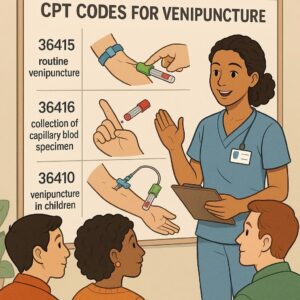
CPT Codes for Venipuncture
Table of Contents
Toggle2. Understanding the Foundation: What is Venipuncture?
Clinical Significance and Procedural Overview
Venipuncture, derived from the Latin words vena (vein) and punctura (a piercing), is the process of obtaining intravenous access for the purpose of blood sampling or therapeutic intervention. For the context of CPT coding, we are primarily concerned with its diagnostic application.
The procedure, while common, requires significant skill and knowledge. A trained phlebotomist, nurse, or other healthcare professional must:
-
Identify the patient using at least two identifiers.
-
Select the appropriate vein, typically in the antecubital fossa (the inner elbow), though dorsal hand or wrist veins may be used.
-
Apply a tourniquet to make the vein more prominent.
-
Disinfect the site thoroughly to prevent infection.
-
Insert a sterile needle into the vein, allowing blood to fill attached vacuum tubes.
-
Release the tourniquet and withdraw the needle, applying pressure to the site to achieve hemostasis.
-
Label the samples accurately at the bedside.
The clinical value of this procedure cannot be overstated. The collected blood enables a vast array of tests—from complete blood counts (CBC) and metabolic panels to genetic testing and toxicology screens—that inform diagnoses, monitor chronic conditions, assess medication levels, and evaluate overall organ function.
From a coding perspective, it is crucial to distinguish the act of venipuncture (the access of the vein) from the actual laboratory tests (the analysis of the specimen). They are separate services with separate codes and are often performed by different entities. This distinction is the source of much coding complexity.
3. The CPT® Coding System: A Brief Primer
The Role of the American Medical Association (AMA)
The Current Procedural Terminology (CPT) code set is a medical code system created and maintained by the American Medical Association (AMA). It is used to describe medical, surgical, and diagnostic services uniformly and provides a standardized language for reporting these services to physicians, coders, patients, accreditation organizations, and payers for administrative, financial, and analytical purposes.
CPT codes are five-digit numeric codes that are updated annually to reflect advances in medicine and the creation of new services. They are categorized into three types:
-
Category I: Codes for procedures and services consistent with contemporary medical practice. Venipuncture codes fall here.
-
Category II: Optional tracking codes used for performance measurement.
-
Category III: Temporary codes for emerging technologies, services, and procedures.
The use of CPT codes is a contractual requirement for billing Medicare and Medicaid, and nearly all private payers in the United States also require them. It is illegal to use CPT codes without a license from the AMA, underscoring the importance of accessing official, updated resources.
4. Decoding the Primary Venipuncture Codes: 36415 and 36416
The CPT manual specifically addresses venipuncture in the “Medicine” section, under “Hydration, Therapeutic, Prophylactic, Diagnostic Injections and Infusions.” The two primary codes are:
Code 36415: Routine Venipuncture
-
CPT Description: “Collection of venous blood by venipuncture.”
-
Interpretation: This code represents the work of accessing a peripheral vein, assembling the equipment, applying a tourniquet, performing the needle stick, and achieving blood flow into the collection device(s). It includes the necessary patient interaction, preparation, and post-puncture care (e.g., applying a bandage).
This code is reported once per encounter, regardless of how many tubes of blood are drawn. Drawing five tubes from a single stick is still a single unit of 36415. Its “routine” nature implies a typical, uncomplicated procedure on a patient who is not exceptionally challenging due to age or physiological condition.
Code 36416: Venipuncture for a Patient Under Age 3
-
CPT Description: “Collection of venous blood by venipuncture; age 3 years or older?” (Note: The AMA’s typical structure implies this is for under age 3, but official descriptor must be checked annually).
-
Interpretation: This code is used specifically for venipuncture performed on an infant or child who is under 3 years of age. This age-based distinction acknowledges the significantly increased difficulty and skill required to perform venipuncture on this population. Their veins are smaller, less prominent, and have more subcutaneous tissue. The procedure often requires a higher level of expertise, more time, specialized equipment (e.g., smaller gauge needles), and additional staff to comfort and restrain the child safely.
Crucial Note: The age threshold is strict. The code is based on the patient’s age on the date of service. A venipuncture for a patient who is 3 years old is reported with 36415, not 36416.
Key Components and Documentation Requirements
The work described by these codes includes:
-
Patient assessment (verifying identity, checking for allergies to antiseptics).
-
Selection of the puncture site.
-
Application of a tourniquet.
-
Cleansing the puncture site.
-
Insertion of the needle.
-
Drawing of the blood.
-
Withdrawal of the needle and application of pressure.
-
Labeling of the specimen(s).
-
Patient instruction post-procedure.
It explicitly does not include the actual analysis of the blood. Those tests have their own set of CPT codes (e.g., 80053 for a comprehensive metabolic panel) from the “Pathology and Laboratory” section.
5. The Bundling Conundrum: Venipuncture as an Integral Part
This is the single most important concept in venipuncture coding. The CPT guidelines and the Centers for Medicare & Medicaid Services (CMS) through the National Correct Coding Initiative (NCCI) have clear rules about when venipuncture can be billed separately from other services.
The National Correct Coding Initiative (NCCI) Edits
The NCCI edits are a set of rules and code pairs designed to prevent improper coding and billing. Their primary purpose is to prevent payment for multiple services that are inherently included in a single, more comprehensive service.
A fundamental NCCI edit states that the work of performing a venipuncture is considered an integral part of another procedure if that procedure requires blood to be drawn. For example:
-
Infusion Services: If a patient comes in for a therapeutic infusion (e.g., 96365, Intravenous infusion for therapy), the venipuncture to establish IV access is a necessary first step. It is bundled into the infusion code and cannot be billed separately.
-
Injection Services: Similarly, if an injection (e.g., 96372, Therapeutic injection) is administered, the venipuncture for that injection is not separately billable.
-
Laboratory Visits: If a patient’s sole reason for the encounter is to have blood drawn for lab tests, the venipuncture is not separately billable with an Evaluation and Management (E/M) code for that same encounter. The E/M service (e.g., 99212) would encompass the reason for the visit and the procedure.
When is it Appropriate to Bill Separately?
Venipuncture (36415 or 36416) can be reported separately only if it is performed:
-
For the purpose of diagnostic blood collection only. The blood draw is the sole procedure performed during the encounter.
-
On a different day than another related procedure.
-
Through a separate and distinct venous access. For instance, if a patient has an existing IV line but the physician orders new labs that must be drawn from a different site to avoid dilution or contamination, the venipuncture may be separately reportable. This almost always requires modifier -59 (see next section).
Bundling Scenarios for Venipuncture Codes
| Scenario | Can 36415/36416 be billed? | Rationale |
|---|---|---|
| Patient visit is solely for a blood draw. | Yes | The venipuncture is the primary and only service. |
| Blood is drawn prior to a scheduled infusion or injection. | No | The venipuncture is the necessary means to administer the other service and is bundled. |
| Blood is drawn from an existing IV line. | No | Drawing blood from an established access is not a venipuncture. It may be included in an IV maintenance code or not separately billable. |
| Blood is drawn during a preventive medicine visit (e.g., annual physical). | It depends | If the blood draw is a routine part of the preventive service, it is likely bundled. If it is for a separate, unrelated diagnostic reason, it may be billable with a modifier. Payer policy varies widely. |
| Blood is drawn from a new, separate site while a pre-existing IV is in place. | Likely Yes (with modifier) | This is a distinct procedural service performed for a specific diagnostic purpose unrelated to the IV’s function. |
6. Modifiers and Venipuncture: Navigating Complex Scenarios
Modifiers are two-digit codes that provide additional information about a service or procedure performed. They can indicate that a service was altered in some way without changing the definition of the code itself.
Modifier -59 (Distinct Procedural Service)
This is the most critical modifier for venipuncture coding. Modifier -59 is used to identify procedures/services that are not normally reported together but are appropriate under the circumstances. It signifies that the procedure was:
-
Performed at a different session or patient encounter
-
Performed by a different procedure or surgery
-
Performed at a different site or organ system
-
A separate incision/excision
-
A separate lesion
-
A separate injury
In the context of venipuncture, -59 would be appended to 36415 to indicate that the venipuncture was a distinct service from another procedure performed on the same day. The most common example is the “separate site” rule mentioned earlier.
Example: A patient is receiving a chemotherapy infusion through an IV in the left arm. The oncologist orders stat labs to check electrolyte levels mid-infusion. To avoid drawing from the line (which could be contaminated with saline or medication), the nurse performs a venipuncture in the right arm.
-
Coding: 36415-59
-
Rationale: The venipuncture was a distinct procedural service performed at a separate anatomical site for a specific diagnostic purpose unrelated to the infusion administration.
Other Relevant Modifiers
-
Modifier -25 (Significant, Separately Identifiable Evaluation and Management Service): This could be used on an E/M code if, during a visit for blood draw, the provider also performs and documents a significant, separate E/M service (e.g., assesses a new patient complaint). The venipuncture would be billed in addition to the E/M-25.
-
Modifier -33 (Preventive Service): If the venipuncture is part of a preventive service mandated by law (like a screening lipid panel under the Affordable Care Act), this modifier may be required by some payers.
7. Documentation: The Bedrock of Compliant Billing
If it isn’t documented, it didn’t happen. This old adage is the cornerstone of medical coding and billing. Clear, precise documentation in the medical record is the only defense against denials and audits.
Essential Elements in the Medical Record
For a venipuncture to be billed, the medical record must support it. Documentation should include:
-
Medical Necessity: The reason for the blood draw must be clear. This is usually established by the provider’s order (e.g., “order for CBC and CMP”).
-
Performance of the Procedure: A note from the performing clinician (nurse, phlebotomist) stating that venipuncture was performed. This can be a simple flowsheet entry or a narrative note.
-
Site of Venipuncture: Documentation of the puncture site (e.g., “right antecubital vein”).
-
Number of Attempts: While not always required, noting a difficult stick with multiple attempts can support medical necessity for the procedure itself.
-
Specimen Handling: Evidence that the specimen was labeled and sent to the lab.
-
For Modifier -59: Crucially, if using modifier -59, the documentation must explicitly state why the venipuncture was distinct. For example: “Drew stat potassium from right hand due to ongoing infusion of normal saline in left antecubital IV. Needed uncontaminated sample.” This level of detail justifies the separate billing.
8. Common Scenarios and Coding Solutions: A Practical Walkthrough
Let’s apply the rules to real-world situations.
Scenario 1: Routine Blood Draw in a Physician Office
A 45-year-old patient presents to her primary care physician’s lab solely to have blood drawn for her annual cholesterol and glucose check as ordered by her doctor last week. The phlebotomist performs a single-stick venipuncture and collects two tubes of blood.
-
Coding: 36415
-
Rationale: The venipuncture is the sole purpose of the encounter. Only one unit is billed regardless of the number of tubes.
Scenario 2: Blood Draw Prior to an Infusion Service
A patient arrives at an infusion center for their monthly biologic drug infusion (96365). The nurse performs a venipuncture to start the IV and administer the drug.
-
Coding: 96365 only.
-
Rationale: The venipuncture is the necessary means to establish vascular access for the infusion and is bundled into the infusion code. 36415 is not billed.
Scenario 3: Multiple Sticks and Difficult Access
An elderly patient with fragile veins requires blood work. The phlebotomist must attempt venipuncture three times before successfully obtaining blood.
-
Coding: 36415 (one unit only).
-
Rationale: CPT codes represent the service performed, not the difficulty or number of attempts. A venipuncture is a venipuncture, whether it takes one attempt or three. The code is reported only once per encounter. The work of the additional attempts is not separately payable.
Scenario 4: Venipuncture in the Hospital Outpatient Setting
A patient is in the Emergency Department being treated for chest pain. They have an IV placed in their left arm for administering medication. The physician orders cardiac enzyme tests to be drawn every 4 hours. The nurse draws the first set from the existing IV line. For the second set, the IV is clogged, so the nurse performs a new venipuncture in the right arm to obtain the sample.
-
Coding: For the first draw: Not billable (from existing IV). For the second draw: 36415-59.
-
Rationale: The second venipuncture was a distinct procedural service performed at a separate site because the initial access was unusable. The modifier -59 indicates this distinction. The medical record must document the reason for the new stick.
9. The Financial Impact: Reimbursement Considerations
The reimbursement for venipuncture is relatively low, which is why understanding the bundling rules is critical to avoid spending more money to submit a claim than you will get paid.
Relative Value Units (RVUs) and Payment
Payment for medical services under Medicare and many other payers is based on the Resource-Based Relative Value Scale (RBRVS). Each CPT code is assigned RVUs that measure:
-
Work RVU (wRVU): The physician’s or clinician’s time, skill, and effort.
-
Practice Expense RVU (peRVU): The cost of overhead, such as staff, equipment, and supplies.
-
Malpractice RVU (mRVU): The cost of professional liability insurance.
These RVUs are multiplied by a geographic practice cost index (GPCI) and a conversion factor (CF) to determine the final payment.
Example (using national averages, actual rates vary):
-
CPT 36415 has very low total RVUs (e.g., 0.18 total RVUs).
-
If the conversion factor is $34.00, the payment would be approximately: 0.18 RVUs * $34.00 = $6.12.
This meager reimbursement highlights why it is financially nonsensical to unbundle and bill 36416 inappropriately. If audited, the practice would have to pay back the $6.12 but could also be fined $50-$5,000 per claim under the False Claims Act, plus face potential penalties and exclusion from federal programs.
10. Audit Risks and Compliance: Avoiding Costly Mistakes
Incorrectly billing for venipuncture is a common audit target for Medicare Administrative Contractors (MACs) and private payers because it is a high-volume, low-cost service where errors are frequent.
Common Audit Triggers
-
Routine Billing with E/M Services: Automatically billing 36415 with every office visit where blood is drawn.
-
Billing with Infusions/Injections: Failing to bundle the venipuncture into these larger procedures.
-
Upcoding Age: Using 36416 for patients who are clearly 3 years or older.
-
Lack of Medical Necessity: No supporting order or reason for the blood draw in the record.
-
Missing Modifier -59 Documentation: Billing 36415-59 without the required documentation justifying the distinct service.
Developing a Proactive Compliance Plan
-
Education: Regularly train all staff—providers, nurses, phlebotomists, coders, and billers—on the correct application of venipuncture codes and NCCI edits.
-
Audit Internally: Conduct periodic internal audits of claims containing 36415/36416 to ensure compliance with payer rules before an external auditor finds the errors.
-
Clear Documentation Policies: Establish protocols for clinicians to document venipuncture, especially when a modifier is needed.
-
Software Edits: Configure your billing software to flag claims that contain 36415/36416 with other codes that have bundling edits, requiring a manual review and justification before submission.
11. The Future of Phlebotomy and Coding
The field is not static. Technology and practice are evolving.
Technological Advancements
-
Automated Phlebotomy Devices: Devices like the Velano Vascular’s needle-free blood draw technology or the automated venipuncture device from VascuLogic could change the physical procedure, potentially leading to new CPT codes or altered guidelines in the future.
-
At-Home Phlebotomy: Services that send phlebotomists to a patient’s home are growing. Coding remains the same (36415), but place-of-service codes and billing logistics differ.
-
Micro-sampling: Technologies that allow for accurate diagnostic testing from a single drop of blood from a fingerstick could reduce the need for traditional venipuncture for certain tests.
Evolving Coding Guidelines
The AMA’s CPT Editorial Panel constantly reviews and updates codes. As technology and medical practice change, the definitions and rules for 36415 and 36416 may be refined. It is imperative to stay updated with the annual CPT changes published by the AMA.
12. Conclusion: Mastering the Nuance
Venipuncture coding, embodied by CPT codes 36415 and 36416, is a deceptively complex element of medical billing. Its simplicity belies a web of strict NCCI bundling edits, precise documentation requirements, and significant compliance risks. Accurate coding demands a clear understanding that this service is only separately reportable when it stands alone as the primary diagnostic procedure. Mastering this nuance—knowing when to bill, when to bundle, and how to document—is essential for ensuring both financial integrity and regulatory compliance in any healthcare setting where blood is drawn.
13. Frequently Asked Questions (FAQs)
Q1: Can I bill a venipuncture code for drawing blood from a central venous access device (e.g., a PICC line or port)?
A: No. CPT codes 36415 and 36416 are specific for venipuncture, which is defined as accessing a peripheral vein. Drawing blood from an established central line is a different procedure and is typically represented by other codes, such as 36591 (Collection of blood specimen from a completely implantable venous access device) or 36592 (from a central venous access device, not elsewhere classified). These codes have their own rules and reimbursement rates.
Q2: What if I am unable to obtain blood after multiple attempts? Can I still bill for the venipuncture?
A: Generally, no. Most payers, including Medicare, consider a procedure to be complete and billable only if it is successful. An unsuccessful attempt is not considered a rendered service for billing purposes. However, you should still document the attempts in the medical record as it demonstrates the medical necessity for any subsequent, successful procedure.
Q3: How do I code for a capillary blood collection (e.g., a fingerstick)?
A: Venipuncture codes are not used for capillary collection. Capillary blood collection is typically coded using 36416 if the patient is under 3 years old, but for a different purpose. For older patients, it’s often included in the lab test itself or may have a specific code like 82962 (Glucose, blood by glucose monitoring device(s) cleared by the FDA specifically for home use). The primary code is usually the lab test itself (e.g., 85027 for a CBC from a capillary sample).
Q4: Can a venipuncture code be billed by itself, or does it need a diagnosis code?
A: Every billed procedure must be linked to a diagnosis code that justifies its medical necessity. For a venipuncture, the diagnosis would be the reason the blood tests were ordered (e.g., Z13.6 for encounter for screening for cardiovascular disorders, or E11.9 for Type 2 diabetes mellitus). The lab tests themselves will also need to be linked to these diagnoses.
14. Additional Resources
For the most accurate and up-to-date information, always consult the primary sources:
-
The Official AMA CPT® Professional Edition Codebook: The definitive source for CPT codes and guidelines. Must be purchased annually.
-
CMS National Correct Coding Initiative (NCCI) Policy Manual: Chapter 9 specifically addresses “Hydration, Injection, and Infusion Coding.”
-
Your Medicare Administrative Contractor (MAC) Website: MACs often publish articles and FAQs with jurisdiction-specific guidance on how they interpret and pay for venipuncture.
-
The American Academy of Professional Coders (AAPC) & American Health Information Management Association (AHIMA): These professional organizations offer certifications, training, webinars, and forums that are invaluable for coders.
Date: September 5, 2025
Author: The MediCodex Team
Disclaimer: The information contained in this article is for educational and informational purposes only and does not constitute medical, legal, or coding advice. While every effort has been made to ensure the accuracy of the information, CPT® codes are proprietary to the American Medical Association (AMA), and users must consult the most current, official AMA CPT code books and guidelines for accurate coding and billing. Always consult with a qualified healthcare professional or certified medical coder for specific advice.