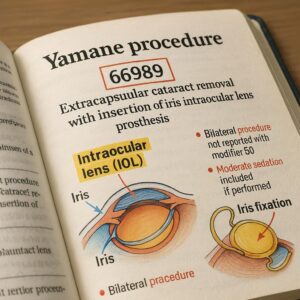
In the intricate world of ophthalmic surgery, few techniques have generated as much enthusiasm and adoption in recent years as the Yamane procedure. A brilliant solution to a complex problem, this technique for securing a secondary intraocular lens (IOL) has given countless patients the gift of clear vision where few options previously existed. Yet, for every elegant surgical innovation, there follows a critical, albeit less glamorous, question: How do we code for it? In the intricate language of Current Procedural Terminology (CPT®), accurately translating the skill, time, and resources required for a procedure like the Yamane technique is paramount. It ensures that surgeons and Ambulatory Surgery Centers (ASCs) are appropriately reimbursed and that a clear data trail exists for this advanced care. This article delves deep into the intersection of surgical artistry and medical coding, providing a definitive guide to understanding, documenting, and correctly coding the Yamane procedure.
CPT Code for the Yamane Procedure
2. Understanding the Clinical Need: Why the Yamane Procedure Was Developed
The Challenge of Aphakia and Insufficient Capsular Support
Aphakia, the absence of the eye’s natural lens, is a significant cause of visual impairment. This can occur due to:
-
Complicated cataract surgery: Where the posterior capsule ruptures, making it impossible to place a standard IOL in the capsular bag.
-
Trauma: Severe eye injury can dislocate the natural lens or a previously implanted IOL.
-
Subluxated lenses: Conditions like pseudoexfoliation syndrome, Marfan syndrome, or homocystinuria can weaken the zonular fibers that hold the lens in place, leading to its partial or complete dislocation.
-
Previous intraocular surgery.
Without a lens, the eye is profoundly hyperopic (farsighted) and unable to focus. The primary goal of secondary IOL implantation is to correct this refractive error and restore functional vision.
Historical Solutions and Their Limitations
Before techniques like Yamane’s became popular, surgeons had several other options, each with notable drawbacks:
-
Anterior Chamber IOLs (AC IOLs): Placed in the front chamber of the eye. While surgically simpler, they are associated with long-term risks like corneal endothelial cell loss (leading to corneal edema and bullous keratopathy), pupil distortion, and chronic inflammation.
-
Iris-Sutured IOLs: A posterior chamber IOL is sutured to the iris. This technique carries risks of chronic iris inflammation, pigment dispersion, iris sphincter erosion, and potential hyphema (blood in the anterior chamber).
-
Trans-scleral Sutured IOLs: A posterior chamber IOL is sutured to the scleral wall. This was a gold standard for years but is a technically challenging, time-consuming procedure. The long-term risk involves the suture material itself—it can degrade, break, or erode through the conjunctiva, leading to IOL dislocation, endophthalmitis (a severe intraocular infection), or vitreous hemorrhage.
These limitations drove the search for a sutureless, secure, and anatomically favorable method for placing a secondary IOL in the posterior chamber—the same location as the natural lens.
3. The Yamane Technique Demystified: A Step-by-Step Surgical Walkthrough
First described by Dr. Shin Yamane of Japan in 2017, the technique is renowned for its elegance and effectiveness. Its core innovation is the creation of a “flanged” haptic tip that is securely locked inside a scleral tunnel.
Principle and Innovation: The Flanged Haptic Technique
The procedure uses a standard three-piece IOL, typically with polypropylene (Prolene) haptics. The key steps involve:
-
Externalizing the haptics of the IOL through strategically placed sclerotomies.
-
Using a fine-tip cautery device to melt the end of each haptic, forming a small, round “ball” or flange.
-
Allowing this flange to cool and solidify.
-
As the haptic retracts slightly back into the scleral tunnel, the flange acts as an anchor, locking the IOL securely in place without the need for sutures.
This creates a stable, ab interno (from the inside) fixation method that positions the IOL in the physiological posterior chamber.
Preoperative Considerations and Patient Selection
Ideal candidates include patients with aphakia and insufficient capsular support who are not suitable for other methods. Critical preoperative steps include:
-
Biometry: Precise measurement of the eye to calculate the correct IOL power is crucial. Specific formulas (e.g., Barrett, Kane, or Holladay 2) have adjustments for sulcus-placed or sutured IOLs.
-
Anterior Segment Imaging: Ultrasound biomicroscopy (UBM) or anterior segment OCT can help assess anatomy, identify the ideal haptic fixation points, and rule out other pathologies.
-
Informed Consent: Patients must be thoroughly counseled on the risks (e.g., haptic breakage, choroidal hemorrhage, IOL tilt, cystoid macular edema, retinal detachment) and benefits compared to other options.
Surgical Steps: From Conjunctival Peritomy to Scleral Tunnel Creation
-
Anesthesia: Peribulbar or retrobulbar block, or general anesthesia.
-
Exposure: A conjunctival peritomy is performed to expose the sclera in the intended quadrants (usually two and eight o’clock for horizontal fixation).
-
Marking: The intended sclerotomy sites are marked 2.0 mm from the limbus.
-
Scleral Tunnels: Two straight, 2.0-3.0 mm long, lamellar scleral tunnels are created with a thin blade (e.g., 15-degree or microvitreoretinal (MVR) blade) directed toward the limbus. The external entry is made with a 27- or 30-gauge needle.
-
Pars Plana Vitrectomy: A standard three-port pars plana vitrectomy is performed to remove the vitreous body, which is essential to prevent traction on the retina.
-
IOL Insertion: The three-piece IOL is inserted into the anterior chamber or the ciliary sulcus.
-
Haptic Externalization: Using intraocular forceps or a specially designed needle (e.g., Yamane Double-Needle Stabilizer), the trailing haptic is grasped and externalized through the opposite sclerotomy. The process is repeated for the leading haptic.
-
The Art of Externalizing and Flanging the Haptic: With the haptic externalized, a low-temperature ophthalmic cautery (e.g., 0.2-mm tip) is gently touched to the tip of the haptic. The polypropylene melts and forms a perfect sphere. The cautery is removed, the flange solidifies within seconds, and the haptic is released, allowing it to retract and seat the flange securely within the scleral tunnel.
-
Final IOL Positioning and Wound Closure: The IOL is centered. The conjunctiva is closed over the sclerotomy sites with suture or fibrin glue. The ports are sutured.
4. Navigating the CPT® Universe: An Introduction to Procedural Coding
CPT® codes are a uniform coding system developed and maintained by the American Medical Association (AMA). They are used to describe medical, surgical, and diagnostic services and are essential for communication between healthcare providers and payers.
Key principles include:
-
Unbundling: Reporting multiple codes for components of a procedure that are included in a single, more comprehensive code. This is incorrect unless the components are performed independently and are distinctly separate.
-
Modifiers: Two-digit codes appended to a CPT code to indicate that a service or procedure was altered by specific circumstances, without changing the code’s definition.
-
Global Period: The number of postoperative days (0, 10, or 90) during which all related care (e.g., follow-up visits, minor complications) is included in the payment for the primary procedure.
5. The Heart of the Matter: Assigning the Correct CPT Code for Yamane
This is the central question. The Yamane procedure involves secondary IOL implantation, but it is not described by a unique, specific CPT code. Therefore, coders must apply existing codes that best describe the work involved.
Code 66982: The Intracapsular Cataract Extraction (ICCE) Paradox
-
CPT Description: “Extracapsular cataract removal with insertion of intraocular lens prosthesis (1 stage procedure), using technique other than phacoemulsification (eg, irrigation or aspiration).”
-
Applicability to Yamane: Not Appropriate. This code is for a primary cataract extraction (specifically ICCE) with primary IOL implantation. The Yamane procedure is performed on an aphakic eye; the natural lens is already absent. Using this code would be incorrect and considered misrepresentation.
Code 66985: The Most Common and Appropriate Choice
-
CPT Description: “Insertion of intraocular lens prosthesis (secondary implant), not associated with concurrent cataract removal.”
-
Applicability to Yamane: This is the most accurate and commonly used code for the Yamane procedure. It explicitly describes the work of placing an IOL in an eye that is already aphakic. It captures the surgical work of the IOL implantation itself.
Code 66986: The Complex Cataract Code
-
CPT Description: “Exchange of intraocular lens.”
-
Applicability to Yamane: Not Appropriate. This code is used when a previously placed IOL is removed and a new one is inserted in its place during the same operative session. The Yamane procedure is for placing an IOL in an aphakic eye, not for exchanging an existing IOL.
CPT Code Comparison for Secondary IOL Procedures
| CPT Code | Code Description | Primary Use Case | Applicable to Yamane? |
|---|---|---|---|
| 66982 | Extracapsular removal + IOL (1 stage) | Primary ICCE surgery | No (Aphakic eye, no lens removal) |
| 66985 | Insertion of IOL (secondary implant) | Placing an IOL in an aphakic eye | Yes, this is the primary code |
| 66986 | Exchange of intraocular lens | Removing an existing IOL and replacing it | No (No existing IOL to remove) |
| 66825 | Suturing of IOL | Repositioning or securing an IOL with suture | No (Yamane is sutureless) |
| 67255 | Repair of retinal detachment | If performed concurrently | Only if a separate, distinct retinal detachment repair is done |
The Critical Role of Vitrectomy (67040)
A pars plana vitrectomy is an integral and necessary part of the Yamane procedure to prevent vitreous traction. CPT code 67040 (Vitrectomy, mechanical, pars plana approach) is typically reported in addition to 66985.
However, a modifier must be appended to 67040 to indicate it is a distinct procedure. This is most commonly Modifier -59 (Distinct Procedural Service) or, more specifically, one of the X{EPSU} modifiers (e.g., -XS, Separate Structure). This tells the payer that the vitrectomy was not a routine component of the IOL insertion but a separate, necessary service.
6. The Nuances of Modifier Use: Telling the Complete Story
Using the correct modifiers is as important as choosing the correct primary code.
-
Modifier -22 (Increased Procedural Services): The Yamane procedure can be significantly more complex than a standard secondary IOL insertion (e.g., in cases of severe trauma, fibrotic tissue, or unstable anatomy). If the documentation supports a level of complexity substantially greater than typically required, Modifier -22 can be appended to 66985. This must be accompanied by a detailed operative report and a special report letter justifying the increased time, effort, and skill required.
-
Modifier -50 (Bilateral Procedure): If the Yamane procedure is performed on both eyes during the same surgical session, report 66985-50. Payer policies on bilateral procedure reimbursement vary.
-
Modifier -51 (Multiple Procedures): When multiple procedures are performed on the same day, the primary procedure is listed first without modifier -51. All subsequent procedures are listed with modifier -51. In a Yamane case, 66985 might be the primary procedure, and 67040 would be listed with modifier -51 (though the -59/X{EPSU} modifier often takes precedence for this specific combination).
-
Modifier -52 (Reduced Services): Rarely used for Yamane, but could apply if, for some unforeseen reason, the procedure was started but not completed (e.g., only one haptic was fixated due to a complication).
-
Modifier -59 / -X{EPSU} (Distinct Procedural Service): This is critical. Append this to the vitrectomy code (67040) to indicate it was a separate service from the IOL insertion. The X{EPSU} modifiers provide more granularity:
-
-XS: Separate Structure
-
-XU: Unusual Non-Overlapping Service
-
7. Operative Note Documentation: The Foundation of Accurate Coding
The operative note is the legal record of the surgery and the basis for all coding. It must be detailed and precise.
Key Elements to Include for the Yamane Procedure:
-
Preoperative Diagnosis: e.g., Aphakia, status post complicated cataract surgery, inadequate capsular support.
-
Postoperative Diagnosis: (Same as above).
-
Procedure(s) Performed:
-
Pars plana vitrectomy of the right eye.
-
Sutureless intrascleral fixation of secondary intraocular lens using the flanged haptic technique (Yamane technique) in the right eye.
-
-
Indication for Surgery: Why it was needed.
-
Detailed Description:
-
Mention the creation of conjunctival peritomy and scleral tunnels 2.0 mm from the limbus.
-
Specify the gauge of the needles used (e.g., 27-gauge, 30-gauge).
-
Explicitly state that a pars plana vitrectomy was performed.
-
Note the type of IOL implanted (e.g., “a three-piece acrylic IOL”).
-
Describe the externalization of both haptics.
-
Crucially, document the use of cautery to create a “flanged” or “mushroom” tip on each haptic.
-
Describe the retraction of the haptics and confirmation of stable IOL position.
-
Note how the conjunctiva was closed (suture or glue).
-
Sample Operative Note Language:
“…The trailing haptic was then grasped with intraocular forceps and externalized through the superotemporal sclerotomy. A low-temperature cautery was applied to the tip of the polypropylene haptic, forming a symmetrical flange. The haptic was released and retracted spontaneously, seating the flange securely within the scleral tunnel. The identical process was then performed for the leading haptic at the superonasal site. The IOL was well-centered and stable…”
8. Billing and Reimbursement Landscape: From Code to Payment
-
RVUs (Relative Value Units): Each CPT code is assigned RVUs by the Centers for Medicare & Medicaid Services (CMS). These measure the resources required to perform a service (physician work, practice expense, malpractice insurance). The total RVU is multiplied by a conversion factor to determine the payment amount.
-
66985 typically has higher work RVUs than a standard cataract surgery (66984) due to its complexity.
-
67040 also carries its own RVU value.
-
-
Payer-Specific Variations: While Medicare follows CMS guidelines, private insurers may have their own policies (Local Coverage Determinations – LCDs) regarding the bundling of 67040 with 66985. Thorough knowledge of your major payers’ policies is essential.
-
Medical Necessity: The diagnosis codes (ICD-10-CM) must support medical necessity for the procedure. Common codes for Yamane include:
-
Z96.1: Presence of intraocular lens (for IOL exchange, not Yamane)
-
H27.0: Aphakia (This is the primary diagnosis)
-
H59.81-: Other intraoperative complications of the eye and adnexa (e.g., H59.811 for a past capsule rupture)
-
H44.31-: Aphakia of eye (use additional code for the cause, if known)
-
-
Common Denials: The most common denial is the bundling of 67040 with 66985. The solution is consistent and correct use of modifier -59/X{EPSU} on 67040, backed by strong documentation in the operative note that clearly describes the vitrectomy as a distinct and necessary step.
9. Beyond the Yamane: Other Secondary IOL Techniques and Their Codes
It’s important to know how Yamane fits into the broader landscape.
-
Iris-Sutured IOL (66682): CPT code 66682 (Suture of iris for fixation of intraocular lens) is specific to this technique.
-
Anterior Chamber IOL (0055T): Category III code 0055T is used for the insertion of a new type of iris-prosthesis complex for aphakia. Standard AC IOLs may be coded with 66985, but payer policies vary.
-
Scleral-Sutured IOL (66225): Code 66225 (Revision or repair of operative wound of posterior segment) is sometimes used, though its description is not a perfect fit. It is more commonly used for repositioning a dislocated IOL with suture. The primary code for the initial implantation of a scleral-sutured IOL would still be 66985, with the work of suturing included.
10. The Future of Coding: Emerging Technologies and Code Evolution
As the Yamane technique and its variations (e.g., using four-haptic IOLs, fibrin glue-assisted techniques) evolve, the CPT coding system may adapt. The AMA’s CPT Editorial Panel is constantly reviewing new procedures. It is possible that a more specific code or a Category III tracking code could be created in the future to more precisely describe intrascleral fixation without suture. Staying abreast of these changes through professional organizations like the American Academy of Ophthalmology (AAO) and the American Society of Cataract and Refractive Surgery (ASCRS) is critical for coding professionals.
11. Conclusion
The Yamane procedure represents a significant advancement in ophthalmic surgery, offering a secure, sutureless solution for aphakic patients. Accurate coding for this complex surgery is achieved primarily through CPT code 66985 for the secondary IOL implantation. Reporting a pars plana vitrectomy with code 67040 with a modifier -59 or -X{EPSU} is essential to reflect the distinct nature of this required step. Ultimately, unwavering adherence to detailed and precise operative documentation is the cornerstone that supports correct coding, ensures appropriate reimbursement, and justifies the high level of skill involved in this remarkable technique.
12. Frequently Asked Questions (FAQs)
Q1: Is there a specific CPT code just for the Yamane procedure?
A1: No, there is not a unique CPT code exclusively for the Yamane technique. It is reported using the existing code for secondary IOL implantation, 66985, along with the code for the necessary vitrectomy, 67040.
Q2: Why do I need to use a modifier with the vitrectomy code (67040)?
A2: Without a modifier, payers may consider the vitrectomy an integral part of the secondary IOL complex and bundle it, denying payment for 67040. Modifier -59 or -X{EPSU} indicates that the vitrectomy was a separate, distinct, and medically necessary procedure.
Q3: Can I report code 66982 for the Yamane procedure?
A3: No. Code 66982 is for a primary cataract extraction (ICCE) combined with primary IOL implantation. The Yamane procedure is performed on an eye that is already aphakic; no cataract is being removed.
Q4: What is the most important factor for getting paid correctly for a Yamane procedure?
A4: Documentation. The operative report must meticulously detail every step of the procedure, specifically highlighting the creation of scleral tunnels, haptic externalization, and the flanging process with cautery. This justifies the use of 66985 and the separate reporting of the vitrectomy.
Q5: How do I code if I have to convert to a different technique mid-surgery?
A5: Code for the procedure that was actually completed. For example, if you start a Yamane but a haptic breaks and you must convert to placing an anterior chamber IOL, you would code only for the AC IOL insertion (likely 66985, but confirm payer policy for AC IOLs). The operative note must clearly explain the reason for the change.
13. Additional Resources
-
American Medical Association (AMA): For purchasing the official CPT® codebook and accessing coding resources. https://www.ama-assn.org/
-
American Academy of Ophthalmology (AAO): Provides coding guides, newsletters, and webinars specifically for ophthalmology. https://www.aao.org/
-
American Society of Cataract and Refractive Surgery (ASCRS): Offers clinical and coding resources, including forums for discussion. https://ascrs.org/
-
Centers for Medicare & Medicaid Services (CMS): For Medicare-specific policies, fee schedules, and National Coverage Determinations (NCDs). https://www.cms.gov/
-
Peer-Reviewed Literature: Reading the original article and subsequent studies is invaluable for understanding the technique.
-
Yamane S, Sato S, Maruyama-Inoue M, Kadonosono K. Flanged Intrascleral Intraocular Lens Fixation with Double-Needle Technique. Ophthalmology. 2017;124(8):1136-1142.
-
Date: September 12, 2025
Disclaimer: This article is intended for informational and educational purposes only. It is not a substitute for professional medical coding, billing, or legal advice. CPT® codes are copyrighted by the American Medical Association (AMA). Medical providers must purchase a license from the AMA and use the most current CPT codebook for accurate coding and billing. Always consult with a certified professional coder and your payer-specific guidelines for definitive guidance.