
In the intricate ecosystem of modern healthcare, the seamless flow of information is as critical as the flow of blood. At the heart of this informational circulatory system lies medical coding—a complex language that translates patient diagnoses, procedures, and services into standardized alphanumeric codes. For the uninitiated, these codes may seem like an arcane series of letters and numbers, but for healthcare administrators, insurers, and researchers, they are the very bedrock upon which reimbursement, public health tracking, and clinical advancement are built. Among the thousands of procedures performed daily, the Magnetic Resonance Imaging (MRI) of the cervical spine stands out as a pivotal diagnostic tool for a myriad of neurological and musculoskeletal conditions. Accurately coding this procedure using the International Classification of Diseases, Tenth Revision, Procedure Coding System (ICD-10-PCS) is not merely an administrative task; it is a precise science that ensures patients receive appropriate care, providers are justly compensated, and data integrity is maintained for future medical discovery. This article delves deep into the world of ICD-10-PCS coding for cervical spine MRI, moving beyond a simple code lookup to explore the anatomical, clinical, and administrative rationale behind each character, empowering coders, clinicians, and healthcare students with the knowledge to navigate this complex landscape with confidence and accuracy.
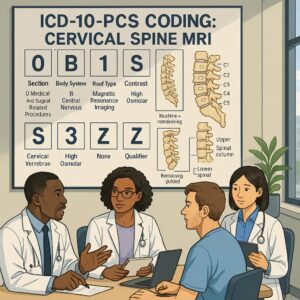
ICD-10-PCS for Cervical Spine MRI
2. Understanding the Foundations: ICD-10-PCS vs. ICD-10-CM
A fundamental point of confusion, even for seasoned healthcare professionals, is the distinction between the two parts of ICD-10 used in the United States. Understanding this difference is the first step toward accurate code assignment.
-
ICD-10-CM (International Classification of Diseases, 10th Revision, Clinical Modification): This system is used to report diagnoses and reasons for encounters. When a physician diagnoses a patient with a condition like “cervical spinal stenosis,” the code for that condition (e.g., M48.02) comes from ICD-10-CM. It describes what is wrong with the patient.
-
ICD-10-PCS (International Classification of Diseases, 10th Revision, Procedure Coding System): This system is used exclusively in inpatient hospital settings to report procedures. It describes what was done to the patient. While CPT (Current Procedural Terminology) codes are used for physician services and outpatient procedures, ICD-10-PCS is mandated for reporting inpatient procedures. It is a multi-axial, seven-character alphanumeric code, where each character has a specific meaning related to the procedure.
For a patient admitted to the hospital for severe neck pain who undergoes a cervical spine MRI, the coder would use:
-
ICD-10-CM codes for the diagnoses: e.g., M54.2 (Cervicalgia), M50.220 (Other cervical disc degeneration, mid-cervical region).
-
ICD-10-PCS code for the procedure: the MRI itself.
This article focuses exclusively on the ICD-10-PCS component of this scenario.
3. The Clinical Imperative: Why a Cervical Spine MRI is Ordered
To code a procedure correctly, one must first understand its clinical purpose. The cervical spine, consisting of the first seven vertebrae (C1-C7), is a marvel of biological engineering, providing structural support for the head while allowing for a remarkable range of motion. It also houses and protects the most critical part of the central nervous system: the spinal cord. Nerves branching off from the spinal cord at each vertebral level innervate the muscles of the neck, shoulders, and arms. Given its complexity and vulnerability, it is prone to a variety of ailments.
A Cervical Spine MRI is the imaging modality of choice for evaluating soft tissues. Unlike X-rays or CT scans, which are excellent for visualizing bone, MRI uses powerful magnets and radio waves to generate detailed, high-resolution images of non-bony structures. A physician will order this study to:
-
Identify Herniated Discs: To visualize when the soft, gel-like center of an intervertebral disc pushes through a tear in its tougher exterior, potentially compressing a nerve root or the spinal cord.
-
Assess Spinal Stenosis: To determine the narrowing of the spinal canal, which can put pressure on the spinal cord (myelopathy) or nerve roots (radiculopathy).
-
Detect Tumors or Masses: To identify both benign and malignant growths within the spinal cord, the meninges (membranes covering the spinal cord), or the vertebrae.
-
Evaluate Traumatic Injuries: Following significant trauma, to assess for ligament tears, spinal cord contusions, or fractures not visible on X-ray.
-
Diagnose Degenerative Disc Disease: To assess the wear-and-tear of discs and facet joints, a common cause of chronic neck pain.
-
Investigate Inflammatory or Infectious Processes: Such as meningitis, arachnoiditis, or discitis (infection of the disc space).
-
Monitor Post-Surgical Changes: To evaluate the spine after a surgical procedure like a discectomy or fusion.
This clinical context directly informs the coder’s work, as the reason for the study is often documented alongside the procedure note and can provide clues for accurate code selection.
4. Deconstructing the ICD-10-PCS Code for Cervical Spine MRI
The power of ICD-10-PCS lies in its logical structure. Every code is seven characters long, and each character represents a specific aspect of the procedure. Let’s build the code for a Cervical Spine MRI from the ground up.
[Image: A detailed, labeled diagram of the cervical spine (C1-C7) showing the vertebrae, intervertebral discs, spinal cord, and nerve roots. This visual will help coders understand the anatomy they are coding.]
*Caption: Understanding cervical spine anatomy is crucial for accurate body part identification in ICD-10-PCS.*
Character 1: Section – The Broadest Category
The first character of any ICD-10-PCS code identifies the Section, which is the general type of procedure performed. For an MRI, the section is B. The “B” section encompasses all Imaging procedures.
Character 2: Body System – Where the Procedure is Focused
The second character specifies the Body System being imaged. For a Cervical Spine MRI, we are imaging the spinal cord and the surrounding structures, which are part of the Central Nervous System. The correct character for the Central Nervous System is 3.
Character 3: Root Operation – The Type of Imaging
This is a critical character. In the Imaging section, the Root Operation describes the type of energy used to create the image. The two most common root operations for a Cervical Spine MRI are:
-
Plain Radiography (Y): This root operation is defined as “taking a picture” using electromagnetic energy. While “radiography” often brings X-rays to mind, in PCS, it is the default for many imaging types, including MRI, when no other root operation is specified. This is the most commonly used root operation for standard diagnostic MRI.
-
Magnetic Resonance Imaging (F): This is a more specific root operation introduced in later versions of ICD-10-PCS. It is used when the documentation explicitly states that the MRI is being performed for a specific, targeted purpose beyond general imaging, such as to guide another procedure. For the vast majority of standard diagnostic MRIs, Plain Radiography (Y) remains the correct choice. Always consult the current year’s official coding guidelines.
For the purpose of this guide, we will focus on the standard diagnostic MRI using Root Operation Y (Plain Radiography).
Character 4: Body Part – The Specific Anatomical Site
This character pinpoints the exact area imaged. For the cervical spine, the options are:
-
0 – Cervical Spinal Cord: This refers to the neural tissue itself, the spinal cord within the cervical region.
-
Y – Cervical Vertebrae: This refers to the bony structures of the cervical spine.
This is a common point of confusion. The clinical indication is key. If the study is to evaluate for cord compression, a syrinx, or a tumor within the spinal cord, the body part is the Cervical Spinal Cord (0). If the study is to evaluate for a herniated disc, degenerative changes, or a fracture, the body part is the Cervical Vertebrae (Y). In practice, a standard “MRI Cervical Spine” often images both, and the coder must rely on the clinical reason for the study and the radiologist’s report to make the determination. When in doubt, the Cervical Vertebrae (Y) is frequently the default for a general study, as disc pathology is a very common indication.
Character 5: Contrast – Enhanced vs. Unenhanced
This character indicates whether a contrast agent was used. Contrast, usually Gadolinium-based for MRI, is injected intravenously to highlight areas of inflammation, infection, or tumors due to increased blood flow.
-
0 – Unenhanced: No contrast material was used.
-
1 – High Osmolar Contrast: Rarely used in modern MRI.
-
2 – Low Osmolar Contrast: This is the standard for Gadolinium-based contrast agents used in MRI.
-
Y – Other Contrast
-
Z – No Contrast: This is equivalent to “Unenhanced.”
The most common scenarios are 0 (Unenhanced) or 2 (Low Osmolar Contrast). The procedure report and medication administration record must be reviewed to confirm.
Character 6: Qualifier – Further Specification
For the Imaging section, this character is almost always Z for “No Qualifier.” There are no commonly used qualifiers for a standard Cervical Spine MRI.
Character 7: Qualifier – The Approach
In Imaging procedures, the approach character describes how the energy source and the image receptor are positioned relative to the body. For an MRI, the approach is virtually always Z – No Qualifier. This is because the magnetic field surrounds the body, and it is not considered to have a directional approach like a surgical procedure.
The Complete Codes
By assembling these characters, we arrive at the primary ICD-10-PCS codes for a Cervical Spine MRI.
ICD-10-PCS Codes for Cervical Spine MRI (Root Operation: Plain Radiography)
| PCS Code | Body Part | Contrast | Description |
|---|---|---|---|
| B30Y0ZZ | Cervical Spinal Cord | Unenhanced | Plain Radiography of Cerv Spinal Cord, Unenhanced |
| B30Y1ZZ | Cervical Spinal Cord | High Osmolar | Plain Radiography of Cerv Spinal Cord, High Osmolar |
| B30Y2ZZ | Cervical Spinal Cord | Low Osmolar | Plain Radiography of Cerv Spinal Cord, Low Osmolar |
| B30YZZZ | Cervical Spinal Cord | None | Plain Radiography of Cerv Spinal Cord, No Contrast |
| B30Y0ZZ | Cervical Vertebrae | Unenhanced | Plain Radiography of Cerv Vertebrae, Unenhanced |
| B30Y1ZZ | Cervical Vertebrae | High Osmolar | Plain Radiography of Cerv Vertebrae, High Osmolar |
| B30Y2ZZ | Cervical Vertebrae | Low Osmolar | Most Common with Contrast |
| B30YZZZ | Cervical Vertebrae | None | Most Common without Contrast |
Note: The codes B30Y2ZZ (with contrast) and B30YZZZ (without contrast) for the Cervical Vertebrae are among the most frequently reported.
[Image: A flow chart titled “ICD-10-PCS Code Selection for Cervical Spine MRI.” It starts with “MRI Procedure,” flows to “Section: B (Imaging),” then “Body System: 3 (Central Nervous System),” then a decision diamond “Root Operation?” with “Y (Plain Radiography)” as the main path. This then splits into two decision diamonds: “Body Part?” with options “0 (Spinal Cord)” and “Y (Vertebrae),” each then leading to a final decision “Contrast?” with the various options, culminating in the final 7-character code.]
*Caption: A logical flowchart can simplify the complex decision-making process for selecting the correct ICD-10-PCS code.*
5. Code Assignment in Practice: Real-World Scenarios
Let’s apply this knowledge to realistic patient cases.
Scenario 1: The Patient with Radiculopathy
-
Documentation: Patient admitted with right arm radiculopathy. MRI Cervical Spine without contrast was performed. The radiology report indicates “C5-C6 right paracentral disc herniation causing moderate foraminal stenosis and impingement on the right C6 nerve root.”
-
Coding Analysis: The clinical indication and findings are related to the intervertebral disc, which is associated with the vertebral body. Therefore, the body part is Cervical Vertebrae (Y). No contrast was used, so the contrast character is Z.
-
Correct ICD-10-PCS Code: B30YZZZ (Plain Radiography of Cervical Vertebrae, No Contrast)
Scenario 2: The Post-Trauma Patient
-
Documentation: Patient admitted after a motor vehicle accident. MRI Cervical Spine with and without contrast was performed to rule out cord contusion. The report states “No evidence of spinal cord lesion or contusion. Mild central canal stenosis at C4-C5.”
-
Coding Analysis: The primary reason for the study was to evaluate the spinal cord itself (“rule out cord contusion”). Therefore, the body part is Cervical Spinal Cord (0). The study was performed both with and without contrast. According to ICD-10-PCS guidelines, if a procedure is performed with and without contrast, only the “with contrast” code is assigned.
-
Correct ICD-10-PCS Code: B30Y2ZZ (Plain Radiography of Cervical Spinal Cord, Low Osmolar Contrast)
Scenario 3: The Patient with a Suspected Tumor
-
Documentation: Patient with a history of lung cancer presents with progressive weakness. MRI Cervical Spine with Gadolinium was ordered to evaluate for metastatic disease. The report confirms “multiple enhancing lesions within the cervical vertebral bodies, consistent with metastatic disease.”
-
Coding Analysis: The findings are in the bone (vertebral bodies). The body part is Cervical Vertebrae (Y). Contrast (Gadolinium, which is Low Osmolar) was used.
-
Correct ICD-10-PCS Code: B30Y2ZZ (Plain Radiography of Cervical Vertebrae, Low Osmolar Contrast)
6. Common Pitfalls and How to Avoid Them
-
Confusing Body Part (Spinal Cord vs. Vertebrae): This is the most frequent error. Solution: Read the radiologist’s impression and the clinical indication. If the findings are “disc herniation,” “stenosis,” or “fracture,” code the Vertebrae. If the findings are “myelitis,” “syrinx,” or “intramedullary lesion,” code the Spinal Cord.
-
Incorrectly Reporting “With and Without” Contrast: Always assign a single code for the “with contrast” procedure. Do not assign two codes.
-
Using an Outdated Code Set: ICD-10-PCS is updated annually. Solution: Always use the current fiscal year’s code set and official guidelines from the Centers for Medicare & Medicaid Services (CMS) and the American Hospital Association (AHA).
-
Misidentifying the Root Operation: Assuming “F – Magnetic Resonance Imaging” is always correct. Solution: For routine diagnostic MRIs, “Y – Plain Radiography” is typically the appropriate root operation unless the documentation is very specific about it being for guidance.
7. The Role of Documentation: A Partnership Between Coder and Clinician
Accurate coding is impossible without precise documentation. A coder can only code what is documented. Vague terms like “MRI C-spine” force the coder to make assumptions, which can lead to errors. Clinicians can support accurate coding by:
-
Specifying the precise anatomical region (e.g., “Cervical Spine”).
-
Clearly stating whether contrast was administered.
-
Providing a detailed clinical indication for the study.
-
Ensuring the radiology report is complete and links findings to the clinical question.
8. Beyond the Basics: Related Procedures and Scenarios
Sometimes, a cervical spine MRI is part of a larger study.
-
MRI of Entire Spine: If a study images the entire spine (cervical, thoracic, and lumbar), separate codes are required for each distinct anatomical region imaged.
-
MRA (Magnetic Resonance Angiography): If an MRA of the neck vessels is performed concurrently, this is an entirely different procedure. It would be coded from the Imaging section, Body System 4 (Arteries), with Root Operation Y (Plain Radiography) or F (Magnetic Resonance Imaging), and Body Part for the specific artery (e.g., 1 for Neck Arteries).
9. Conclusion
The assignment of the ICD-10-PCS code for a Cervical Spine MRI is a meticulous process that hinges on a deep understanding of the code’s structure, relevant anatomy, and clinical context. By carefully analyzing the procedure report, the clinical indication, and the use of contrast, medical coders can move beyond simple data entry to become essential contributors to the quality and financial health of the healthcare system. The codes B30Y2ZZ and B30YZZZ are not just random strings; they are precise, data-rich descriptors of a critical diagnostic endeavor.
10. Frequently Asked Questions (FAQs)
Q1: What is the difference between ICD-10-PCS code B30YZZZ and CPT code 72141?
A1: ICD-10-PCS code B30YZZZ is used to report the procedure when it is performed in an inpatient hospital setting. CPT code 72141 (MRI, cervical spine; without contrast) is used by physicians for their professional interpretation and for reporting the service in outpatient or office settings. The setting dictates which code set is used.
Q2: My document says “MRI C-spine WO contrast.” Which body part should I use, Spinal Cord or Vertebrae?
A2: This is ambiguous documentation. In such cases, the coder should query the physician for clarification. If a query is not possible, the coder may need to default to the more commonly used Cervical Vertebrae (Y) based on institutional policy, but this is not ideal. This highlights the need for precise documentation.
Q3: What if the MRI is performed both with and without contrast?
A3: Per the ICD-10-PCS guidelines, you code only the procedure “with contrast.” You would assign B30Y2ZZ (for the Vertebrae) or B30Y2ZZ (for the Spinal Cord), depending on the body part.
Q4: Are there different codes for an “Open” vs. “Closed” MRI machine?
A4: No. The type of MRI scanner (open, closed, high-field, low-field) does not affect the ICD-10-PCS code assignment. The code is based on the anatomy imaged and the use of contrast.
11. Additional Resources
-
Centers for Medicare & Medicaid Services (CMS) ICD-10 Page: The official source for code sets and guidelines.
https://www.cms.gov/medicare/coding/icd10 -
American Hospital Association (AHA) Coding Clinic: The definitive authority for official coding advice and guidance.
https://www.codingclinicadvisor.com/ -
The American Health Information Management Association (AHIMA): A premier association for health information management professionals, offering resources and education.
https://www.ahima.org/
Date: November 17, 2025
Author: The Healthcare Coding Specialist
Disclaimer: This article is intended for educational and informational purposes only. It is not a substitute for professional medical coding advice. Code assignment must be based on the complete clinical documentation in the patient’s medical record, official ICD-10-PCS guidelines, and payer-specific policies. The author and publisher are not responsible for any errors or omissions, or for any outcomes resulting from the use of this information.


