
In the intricate world of modern healthcare, the journey of a patient from admission to discharge is meticulously documented not only in clinical notes but also through a complex language of alphanumeric codes. These codes, far from being mere administrative formalities, are the lifeblood of healthcare data. They drive reimbursement, inform public health policy, enable clinical research, and measure the quality of care. At the heart of this system in the United States lies the International Classification of Diseases, Tenth Revision, Procedure Coding System (ICD-10-PCS). Within its vast taxonomy of over 78,000 codes, precision is not just a goal—it is an absolute requirement. A single misplaced character can alter the narrative of a patient’s stay, leading to claim denials, compliance issues, and skewed health data.
One of the most common, yet frequently misunderstood, areas of inpatient coding involves non-invasive respiratory support. Specifically, the application of Bilevel Positive Airway Pressure (BiPAP) for a period of less than 24 hours presents a unique coding challenge that sits at the crossroads of clinical practice and administrative accuracy. Coders are often faced with a critical question: How do you accurately capture a therapy that is intensive and life-supporting but may be applied for a relatively short duration? The answer lies in a specific, seven-character code: 5A09357.
This article serves as a definitive, in-depth exploration of ICD-10-PCS code 5A09357. We will dissect its meaning, explore the clinical reasoning behind its time-based distinction, delve into the essential elements of supporting documentation, and differentiate it from other similar codes. Our journey will navigate through complex clinical scenarios, address common pitfalls, and underscore the profound impact that accurate coding in this area has on healthcare organizations and the system at large. By the end of this guide, medical coders, clinical documentation integrity (CDI) specialists, respiratory therapists, and healthcare administrators will possess a masterful understanding of how to correctly classify short-duration BiPAP therapy, ensuring compliance, securing appropriate reimbursement, and contributing to the integrity of invaluable health data.
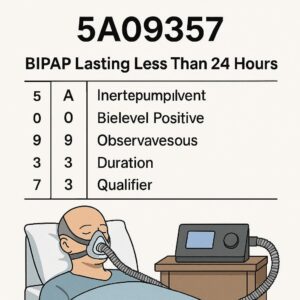
ICD-10-PCS Code 5A09357 for BiPAP Lasting Less Than 24 Hours
2. Understanding the Fundamentals: What is BiPAP?
Before we can decode the code, we must first understand the therapy it represents. Bilevel Positive Airway Pressure (BiPAP), also known generically as Non-Invasive Ventilation (NIV), is a form of mechanical ventilation that does not require an invasive artificial airway, such as an endotracheal tube. It is delivered through a tight-fitting mask that covers the nose, mouth, or both.
The core principle of BiPAP is the delivery of two distinct levels of positive pressure:
-
Inspiratory Positive Airway Pressure (IPAP): This is a higher pressure level that supports the patient’s inhalation. It helps to augment tidal volume, improve gas exchange, and reduce the work of breathing by actively assisting the inspiratory effort.
-
Expiratory Positive Airway Pressure (EPAP): This is a lower pressure level that is maintained during exhalation. It serves to stent open the alveoli (the tiny air sacs in the lungs), prevent their collapse at the end of expiration (a phenomenon known as atelectasis), and improve oxygenation by increasing the functional residual capacity.
The difference between the IPAP and EPAP is critical; this pressure support is what primarily aids the patient’s respiratory muscle effort. BiPAP is typically employed to manage acute or chronic respiratory failure, most commonly in conditions like:
-
Acute exacerbation of Chronic Obstructive Pulmonary Disease (COPD)
-
Cardiogenic Pulmonary Edema
-
Hypoxemic Respiratory Failure (e.g., from pneumonia)
-
Neuromuscular diseases affecting respiratory muscles
-
Obesity Hypoventilation Syndrome
It is crucial to distinguish BiPAP from its close relative, Continuous Positive Airway Pressure (CPAP). While both are forms of non-invasive ventilation, CPAP delivers a single, constant pressure throughout the entire breathing cycle. It is primarily used to maintain open airways, famously in the treatment of Obstructive Sleep Apnea (OSA), but does not provide the inspiratory support that defines BiPAP. This clinical distinction is the foundation for their separate classifications within the ICD-10-PCS system.
3. The ICD-10-PCS Framework: A Brief Primer on the Code Structure
ICD-10-PCS is a multi-axial coding system where each code is composed of seven characters. Each character represents a specific aspect of the procedure, and the combination defines a unique procedure. Understanding this structure is essential to comprehending the code for BiPAP.
Let’s break down the general structure:
-
Section (1st Character): Identifies the broad section where the procedure belongs (e.g., Medical and Surgical, Obstetrics, Administration, etc.).
-
Body System (2nd Character): Specifies the general body system on which the procedure is performed.
-
Root Operation (3rd Character): This is the cornerstone of the code. It defines the objective of the procedure—what the provider did. Examples include excision, resection, insertion, and, relevant to our topic, performance.
-
Body Part (4th Character): Provides greater specificity regarding the anatomical site.
-
Approach (5th Character): Describes the technique used to reach the procedure site (e.g., open, percutaneous, via natural or artificial opening).
-
Device (6th Character): Qualifies the device involved in the procedure, if any.
-
Qualifier (7th Character): Provides additional information about the procedure that is not captured in the other characters. This is often where crucial details, such as the type of assistance or the duration, are specified.
For procedures related to the administration of therapies like BiPAP, we operate within the “Measurement and Monitoring” and “Administration” sections, not the “Medical and Surgical” section. This is a fundamental point of differentiation.
4. The Code in Question: Deconstructing 5A09357
Now, let’s apply this framework to our specific code for BiPAP lasting less than 24 hours: 5A09357.
A character-by-character deconstruction reveals its precise meaning:
-
5 (Section): Administration
-
This section includes procedures where a substance or procedure is performed to achieve a therapeutic, prophylactic, or diagnostic objective. Delivering respiratory assistance is considered an “administration” of a treatment.
-
-
A (Body System): Physiological Systems and Anatomical Regions
-
This character is used for procedures that are performed on physiological systems as a whole (like the respiratory system) rather than on a specific body part.
-
-
0 (Root Operation): Performance
-
This is the critical root operation. The ICD-10-PCS Official Guidelines define “Performance” as “carrying out a function or activity.” In this context, it means carrying out the function of respiratory assistance. It is distinct from “Assistance,” which means taking over a portion of a physiological function.
-
-
9 (Body Part): Respiratory System
-
This specifies that the function being performed is related to the respiratory system.
-
-
3 (Approach): External
-
This character confirms that the procedure is performed without any internal intervention. The BiPAP machine interfaces with the patient externally via a mask.
-
-
5 (Device): Ventilator
-
This character identifies the equipment used. In ICD-10-PCS, a BiPAP machine is classified under the broader term “Ventilator.”
-
-
7 (Qualifier): Less than 24 Hours
-
This is the pivotal character that defines the specific circumstance of our code. It explicitly states that this performance of respiratory assistance using a ventilator lasted for a cumulative duration of fewer than 24 hours.
-
Therefore, the complete code 5A09357 translates to: “Performance of a function of the respiratory system, using an external approach with a ventilator, for a duration of less than 24 hours.”
5. The 24-Hour Conundrum: Clinical Rationale for the “Less Than 24 Hours” Distinction
Why does ICD-10-PCS make a distinction based on a 24-hour threshold? This is not an arbitrary line in the sand; it is rooted in clinical significance and resource utilization.
1. Intensity of Monitoring and Care:
A patient requiring BiPAP, even for a short period, demands a significantly higher level of nursing and respiratory therapy care than a standard medical-surgical patient. Staff must continuously monitor for mask fit, skin breakdown, patient-ventilator synchrony, and changes in clinical status. However, the initiation and stabilization phase is often the most labor-intensive. A patient who remains on BiPAP for more than 24 hours represents a sustained, ongoing consumption of high-acuity resources. The 24-hour mark serves as a proxy for distinguishing a brief intervention from a sustained, long-term therapy.
2. Clinical Trajectory and Acuity:
The ability to wean a patient off BiPAP within 24 hours often indicates a less severe episode of respiratory failure or a highly responsive condition (e.g., rapid diuresis for pulmonary edema). Conversely, a patient who continues to require support beyond 24 hours is likely experiencing a more profound or complex respiratory insult. This difference in clinical acuity and patient stability is meaningful from both a clinical and a data analytics perspective.
3. Reimbursement and DRG Assignment:
In the Medicare Severity Diagnosis-Related Group (MS-DRG) system used for inpatient reimbursement, the presence of certain procedures can significantly impact the assigned DRG and its associated payment weight. The performance of a ventilator procedure for 96+ hours or less than 96 hours can trigger a “Mechanical Ventilation” DRG, which carries a much higher reimbursement. While BiPAP coded with 5A09357 or 5A09358 does not typically trigger the highest-level ventilation DRG on its own, its duration can be a contributing factor to the patient’s overall complexity and can influence the assignment of other respiratory-related DRGs. Accurate duration coding is essential for ensuring that hospital reimbursement accurately reflects the resources used in patient care.
4. Data Integrity and Public Health:
Precise coding allows for meaningful aggregation of data. Researchers and public health officials can analyze trends in the use of short-term vs. long-term non-invasive ventilation. Are outcomes different? Are there specific patient populations that typically require shorter durations? This data-driven insight is only possible if the coding accurately reflects the clinical reality.
6. The Art of Medical Documentation: Painting a Clear Picture for the Coder
The coder’s ability to assign the correct code is entirely dependent on the information documented in the medical record. Vague or inconsistent documentation is the primary cause of coding errors in this area. The physician, respiratory therapist, and nursing notes must form a coherent and precise narrative.
Essential Elements of Documentation for 5A09357:
-
Clear Statement of the Modality: The record must explicitly state “BiPAP” or “Bilevel Positive Airway Pressure.” Terms like “non-invasive ventilation” or “mask ventilation” are acceptable only if the specific settings (IPAP/EPAP) are documented, confirming it is BiPAP and not CPAP.
-
Start Time and Date: A precise timestamp for when the BiPAP therapy was initiated is non-negotiable. This should be documented in the physician’s order, the respiratory therapy flow sheet, and the nursing notes.
-
Stop Time and Date: Equally critical is a precise timestamp for when the BiPAP was discontinued. Documentation must clearly indicate that the therapy was terminated and not merely paused for meals, hygiene, or other short breaks.
-
Cumulative Duration: While the coder will calculate the duration from start and stop times, a clear statement such as “BiPAP was administered for a total of 18 hours and then discontinued” serves as an excellent cross-reference and eliminates ambiguity.
-
Clinical Indication: The reason for initiating BiPAP (e.g., “for acute hypercapnic respiratory failure secondary to COPD exacerbation”) must be documented. This supports the medical necessity of the procedure.
-
Settings: Documentation of the IPAP, EPAP, and sometimes the backup rate provides further confirmation that BiPAP was the modality used.
Examples of Strong vs. Weak Documentation:
-
Weak: “Patient placed on BiPAP. Did well overnight. Off in AM.”
-
Problem: No start/stop times, no clear duration. The coder cannot determine if it was less than or more than 24 hours.
-
-
Strong: “6/15/2025 22:30 – Patient developed increased work of breathing and rising pCO2 to 65. BiPAP initiated per protocol with IPAP 12, EPAP 5. 6/16/2025 16:00 – Patient significantly improved. ABG improved, work of breathing normalized. BiPAP discontinued after a total of 17.5 hours of therapy.”
-
Analysis: This documentation provides everything the coder needs: modality, precise start/stop times, calculated duration (17.5 hours, which is <24), clinical indication, and settings.
-
7. Common Clinical Scenarios and Coding Applications
Let’s apply the code to realistic patient cases to solidify understanding.
Scenario 1: The Classic COPD Exacerbation
-
Presentation: A 68-year-old male with severe COPD presents to the ED with increased shortness of breath and wheezing. ABG shows respiratory acidosis (pH 7.28, pCO2 68).
-
Action: He is admitted to a step-down unit and started on BiPAP at 02:00 on Day 1. With bronchodilators and steroids, he improves steadily.
-
Outcome: BiPAP is successfully discontinued at 18:30 on Day 1.
-
Coding: The cumulative duration is 16.5 hours. The correct code is 5A09357.
Scenario 2: Post-Extubation Support
-
Presentation: A patient is extubated after 3 days on a mechanical ventilator following major surgery.
-
Action: To prevent post-extubation stridor and respiratory failure, the patient is placed on BiPAP immediately after extubation at 10:00.
-
Outcome: The patient maintains good oxygenation and ventilation and is transitioned to a simple face mask at 04:00 the next morning.
-
Coding: The duration is 18 hours. The correct code is 5A09357.
Scenario 3: Cardiogenic Pulmonary Edema
-
Presentation: A patient with congestive heart failure is admitted with flash pulmonary edema. They are in severe respiratory distress.
-
Action: BiPAP is initiated in the ED at 20:00 along with intravenous diuretics. The patient has a rapid diuresis and clinical improvement.
-
Outcome: BiPAP is weaned off and discontinued by 08:00 the following morning.
-
Coding: The duration is 12 hours. The correct code is 5A09357.
8. The Critical Distinction: 5A09357 vs. 5A09358 vs. 5A09457
A common area of confusion lies in differentiating between codes for BiPAP and CPAP, and for different durations. The table below provides a clear comparison.
ICD-10-PCS Code Comparison for Non-Invasive Respiratory Assistance
| Code | Section | Body System | Root Operation | Body Part | Approach | Device | Qualifier | Meaning |
|---|---|---|---|---|---|---|---|---|
| 5A09357 | Administration | Physiological Systems | Performance | Respiratory | External | Ventilator | < 24 Hours | BiPAP for less than 24 hours |
| 5A09358 | Administration | Physiological Systems | Performance | Respiratory | External | Ventilator | 24-96 Hours | BiPAP for 24 to 96 hours |
| 5A09457 | Administration | Physiological Systems | Performance | Respiratory | External | Ventilator | > 96 Hours | BiPAP for more than 96 hours |
| 5A0935Z | Administration | Physiological Systems | Performance | Respiratory | External | Ventilator | No Qualifier | BiPAP, duration unspecified |
| 5A0945Z | Administration | Physiological Systems | Performance | Respiratory | External | Continuous Airway Pressure | No Qualifier | CPAP, any duration |
Key Takeaways from the Table:
-
The 6th character (Device) is the primary differentiator between BiPAP (“Ventilator”) and CPAP (“Continuous Airway Pressure”).
-
The 7th character (Qualifier) is the primary differentiator for the duration of BiPAP therapy.
-
It is crucial to use the “unspecified” codes (5A0935Z, 5A0945Z) only as a last resort when the medical record provides absolutely no information about the modality or duration. CDI should always be pursued to clarify.
9. Navigating Gray Areas and Complex Cases
Coding is not always straightforward. Here are some complex scenarios and how to approach them.
Intermittent or Nocturnal-Only Use:
A patient may be placed on BiPAP only at night for several days. How is duration calculated?
-
Guidance: ICD-10-PCS instructions state that the cumulative duration of a single episode of care should be calculated. If a patient is on BiPAP each night from 22:00 to 06:00 (8 hours) for three consecutive nights, the cumulative duration is 24 hours. In this case, the correct code would be 5A09358 (24-96 hours), not three separate codes of 5A09357. The “episode of care” is considered continuous until the therapy is permanently discontinued.
Multiple Separate Episodes:
A patient is on BiPAP for 12 hours, off for 24 hours, and then requires it again for another 10 hours due to a new clinical event.
-
Guidance: These are considered two separate episodes. The first 12-hour episode is coded with 5A09357. The second 10-hour episode is also coded with 5A09357.
Transition from Invasive to Non-Invasive Ventilation:
A patient is on a mechanical ventilator via an endotracheal tube for 48 hours, is extubated, and then immediately placed on BiPAP for 20 hours.
-
Guidance: These are two distinct procedures. The invasive mechanical ventilation is coded from the Medical and Surgical section, typically with a code from the 0BH series (Insertion of respiratory device). The subsequent non-invasive BiPAP therapy is coded separately as 5A09357. The durations are not combined.
10. The Impact of Accurate Coding: Compliance, Reimbursement, and Data Integrity
The consequences of misassigning 5A09357 are far-reaching.
-
Compliance Risks: Incorrect coding can be construed as fraud and abuse. If a coder consistently assigns a code for a longer duration (5A09358) when the documentation only supports a shorter one (5A09357), it could be seen as “upcoding” to seek higher reimbursement. Conversely, “undercoding” can also be a compliance issue if it leads to systematic underreporting of service complexity.
-
Reimbursement Impact: As mentioned, while BiPAP duration may not single-handedly determine a DRG, it contributes to the patient’s severity of illness and risk of mortality scores. Accurate coding ensures the hospital’s case mix index (CMI) reflects the true acuity of its patient population, which directly impacts overall reimbursement.
-
Data Integrity: At a macro level, inaccurate coding distorts our understanding of disease patterns and treatment efficacy. If short-duration BiPAP is consistently miscoded as long-duration, national data on the success rates and resource use for managing respiratory failure becomes unreliable, hindering quality improvement and research efforts.
11. Conclusion: Summarizing the Content of the Article in Three Lines
Accurately coding BiPAP therapy of less than 24 hours with ICD-10-PCS 5A09357 requires a deep understanding of its seven-character structure, particularly the “Performance” root operation and the “Less than 24 Hours” qualifier. This precision is wholly dependent on clear, time-specific documentation from clinical staff regarding the start, stop, and total duration of therapy. Mastering this nuanced code is essential for ensuring regulatory compliance, securing appropriate reimbursement, and maintaining the integrity of crucial healthcare data that drives quality and research.
12. Frequently Asked Questions (FAQs)
Q1: If a patient is on BiPAP for 23 hours and 59 minutes, is it still coded as 5A09357?
A: Yes. The code 5A09357 is used for any cumulative duration that is less than 24 hours. The 24-hour threshold is exclusive; the moment the therapy reaches the 24-hour mark, the code changes to 5A09358.
Q2: How do we handle BiPAP that is used continuously for more than 24 hours but is turned off for short breaks (e.g., for meals or bathing)?
A: Short, temporary interruptions for patient care activities are considered part of the continuous episode. The clock does not reset for these breaks. The cumulative time is calculated from the initial start time to the final discontinuation time, minus the short break periods only if they are explicitly documented. In practice, if the breaks are brief (e.g., less than an hour), the time is typically considered continuous.
Q3: What is the difference between “Performance” and “Assistance” in the context of ventilation?
A: This is a crucial distinction. “Performance” (root operation 0) means carrying out a function, which applies to non-invasive ventilation like BiPAP and CPAP that support the patient’s own breathing effort. “Assistance” (root operation 2) means taking over a portion of a physiological function. This is used for invasive mechanical ventilation where the ventilator is taking over all or most of the work of breathing. They are found in different sections of the codebook.
Q4: Can code 5A09357 be assigned if the patient was on BiPAP during transport from the ED to the floor?
A: Yes. The location does not matter. If BiPAP was medically necessary and administered as part of the inpatient care, the duration during transport counts towards the cumulative total.
Date: November 20, 2025
Author: Healthcare Coding Insights
Disclaimer: This article is intended for educational and informational purposes only and is based on coding guidelines and conventions available as of the publication date. It does not constitute professional medical coding, billing, or legal advice. Medical coders must consult the most current official ICD-10-PCS code set, CMS guidelines, and payer-specific policies for accurate coding. The author and publisher are not responsible for any claims, losses, or damages arising from the use of this information.


