
In the intricate ecosystem of modern healthcare, few tasks carry the weight and complexity of medical coding. It is the critical bridge between the nuanced, life-saving work performed in the operating room and the administrative, financial, and research engines that drive the medical industry forward. At the heart of this system for inpatient procedures in the United States lies the ICD-10-PCS (International Classification of Diseases, Tenth Revision, Procedure Coding System), a highly detailed and logical alphanumeric system. For the coder, mastering ICD-10-PCS is akin to a linguist mastering a new language—one where precision is not merely valued but mandated.
Among the myriad of procedures coded, small bowel resection stands as a quintessential example of a common yet complex surgery that tests a coder’s knowledge to its limits. The small intestine, a convoluted tube approximately 20 feet long, is not a single, monolithic structure. It is a carefully segmented organ comprising the duodenum, jejunum, and ileum, each with distinct anatomical and physiological roles. A surgeon’s approach to this organ can vary dramatically: a curative resection for cancer, a palliative bypass for an obstruction, a controlled excision of a bleeding lesion, or a reconstructive alteration to restore function.
Each of these clinical intentions maps to a different “root operation” in the ICD-10-PCS lexicon. The choice of surgical approach—a traditional open laparotomy, a minimally invasive laparoscopic procedure, or an endoscopic intervention—further refines the code. The failure to correctly identify these elements can lead to a cascade of negative outcomes: inaccurate reimbursement that fails to cover the cost of care, skewed hospital data that misrepresents surgical volumes and complexities, and flawed public health data that impedes research into gastrointestinal diseases.
This article is designed to be the definitive guide for the healthcare professional navigating this complex terrain. We will embark on a detailed journey, dissecting the ICD-10-PCS code for small bowel resection layer by layer. We will move beyond simple code lookup and delve into the underlying principles, the anatomical nuances, and the clinical reasoning that underpins accurate code assignment. By the end of this exploration, you will not just know how to code a small bowel resection; you will understand why it is coded that way, empowering you to handle even the most obscure and complex cases with confidence and accuracy.
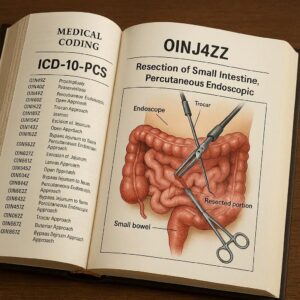
ICD-10-PCS code for small bowel resection
2. Deconstructing the ICD-10-PCS Framework: The Seven-Character Alphanumeric System
Before we can build a code, we must understand its components. Every ICD-10-PCS code is a seven-character string, where each character occupies a specific position and conveys a specific piece of information. There are no codes that are “almost right”; a single incorrect character renders the entire code invalid. Let’s break down the meaning of each character in the context of the Medical and Surgical section (which covers the vast majority of small bowel resections).
-
Section (Character 1): This identifies the broad section where the procedure belongs. For almost all small bowel resections, this will be “0” for the Medical and Surgical section.
-
Body System (Character 2): This specifies the general body system. For procedures on the small intestine, this is “D” for the Gastrointestinal System.
-
Root Operation (Character 3): This is the cornerstone of the code. It defines the objective of the procedure—what the physician set out to accomplish. This is the most critical and often the most challenging character to determine. For small bowel procedures, common root operations include Resection, Excision, Bypass, and Alteration.
-
Body Part (Character 4): This character identifies the specific part of the body system on which the procedure was performed. For the small bowel, this is where we differentiate between the Duodenum (1), Jejunum (2), and Ileum (3).
-
Approach (Character 5): This describes the technique used to reach the site of the procedure. Key approaches for small bowel surgery include Open (0), Percutaneous Endoscopic (F), and Laparoscopic (4).
-
Device (Character 6): This character is used to specify a device that remains in the patient after the procedure is completed. In small bowel resection, this is most often related to the method of re-anastomosis or diversion. If no device remains, this character is “Z” for No Device.
-
Qualifier (Character 7): This character provides additional information about the procedure that is not captured elsewhere. For the gastrointestinal system, this is frequently used to specify the purpose of a bypass or the type of tissue involved. If no qualifier is needed, this character is “Z” for No Qualifier.
Visual Guide to the ICD-10-PCS Code Structure:
*(Imagine a simple graphic here showing a 7-blank code: _ _ _ _ _ _ _ with arrows pointing to each blank from the descriptions below)*
-
Character 1: [0] Medical and Surgical
-
Character 2: [D] Gastrointestinal System
-
Character 3: [Root Operation, e.g., B, 1, 0]
-
Character 4: [Body Part, e.g., 1, 2, 3]
-
Character 5: [Approach, e.g., 0, 4, F]
-
Character 6: [Device, e.g., Z, D]
-
Character 7: [Qualifier, e.g., Z, 1]
This structured approach ensures that every code tells a complete and specific story about the procedure performed.
3. The Core of the Matter: Root Operations for Small Bowel Resection
Determining the correct root operation is the single most important step in ICD-10-PCS coding. The coder must read the operative report and answer the fundamental question: “What was the goal of this procedure?” The same physical action (cutting out a piece of bowel) can be classified under different root operations based on intent.
3.1. Root Operation: Resection (Character 3 = B)
Definition: Cutting out or off, without replacement, all of a body part.
Explanation: Resection is the most common root operation for a classic small bowel resection. The key phrase is “all of a body part.” The body part value is the specific segment of small intestine that is removed. For example, if the surgeon removes the entire terminal ileum, the body part is “Ileum.” It does not matter if the removed segment is 2 cm or 20 cm; the definition is based on the anatomical totality of that specific body part value, not its length. The procedure involves severing the mesentery, removing the segment, and typically creating a primary anastomosis to re-establish continuity.
Clinical Examples: Resection of a segment of jejunum for a tumor; resection of the terminal ileum for Crohn’s disease.
3.2. Root Operation: Excision (Character 3 = B)
Definition: Cutting out or off, without replacement, a portion of a body part.
Explanation: The distinction between Resection and Excision is subtle but critical. Excision is used when only a portion of a body part is removed, and that portion is not defined by the PCS table as a body part itself. A classic example is the removal of a Meckel’s diverticulum. A Meckel’s diverticulum is an outpouching of the ileum; it is not a distinct body part value in PCS. Therefore, cutting it off is an excision of a portion of the “Ileum” body part. Similarly, removing a small polyp or lesion from the wall of the duodenum would be an excision.
Clinical Examples: Excision of Meckel’s diverticulum; local excision of a duodenal polyp.
3.3. Root Operation: Bypass (Character 3 = 1)
Definition: Altering the route of passage of the contents of a tubular body part.
Explanation: A bypass does not involve removing any tissue. Instead, it reroutes the flow of gastrointestinal contents around a diseased, obstructed, or non-functional segment. This is often a palliative procedure. In PCS, a bypass procedure requires three key pieces of information:
-
The body part bypassed from (the source).
-
The body part bypassed to (the destination).
-
The qualifier that indicates the destination.
The code is assigned from the perspective of the source. For example, a gastrojejunostomy bypasses from the stomach to the jejunum; the code would be in the “Stomach” body part table, with a qualifier specifying the jejunum.
Clinical Examples: Ileotransverse colostomy for an obstructing ileal tumor (bypassing from ileum to colon); duodenojejunostomy for superior mesenteric artery syndrome (bypassing from duodenum to jejunum).
3.4. Root Operation: Alteration (Character 3 = 0)
Definition: Modifying the natural anatomic structure of a body part without affecting the function of the body part.
Explanation: This root operation is used for procedures that change the shape or configuration of a body part but do not take over its function (as in Bypass) or take it out (as in Resection). The most common small bowel procedure falling under this category is stricturoplasty. In a stricturoplasty, a narrowed (stenotic) segment of the bowel is surgically opened and reshapen to widen the lumen, but the bowel itself is not removed. The function—carrying digestive contents—remains the same, but the anatomic structure is altered to facilitate that function.
Clinical Examples: Stricturoplasty of the jejunum for Crohn’s disease-related strictures.
Summary of Key Root Operations for Small Bowel Procedures
| Root Operation | ICD-10-PCS Character | Definition | Key Question to Ask | Example Procedure |
|---|---|---|---|---|
| Resection | B | Cutting out ALL of a body part. | “Did the surgeon remove an entire distinct anatomical segment (e.g., a section of ileum)?” | Open right hemicolectomy with ileal resection. |
| Excision | B | Cutting out a PORTION of a body part. | “Did the surgeon remove only a part of a body part, like a diverticulum or polyp?” | Laparoscopic excision of a Meckel’s diverticulum. |
| Bypass | 1 | Rerouting contents around a body part. | “Was the goal to go around a problem area without removing it?” | Ileocolonic bypass for an inoperable tumor. |
| Alteration | 0 | Changing the shape/structure of a body part. | “Did the surgeon reshape the bowel without removing a segment?” | Stricturoplasty for a jejunal stricture. |
4. Navigating the Anatomy: A Deep Dive into Body Part Characters (Character 4)
Accuracy in coding demands precision in anatomy. The small intestine is not coded as a single entity. The coder must identify the specific segment addressed in the procedure based on the surgeon’s documentation.
4.1. The Duodenum (Body Part Character = 1)
The duodenum is the first and shortest part of the small intestine, connecting the stomach to the jejunum. It is a C-shaped structure that curves around the head of the pancreas and is divided into four parts. Procedures explicitly documented as involving the duodenum (e.g., “duodenal resection,” “duodenal polypectomy”) will use this body part value.
4.2. The Jejunum (Body Part Character = 2)
The jejunum is the middle segment of the small intestine, making up about two-fifths of the total length. It begins at the duodenojejunal flexure and is characterized by a thick wall and a rich blood supply. It is primarily involved in nutrient absorption. Any procedure specifically targeting the jejunum will use this body part value.
4.3. The Ileum (Body Part Character = 3)
The ileum is the final and longest segment, comprising about three-fifths of the small intestine. It connects to the cecum of the large intestine at the ileocecal valve. It has a thinner wall than the jejunum and is responsible for absorbing vitamin B12 and bile salts. The “terminal ileum” is a specific portion of the ileum closest to the colon and is a common site for Crohn’s disease. Procedures on the ileum, including the terminal ileum, use the “Ileum” body part value.
Coding Tip: If the operative report documents a resection of a segment that includes both the terminal ileum and the cecum (e.g., a right hemicolectomy), the correct body part is no longer “Ileum” but “Ileocecal Valve” (Body Part Character = V). This is a crucial distinction, as the Ileocecal Valve is a distinct body part value in the Gastrointestinal system.
5. The Surgical Journey: Understanding the Approach (Character 5)
The approach describes how the surgeon accessed the surgical site. This character significantly impacts the code and often the associated DRG (Diagnosis-Related Group) and reimbursement.
5.1. Open Approach (0)
An open approach involves cutting through the skin and other tissues to expose the surgical site fully. A laparotomy (a large incision through the abdominal wall) is the classic open approach for small bowel surgery. It provides the surgeon with the most direct access and visualization but is associated with longer recovery times.
5.2. Laparoscopic Approach (4)
A laparoscopic approach involves the insertion of a laparoscope (a thin, lighted tube with a camera) and other instruments through several small incisions in the abdomen. The abdomen is insufflated with gas to create a working space. The surgeon views the procedure on a video monitor. This is a minimally invasive technique that typically results in less pain, shorter hospital stays, and faster recovery.
5.3. Percutaneous Endoscopic Approach (F)
This approach is defined as entry through the skin, or through an existing orifice, and into a body cavity using an endoscope for visualization. For the small bowel, this is less common for resections but might be used for very specific procedures like percutaneous endoscopic jejunostomy tube placement. It is unlikely to be the primary approach for a resection.
5.4. Via Natural or Artificial Opening (7) and Via Natural or Artificial Opening Endoscopic (8)
These approaches involve entering the body through a natural orifice (e.g., mouth, anus) or an artificially created opening. An enteroscopy, where a scope is passed orally or anally to visualize the small bowel, would use one of these approaches. However, a resection itself is almost never performed solely through these approaches without a laparoscopic or open component for the actual cutting and suturing.
6. Device and Qualifier Characters (Characters 6 & 7): Closing the Loop
These final characters add the finishing details to the procedural story.
-
Device (Character 6): In the context of small bowel resection, a device is rarely left behind. The anastomosis is typically hand-sewn or created with a surgical stapler, neither of which is considered a “device” in PCS (they are instruments). Therefore, Character 6 is almost always “Z” for No Device. The exception would be if the procedure ends with the creation of a stoma (an opening to the skin) and the application of a drainage device, but this is a separate procedure from the resection itself.
-
Qualifier (Character 7): This character’s use is highly dependent on the root operation.
-
For Resection and Excision, the qualifier is almost always “Z” for No Qualifier.
-
For Bypass, the qualifier is critical. It specifies the destination of the bypass. For example, in the Gastrointestinal system table for the “Duodenum,” a qualifier of “3” means the bypass goes to the Jejunum. A qualifier of “4” means it goes to the Ileum. The coder must cross-reference the specific PCS table to find the correct qualifier value.
-
7. Coding in Action: Real-World Clinical Scenarios and Code Assignments
Let’s apply our knowledge to realistic operative reports.
Scenario 1: Open Resection of an Ileal Tumor
-
Operative Report Snippet: “A midline laparotomy was performed. A 4 cm mass was identified in the mid-ileum. The mesentery to this segment was divided and ligated. The involved segment of ileum was resected. A functional side-to-side stapled anastomosis was created to restore bowel continuity.”
-
Code Breakdown:
-
Section: 0 (Medical and Surgical)
-
Body System: D (Gastrointestinal System)
-
Root Operation: B (Resection – the entire segment of ileum containing the tumor was removed)
-
Body Part: 3 (Ileum)
-
Approach: 0 (Open – via laparotomy)
-
Device: Z (No Device – the stapler is an instrument, not an implant)
-
Qualifier: Z (No Qualifier)
-
-
Final ICD-10-PCS Code: 0DTB3ZZ – Resection of Ileum, Open Approach
Scenario 2: Laparoscopic Resection of Jejunal Segment for Crohn’s Disease
-
Operative Report Snippet: “The patient was placed in supine position. Four laparoscopic ports were placed. The abdomen was insufflated. A diseased, thickened segment of proximal jejunum was identified. The mesentery was divided with a harmonic scalpel. The jejunal segment was resected and removed through a slightly extended port site. A side-to-side isoperistaltic anastomosis was created intracorporeally using a linear stapler.”
-
Code Breakdown:
-
Section: 0
-
Body System: D
-
Root Operation: B (Resection)
-
Body Part: 2 (Jejunum)
-
Approach: 4 (Laparoscopic)
-
Device: Z (No Device)
-
Qualifier: Z (No Qualifier)
-
-
Final ICD-10-PCS Code: 0DTB4ZZ – Resection of Jejunum, Laparoscopic Approach
Scenario 3: Duodenojejunal Bypass for Superior Mesenteric Artery Syndrome
-
Operative Report Snippet: “Due to chronic compression of the third portion of the duodenum, a decision was made to perform a bypass. A loop of proximal jejunum was brought up to the dilated second portion of the duodenum. A side-to-side duodenojejunostomy was created using a linear stapler.”
-
Code Breakdown:
-
Section: 0
-
Body System: D
-
Root Operation: 1 (Bypass – rerouting contents from the obstructed duodenum)
-
Body Part: 1 (Duodenum – the source of the bypass)
-
Approach: 0 (Open – the report implies a traditional open procedure)
-
Device: Z (No Device)
-
Qualifier: 3 (Jejunum – the destination of the bypass. Found in the PCS table for Duodenum bypass.)
-
-
Final ICD-10-PCS Code: 0D110Z3 – Bypass of Duodenum to Jejunum, Open Approach
Scenario 4: Excision of a Meckel’s Diverticulum
-
Operative Report Snippet: “Laparoscopically, a Meckel’s diverticulum was identified on the antimesenteric border of the ileum, approximately 50 cm from the ileocecal valve. The diverticulum was grasped and its base was transected with a linear stapler. The diverticulum was removed.”
-
Code Breakdown:
-
Section: 0
-
Body System: D
-
Root Operation: B (Excision – a portion of the ileum (the diverticulum) was removed, not the entire ileum as a body part)
-
Body Part: 3 (Ileum)
-
Approach: 4 (Laparoscopic)
-
Device: Z (No Device)
-
Qualifier: Z (No Qualifier)
-
-
Final ICD-10-PCS Code: 0DB94ZZ – Excision of Ileum, Percutaneous Endoscopic Approach (Note: Laparoscopic falls under the broader “Percutaneous Endoscopic” approach character “4” in PCS)
Scenario 5: Stricturoplasty (Alteration) of the Ileum
-
Operative Report Snippet: “A long, fibrotic stricture was identified in the mid-ileum. A longitudinal incision was made along the antimesenteric border through the strictured area. The enterotomy was then closed in a transverse fashion (Heineke-Mikulicz technique), effectively widening the lumen.”
-
Code Breakdown:
-
Section: 0
-
Body System: D
-
Root Operation: 0 (Alteration – the shape of the ileum was changed to relieve the stricture)
-
Body Part: 3 (Ileum)
-
Approach: 0 (Open)
-
Device: Z (No Device)
-
Qualifier: Z (No Qualifier)
-
-
Final ICD-10-PCS Code: 0D0B0ZZ – Alteration of Ileum, Open Approach
8. Common Pitfalls and Pro-Tips for Flawless Coding
-
Pitfall 1: Confusing Resection with Excision. Remember: Resection = all of a body part. Excision = a portion of a body part. The Meckel’s diverticulum is the classic trap.
-
Pitfall 2: Misidentifying the Body Part in a Right Hemicolectomy. When the terminal ileum and cecum are removed together, the body part is the “Ileocecal Valve,” not “Ileum.”
-
Pitfall 3: Incorrectly Assigning the Bypass Qualifier. Always assign the bypass code from the source organ and use the qualifier to specify the destination organ. Double-check the PCS table for the correct qualifier value.
-
Pitfall 4: Assuming the Approach. Do not assume an approach based on the procedure name. An “open cholecystectomy” is open, but a “laparoscopic-assisted small bowel resection” is laparoscopic. Read the report for the specific technique.
-
Pro-Tip 1: Read the Operative Report Backwards. Start with the “Procedure Performed” section to understand the surgeon’s intent, then read the “Description of Procedure” to confirm the details and identify any additional procedures.
-
Pro-Tip 2: Leverage the PCS Tables. Don’t just rely on the index. Always go to the complete PCS table for the section and body system to see all possible options for a given root operation. This helps prevent errors with body part and qualifier selection.
-
Pro-Tip 3: Query When Necessary. If the documentation is unclear, contradictory, or missing key details (e.g., the specific segment of small bowel, the approach), initiate a physician query. It is better to ask for clarification than to assign an incorrect code.
9. The Impact of Accurate Coding: From Reimbursement to Patient Care
Accurate ICD-10-PCS coding is far more than an administrative chore. It is a vital function with wide-reaching implications:
-
Reimbursement: Codes directly determine the DRG assigned to a patient’s stay, which in turn determines the fixed payment the hospital receives from Medicare and other insurers. An under-coded case (e.g., coding a complex laparoscopic resection as a simple excision) can lead to significant financial loss. An over-coded case can be considered fraud.
-
Quality Metrics and Outcomes Research: Coded data is aggregated to track surgical outcomes, complication rates, and the effectiveness of different surgical approaches (e.g., open vs. laparoscopic). Accurate data is essential for hospitals to benchmark their performance and for researchers to identify best practices.
-
Public Health and Epidemiology: Data on the frequency of procedures for conditions like Crohn’s disease or small bowel cancers helps public health officials allocate resources and track disease trends over time.
-
Hospital Operations and Planning: Data on surgical volumes helps hospital administrators plan for staffing, equipment purchases, and operating room capacity.
In essence, every correctly assigned code is a clean, reliable data point that fuels the entire healthcare system, ultimately contributing to better patient care, more efficient operations, and advancements in medical science.
10. Conclusion
Mastering the ICD-10-PCS code for small bowel resection requires a meticulous, multi-step process centered on understanding the surgeon’s intent (Root Operation), the precise anatomy involved (Body Part), and the technical method used (Approach). By systematically deconstructing the operative report and applying the logical framework of the seven-character system, coders can ensure accuracy and consistency. This precision is not an abstract goal but a fundamental responsibility that directly impacts healthcare financing, quality measurement, and the integrity of the data that shapes future medical care. Continuous education and a thorough understanding of both coding guidelines and clinical practices are the keys to success in this dynamic field.
11. Frequently Asked Questions (FAQs)
Q1: How do I code a small bowel resection that involves multiple distinct segments, like both the jejunum and the ileum?
A: You would assign multiple codes. Each distinct body part that is resected requires its own code. For example, if one segment of jejunum and one segment of ileum are resected for separate tumors, you would assign 0DTB4ZZ (Resection of Jejunum) and 0DTB4ZZ (Resection of Ileum). Do not combine them into a single, non-existent “small intestine” code.
Q2: What is the difference between a laparoscopic (4) and a percutaneous endoscopic (F) approach?
A: In PCS, the “Laparoscopic” approach is a subset of the broader “Percutaneous Endoscopic” approach. The index directs you to use character “4” for procedures that are specifically described as laparoscopic. Character “F” is used for other types of percutaneous endoscopic procedures that are not laparoscopic, such as those guided by ultrasound or fluoro.
Q3: If a resection is started laparoscopically but has to be converted to an open procedure, which approach do I code?
A: You always code the approach that the procedure was completed with. If the surgeon converted from laparoscopic to open, you would code the Open Approach (0). The initial attempt does not change the final approach.
Q4: How do I handle a diagnostic laparoscopy that turns into a therapeutic small bowel resection?
A: You code both procedures. The diagnostic laparoscopy (e.g., 0WJ84ZZ, Inspection of Abdominal Cavity) is coded separately from the therapeutic resection (e.g., 0DTB4ZZ). The fact that one led to the other does not negate the need to code the diagnostic procedure.
Q5: Where can I find the official, most up-to-date ICD-10-PCS guidelines and codes?
A: The Centers for Medicare & Medicaid Services (CMS) and the Centers for Disease Control and Prevention (CDC) maintain the official ICD-10-PCS files and guidelines on their websites. These are the definitive sources and should be consulted regularly for updates.
Date: November 20, 2025
Author: The Healthcare Coding Specialist
Disclaimer: This article is intended for educational and informational purposes only and is based on the ICD-10-PCS guidelines and coding structure as of the 2025 fiscal year. It is not a substitute for the official ICD-10-PCS code set, official coding guidelines, or professional clinical advice. Medical coders must always consult the most current official resources and facility-specific policies when assigning codes. The author and publisher are not responsible for any errors, omissions, or consequences resulting from the use of this information.


