
In the vast and intricate world of healthcare, few elements are as universally critical yet often overlooked as medical coding. It is the language that translates complex medical procedures, diagnoses, and equipment into a standardized, alphanumeric system that drives reimbursement, informs public health data, and facilitates medical research. For the patient, the removal of a ureteral stent is a moment of relief, a final step in a often uncomfortable journey. For the urologist, it is a routine, minutes-long procedure. But for the medical coder, it is a puzzle of precision, where a single misstep in a single character can trigger a cascade of financial and administrative complications.
This article embarks on a detailed exploration of one specific, common procedure: the removal of a double-J ureteral stent, and its accurate representation within the ICD-10-PCS (International Classification of Diseases, Tenth Revision, Procedure Coding System) framework. We will move beyond a simple code lookup and delve into the “why” and “how,” building a foundational understanding that empowers coders to navigate this and countless other procedures with confidence. From the anatomy of the urinary tract to the nuanced definitions of the ICD-10-PCS root operations, this guide aims to be the definitive resource, ensuring that the code 0TJDX6Z and its variants are not just memorized, but thoroughly understood.
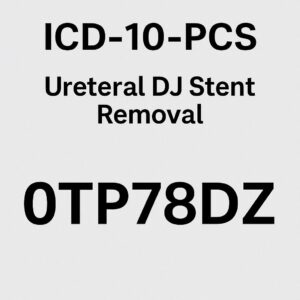
ICD-10-PCS coding for ureteral (DJ) stent removal
2. Understanding the Ureteral Stent: More Than Just a Tube
To accurately code a procedure, one must first understand the device involved and its purpose within the human body.
Anatomy and Physiology of the Urinary Tract
The urinary system is a sophisticated filtration and waste-removal network. Its key components are:
-
Kidneys: Two bean-shaped organs that filter blood to form urine.
-
Ureters: Two narrow, muscular tubes, each approximately 25-30 cm long, that transport urine from the kidneys to the bladder via peristaltic waves.
-
Bladder: A hollow, muscular sac that serves as a reservoir for urine.
-
Urethra: The tube through which urine is expelled from the bladder to the outside of the body.
The ureters are particularly vulnerable to obstruction, which can lead to debilitating pain, infection, and permanent kidney damage.
Indications for Ureteral Stent Placement
A ureteral stent is not placed without cause. Its primary function is to ensure urinary drainage from the kidney to the bladder when the ureter is compromised. Common indications include:
-
Obstruction: Caused by kidney stones, blood clots, or tumors.
-
Post-Surgical Support: Following procedures like ureteroscopy, lithotripsy (stone breaking), or ureteral reimplantation to maintain patency and allow healing.
-
Trauma: To protect the ureter after a physical injury.
-
Malignancy: To bypass extrinsic compression from cancers such as cervical or prostate cancer.
The Double-J (DJ) Stent: Design and Function
The term “DJ stent” is derived from its distinctive shape—a coil at each end resembling the letter “J.” This design is intentional and functional:
-
Proximal J: Coils within the renal pelvis of the kidney, preventing it from migrating down the ureter.
-
Distal J: Coils within the bladder, preventing it from migrating up the ureter.
-
The Shaft: The hollow tube between the coils allows urine to bypass any obstruction, draining from the kidney directly into the bladder.
These stents are typically made of silicone or polyurethane and are designed to be temporary, residing in the body for days, weeks, or sometimes months.
3. The Foundation: A Deep Dive into the ICD-10-PCS System
ICD-10-PCS is a multi-axial, procedure-based classification system. Unlike its diagnosis counterpart, it is not based on etymology but on a logical structure where each character has a specific meaning.
The Seven-Character Alphanumeric Structure
Every ICD-10-PCS code is seven characters long. Each character represents an aspect of the procedure:
| Character | Component | Description |
|---|---|---|
| 1 | Section | The broadest category (e.g., Medical and Surgical) |
| 2 | Body System | The general physiological system involved |
| 3 | Root Operation | The objective of the procedure (the definitive goal) |
| 4 | Body Part | The specific anatomical site |
| 5 | Approach | The technique used to reach the site |
| 6 | Device | The device involved, if any |
| 7 | Qualifier | Adds additional information about the procedure |
The Medical and Surgical Section (0)
The first character for the vast majority of invasive procedures, including stent removal, is “0,” denoting the Medical and Surgical section.
Understanding the Root Operation: What is Actually Being Done?
This is the most critical conceptual step in PCS coding. The root operation defines the procedure’s objective. For stent removal, the correct root operation is Extraction.
-
ICD-10-PCS Official Definition of Extraction: “Pulling out or off of all or a portion of a body part by the use of force.” The guideline further clarifies that the body part value is the part being pulled out, not the site from which it is pulled.
This is distinct from other root operations that may seem similar:
-
Removal: Taking out a device that is not integral to the body’s function (e.g., a bandage, drain). A stent is considered integral once placed.
-
Revision: Correcting a malfunctioning device in situ. The device is not taken out.
-
Change: Taking out a device and putting in a new one.
4. Deconstructing the Code for Cystoscopic Stent Removal
The most common method for removing a ureteral stent is via cystoscopy. Let’s build the code step-by-step.
-
Character 1: Section =
0(Medical and Surgical)
This is straightforward, as the procedure is surgical in nature. -
Character 2: Body System =
T(Urinary System)
The stent resides in the ureter, which is part of the urinary system. -
Character 3: Root Operation =
D(Extraction)
The physician is pulling out the stent by force (e.g., with a grasper). This is the correct root operation. -
Character 4: Body Part =
5, 6, or 7(Ureter)
This is where precision is key. The body part is the ureter from which the stent is being extracted. The PCS table provides specific values:-
5– Ureter, Right -
6– Ureter, Left -
7– Ureter, Bilateral (if both stents are removed in the same session) -
X– Ureter (used if the documentation does not specify laterality)
Coder’s Note: The body part is not the urethra or bladder. The action of extraction is happening within the ureter itself, even though access is gained through the bladder.
-
-
Character 5: Approach =
C(Via Natural or Artificial Opening) or8(Via Natural or Artificial Opening Endoscopic)
The cystoscope is passed through the urethra, a natural opening. There is a nuanced choice here:-
C– Via Natural or Artificial Opening: Used if the procedure is performed without endoscopic visualization. -
8– Via Natural or Artificial Opening Endoscopic: Used if an endoscope (the cystoscope) is used to visualize the procedure.
In nearly all modern clinical settings, a cystoscope is used for visualization and guidance. Therefore,8is the most accurate and commonly used approach for this procedure.
-
-
Character 6: Device =
6(Drainage Device)
A ureteral stent is classified in the ICD-10-PCS tables as a “Drainage Device.” This value is fixed for this procedure. -
Character 7: Qualifier =
Z(No Qualifier)
For this specific procedure, no further qualification is needed.
The Final Code: Putting it all together for the removal of a left ureteral stent via cystoscopy, the code is 0TJD86Z.
-
0= Medical and Surgical -
T= Urinary System -
J= Extraction -
D= Ureter, Left -
8= Via Natural or Artificial Opening Endoscopic -
6= Drainage Device -
Z= No Qualifier
5. Alternative Approaches and Scenarios: Beyond the Standard Cystoscopy
While cystoscopy is the norm, coders must be prepared for other documented scenarios.
Fluoroscopic Removal (Percutaneous Approach)
In rare cases, a stent with a string left attached to the distal end and protruding from the urethra may be removed by simply pulling the string. If this is done under fluoroscopic guidance (to monitor its movement), the approach changes. The access is still through the urethra (a natural opening), so the approach would remain 8. However, if a stent was placed percutaneously (e.g., through the kidney via a nephrostomy tract) and is now being removed via that same tract, the approach would be Percutaneous (3).
Example Code (Percutaneous removal from right kidney/ureter): 0TJD36Z
Removal During Another Procedure
If a stent is removed as an integral part of a more complex procedure (e.g., it is removed during a scheduled ureteroscopy for stone fragmentation), coding rules dictate that the definitive procedure (the ureteroscopy with fragmentation) is coded. The stent removal is considered inherent to the larger procedure and is not coded separately.
The Critical Role of Physician Documentation
The coder’s entire universe is defined by the physician’s operative report. Key phrases to look for include:
-
“Cystoscopy with removal of left ureteral stent.”
-
“The previously placed double-J stent was grasped with alligator forceps and withdrawn without difficulty.”
-
“Under fluoroscopic guidance, the string was tensioned and the stent was removed intact.”
Ambiguous documentation like “stent taken out” is insufficient. The coder must query the physician for clarification on the approach, laterality, and method.
6. Common Pitfalls and Coding Challenges: Avoiding Costly Errors
Miscoding can lead to claim denials, audits, and financial losses.
-
Pitfall 1: Confusing Root Operations. Using “Removal” (root operation
P) instead of “Extraction” (D) is the most common error. Remember, a stent is an integral device, not an external one. -
Pitfall 2: Misidentifying the Body Part. Coding the body part as the “Bladder” or “Urethra” is incorrect. The stent is being extracted from the ureter.
-
Pitfall 3: Incorrectly Specifying the Approach. Using “Open” or “Percutaneous” when the procedure was clearly done cystoscopically.
-
Pitfall 4: Ignoring Laterality. Failing to assign the correct laterality (right, left, bilateral) or using the unspecified code
Xwhen the documentation is clear.
The Impact of Inaccurate Coding
-
Financial: Claim denials or down-coding by payers.
-
Compliance: Failing an audit can result in fines and penalties.
-
Data Integrity: Skews hospital and national health statistics, impacting research and public health planning.
7. A Coder’s Workflow: From Patient Chart to Final Code
A proficient coder follows a disciplined process:
-
Obtain Documentation: Retrieve the complete operative report.
-
Identify the Procedure: Confirm it is a ureteral stent removal.
-
Determine the Root Operation: Confirm it is “Extraction.”
-
Abstract Key Details: Note the laterality (right, left, bilateral) and the approach (cystoscopic, fluoroscopic, etc.).
-
Reference the PCS Table: Navigate to the Medical and Surgical section, Urinary System body system, and locate the “Extraction” table.
-
Build the Code: Assemble the seven characters based on the abstracted details.
-
Verify and Double-Check: Review the code against the official guidelines and the documentation one final time.
8. Conclusion
Accurate ICD-10-PCS coding for ureteral stent removal hinges on a deep understanding of the procedure’s objective: the forceful pulling of a device from the ureter. The code 0TJD86Z for a left-sided, cystoscopic removal is built on the precise definitions of Extraction, the urinary system, and an endoscopic approach. Mastery of this process requires meticulous attention to physician documentation, a firm grasp of PCS definitions, and a commitment to continuous learning, ensuring that the vital language of medical coding remains both precise and powerful.
9. Frequently Asked Questions (FAQs)
Q1: What is the ICD-10-PCS code for removing a ureteral stent that has a string attached?
A: The code is typically the same: 0TJD86Z. The presence of a string may simplify the physical removal for the physician, but the root operation is still “Extraction” (pulling out by force), and the approach is still via a natural opening endoscopic (cystoscopy) if a scope is used to visualize and grasp the string. The fundamental components of the code do not change.
Q2: How do I code the removal of a nephroureteral stent?
A: A nephroureteral stent has a coil in the renal pelvis and a long external portion. Its removal is more complex. If the entire stent is pulled out through the percutaneous tract in the kidney, the approach is “Percutaneous” (3), and the body part would be the “Kidney Pelvis” (4), as the extraction is from the kidney, resulting in a code like 0TJD36Z. If only the ureteral portion is manipulated and removed, with the nephrostomy tube remaining, a different code may be needed. The documentation is critical.
Q3: The operative report states “cystoscopy with removal of right ureteral stent and insertion of a new stent.” How is this coded?
A: This is a “Change” procedure. The root operation “Change” (2) is defined as taking out a device and putting in a new one of the same type in the same anatomical site. You would code a single “Change” procedure, not separate “Extraction” and “Insertion” codes. The code would be 0TJC86Z for the change of a drainage device in the right ureter via a cystoscope.
Q4: What if the documentation is unclear on which ureter the stent was removed from?
A: If the medical record does not specify laterality (right or left), you must use the ICD-10-PCS code for the unspecified body part. In this case, you would use 0TJDX6Z, where the fourth character ‘X’ denotes “Ureter, unspecified.”
10. Additional Resources
-
CMS ICD-10-PCS Official Guidelines: The definitive source for coding rules and conventions. [Link to CMS.gov]
-
AHA Coding Clinic for ICD-10-CM/PCS: Provides official advice and clarifications on complex coding scenarios. Subscription required.
-
American Health Information Management Association (AHIMA): Offers professional development, certifications, and resources for medical coders. [Link to AHIMA.org]
-
American Academy of Professional Coders (AAPC): A leading organization for coder education and certification. [Link to AAPC.com]
Date: November 22, 2025
Author: Healthcare Coding Insights
Disclaimer: This article is intended for educational and informational purposes only and is based on the ICD-10-PCS coding system as of the stated date. It does not constitute medical or professional coding advice. Medical coders must use the current, official ICD-10-PCS code set and guidelines, along with complete physician documentation, to ensure accurate and compliant coding. The author and publisher are not responsible for any errors or omissions, or for any outcomes resulting from the use of this information.


