
Imagine a intricate, silent web forming inside the human abdomen—a web not of silk, but of fibrous scar tissue. For millions of patients worldwide, this internal scaffolding, known as abdominal adhesions, is a source of chronic pain, digestive dysfunction, and a potential surgical emergency. They are the body’s overzealous response to injury, a biological attempt to heal that, in excess, can itself become a pathology. When this web tightens, twisting and compressing the delicate loops of the intestine, it can bring the complex machinery of digestion to a grinding halt. The surgical answer to this potentially life-threatening condition is a procedure known as enterolysis—the precise and deliberate cutting and freeing of these adhesive bands.
For the medical coder, the act of translating this intricate, life-saving procedure into the precise alphanumeric language of ICD-10-PCS is a task of immense responsibility. It is not merely an administrative function; it is a critical bridge between clinical action and healthcare infrastructure. An accurately coded enterolysis procedure ensures appropriate reimbursement, contributes to vital health data statistics, and supports quality patient care. Conversely, a miscoded procedure can lead to financial loss for the healthcare facility, compliance issues, and a distorted picture of public health trends. This article is designed as the definitive guide for medical coders, health information management (HIM) professionals, and students seeking to master the art and science of coding enterolysis. We will embark on a detailed journey, dissecting the clinical rationale, the surgical techniques, and the granular specifics of the ICD-10-PCS system to build a complete and unambiguous understanding of how to code this common yet complex procedure.
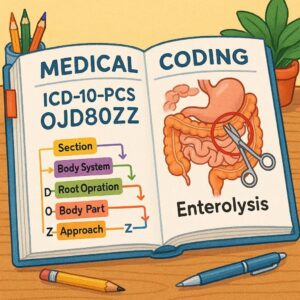
ICD-10-PCS code for Enterolysis
2. Understanding the Clinical Problem: What Are Abdominal Adhesions and Why Do They Form?
Before one can code the solution, one must understand the problem. Abdominal adhesions are bands of fibrous tissue that form between abdominal tissues and organs. Normally, the surfaces of these organs are slippery and can shift easily against one another. Adhesions cause them to stick together, like layers of plastic wrap fused by heat.
The Pathophysiology of Adhesion Formation
The primary catalyst for adhesion formation is trauma to the peritoneal lining, the delicate membrane that lines the abdominal cavity and covers the abdominal organs. The body’s healing process involves an inflammatory response and the deposition of fibrin—a sticky protein—at the site of injury. Under normal circumstances, this fibrin matrix is broken down (fibrinolysis). However, when the trauma is significant or the healing environment is compromised, the fibrin persists, acting as a scaffold into which collagen-producing cells (fibroblasts) migrate. This collagen matures into the strong, fibrous bands we recognize as adhesions.
The most common cause of adhesions is previous abdominal surgery. Nearly 95% of patients who undergo major abdominal surgery will develop adhesions. Other causes include:
-
Inflammation: From conditions like appendicitis, diverticulitis, pelvic inflammatory disease (PID), or Crohn’s disease.
-
Infection: Peritonitis.
-
Radiation Therapy: To the abdominal or pelvic area.
-
Endometriosis.
-
Trauma: Blunt or penetrating abdominal injury.
Clinical Consequences: From Chronic Pain to Bowel Obstruction
Many patients with adhesions are asymptomatic. For others, the consequences can be severe:
-
Chronic Abdominal Pain: Adhesions can pull and stretch on nerves and organs, causing intermittent or constant pain.
-
Female Infertility: Adhesions involving the fallopian tubes or ovaries can impede the journey of the egg or embryo.
-
Bowel Obstruction: This is the most serious complication. Adhesive bands can kink, compress, or twist a segment of the intestine, creating a partial or complete blockage. A complete obstruction is a surgical emergency, as it can lead to bowel ischemia (lack of blood flow), necrosis (tissue death), perforation, and life-threatening infection (sepsis).
3. The Surgical Solution: A Deep Dive into the Enterolysis Procedure
When adhesions cause significant symptoms, particularly bowel obstruction, surgery becomes necessary. This procedure is known by several names: adhesiolysis, lysis of adhesions (LOA), and the more specific enterolysis.
Defining Enterolysis: More Than Just Cutting
The term “enterolysis” is derived from Greek: enteron (intestine) and lysis (loosening or freeing). Therefore, enterolysis specifically refers to the freeing of adhesions involving the intestine. While “lysis of adhesions” is a broader term that could include freeing the liver, uterus, or other organs, “enterolysis” is anatomically precise. The core objective is to restore normal anatomical relationships and function by meticulously dividing the constricting bands of tissue.
Surgical Approaches: Open, Laparoscopic, and Robotic-Assisted Techniques
The surgeon’s choice of approach is a critical factor that will directly influence the ICD-10-PCS code.
-
Open Approach (Laparotomy): This is the traditional approach, involving a large abdominal incision. It provides the surgeon with the widest field of view and greatest manual access, which is often necessary in cases of dense, complex adhesions or in emergency situations like a complete bowel obstruction.
-
Laparoscopic Approach: This is a minimally invasive technique involving several small “keyhole” incisions. A camera (laparoscope) is inserted, and long, thin instruments are used to perform the adhesiolysis. Benefits include less post-operative pain, shorter hospital stays, and faster recovery. However, it requires significant skill, especially when adhesions are severe.
-
Robotic-Assisted Approach: A refinement of laparoscopy, this approach uses a robotic system controlled by the surgeon. It offers 3D high-definition vision and wristed instruments that provide greater dexterity than standard laparoscopic tools, which can be advantageous for delicate dissection in confined spaces.
The Surgical Nuances: Sharp Dissection, Electrocautery, and Laser
The method used to divide the adhesion is also a key clinical detail. Sharp dissection with scissors or a scalpel is the most precise method and minimizes thermal damage to surrounding tissue. Electrocautery (or diathermy) uses a high-frequency electrical current to cut and coagulate tissue simultaneously, which helps control bleeding. Laser is less common but can be used for very precise cutting. For the ICD-10-PCS coder, the specific instrument used does not change the code, as the root operation “Release” encompasses all methods of freeing a body part.
4. Introduction to ICD-10-PCS: The Foundation of Procedural Coding
ICD-10-PCS (International Classification of Diseases, 10th Revision, Procedure Coding System) is the standardized system used in the United States to code hospital inpatient procedures. Unlike its diagnosis counterpart, ICD-10-CM, PCS is not based on a pre-existing list of codes. It is a multi-axial system where each character in a seven-character code has a specific meaning, allowing for the creation of a highly specific code for virtually any procedure.
The Structure of a PCS Code: A Seven-Character Alphanumeric System
Each of the seven characters represents a specific aspect of the procedure:
-
Character 1: Section – The broadest category (e.g., Medical and Surgical).
-
Character 2: Body System – The general physiological system involved.
-
Character 3: Root Operation – The objective of the procedure (the what).
-
Character 4: Body Part – The specific anatomical site (the where).
-
Character 5: Approach – How the surgeon accessed the site.
-
Character 6: Device – Any device that remains after the procedure.
-
Character 7: Qualifier – An additional attribute for specific procedures.
The Importance of Precision: Why Every Character Matters
A single incorrect character can change the entire meaning of a code, leading to inaccurate data and potential denial of reimbursement. For example, coding an open procedure as laparoscopic could significantly impact the assigned DRG (Diagnosis-Related Group) and subsequent payment.
5. Deconstructing the ICD-10-PCS Code for Enterolysis: A Step-by-Step Guide
Now, we apply the PCS framework specifically to the enterolysis procedure.
Section 0: Medical and Surgical
All procedures that are performed in an operating room for the purpose of cutting, altering, or taking out a body part fall into this section. Enterolysis is unequivocally a Medical and Surgical procedure. Therefore, the first character is always 0.
Body System: D – Gastrointestinal System
Since enterolysis involves freeing the small or large intestine (components of the GI system), the second character is D.
Root Operation: The Heart of the Matter – “Release”
This is the most critical and often misunderstood component. The official definition of the root operation Release is: Freeing a body part from an abnormal physical restraint by cutting or by use of force. Some of the restraining body part may be taken out but none of the body part being freed is taken out.
This definition fits enterolysis perfectly. The adhesion is the “abnormal physical restraint.” The surgeon cuts this restraint to free the intestine (the body part). It is crucial to note that no portion of the intestine itself is removed; only the adhesive band is divided and potentially removed. If a segment of intestine is removed because it is non-viable (necrotic), then a different root operation, such as Resection, would be used for that part of the procedure.
Distinguishing “Release” from Other Root Operations:
-
Division: This root operation means cutting into a body part without draining fluids and without taking out a piece of the body part. Division is used for procedures like severing a nerve to relieve pain or cutting a tendon to correct a contracture. The key difference is that Division is performed on the body part being cut, whereas Release is performed on a separate structure (the adhesion) that is restraining the body part.
-
Excision: This involves cutting out or off a portion of a body part. If a small piece of adhesion is sent to pathology, it does not make the procedure an Excision. The PCS guidelines state that the root operation is based on the objective of the procedure. The objective of enterolysis is to “free” the intestine, not to “take out” the adhesion. The removal of the adhesion is incidental to the goal of freeing the organ.
Body Part: Pinpointing the Anatomical Location (Character 4)
This character specifies the precise part of the gastrointestinal system that was freed. The coder must rely entirely on the surgeon’s operative report for this information.
-
Small Intestine:
-
Duodenum: The first part of the small intestine.
-
Jejunum: The upper part of the small intestine.
-
Ileum: The final and longest section of the small intestine.
-
-
Large Intestine:
-
Ascending Colon
-
Transverse Colon
-
Descending Colon
-
Sigmoid Colon
-
-
Other Sites:
-
Omentum: A fatty apron of tissue that overlies the intestines.
-
Mesentery: The fan-shaped tissue that attaches the intestines to the posterior abdominal wall and contains blood vessels and nerves.
-
Peritoneum: The general lining of the abdominal cavity.
-
Coding Multiple Sites:
If adhesions are lysed from multiple, distinct anatomical sites (e.g., the small intestine and the sigmoid colon), multiple codes are required. However, if the procedure is described as “extensive enterolysis” of the small bowel without specifying distinct subsections, a single code for “Small Intestine” is generally sufficient.
Approach: How the Surgeon Accesses the Site (Character 5)
This character describes the technique used to reach the operative site.
-
Open (0): Cutting through the skin or mucous membrane and other body layers to expose the site.
-
Percutaneous Endoscopic (4): Entry via a puncture or small incision, using an endoscope for visualization (this encompasses both standard laparoscopic and robotic-assisted approaches).
-
Percutaneous (3): Entry via a puncture, but without endoscopic visualization. This is rarely used for enterolysis.
-
Via Natural or Artificial Opening (7): This would not apply to enterolysis, as the procedure is performed within the peritoneal cavity, not via the lumen of the intestine.
Device: Understanding the Seventh Character (Qualifier)
For the root operation Release in the Gastrointestinal system, the seventh character is always a Qualifier. The standard qualifier is Z (No Device). This is because no device remains in the body after an enterolysis procedure. The adhesion is simply cut and removed; no implant is left behind.
6. Common Coding Scenarios and Case Studies
Let’s apply our knowledge to real-world examples.
Case Study 1: Laparoscopic Lysis of Small Bowel Adhesions
-
Operative Report Snippet: “Under general anesthesia, three laparoscopic ports were placed. The abdomen was insufflated. Dense adhesions were noted between several loops of the jejunum and the anterior abdominal wall. These were carefully divided using laparoscopic scissors. The small bowel was completely freed and was viable.”
-
Code Building:
-
Section: 0 (Medical and Surgical)
-
Body System: D (Gastrointestinal System)
-
Root Operation: N (Release)
-
Body Part: D (Jejunum)
-
Approach: 4 (Percutaneous Endoscopic)
-
Device: Z (No Device)
-
-
Final ICD-10-PCS Code: 0DND4ZZ
Case Study 2: Open Enterolysis for Acute Bowel Obstruction
-
Operative Report Snippet: “A midline laparotomy was performed. A tight adhesive band was found obstructing the ileum. The band was sharply divided and removed. The affected segment of ileum was pink and viable after release.”
-
Code Building:
-
Section: 0
-
Body System: D
-
Root Operation: N
-
Body Part: F (Ileum)
-
Approach: 0 (Open)
-
Device: Z
-
-
Final ICD-10-PCS Code: 0DNF0ZZ
Case Study 3: Lysis of Adhesions Involving the Omentum and Colon
-
Operative Report Snippet: “Via an open approach, the peritoneal cavity was entered. The omentum was found to be densely adherent to the transverse colon. Adhesiolysis was performed, sharply freeing the omentum from the colon. The colon was then inspected and was free of injury.”
-
Analysis: Two distinct body parts were freed: the Omentum and the Transverse Colon. Two codes are required.
-
Code 1 (Omentum): 0DNN0ZZ (Release of Omentum, Open Approach)
-
Code 2 (Transverse Colon): 0DNT0ZZ (Release of Transverse Colon, Open Approach)
7. Advanced Topics and Complex Scenarios
Coding when Enterolysis is an Inherent Part of a Larger Procedure
A common dilemma arises when a surgeon performs an enterolysis simply to gain access to another organ for a planned procedure. For example, to perform a cholecystectomy (gallbladder removal), the surgeon must first lyse adhesions from the liver and gallbladder. The PCS Official Coding Guidelines provide clarity: If a lysis of adhesions is performed solely for the purpose of approaching the site of the principal procedure, only the principal procedure is coded. In this scenario, only the cholecystectomy is coded.
The “Inspection” Rule: When is Separate Coding Permitted?
The guideline continues: If the lysis of adhesions is performed for purposes other than to allow the performance of the principal procedure, such as to free a body part from adhesions that are causing an obstruction, the lysis of adhesions is coded separately. If the operative report indicates the patient had a bowel obstruction due to adhesions, and the surgeon documents freeing the bowel to relieve that obstruction, then the enterolysis is coded separately, even if it was performed during a larger, planned procedure.
Dealing with Complications: Coding for Accidental Enterotomy and Repair
During enterolysis, the surgeon is working in a field of distorted anatomy. It is not uncommon for the intestine to be accidentally nicked or torn—an “enterotomy.” If this occurs and the surgeon repairs it, the repair is coded separately. The root operation for the repair would be Repair (Q), defined as restoring, to the extent possible, a body part to its normal anatomic structure and function. For example, the repair of a small laceration on the jejunum would be coded as 0DQDXZZ (Repair of Jejunum, Open Approach).
8. The Critical Link: Accurate Enterolysis Coding and Reimbursement
In the inpatient setting, hospitals are reimbursed based on DRGs. A DRG is a patient classification system that groups patients with similar clinical characteristics and resource consumption.
DRGs and CC/MCCs: How Enterolysis Impacts Payment
A patient admitted for a bowel obstruction requiring an open enterolysis will be assigned to a specific DRG for “Small & Large Bowel Procedures.” The presence of a major complication or comorbidity (MCC), such as sepsis or acute renal failure, can shift the DRG to a higher-paying tier. The accurate coding of the enterolysis procedure (0DNF0ZZ) is what triggers the assignment to this surgical DRG in the first place. If the coder mistakenly uses a medical DRG code or fails to code the procedure, the reimbursement will be significantly lower.
Compliance and Audit Risks: Avoiding Overcoding and Undercoding
Coding an enterolysis that was only an access procedure constitutes overcoding and is a compliance risk that can lead to audits and penalties. Conversely, failing to code a therapeutic enterolysis performed to relieve an obstruction is undercoding, which results in lost revenue. The coder’s diligence in reading the entire operative report and applying the official guidelines is the primary defense against these risks.
9. Tables for Clarity
ICD-10-PCS Root Operation “Release” vs. Similar Root Operations
| Root Operation | Definition | Example | Does it apply to Enterolysis? |
|---|---|---|---|
| Release (N) | Freeing a body part from an abnormal physical restraint. | Cutting adhesive bands constricting the ileum. | Yes, this is the correct root operation. |
| Division (8) | Cutting into a body part without taking anything out. | Severing the vagus nerve (vagotomy) to reduce acid secretion. | No. The adhesion is a separate structure, not the body part being cut. |
| Excision (B) | Cutting out or off a portion of a body part. | Taking a biopsy of the liver. | No. The objective is to free the intestine, not to take out the adhesion. |
| Resection (T) | Cutting out or off all of a body part. | Removing a segment of necrotic small bowel. | No. Enterolysis does not involve removing the intestine itself. |
Common ICD-10-PCS Codes for Enterolysis Procedures
| Procedure Description | Body Part Character | Approach Character | ICD-10-PCS Code |
|---|---|---|---|
| Open Release of Duodenum | C – Duodenum | 0 – Open | 0DNC0ZZ |
| Laparoscopic Release of Jejunum | D – Jejunum | 4 – Percutaneous Endoscopic | 0DND4ZZ |
| Open Release of Ileum | F – Ileum | 0 – Open | 0DNF0ZZ |
| Laparoscopic Release of Ileum | F – Ileum | 4 – Percutaneous Endoscopic | 0DNF4ZZ |
| Open Release of Ascending Colon | P – Ascending Colon | 0 – Open | 0DNP0ZZ |
| Open Release of Transverse Colon | T – Transverse Colon | 0 – Open | 0DNT0ZZ |
| Open Release of Omentum | N – Omentum | 0 – Open | 0DNN0ZZ |
10. Visual Aids and Graphics
Graphic 1: Anatomy of the Small and Large Intestine
(A detailed diagram would be here, labeling the Duodenum, Jejunum, Ileum, Cecum, Ascending, Transverse, Descending, and Sigmoid Colon, as well as the Omentum and Mesentery.)
Graphic 2: ICD-10-PCS Code Structure for Enterolysis (Example: 0DNF0ZZ)
(A visual breakdown of the code would be here:)
-
0 – Medical and Surgical Section
-
D – Gastrointestinal System
-
N – Root Operation: Release
-
F – Body Part: Ileum
-
0 – Approach: Open
-
Z – Device: None
-
Z – Qualifier: None
11. Conclusion
Mastering the ICD-10-PCS coding for enterolysis requires a synthesis of clinical knowledge and coding expertise. The coder must first comprehend the pathophysiology of adhesions and the surgical intent behind the procedure. By meticulously deconstructing the operative report and applying the precise definitions of the PCS system—particularly the root operation Release—the coder can accurately translate a complex surgical intervention into a specific, unambiguous code. This precision is not an academic exercise; it is a critical function that ensures proper reimbursement, supports data integrity, and ultimately contributes to the financial and clinical health of the healthcare institution.
12. Frequently Asked Questions (FAQs)
Q1: If the surgeon uses the term “adhesiolysis” instead of “enterolysis,” how do I code it?
A1: The terminology used by the surgeon is a clue, but the coder must rely on the procedural description in the operative report. “Adhesiolysis” is a generic term. You must identify the specific body part that was freed. If it was the small intestine, code it as an enterolysis (e.g., 0DND4ZZ). If it was the uterus, you would code a Release in the Female Reproductive System. Always code to the body part, not the colloquial name.
Q2: The surgeon documented “extensive lysis of adhesions” but did not specify the exact intestinal segments. What body part value should I use?
A2: When the documentation is not specific, you should use the general body part value that encompasses the area. For the small intestine, the general value is “Small Intestine” (character D). If the documentation simply states “bowel” and you cannot determine if it was small or large, you should query the physician for clarification.
Q3: A specimen of the adhesion was sent to pathology. Does this change the root operation from Release to Excision?
A3: No. The PCS Official Guidelines state that the root operation is based on the objective of the procedure. The objective was to free the intestine, not to take out the adhesion. The removal of the adhesion is incidental to the Release. Therefore, the root operation remains Release.
Q4: How do I code a robotic-assisted enterolysis?
A4: Robotic-assisted procedures are classified under the Percutaneous Endoscopic approach (character 5). The robotic system is a method for performing a percutaneous endoscopic procedure. Therefore, you would use the same approach value of “4” as you would for a standard laparoscopic procedure.
Date: November 23, 2025
Author: Healthcare Coding Insights
Disclaimer: The information contained in this article is for educational and informational purposes only and is not intended as a substitute for professional medical coding advice, diagnosis, or treatment. Always seek the advice of your facility’s coding manager, compliance officer, or a qualified healthcare provider with any questions you may have regarding medical coding. The authors and publishers are not responsible for any errors or omissions or for any consequences from application of the information herein. Official coding guidelines and the current year’s ICD-10-PCS code set should always be consulted for final coding determination.


