
In the intricate tapestry of modern healthcare, two seemingly disparate fields—high-stakes vascular surgery and the meticulous world of medical coding—converge at a point of profound importance. This junction is epitomized by the procedure known as a left carotid endarterectomy, a surgical intervention designed to prevent catastrophic stroke by removing atherosclerotic plaque from a critical neck artery. For the surgeon, success is measured in millimeters, steady hands, and restored blood flow. For the medical coder, success is encapsulated in a precise, seven-character alphanumeric sequence: ICD-10-PCS Code 03CH0BZ.
This code is far more than a billing footnote. It is a standardized linguistic key that translates a complex, life-altering surgical event into a universal data point. This data point fuels healthcare economics, informs public health research, tracks surgical outcomes, and shapes future clinical guidelines. An error in this code is not merely a clerical mistake; it can lead to misrepresentation of a patient’s medical history, improper reimbursement that jeopardizes a hospital’s ability to provide care, and corrupted datasets that undermine our collective understanding of disease treatment.
This article aims to be the definitive resource on this specific code. We will journey from the pathophysiology of carotid artery disease, through the operative steps of the endarterectomy, and into the rigorous logic of the ICD-10-PCS system. We will deconstruct 03CH0BZ character by character, explore challenging clinical scenarios, and illuminate the coder’s critical role in the healthcare ecosystem. Our goal is to provide not just instructions, but understanding—empowering coders, clinicians, and healthcare administrators to appreciate the full significance of this precise procedural descriptor.
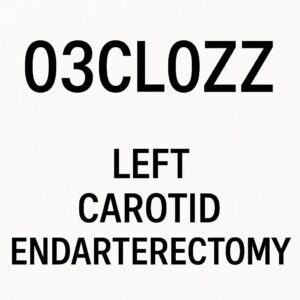
ICD-10-PCS Code for Left Carotid Endarterectomy
2. Understanding Carotid Artery Disease: The “Why” Behind the Procedure
To code a procedure accurately, one must first understand the disease it treats. The common carotid arteries are the major blood vessels that ascend through the neck, supplying oxygenated blood to the brain, face, and scalp. The left carotid artery typically arises directly from the aortic arch, making its hemodynamic and anatomical course unique.
Atherosclerosis is the pathological process at the core of carotid disease. It involves the buildup of plaque—a heterogeneous mixture of cholesterol, fatty substances, cellular waste products, calcium, and fibrin (a clotting material)—within the inner lining (intima) of the artery. Over decades, this plaque narrows the arterial lumen, a condition known as stenosis.
The danger is twofold:
-
Hemodynamic Insufficiency: Severe stenosis (typically >70-80%) can critically reduce blood flow to the brain, leading to symptoms like transient ischemic attacks (TIAs or “mini-strokes”) or strokes.
-
Embolization: More commonly, the unstable plaque can rupture or ulcerate. This rupture exposes thrombogenic material to the bloodstream, causing clot formation. Fragments of this clot or plaque (emboli) can break off and travel distally into the smaller cerebral arteries, blocking them and causing an ischemic stroke.
The left carotid artery is of particular significance in clinical practice. Due to its direct origin from the aorta and its anatomical geometry, it may be subject to specific hemodynamic stresses. Furthermore, for the majority of the population where the left hemisphere is dominant for language (the location of Broca’s and Wernicke’s areas), a stroke in the left middle cerebral artery territory—often fed by the left carotid—can result in aphasia (loss of speech), a profoundly disabling outcome.
Diagnosis involves a combination of clinical assessment for neurological symptoms and imaging studies, primarily carotid duplex ultrasound, which measures the degree of stenosis and characterizes the plaque. Confirmatory imaging with CT Angiography (CTA) or MR Angiography (MRA) is often employed to plan surgical intervention.
3. Carotid Endarterectomy (CEA) Explained: A Surgical Deep Dive
A carotid endarterectomy is the surgical gold standard for removing this atherosclerotic plaque to restore normal blood flow and prevent stroke. The procedure for the left side involves a specific series of steps:
-
Positioning and Incision: The patient is placed supine, with the neck extended and head turned to the right. A vertical or oblique incision is made along the anterior border of the left sternocleidomastoid muscle.
-
Exposure: The surgeon meticulously dissects through tissue planes to expose the left common carotid artery, its bifurcation into the internal carotid (going to the brain) and external carotid (going to the face), and the relevant segments.
-
Vascular Control: Clamps or loops are placed proximal and distal to the diseased segment to control blood flow.
-
Arteriotomy: The surgeon makes a longitudinal incision directly into the lumen of the diseased portion of the left internal carotid artery (and often extending into the common carotid).
-
Plaque Extraction (The Core of the Procedure): Using a delicate instrument called a Freer elevator, the surgeon finds the plane between the hardened plaque and the inner arterial wall. The entire atheromatous core is then meticulously extracted or “peeled out” as a single cylindrical cast of the artery. This is the definitive therapeutic action.
-
Closure: The arteriotomy is closed, sometimes with a patch (vein or synthetic) to prevent restenosis. Clamps are removed to restore blood flow to the left brain.
-
Hemostasis and Closure: The surgical site is checked for bleeding, and the neck incision is closed in layers.
This detailed understanding is crucial for coding. The coder must recognize that the essence of the procedure is the removal of a pathological substance (plaque) from a blood vessel, not the repair of the vessel itself, which is a secondary consideration.
4. The ICD-10-PCS Universe: A Primer for Procedural Coding
ICD-10-PCS (International Classification of Diseases, 10th Revision, Procedure Coding System) is a completely different system from its diagnosis counterpart (ICD-10-CM). Its primary purpose is to describe procedures performed in hospital inpatient settings. It is built on a logical, multiaxial structure where each of the seven characters has a specific meaning and comes from a predefined table.
The Seven Characters of ICD-10-PCS:
-
Section: The broadest category (e.g., Medical and Surgical = 0).
-
Body System: The general physiological system (e.g., Cardiovascular System = 3).
-
Root Operation: The objective of the procedure—the single most important conceptual choice (e.g., Extraction = B).
-
Body Part: The specific anatomical site (e.g., Internal Carotid Artery, Left = H).
-
Approach: How the site was reached (e.g., Open = 0).
-
Device: Any device that remains after the procedure (e.g., No Device = Z).
-
Qualifier: Additional information about the procedure (e.g., Diagnostic = Z, No Qualifier = Z).
The coder’s task is to analyze the operative report, identify the root operation, and navigate the appropriate table to build the code.
5. Deconstructing Code 03CH0BZ: Left Carotid Endarterectomy, Open Approach
This is the core of our exploration. Let’s break down the code assigned to a standard, open left carotid endarterectomy without patch angioplasty.
03CH0BZ
-
0: Section – Medical and Surgical
-
3: Body System – Cardiovascular System
-
C: Root Operation – Extraction
-
H: Body Part – Internal Carotid Artery, Left
-
0: Approach – Open
-
B: Device – No Device
-
Z: Qualifier – No Qualifier
Deconstruction of ICD-10-PCS Code 03CH0BZ
| Character Position | Character Value | Meaning | Key Documentation Clues in Operative Report |
|---|---|---|---|
| 1 (Section) | 0 | Medical and Surgical | Procedure involves cutting, suctioning, or manually removing. |
| 2 (Body System) | 3 | Cardiovascular System | Procedure is performed on the heart, arteries, or veins. |
| 3 (Root Operation) | C | Extraction: Pulling or stripping out or off all or a portion of a body part by the use of force. | “Removed plaque,” “performed endarterectomy,” “extracted atheromatous core.” |
| 4 (Body Part) | H | Internal Carotid Artery, Left | Explicit mention of operating on the left internal carotid artery. |
| 5 (Approach) | 0 | Open: Cutting through skin/mucous membrane to expose site. | Description of a neck incision, dissection, and direct visualization. |
| 6 (Device) | B | No Device | No mention of a patch (vein or synthetic) left in place. |
| 7 (Qualifier) | Z | No Qualifier | Procedure was therapeutic, not diagnostic. |
6. The “Root Operation”: Extraction (B) – The Heart of the Matter
The selection of the Root Operation is the most critical and often debated step. For CEA, the definitive root operation is Extraction (B).
-
ICD-10-PCS Definition: “Pulling or stripping out or off all or a portion of a body part by the use of force.” The key phrases are “by the use of force” and “a portion of a body part.”
-
Application to CEA: The atheromatous plaque, while pathological, is considered an abnormal portion of the blood vessel wall. It is not a foreign body (which is coded under root operation “Removal”). The surgeon uses force with an instrument to strip it from the intimal plane. This matches the definition of Extraction perfectly.
Why not Excision? Excision (B) is “cutting out or off, without replacement, a portion of a body part.” While similar, CEA does not involve “cutting out” the plaque in the typical sense; it is peeled out from a natural plane. The ICD-10-PCS Official Guidelines and Coding Clinics have consistently designated CEA as an Extraction.
Why not Repair? While the artery is indeed repaired by closure, the root operation must capture the principal objective. The primary goal is to remove the obstructive plaque to prevent stroke; the repair of the arteriotomy is a necessary secondary step.
7. Body Part & Approach: Precision in Specification
Body Part (Character 4): The coding must reflect the precise artery from which the plaque was extracted. The body part value H is for the Internal Carotid Artery, Left. The operative report must specify this. If the endarterectomy extends into the common carotid artery, it is still coded to the internal carotid, as that is the target vessel for the procedure. However, if a separate, distinct endarterectomy is performed only on the common carotid, a different body part value (0) would be used.
Approach (Character 5): The standard approach is Open (0), as described. While other approaches exist (e.g., percutaneous), they are not applicable to traditional CEA. The open approach is defined as cutting through the skin and tissues to directly visualize the operative site.
8. Laterality in ICD-10-PCS: The Critical Importance of “Left”
ICD-10-PCS demands explicit laterality. The body part table distinguishes between:
-
Internal Carotid Artery, Right (Body Part value
G) -
Internal Carotid Artery, Left (Body Part value
H) -
Internal Carotid Artery, Bilateral (value
F) – used only if separate procedures are performed on both sides in the same operative episode.
Coding a left procedure as right is a significant error that misrepresents the patient’s surgery and can affect future care decisions. The coder must vigilantly confirm laterality from the preoperative diagnosis, operative report (which should state “left” in the title and narrative), and anesthesia records.
9. Device and Qualifier: Completing the 7-Character Code
Device (Character 6): This character identifies any device that remains after the procedure. In a standard CEA, if the arteriotomy is closed primarily with sutures, No Device (B) is correct. However, if a patch angioplasty is performed—where a piece of vein (e.g., saphenous) or synthetic material (e.g., Dacron, PTFE) is sewn onto the artery to widen it—this constitutes a device. The coder must then shift to a different row in the PCS table. For example, using a synthetic patch on the left internal carotid would change the 6th character. The operative report must be scrutinized for terms like “closed with a patch,” “patch angioplasty,” or mention of harvesting a vein segment.
Qualifier (Character 7): For most therapeutic CEAs, the qualifier is No Qualifier (Z). A diagnostic qualifier would only be used in the extraordinarily rare case where the procedure was performed solely to obtain a specimen for pathology with no therapeutic intent, which is not the clinical reality for CEA.
10. Coding Scenarios & Clinical Nuances
-
Standard Left CEA with Synthetic Patch: The root operation remains Extraction. The body part is still Left Internal Carotid. The approach is Open. The Device changes to reflect the synthetic patch (specific value from the Device column for “synthetic substitute”). Code: 03CH0[Device Code]Z.
-
Left CEA with Concurrent Bypass: If the CEA is part of a more complex reconstruction (e.g., plaque extraction followed by a bypass graft to a more distal segment), the coder must apply the Multiple Procedure Rule from the ICD-10-PCS Guidelines. The procedure that constitutes the objective of the operative episode (often the Bypass) is coded first, and the CEA may be coded if the documentation states it was a significant, distinct procedure.
-
Failed Percutaneous Intervention Leading to Emergent CEA: A patient might have a stent placement attempt that fails, leading to an immediate open conversion and endarterectomy. The emergent CEA would be coded as described (03CH0BZ). The earlier percutaneous attempt may also be coded if it meets criteria for reporting.
-
CEA with Eversion Technique: Some surgeons use an “eversion” technique, where the internal carotid is transected, everted, the plaque removed, and then re-anastomosed. The root operation is still Extraction, as the core action is the removal of plaque by force. The specific technique does not change the root operation.
11. Common Errors and How to Avoid Them
-
Error: Using Root Operation Excision or Repair.
-
Avoidance: Internalize the PCS definition of Extraction. Remember that CEA is the classic example of this root operation in cardiovascular coding.
-
-
Error: Incorrect laterality (coding Right instead of Left).
-
Avoidance: Create a mental checklist. Verify laterality in the procedure title, preoperative diagnosis, operative narrative, and surgeon’s final post-op note.
-
-
Error: Missing a documented patch angioplasty.
-
Avoidance: Use a highlight or checklist for devices. Terms like “patch,” “vein graft,” “Dacron,” or “PTFE” should trigger a review of the Device column.
-
-
Error: Confusing the body part (e.g., coding Common Carotid when the target is the Internal).
-
Avoidance: Focus on the surgeon’s description of where the plaque was located and the arteriotomy was made. The internal carotid is almost always the primary target.
-
12. The Impact of Accurate Coding: Reimbursement, Data, and Patient Care
Accurate coding for 03CH0BZ is not an academic exercise; it has real-world consequences:
-
Reimbursement (DRG Assignment): Inpatient reimbursement under Medicare’s MS-DRG system is driven by the principal diagnosis and procedures. 03CH0BZ, when combined with a diagnosis of carotid stenosis with cerebral infarction, maps to a specific DRG with a higher weight and payment than a medical stroke DRG. An error can lead to underpayment or audit-based recoupment.
-
Healthcare Data & Research: This code feeds national databases. Accurate data allows researchers to track the outcomes of left vs. right CEAs, the complication rates of patched vs. unpatched procedures, and long-term stroke prevention efficacy. Inaccurate codes corrupt these studies.
-
Quality Metrics & Public Reporting: Hospital quality scores, such as stroke care metrics and surgical outcome reports, rely on accurate procedural data. Miscoding can unfairly penalize or misrepresent a hospital’s performance.
-
Patient Care Continuity: A patient’s coded medical history follows them. An accurate record of a left CEA informs future clinicians about the patient’s vascular status, preventing unnecessary repeat imaging or inappropriate treatment plans.
13. The Future: ICD-11-PCS and Beyond
The World Health Organization (WHO) has released ICD-11, which includes a procedural classification (ICD-11-PCS). While the US has not set a timeline for adoption, understanding the conceptual shift is prudent. ICD-11-PCS uses a more granular “stem-code” system with extensions. A procedure like CEA may be represented with a core stem code for “extraction of anatomical object from blood vessel” extended with detailed modifiers for laterality, approach, and use of patch. The fundamental principle—precise description of the intervention—will remain, even as the syntax evolves.
14. Conclusion
The ICD-10-PCS code 03CH0BZ for a left carotid endarterectomy is a precise digital signature for a vital surgical intervention. It encapsulates the removal of life-threatening plaque from a specific artery via an open approach. Mastery of this code requires understanding the disease, the surgery, and the rigorous logic of the PCS system. Accurate assignment is a professional responsibility with direct impacts on healthcare finance, data integrity, and ultimately, the ecosystem of patient care. The coder, armed with clinical knowledge and coding expertise, plays an indispensable role in accurately translating the surgeon’s work into the language of health information.
15. Frequently Asked Questions (FAQs)
Q1: What if the operative report for a left CEA says “excision of plaque”? Should I code it as Excision?
A: No. The surgeon’s verb may be “excised,” but in the context of ICD-10-PCS, carotid endarterectomy is definitively classified under the root operation Extraction. Always follow the PCS definitions, not the colloquial surgical terms.
Q2: How do I code a left CEA that uses a vein patch from the patient’s own leg?
A: The root operation (Extraction), body part (Left Internal Carotid), and approach (Open) remain the same. The device character changes. You would select the device value for “autologous tissue substitute” from the Device column in the 03C table. This differentiates it from a synthetic patch.
Q3: Is there a different code for an endarterectomy of the left common carotid artery only?
A: Yes. The body part character would change. In the 03C table, the body part value for “Common Carotid Artery, Left” is 0. The code would be 03C00BZ for an open extraction with no device. Always code to the specific artery documented as the focus of the endarterectomy.
Q4: Can 03CH0BZ be used for an emergency CEA after trauma?
A: Possibly, but the context is different. Trauma may cause a dissection or intimal flap, not atherosclerotic plaque. The root operation might still be Extraction if the objective is pulling/stripping out the damaged intima. However, the diagnosis (injury) and procedural details must be reviewed closely, as a different root operation like Destruction or Repair could be more appropriate based on the documented objective.
Q5: Where can I find official guidance and updates on this code?
A: The primary sources are the *ICD-10-PCS Official Guidelines for Coding and Reporting* and the AHA’s *Coding Clinic for ICD-10-CM/PCS*. These provide quarterly updates, clarifications, and official advice on complex scenarios.
16. Additional Resources
-
CMS ICD-10-PCS Official Guidelines: https://www.cms.gov/medicare/coding-billing/icd-10-codes
-
AHA Coding Clinic Advisor: (Subscription-based resource for official Q&As)
-
American Health Information Management Association (AHIMA): https://www.ahima.org – Offers credentials (CCS) and educational materials.
-
Society for Vascular Surgery (SVS) Patient Resources: https://vascular.org – For clinical understanding of the procedure.
-
National Stroke Association: https://www.stroke.org – For context on the disease being treated.
Disclaimer
The information contained in this article is for educational and informational purposes only and is not intended as a substitute for the official ICD-10-PCS coding guidelines, official coding advice, or professional medical coding consultation. While every effort has been made to ensure accuracy, coding standards and policies are subject to change. The author and publisher disclaim any liability for any loss or damage resulting from reliance on this information. Always consult the current year’s official ICD-10-PCS code set, guidelines, and relevant Coding Clinic advice before assigning codes for clinical or billing purposes.
Date: December 1, 2025
Author: Dr. Anya Sharma, MD, CCS-P


