
The International Classification of Diseases, Tenth Revision, Procedure Coding System (ICD-10-PCS) is more than just a nomenclature; it is the digital language through which the United States healthcare system documents, tracks, and bills for every procedure performed in an inpatient setting. Unlike its predecessor, ICD-9-CM Volume 3, the PCS system is built upon a revolutionary, multi-axial structure. This design moves away from simple narrative descriptions to a highly granular, seven-character alphanumeric code, where each character holds a specific, non-overlapping meaning. This systematic architecture ensures that virtually every unique surgical, medical, and diagnostic intervention is captured with unparalleled specificity, forming the bedrock for clinical data analysis, reimbursement methodologies (like MS-DRGs), quality reporting, and health policy planning. Without this precise documentation, the flow of information, and consequently, the flow of revenue, within a hospital grinds to a halt.
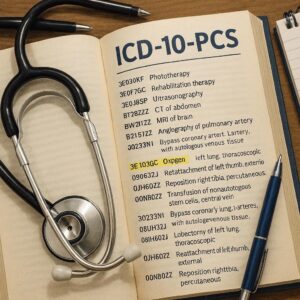
ICD-10-PCS Coding for Oxygen
The Unique Challenge of Coding Respiratory Interventions
Within the vast lexicon of PCS codes, procedures related to the Respiratory System (Body System 0B) and Extracorporeal Assistance (Body System 5A) present some of the most intricate and challenging coding scenarios. The sheer spectrum of respiratory support—ranging from the simple administration of supplemental oxygen to the highly technical management of mechanical ventilation and sophisticated interventions like Extracorporeal Membrane Oxygenation (ECMO)—necessitates a deep understanding of multiple distinct ICD-10-PCS sections and root operations. The ambiguity of “oxygen administration” versus “ventilator management” is a critical differentiator. Simple supplemental oxygen, a common and essential therapeutic agent, does not typically require a PCS code, as it is considered part of routine care. Conversely, the continuous, life-sustaining functions provided by a mechanical ventilator must be coded with absolute precision, utilizing codes that define not only the nature of the assistance but also the precise duration of that assistance. This duration character is an operational lynchpin, directly impacting the final assigned Medicare Severity-Diagnosis Related Group (MS-DRG) and, by extension, the hospital’s reimbursement.
Target Audience and Scope of Analysis
This article is designed for a professional audience including inpatient hospital coders, clinical documentation integrity (CDI) specialists, health information management (HIM) auditors, revenue cycle managers, and respiratory therapists who require a mastery of the official guidelines and practical application of ICD-10-PCS for all procedures related to oxygenation and respiratory support. Our analysis will move systematically through the relevant ICD-10-PCS sections, focusing on the often-confused root operations and character definitions, ultimately providing a comprehensive and authoritative guide to accurately translating complex clinical documentation into the precise, mandated language of the PCS code set.
4. Chapter 5: Extracorporeal or Systemic Assistance and Performance (The Oxygen-Related Chapter)
While many respiratory procedures are found in the Body System 0B (Respiratory System), the most critical codes for oxygen-related life support, particularly mechanical ventilation, reside in Section 5: Extracorporeal or Systemic Assistance and Performance. This section is distinct because it describes procedures that either supplement or entirely take over a physiological function, often involving an external apparatus.
Section 5A: Administration and Management of Respiratory Support
Section 5A, titled “Assistance and Performance,” is the primary home for the codes that capture the critical work of respiratory life support. This section is essential because it is procedural rather than diagnostic and directly quantifies the level of clinical effort required to maintain the patient’s oxygenation and ventilation status.
Root Operation 0: Assistance—Defining the Use of a Mechanical Ventilator
The codes for mechanical ventilation are structured around the root operation Assistance (0). The function of this root operation is defined as “Taking over a portion of a physiological function.” In the context of respiratory care, this specifically means a mechanical ventilator is assisting the lungs in the vital task of gas exchange (ventilation).
The basic structure for mechanical ventilation begins with:
-
Section: 5 (Extracorporeal or Systemic Assistance and Performance)
-
Body System: A (Physiological Systems)
-
Root Operation: 0 (Assistance)
-
Body System: B (Respiratory)
-
Operation Qualifier: 1 (Ventilation)
This brings us to the common starting point: 5A093… (Respiratory Assistance, Ventilation). The critical remaining characters define the clinical application and, most importantly, the duration.
Understanding the Ventilator Duration (The 7th Character)
The seventh character (Qualifier) is the most significant element for mechanical ventilation coding and is often the main determinant of the final MS-DRG assignment. It represents the cumulative duration of continuous mechanical ventilation, calculated from the time of intubation and initiation of the ventilator until a sustained weaning or removal of the device.
There are four primary duration characters that apply:
| Character | Qualifier Description | Clinical Interpretation and MS-DRG Impact |
| 0 | Continuous | Ventilation for less than 24 consecutive hours. |
| 1 | Intermittent | Generally not used for initial mechanical ventilation but for recurring, non-continuous periods. |
| 2 | < 24 Consecutive Hours | This is the most common code for brief intubations (e.g., post-operative or brief resuscitation). |
| 3 | 24-96 Consecutive Hours | Indicates a more significant period of respiratory failure and support. |
| 4 | > 96 Consecutive Hours | This code is the most impactful. It signifies “Prolonged Mechanical Ventilation” and typically maps to a higher-weighted MS-DRG, reflecting a much higher resource utilization and severity of illness. |
Table 1: Key ICD-10-PCS Codes for Mechanical Ventilation Duration (5A093 Family)
| ICD-10-PCS Code | Definition | Associated Duration | Key Coding Guideline (Excerpt) |
| 5A0935Z | Assistance, Physiological Systems, Respiratory, Ventilation, Continuous, Greater than 96 Consecutive Hours | > 96 hours | C.2.b: The duration of mechanical ventilation is cumulative, including time on and off the vent, provided the time off is less than 2 hours. |
| 5A0934Z | Assistance, Physiological Systems, Respiratory, Ventilation, Continuous, 24-96 Consecutive Hours | 24-96 hours | Time begins at the moment of intubation/tracheostomy and commencement of mechanical assistance. |
| 5A093B | Assistance, Physiological Systems, Respiratory, Ventilation, Continuous, < 24 Consecutive Hours | < 24 hours | If a patient is ventilated, removed, and then re-ventilated, the time periods are added together until the 96-hour threshold is met. |
Source: Official ICD-10-PCS Guidelines and Codebook (2025 Edition)
11. Conclusion
The accurate application of ICD-10-PCS codes to respiratory services is paramount for proper healthcare administration and resource management. The coding system precisely differentiates between simple supplemental oxygen administration and critical life-support procedures like mechanical ventilation (5A093) and ECMO (5A1). Mastery of the root operations, especially Assistance and Performance, and the critical seven-character duration value is essential for accurate MS-DRG assignment, ensuring appropriate reimbursement that reflects the true complexity and resource utilization of inpatient respiratory care.
12. FAQs: ICD-10-PCS and Respiratory Coding
| Q1: Does administering simple oxygen via a nasal cannula require an ICD-10-PCS code? | A: No. The official guidelines state that simple oxygen administration (e.g., via nasal cannula or simple face mask) is generally considered a routine, non-procedural component of medical care and does not meet the threshold for a separate PCS code assignment. |
| Q2: What is the difference between root operations Assistance and Performance in Section 5? | A: Assistance (5A0) means the device supplements a portion of a physiological function (e.g., a mechanical ventilator assisting breathing). Performance (5A1) means the device completely takes over a physiological function (e.g., ECMO or Hemodialysis completely performing gas exchange or waste filtering). |
| Q3: How is the duration for prolonged mechanical ventilation (over 96 hours) calculated? | A: The time is cumulative. It starts with the initial intubation/ventilation and continues unless the patient is successfully off the ventilator for a sustained period of more than two hours. If the patient is re-ventilated within that two-hour window, the time is continuous. The 96-hour mark is the critical threshold for the highest-weighted MS-DRGs related to respiratory assistance. |
| Q4: Which ICD-10-PCS body system includes the procedure for an in-hospital tracheostomy placement? | A: The procedure to create a new tracheostomy (opening the trachea) is found under the Body System 0B (Respiratory System), often with the root operation Bypass (e.g., to create a new route for air). Subsequent procedures, like changing the trach tube, may be coded differently (e.g., Change or Removal). |
13. Additional Resources
-
The Official ICD-10-PCS Codebook and Coding Guidelines (Current Fiscal Year Edition).
-
AHA Coding Clinic for ICD-10-PCS (Quarterly publications for authoritative interpretation).
-
Centers for Medicare & Medicaid Services (CMS) Inpatient Prospective Payment System (IPPS) Final Rule.
-
The American Health Information Management Association (AHIMA) official resources and training modules.
Date: December 04, 2025
Author: Expert Coding Team
Disclaimer: This article provides information for educational and reference purposes only regarding the ICD-10-PCS coding system. It is not intended as a substitute for professional coding advice, clinical documentation guidance, or payer-specific requirements. Coders, auditors, and healthcare professionals must consult the official ICD-10-PCS codebook, Coding Clinic, and current official guidelines for all coding decisions.


