
In the intricate world of modern medicine, where a surgeon’s skill meets complex disease, few procedures carry the weight and technical majesty of the pancreaticoduodenectomy, universally known as the Whipple procedure. It is a surgery of monumental proportion, undertaken to combat cancers and pathologies nestled in the core of our anatomy. Yet, for every physical procedure performed in the operating room, there exists a parallel narrative of precision unfolding in the administrative heart of the hospital—a narrative written in code. The ICD-10-PCS (International Classification of Diseases, Tenth Revision, Procedure Coding System) code for a pancreaticoduodenectomy is not merely a billing footnote; it is a dense, structured linguistic capsule containing the entire story of the patient’s operation. This 7-character alphanumeric string holds critical data on what was removed, how it was removed, what pathway the surgeon took, and what was reconstructed. In an era defined by data-driven healthcare, this code influences hospital reimbursement, shapes national cancer statistics, guides quality improvement initiatives, and fuels vital clinical research. This article embarks on a detailed journey to decode this specific code, unraveling its characters to reveal its profound significance for medical coders, surgeons, healthcare administrators, and anyone invested in the ecosystem of high-stakes surgical care.
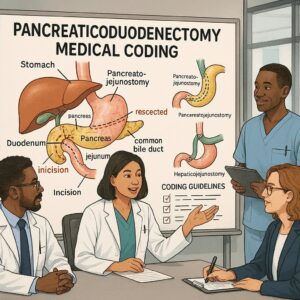
ICD-10-PCS for Pancreaticoduodenectomy
2. Anatomy and Procedure Primer: Understanding the Pancreaticoduodenectomy
To comprehend the code, one must first understand the procedure and the anatomy it involves. The Whipple procedure is primarily performed for malignant tumors in the head of the pancreas, the ampulla of Vater, the distal common bile duct, or the duodenum. The goal is en bloc resection—removing the tumor with clear margins along with the regional lymph nodes and the organs to which it is anatomically attached.
Key Anatomical Structures Involved:
-
Head of the Pancreas: The right-sided portion of the pancreas, nestled in the C-loop of the duodenum.
-
Duodenum: The first part of the small intestine.
-
Common Bile Duct: The vessel carrying bile from the liver and gallbladder to the intestine.
-
Gallbladder: Often removed as part of the procedure.
-
Distal Stomach (Antrum): Often a portion is removed, though pylorus-preserving variations exist.
The Surgical Steps (Standard Whipple):
-
Exploration & Mobilization: The abdomen is entered, and the organs are assessed for resectability. The pancreas, duodenum, and bile duct are meticulously freed.
-
Resection: The surgeon transects the stomach (if applicable), the common bile duct, the neck of the pancreas, and the jejunum. The specimen—containing the pancreatic head, duodenum, gallbladder, distal bile duct, and often the distal stomach—is removed.
-
Reconstruction (The Anastomoses): This is the most critical and technically demanding phase, involving a series of reconnections:
-
Pancreaticojejunostomy: The remaining pancreas is connected to the jejunum.
-
Hepaticojejunostomy: The common hepatic duct is connected to the jejunum.
-
Gastrojejunostomy (or Duodenojejunostomy): The stomach (or preserved duodenum) is connected to the jejunum.
-
This complex dance of removal and reconstruction is what the ICD-10-PCS code must capture with unerring accuracy.
3. The ICD-10-PCS Universe: A Foundation for Procedural Coding
ICD-10-PCS is a multi-axial, procedure-based coding system. Each of the 7 characters has a specific meaning and belongs to a specific axis (or category) of information. The characters are always in the same order.
The 7-Character Structure:
-
Character 1: Section – The broad category (e.g., Medical/Surgical, Obstetrics).
-
Character 2: Body System – The general physiological system (e.g., Hepatobiliary System and Pancreas).
-
Character 3: Root Operation – The objective of the procedure (e.g., Resection, Excision).
-
Character 4: Body Part – The specific part addressed.
-
Character 5: Approach – How the site was reached (e.g., Open, Percutaneous).
-
Character 6: Device – Any device remaining after the procedure.
-
Character 7: Qualifier – Additional procedural detail.
For a pancreaticoduodenectomy, we are almost exclusively within the Medical and Surgical section (Character 1: 0).
4. Deconstructing the Pancreaticoduodenectomy Code: A Step-by-Step Build
Let’s construct the code for a standard, open, classic Whipple procedure with resection of the pancreatic head, duodenum, gallbladder, distal stomach, and distal bile duct, with reconstruction via pancreaticojejunostomy and hepaticojejunostomy.
ICD-10-PCS Code Build for a Classic Pancreaticoduodenectomy
| Character | Axis of Information | Options Relevant to Whipple | Selection for Classic Open Whipple | Rationale |
|---|---|---|---|---|
| 1 | Section | Medical and Surgical | 0 | The procedure is surgical. |
| 2 | Body System | Hepatobiliary System and Pancreas | F | The primary focus is on pancreas and bile duct structures. |
| 3 | Root Operation | Resection, Excision | T (Resection) | The entire pancreatic head and duodenum are cut out or off, not just a portion. |
| 4 | Body Part | Pancreatic Head, Duodenum, Ampulla of Vater | G (Pancreatic Head) | The head is the primary site; the duodenectomy is inherent. |
| 5 | Approach | Open, Percutaneous Endoscopic, etc. | 0 (Open) | A large abdominal incision is made. |
| 6 | Device | Synthetic Substitute, Autologous Tissue, etc. | Z (No Device) | No device remains; reconstruction uses native tissue (jejunum). |
| 7 | Qualifier | Diagnostic, No Qualifier, etc. | Z (No Qualifier) | For a standard resection. A qualifier like “X” for diagnostic would be rare. |
| Final Code: | 0FTG0ZZ | Resection of Pancreatic Head, Open Approach |
Crucially, this single code (0FTG0ZZ) represents the core resection. However, it does not tell the whole story.
5. The Root Operation: “Resection” vs. “Excision” – The Critical First Decision
The choice of Root Operation (Character 3) is the most consequential and often debated. The official definitions are:
-
Excision (B): Cutting out or off, without replacement, a portion of a body part. The body part value is for the site of the excision, not the tissue removed.
-
Resection (T): Cutting out or off, without replacement, all of a body part.
For a Whipple, if the physician documents “pancreaticoduodenectomy” or “removal of the pancreatic head and duodenum,” the intent is to remove the entire head of the pancreas and the entire duodenum. Therefore, Resection (T) is the correct root operation. If only a portion of the pancreatic head was removed (e.g., a limited enucleation), then Excision (B) would be appropriate. Misapplying this distinction is a major audit risk.
6. Navigating the Body Part: The Complex Landscape of the Hepatopancreatic System
Character 4 (Body Part) requires careful attention to the PCS tables. In the Hepatobiliary System (F), the options include:
-
G: Pancreatic Head – This value inherently includes the duodenum. The official PCS Body Part definition for “Pancreatic Head” states it includes the associated duodenum. Therefore, 0FTG0ZZ captures the resection of both the pancreatic head and the duodenum with one code. You do not also code a separate duodenectomy.
-
6: Ampulla of Vater – Used if the procedure is specifically a local resection of the ampulla only (a much rarer procedure).
-
Other structures like the bile duct or gallbladder are not the primary body part for this root operation. Their removal is often considered an inherent component of the larger resection when performed together. However, separate codes may be needed for their removal if the documentation specifies they were removed separately or if only a bile duct resection with duodenectomy is performed (e.g., for a distal bile duct tumor).
7. The Approach: From Open to Robotic – Capturing Technological Evolution
Character 5 (Approach) defines the surgical technique’s invasiveness.
-
Open (0): Traditional approach via a large laparotomy incision.
-
Laparoscopic (4): Minimally invasive, using several small incisions and a camera.
-
Robotic Assisted (8): A subset of laparoscopic surgery where the surgeon controls robotic arms. In PCS, this is coded as Percutaneous Endoscopic with the qualifier X (Diagnostic) for the robotic assist? No. This is a common confusion. The 2025 ICD-10-PCS guidelines provide specific direction for robotic-assisted procedures. The approach is based on the instrumentation used to perform the core part of the procedure. If the resection is performed by the robotic arms, the approach is Percutaneous Endoscopic (4). The robotic technology is not specified in the approach character but is captured by an additional qualifier in the Device character (Character 6) if applicable, or more commonly, is implied by the approach and documented technique. Always consult the most current guidelines.
-
Example, Robotic Whipple: The approach would likely be 4 (Percutaneous Endoscopic), and the final code might be 0FTG4ZZ.
-
8. Device and Qualifier Characters: The Nuances of Reconstruction and Technique
For a standard Whipple:
-
Character 6 (Device): Typically Z (No Device). No artificial device is left. The reconstruction uses the patient’s own jejunum (autologous tissue), which is not considered a “device” in PCS terminology. If a synthetic graft or stent were placed during reconstruction, this character would change.
-
Character 7 (Qualifier): Typically Z (No Qualifier) for a therapeutic resection. A qualifier like X (Diagnostic) would only be used if the primary purpose of the resection was to obtain tissue for a biopsy, which is virtually never the case in an oncologic Whipple.
The “Complete” Picture: Multiple Codes
It is vital to remember that 0FTG0ZZ is rarely the only code for the encounter. The Whipple is a multi-procedural surgery. Additional codes are required to fully represent the operation:
-
Bile Duct Resection: If separately documented, e.g., 0FT60ZZ (Resection of Common Bile Duct, Open).
-
Cholecystectomy: Removal of the gallbladder, e.g., 0FT44ZZ (Resection of Gallbladder, Open).
-
Gastrectomy (partial): If performed, e.g., 0DT60ZZ (Resection of Stomach, Open) – note this is in the Gastrointestinal system (D).
-
Anastomoses: The reconstructive anastomoses (pancreaticojejunostomy, hepaticojejunostomy, gastrojejunostomy) are also coded separately. They are root operations of Bypass (creating a new route for content flow) or Reattachment. For example, a pancreaticojejunostomy would be coded as 0D1G0Z7 (Bypass of Pancreas to Jejunum, Open).
A complete procedural report will generate 4-6 or more ICD-10-PCS codes to paint the full picture.
9. Case Studies: Applying Knowledge to Real-World Scenarios
Case 1: The Classic Open Whipple
-
Op Note: “Open pancreaticoduodenectomy with antrectomy, cholecystectomy, and reconstruction via pancreaticojejunostomy, hepaticojejunostomy, and gastrojejunostomy.”
-
Primary Codes:
-
0FTG0ZZ – Resection of Pancreatic Head/Duodenum, Open
-
0DT60ZZ – Resection of Stomach, Open
-
0FT44ZZ – Resection of Gallbladder, Open
-
0D1G0Z7 – Bypass Pancreas to Jejunum, Open
-
0D1H0Z7 – Bypass Hepatic Duct to Jejunum, Open
-
0D1D0Z7 – Bypass Stomach to Jejunum, Open
-
Case 2: The Pylorus-Preserving Pancreaticoduodenectomy (PPPD)
-
Op Note: “Laparoscopic pylorus-preserving pancreaticoduodenectomy with cholecystectomy.”
-
Key Difference: The stomach is not resected. The duodenum is transected just distal to the pylorus.
-
Primary Codes:
-
0FTG4ZZ – Resection of Pancreatic Head/Duodenum, Percutaneous Endoscopic (Laparoscopic)
-
0FT44ZZ – Resection of Gallbladder, Percutaneous Endoscopic (Laparoscopic)
-
(Bypass codes for pancreas and bile duct to jejunum, and a duodenojejunostomy for reattachment of the preserved duodenal stump).
-
10. The Ripple Effect: How Accurate Coding Impacts Reimbursement, Data, and Care
An inaccurate code is not just an administrative error; it has cascading consequences.
-
Reimbursement (DRG Assignment): Inpatient payment under Medicare’s MS-DRG system is heavily driven by the principal procedure code. Miscoding a major resection like a Whipple can place the case in an incorrect DRG, leading to significant underpayment or overpayment (which can trigger audits and recoupment).
-
Clinical Data & Research: Cancer registries (e.g., National Cancer Database) use these codes to track surgical trends and outcomes. Inaccurate coding corrupts this data, hindering our ability to understand which techniques yield the best survival rates or fewest complications.
-
Quality Metrics & Benchmarking: Hospitals are compared on complication rates, mortality, and length of stay for specific procedures. Accurate coding ensures a hospital’s performance for complex procedures like the Whipple is correctly categorized and compared.
-
Denial Management: A poorly constructed or unsupported code is a direct path to claim denial, requiring costly rework and delaying revenue.
11. Common Pitfalls and Auditing Challenges
-
Coding Only the Resection: Forgetting to code the concurrent cholecystectomy, gastrectomy, and the crucial reconstructive anastomoses.
-
Confusing Excision vs. Resection: Undercoding by using Excision for a total removal.
-
Duplicating the Duodenectomy: Coding both 0FTG0ZZ and a separate code for duodenum resection.
-
Misapplying the Approach for Robotic Surgery: Not following the latest guidelines for robotic-assisted procedures.
-
Insufficient Documentation: The code must be supported by the physician’s operative report. Ambiguous language like “partial removal” can lead to coder confusion and queries.
12. The Future: ICD-11-PCS and Beyond
The World Health Organization’s ICD-11 includes a procedural classification (ICD-11-PCS) that is even more detailed and digital-friendly. While the US has not set a timeline for adoption, its structure promises greater granularity. Future systems may integrate more seamlessly with electronic health records and surgical outcome data, making the link between the coded data point and the patient’s long-term health journey even more powerful.
13. Conclusion
The ICD-10-PCS code for a pancreaticoduodenectomy is a masterpiece of administrative precision, mirroring the surgical masterpiece it represents. It transcends its role as a billing tool to become a vital piece of healthcare intelligence. Mastering its construction—from the root operation decision through the nuances of approach and concomitant procedures—is essential for ensuring financial integrity, contributing to reliable national health data, and ultimately, supporting the ecosystem that makes these life-saving surgeries possible. In the digital age of medicine, the coder’s accuracy is as non-negotiable as the surgeon’s skill.
14. Frequently Asked Questions (FAQs)
Q1: Is the Whipple procedure always coded as a “Resection”?
A: Almost always. If the entire pancreatic head and duodenum are removed, “Resection (T)” is correct. “Excision” would apply only for a limited, partial removal of a portion of the pancreas.
Q2: How many ICD-10-PCS codes are needed for a single Whipple procedure?
A: Typically between 4 and 7 codes. One for the core pancreaticoduodenectomy (0FTG0ZZ), plus separate codes for any concurrent procedures (cholecystectomy, gastrectomy) and each of the reconstructive anastomoses (pancreatic, biliary, gastrointestinal).
Q3: How do I code a laparoscopic or robotic Whipple?
A: The approach character changes. For laparoscopic, use 4 (Percutaneous Endoscopic). For robotic-assisted, the current guidelines generally direct you to use the approach that matches the instrumentation (e.g., Percutaneous Endoscopic). Always reference the most current ICD-10-PCS Official Guidelines for Coding and Reporting for specific robotic surgery instructions.
Q4: Why don’t I use a separate code for the duodenum?
A: In the ICD-10-PCS table, the body part value “Pancreatic Head” (G) explicitly includes the associated duodenum. Therefore, it is bundled into that single code. Coding it separately would be incorrect duplication.
Q5: Where can I find the most authoritative source for building these codes?
A: The definitive sources are: 1) The current year’s *ICD-10-PCS Official Code Set* and Official Guidelines for Coding and Reporting published by the CMS and the AHA; 2) The AHA’s *Coding Clinic for ICD-10-CM/PCS* which provides official advice on complex scenarios.
Date: December 08, 2025
Disclaimer: This article is intended for educational and informational purposes within the healthcare coding and administration field. It does not constitute medical or coding advice. Always consult the latest official ICD-10-PCS coding manuals, guidelines, and clinical documentation for definitive code assignment.


