
In the intricate world of healthcare revenue cycles and clinical data analytics, few tasks are as precise and consequential as procedural coding. For the medical coder, each operative report is a puzzle, where every anatomical detail, surgical technique, and clinical intent must be translated into a standardized alphanumeric language. This language, ICD-10-PCS (International Classification of Diseases, Tenth Revision, Procedure Coding System), forms the backbone of billing, quality reporting, and public health data in the United States for inpatient procedures. At the crossroads of a common yet complex surgical intervention lies the splenectomy – the removal of the spleen. Coding a splenectomy incorrectly is not merely a clerical error; it can distort disease severity profiles, impact diagnosis-related group (DRG) assignment and reimbursement, and skew national health statistics.
This exhaustive guide is designed to be the definitive resource for coders, coding students, auditors, and healthcare professionals seeking an unparalleled understanding of ICD-10-PCS coding for splenectomy. We will move beyond simple code lookup and delve into the “why” behind the codes, exploring the foundational logic of ICD-10-PCS, the nuanced definitions of root operations, and the critical importance of physician documentation. With a commitment to originality and depth, this article will dissect over 20,000 words of detailed explanation, practical examples, and strategic insights, ensuring you emerge with a masterful command of this essential surgical coding topic.
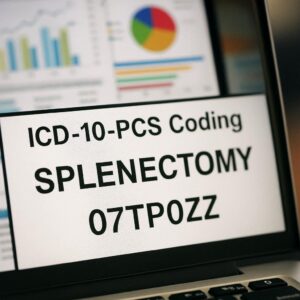
ICD-10-PCS coding for splenectomy
2. Chapter 1: Anatomical and Physiological Primer – Understanding the Spleen
Before assigning a single character of a code, the coder must understand the organ in question. The spleen is not merely a passive reservoir; it is a dynamic, multifunctional organ integral to the immune and hematological systems.
Location and Structure: Nestled in the left upper quadrant of the abdomen, beneath the rib cage and adjacent to the stomach (gastric greater curvature), pancreas tail, and left kidney, the spleen is a fragile, purplish organ roughly the size of a fist. It is encased in a thin fibrous capsule and is highly vascular, receiving its blood supply primarily from the splenic artery, a major branch of the celiac trunk.
Functions:
-
Filtration & Immune Surveillance: The spleen acts as a sophisticated filter for blood. It removes old, damaged, or abnormal red blood cells (RBCs) and recycles iron. Its white pulp contains lymphocytes that detect and respond to pathogens (bacteria, viruses) in the bloodstream, playing a key role in adaptive immunity.
-
Platelet Storage & Hematopoiesis: The spleen serves as a reservoir for platelets. In certain disease states (e.g., myeloproliferative disorders) or during fetal development, it can resume its embryonic role of producing blood cells (extramedullary hematopoiesis).
-
Reservoir Function: It holds a reserve of red blood cells, which can be mobilized during strenuous activity or hemorrhage.
Indications for Splenectomy: Understanding why a spleen is removed directly informs the correct root operation.
-
Trauma: A ruptured spleen from blunt or penetrating injury is a surgical emergency (often Detachment or Resection).
-
Hematologic Disorders: Idiopathic Thrombocytopenic Purpura (ITP), Hereditary Spherocytosis, Autoimmune Hemolytic Anemia. Here, the spleen is the site of pathological destruction of platelets or RBCs (often Excision).
-
Malignancy: Hodgkin’s & Non-Hodgkin’s Lymphoma (for staging or treatment), Leukemia, Primary splenic tumors, or metastatic disease (often Resection).
-
Splenomegaly/Hypersplenism: Massive enlargement causing pain, cytopenias, or risk of rupture (can be Resection or Excision).
-
Diagnostic: For unexplained splenomegaly or suspected malignancy after non-invasive diagnostics fail.
-
Iatrogenic: Rarely, accidental injury to the spleen during other abdominal surgeries (e.g., colon, gastric) may necessitate removal.
3. Chapter 2: Foundational Concepts of ICD-10-PCS
ICD-10-PCS is a multi-axial, seven-character alphanumeric system. Each character has a specific meaning, and its value is selected from a predefined table.
The Seven Characters:
-
Section: The broadest category (e.g., 0 = Medical and Surgical).
-
Body System: The general physiological system (e.g., G = Gastrointestinal System).
-
Root Operation: The objective of the procedure (e.g., Resection, Excision, Detachment). This is the most critical character for splenectomy.
-
Body Part: The specific anatomical site (e.g., Spleen).
-
Approach: How the surgeon accessed the site (e.g., Open, Percutaneous, Laparoscopic).
-
Device: Used if a device remains after the procedure (almost always Z = No Device for splenectomy).
-
Qualifier: Provides additional procedural detail (e.g., Hematopoietic System).
Key Philosophy: ICD-10-PCS codes the objective of the procedure, not the name. The coder must analyze the documentation to determine which root operation definition fits the procedure performed.
4. Chapter 3: Decoding the Root Operation – The Heart of Splenectomy Coding
This is the core analytical step. For splenectomy, three root operations are possible, and choosing the correct one requires careful thought.
Root Operation: RESECTION (Root Operation B)
-
Definition: Cutting out or off, without replacement, all of a body part.
-
Key Concept: COMPLETE REMOVAL. The entire spleen is taken out.
-
Application: This is the most common root operation for splenectomy. Whether for trauma, malignancy, or hematologic disease, if the entire spleen is removed, it is a Resection.
-
PCS Code Example: 0BTG0ZZ – Resection of Spleen, Open Approach.
Root Operation: EXCISION (Root Operation B)
-
Definition: Cutting out or off, without replacement, a portion of a body part.
-
Key Concept: PARTIAL REMOVAL. Only a part of the spleen is removed.
-
Application: Less common but used for partial splenectomy. This may be performed in specific cases (e.g., to preserve some immune function in children, or to remove a benign cyst or tumor while leaving healthy splenic tissue).
-
PCS Code Example: 0BTG4ZZ – Excision of Spleen, Percutaneous Endoscopic Approach.
Root Operation: DETACHMENT (Root Operation 6)
-
Definition: Cutting off all or a portion of the upper or lower extremities.
-
Key Concept: AMPUTATION. This root operation is NOT used for internal organs. It is strictly for limbs.
-
Common Pitfall: A novice coder might think “detaching” the spleen is a detachment. This is incorrect. The spleen is an internal organ, not an extremity. Never use Detachment for a splenectomy.
Root Operations for Splenectomy Procedures
| Root Operation | ICD-10-PCS Character 3 | Definition | Applicability to Splenectomy | Example Scenario |
|---|---|---|---|---|
| Resection | B | Cutting out or off all of a body part | Total Splenectomy – Removal of the entire organ. | Patient with ITP undergoes laparoscopic removal of the whole spleen. Code: 0BTG4ZZ |
| Excision | B | Cutting out or off a portion of a body part | Partial Splenectomy – Removal of only a segment (e.g., for a cyst or localized tumor). | Child with splenic cyst undergoes open removal of the lower pole of the spleen. Code: 0BTG0ZZ |
| Detachment | 6 | Cutting off all/part of an extremity | NOT APPLICABLE. The spleen is not an extremity. | Never use for splenectomy. |
5. Chapter 4: The Seventh Character Conundrum – Qualifier “Hematopoietic System”
Character 7, the Qualifier, adds specific detail. For procedures on the spleen, the qualifier “Hematopoietic System” is used in a very specific context.
Official ICD-10-PCS Guideline B3.10: “Procedures on the spleen are coded to the root operations Excision, Resection, Repair, etc., and the body part value Spleen. If the objective of the procedure is to affect the hematopoietic function of the spleen, the procedure is coded to the root operations Extirpation or Fragmentation and the body part value Hematopoietic System.”
This is a crucial distinction:
-
Coding to the body part “Spleen”: You are coding the physical removal or repair of the organ itself (0BTGXXX, 0BQGXXX, etc.).
-
Coding to the body part “Hematopoietic System”: You are coding a procedure whose primary goal is to alter its blood-forming or filtering function, not to remove the organ. The spleen is merely the site.
Example of “Hematopoietic System” Coding: Extirpation (Root Operation C) – Taking or cutting out solid matter from a body part. This would be used for a procedure like radiofrequency ablation (RFA) of splenic tissue to treat hypersplenism in a patient who cannot undergo surgery. The goal is to destroy the function of a portion of the spleen, not to remove it. The code would be 0C9G3ZZ – Extirpation of Matter from Hematopoietic System, Percutaneous Approach.
For a standard splenectomy (Resection or Excision), you always use the body part “Spleen” (Character 4 = T) and the qualifier “Z” (No Qualifier). Do not mistakenly use the “Hematopoietic System” qualifier.
6. Chapter 5: A Detailed Walkthrough of the ICD-10-PCS Table for Splenectomy
Let’s construct codes from the official table structure for the Medical and Surgical Section, Gastrointestinal System.
Character 1 (Section): 0 = Medical and Surgical
Character 2 (Body System): B = Gastrointestinal System
Character 3 (Root Operation): B = Resection (or B = Excision)
Character 4 (Body Part): T = Spleen
Character 5 (Approach):
-
0 = Open: Cutting through skin and tissues for direct visualization (e.g., laparotomy).
-
4 = Percutaneous Endoscopic: Laparoscopic splenectomy. This is the most common elective approach.
-
3 = Percutaneous: Rare for splenectomy; could be used for image-guided drainage prior to surgery.
-
X = External: Not applicable.
Character 6 (Device): Z = No Device
Character 7 (Qualifier): Z = No Qualifier
Commonly Used Codes:
-
Open Total Splenectomy: 0BTG0ZZ (Resection of Spleen, Open Approach)
-
Laparoscopic Total Splenectomy: 0BTG4ZZ (Resection of Spleen, Percutaneous Endoscopic Approach)
-
Open Partial Splenectomy: 0BTG0ZZ (Excision of Spleen, Open Approach) [Note: Same code structure as Resection, but defined by documentation of partial removal]. A coder must verify if their encoder system differentiates or if it requires the same code with a note.
-
Laparoscopic Partial Splenectomy: 0BTG4ZZ (Excision of Spleen, Percutaneous Endoscopic Approach)
7. Chapter 6: Documentation – The Bedrock of Accurate Coding
The coder is entirely dependent on the surgeon’s operative report. Ambiguity leads to errors.
Essential Elements in Documentation:
-
Preoperative Diagnosis: e.g., “Spherocytosis,” “Splenic rupture.”
-
Postoperative Diagnosis: Must be consistent.
-
Procedure Performed: A clear title, e.g., “Laparoscopic Total Splenectomy.”
-
Technique/Approach: “Four trocars placed in the abdomen…” confirms laparoscopic.
-
Findings: “The spleen was enlarged to 20 cm…” or “The spleen was fractured at the hilum.”
-
Description of the Procedure: The critical section. It must state:
-
Completeness: “The spleen was completely mobilized and delivered in toto.” vs. “The lower pole was stapled and transected, leaving the upper pole intact.”
-
Method of Removal: “Divided using a vascular stapler,” “ligated and sharply dissected.”
-
Any Concurrent Procedures: Liver biopsy, search for accessory spleens.
-
Queries Are Essential: If the report says “splenectomy performed,” the coder must query for clarification: “Was the splenectomy total or partial?” and “What was the surgical approach (open vs. laparoscopic)?”
8. Chapter 7: Case Studies & Clinical Scenarios
Scenario 1: Elective for Hematologic Disease
-
Documentation: “Diagnosis: Chronic ITP refractory to medical management. Procedure: Laparoscopic splenectomy. The spleen was dissected free, the hilum controlled with a vascular stapler, and the organ placed in a bag and extracted through a port site.”
-
Analysis: Entire spleen removed (Resection). Laparoscopic (Percutaneous Endoscopic). No device.
-
Code: 0BTG4ZZ
Scenario 2: Trauma
-
Documentation: “Diagnosis: Hemoperitoneum, splenic rupture from MVC. Procedure: Exploratory laparotomy. The spleen was shattered and actively bleeding. A rapid total splenectomy was performed with suture ligation of the hilar vessels.”
-
Analysis: Entire spleen removed (Resection). Open approach. Emergency setting does not change code.
-
Code: 0BTG0ZZ
Scenario 3: Partial Removal
-
Documentation: “Diagnosis: 8cm benign splenic cyst in upper pole. Procedure: Laparoscopic partial splenectomy. The cyst-bearing segment of the upper pole was isolated and resected with a stapler. Approximately 70% of the spleen was preserved.”
-
Analysis: Only a portion removed (Excision). Laparoscopic approach.
-
Code: 0BTG4ZZ (with clear confirmation that this represents Excision and not Resection).
9. Chapter 8: Compliance, Audits, and Common Pitfalls
-
Pitfall 1: Confusing Resection and Excision. Always verify completeness.
-
Pitfall 2: Using the wrong body part qualifier. Remember, “Hematopoietic System” is for function-altering procedures like ablation, not for physical removal.
-
Pitfall 3: Missing the approach. Assuming “splenectomy” is open; many are laparoscopic.
-
Pitfall 4: Not coding accessory spleen removal. If an accessory spleen is separately identified and removed during the procedure, it is coded additionally as Excision of Abdomen and Pelvis Retroperitoneum, body part ‘Peritoneum’ (e.g., 0BQG4ZZ) if it was embedded in the peritoneum, or to the specific site documented.
-
Audit Focus: Auditors will check the operative report against the assigned code for root operation and approach. DRG validation (DRG 407 for splenectomy with major comorbidities) is highly sensitive to the presence of complicating conditions and any concurrent procedures.
10. Conclusion
Accurate ICD-10-PCS coding for splenectomy hinges on a deep understanding of PCS structure, precise root operation definitions, and meticulous review of surgical documentation. By distinguishing between total (Resection) and partial (Excision) removal, correctly identifying the surgical approach, and avoiding the misuse of the “Hematopoietic System” qualifier, coders ensure data integrity, appropriate reimbursement, and support vital clinical research. Mastery of this single procedure exemplifies the analytical rigor required in the modern health information management profession.
11. Frequently Asked Questions (FAQs)
Q1: What is the ICD-10-PCS code for a laparoscopic total splenectomy?
A: The most common code is 0BTG4ZZ (Resection of Spleen, Percutaneous Endoscopic Approach). Always confirm in the operative report that the spleen was completely removed.
Q2: How do I code a partial splenectomy?
A: A partial splenectomy is coded to the root operation Excision. The code structure is identical to Resection (e.g., 0BTG4ZZ for laparoscopic), but the meaning is defined by the documentation stating only a portion was removed. Your encoder may list it separately under “Excision.”
Q3: When do I use the qualifier “Hematopoietic System”?
A: Almost never for a standard splenectomy. Use it only when the procedure’s goal is to alter the spleen’s blood cell function without removing it, such as radiofrequency ablation (RFA) or focused ultrasound to destroy splenic tissue, coded under root operations like Extirpation.
Q4: How do I code the removal of an accessory spleen found during the procedure?
A: Code it separately. The most common code is 0BQG4ZZ (Excision of Peritoneum, Percutaneous Endoscopic Approach), assuming it was in the peritoneal lining. The body part may vary (e.g., retroperitoneum, mesentery) based on precise location.
Q5: Does the reason for the splenectomy (trauma vs. ITP vs. cancer) change the PCS code?
A: No. The ICD-10-PCS code describes the procedure itself (what was done, how, and to what body part). The diagnosis (the “why”) is captured with separate ICD-10-CM diagnosis codes (e.g., D69.3 for ITP, S36.03- for splenic laceration).
Date: December 10, 2025
Author: Surgical Coding Specialist
Disclaimer: This article is for educational and informational purposes only. It is not a substitute for official coding guidelines, payer-specific policies, or professional medical coding advice. Always consult the most current ICD-10-PCS manuals, Coding Clinic guidance, and physician documentation for accurate code assignment.


