
Imagine a world where architects, engineers, and construction workers on the same skyscraper project used entirely different blueprints, measurement systems, and terminology. Chaos would ensue, progress would halt, and the final structure would be perilously unstable. This analogy mirrors the complex reality of the modern healthcare system, where multiple, intricate languages are used to describe what happens to a patient. Two of the most critical—and fundamentally different—languages are ICD-10-PCS (International Classification of Diseases, 10th Revision, Procedure Coding System) and CPT (Current Procedural Terminology).
For healthcare professionals navigating reimbursement, data analytics, and compliance, the need to translate between these two systems is constant. This translation process is embodied in the concept of a “crosswalk.” But what exactly is an ICD-10-PCS to CPT code crosswalk? Is it a simple one-to-one dictionary? A Rosetta Stone for procedures? Or is it a fraught landscape of approximations, payer-specific rules, and potential pitfalls that can significantly impact a healthcare facility’s financial health?
This exhaustive article, crafted exclusively for our readers, delves deeper than any surface-level explanation. Over the next 10,000+ words, we will dissect the anatomy of these coding systems, unravel the complex purpose behind crosswalking, explore the mechanical and intellectual process of mapping, and confront the very real challenges that make this anything but an automated task. Designed for medical coders, health information managers, billing specialists, and curious administrators, this guide aims to transform the crosswalk from a mysterious necessity into a mastered tool. We will equip you not with a copy-pasted table, but with the foundational understanding to navigate this labyrinth with confidence and precision.
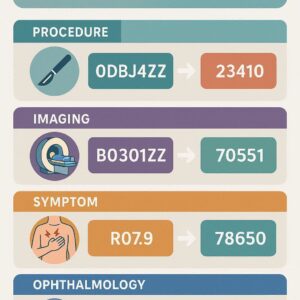
ICD-10-PCS and CPT Code Crosswalks
Chapter 1: Foundational Languages – Understanding ICD-10-PCS and CPT
Before one can map between two languages, one must understand their unique grammars, vocabularies, and purposes. ICD-10-PCS and CPT were born from different needs and function under different paradigms.
ICD-10-PCS: The System of “What Was Structurally Done”
-
Ownership & Purpose: Maintained by the U.S. Centers for Disease Control and Prevention (CDC) and the Centers for Medicare & Medicaid Services (CMS), its primary purpose is tracking morbidity and mortality data for public health and epidemiology. In the inpatient setting, it is used for reporting procedures for reimbursement under Medicare Severity-Diagnosis Related Groups (MS-DRGs).
-
Structure: It is a multi-axial, alphanumeric code composed of 7 characters. Each character represents a specific aspect of the procedure, chosen from a table related to the procedure’s section.
-
Character 1: Section (e.g., Medical and Surgical, Obstetrics, Imaging)
-
Character 2: Body System
-
Character 3: Root Operation (the objective of the procedure—this is key)
-
Character 4: Body Part
-
Character 5: Approach (Open, Percutaneous, Via Natural/Artificial Opening, etc.)
-
Character 6: Device
-
Character 7: Qualifier
-
-
Philosophy: ICD-10-PCS is combinatorial. Its strength lies in its ability to create highly specific descriptions from a finite set of values. Its focus is on the objective action (the root operation) performed on an anatomical site.
CPT: The System of “What Professional Service Was Provided”
-
Ownership & Purpose: Owned and updated annually by the American Medical Association (AMA). Its purpose is to describe medical, surgical, and diagnostic services for the uniform communication among physicians, patients, and third-party payers for reimbursement.
-
Structure: It is a numeric code (mostly 5-digits) organized into three categories:
-
Category I: The vast majority of codes for procedures and services.
-
Category II: Optional performance measurement tracking codes.
-
Category III: Temporary codes for emerging technologies and services.
-
-
Philosophy: CPT is encyclopedic. It provides a pre-defined, standardized code for a specific described service or procedure. Its focus is often on the physician’s work, including the skill, time, and intensity required.
Core Differences Between ICD-10-PCS and CPT
| Feature | ICD-10-PCS | CPT |
|---|---|---|
| Primary Purpose | Inpatient billing (MS-DRGs), morbidity statistics | Physician & outpatient billing (APCs, fee schedules) |
| Maintainer | CMS/CDC (U.S. Government) | AMA (Private Association) |
| Code Structure | 7 alphanumeric characters, multi-axial | Mostly 5 numeric digits, narrative description |
| Philosophy | Combinatorial (build a code from parts) | Encyclopedic (choose a pre-defined code) |
| Scope | Hospital inpatient procedures | Physician services across all settings |
| Specificity Driver | Approach, device, detailed anatomy | Technique, physician work, sometimes approach |
Chapter 2: The “Why” – The Critical Purpose of a Crosswalk
The coexistence of these two systems creates several operational necessities that drive the need for crosswalking.
-
The Transition from Inpatient to Outpatient Care: A patient undergoes a major surgery (coded in ICD-10-PCS for the inpatient stay) and later presents for a follow-up wound check or suture removal in the physician’s office (coded in CPT). The physician’s billing system may need to reference the original procedure for context, requiring a mapping link.
-
Data Analytics and Population Health: Researchers and health systems analyzing comprehensive patient journeys need to combine data from inpatient (ICD-10-PCS) and outpatient/physician (CPT) records. A crosswalk allows them to identify all patients who had a specific type of procedure, regardless of where it was performed.
-
Charge Capture and Reconciliation: In integrated health systems, the hospital’s chargemaster (often built on CPT) and the inpatient coding system (ICD-10-PCS) must be aligned to ensure all billable items from a procedure are captured and reconciled correctly.
-
Payer Requirements and Audits: Some payers, in their audit requests, may ask for a translation of inpatient procedures into CPT-like terminology for their internal review processes, especially for outlier cases or complex claims reviews.
-
Educational and Reference Tool: For coding students and professionals learning both systems, understanding how a procedure is represented in each provides a deeper conceptual grasp of the nature of the service.
Chapter 3: The “How” – Mechanics and Methodologies of Mapping
Mapping is not a science of equality, but of correlation. The foundational tool provided by the U.S. government is the General Equivalence Mappings (GEMs).
What are the GEMs?
The GEMs are a publicly available set of files created by CMS and the CDC to assist with the transition from ICD-9-CM to ICD-10. They also serve as a foundational crosswalk between ICD-10-PCS and CPT. Crucially, they are “dictionaries” of plausible translations, not a definitive one-to-one map.
Key Mapping Concepts in the GEMS:
-
“Forward” Mapping: From an ICD-10-PCS code to potential CPT codes.
-
“Backward” Mapping: From a CPT code to potential ICD-10-PCS codes.
-
Flags: The GEMs use flags to indicate the confidence and type of relationship:
-
“No Map” Flag: There is no appropriate correlation.
-
“Single” Flag (0): A clear, single correspondence.
-
“One-to-Many” Flag (1): One source code maps to multiple target codes (the most common scenario for PCS→CPT).
-
“Many-to-One” Flag (2): Multiple source codes map to one target code.
-
“Approximate” Flag (3): The mapping is not precise; the codes are related but not equivalent.
-
The Human Coder’s Role: The “Post-Coordination” Imperative
This is the most critical step. The GEMs output is a starting point. The coder or analyst must apply clinical knowledge and coding guidelines to select the correct match. For example, an ICD-10-PCS code for “Excision of stomach, open approach” might map to a dozen CPT codes for various gastric resections (antrectomy, wedge resection, total gastrectomy, etc.). Only the operative report and clinical details can determine the correct CPT correlation. This process of using the GEMs and then applying clinical judgment is often called “post-coordination.”
Chapter 4: The Quicksand – Inherent Challenges and Pitfalls
Relying on an automated crosswalk without understanding its limitations is a direct path to error.
-
The Granularity Mismatch: This is the core challenge. ICD-10-PCS’s 7-character specificity (especially approach and device) often has no direct match in CPT. Mapping a “Percutaneous endoscopic” ICD-10-PCS procedure to CPT may require choosing a CPT code that simply describes the root operation, as CPT may not specify the approach as granularly.
-
The “Procedure Bundle” Problem: ICD-10-PCS requires separate codes for each distinct objective (root operation). A single CPT code often describes a package of services. For example, a total hip arthroplasty in CPT (27130) is one code. In ICD-10-PCS, it may involve codes for “Insertion of prosthetic device” into the femur and acetabulum, and possibly “Osteotomy” or “Repositioning.” One CPT code maps to multiple ICD-10-PCS codes.
-
Payer-Specific Edits: The most reliable mapping for reimbursement is often defined by the payer (e.g., Medicare Administrative Contractor or private insurer). They may have their own proprietary crosswalks or rules that override the GEMs.
-
The “No Map” Scenario: New technologies or highly specific PCS codes may have no logical CPT counterpart, and vice-versa.
-
Audit Risk: Using an automated crosswalk to code a claim is a severe compliance risk. Codes must always be derived from the physician’s documentation, not from a mapping tool.
Chapter 5: A Practical Expedition – Case Studies in Crosswalk Application
Case Study 1: Laparoscopic Cholecystectomy
-
ICD-10-PCS: 0FT44ZZ – Extraction of Gallbladder, Percutaneous Endoscopic Approach.
-
GEMs Lookup: This would likely have a “1” (one-to-many) flag, pointing to several CPT codes in the 47560-47620 range.
-
Human Decision: The coder reviews the report. Was it a simple laparoscopic cholecystectomy (47562)? Was there an intraoperative cholangiography (47563)? Was it converted to an open procedure (47600)? The crosswalk provides options; the documentation provides the answer.
Case Study 2: Coronary Artery Bypass Graft (CABG)
-
CPT Code: 33533 – Coronary artery bypass, vein only; two coronary venous grafts.
-
GEMs Lookup (Backward): This would map to a combination of ICD-10-PCS codes.
-
Human Decision: The inpatient coder must build the PCS picture: one code for “Bypass Coronary Artery to Coronary Artery” and another for “Bypass Coronary Artery to Coronary Artery” for the second graft (using different body part characters). They would also need a code for harvesting the saphenous vein graft. One CPT code necessitates multiple ICD-10-PCS codes.
Chapter 6: Tools of the Trade – Software, Encoders, and GEMs
While the raw GEMs files are available for download, most professionals use more sophisticated tools:
-
Professional Encoders: Software like TruCode, 3M, or Optum360 have built-in crosswalk functionality that layers the GEMs data with proprietary logic and guidelines, offering a more user-friendly interface.
-
Payer-Specific Tools: Medicare’s Pricer files and certain commercial payer portals often embed their required mappings for claim processing.
-
Internal Databases: Large health systems often develop and maintain their own validated crosswalk tables for common procedures to ensure consistency across departments.
Chapter 7: The Financial and Compliance Imperative
Inaccurate mapping has direct consequences. Under-mapping can lead to lost revenue in charge reconciliation. Over-mapping or incorrect mapping for data reporting can skew analytics, leading to poor strategic decisions. Using a crosswalk as a coding tool, rather than a reference, violates compliance guidelines and can result in claim denials, audits, and potential fines under fraud and abuse statutes. The financial integrity of the revenue cycle depends on understanding that the crosswalk is a guidepost, not an autopilot.
Chapter 8: The Horizon – The Future of Procedure Coding and Mapping
The landscape is not static. The rise of AI and Natural Language Processing (NLP) promises more intelligent mapping tools that can read operative notes and suggest mappings with greater context. More significantly, there is ongoing discussion about the potential for a single, unified procedure coding system in the U.S. to eliminate this crosswalk challenge entirely. While such a change is years away, it underscores the fundamental tension the crosswalk seeks to manage. Furthermore, the expansion of value-based care and episode-of-bundled payments increases the need for accurate, linked procedural data across the continuum, making robust mapping logic more valuable than ever.
Conclusion: The Map is Not the Territory
The ICD-10-PCS to CPT crosswalk is an indispensable, complex, and imperfect bridge between two distinct worlds of healthcare information. It is a powerful tool for data linkage, analytics, and operational reconciliation, but a dangerous substitute for clinical knowledge and compliant coding practices. Mastery of its use requires respecting its limitations, applying expert judgment, and remembering always that the code—whether PCS or CPT—must be a faithful reflection of the patient’s story as told in the medical record, not an output from a database.
Frequently Asked Questions (FAQs)
Q1: Can I use an automated crosswalk to code my claims?
A: Absolutely not. Crosswalks are for reference, data analysis, and charge reconciliation. Claim coding must always be based on the physician’s documentation in the medical record, following official coding guidelines for each code set.
Q2: Where can I find the official GEMs files?
A: The CMS website hosts the official GEMs files. You can search for “ICD-10-PCS GEMs” on CMS.gov.
Q3: My software gives me one CPT code for my ICD-10-PCS code. Is that always correct?
A: Not necessarily. While some mappings are straightforward, you must verify it against the clinical documentation. Your software may be applying logic to choose a “most likely” code, which may not match your specific case.
Q4: Who is responsible for creating a crosswalk in a hospital?
A: Typically, a collaborative effort involving HIM/Coding, Revenue Cycle/Charge Integrity, and IT. It is governed by compliance and subject to regular review.
Q5: Are crosswalks the same for Medicare and private insurers?
A: No. While many payers start with the GEMs, they often have their own edits and preferred mappings. Always check with the specific payer’s policies for billing-related mapping.
Date: December 12, 2025
Author: Healthcare Coding Insights Team
Disclaimer: The information contained in this article is for educational and informational purposes only and does not constitute professional coding, billing, or legal advice. Always consult the official ICD-10-PCS, CPT code sets, and payer-specific guidelines for accurate coding.


