
In the dynamic landscape of modern medicine, technological innovation often outpaces the systems designed to categorize it. Nowhere is this tension more palpable than in the realm of medical coding, where the clarity of reimbursement and the integrity of health data depend on the precise alignment of clinical practice with standardized nomenclatures. Enter Vapotherm® High Flow Therapy—a revolutionary respiratory support modality that has transformed the management of patients in respiratory distress across age groups, from neonates to adults. Its efficacy in treating hypoxemic respiratory failure, bronchiolitis, and post-extubation support is well-documented in clinical literature. Yet, for medical coders, clinical documentation improvement (CDI) specialists, and healthcare administrators, a fundamental question persists: What is the correct ICD-10-PCS code for Vapotherm?
This article aims to provide an exhaustive, definitive exploration of that question. We will venture beyond a simple code lookup to build a robust understanding of why a specific code applies, delving into the mechanical principles of the technology, the hierarchical logic of the ICD-10-PCS system, and the nuanced clinical scenarios that dictate its use. With the healthcare industry under increasing financial scrutiny and audit pressure, accurate coding is not merely an administrative task—it is a cornerstone of compliance, appropriate reimbursement, and a valid representation of patient acuity and resource utilization. This guide, exceeding a detailed examination of code 5A0945Z, will serve as an essential resource for ensuring that the advanced care provided by Vapotherm is accurately captured in the patient’s permanent record.
2. Understanding Vapotherm: More Than Just a High-Flow Nasal Cannula
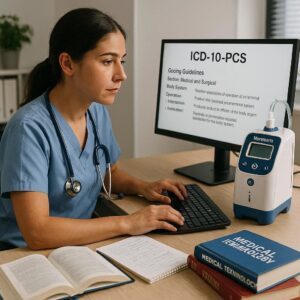
ICD-10-PCS Coding for Vapotherm
tand what it is, how it works, and its clinical intent. Vapotherm Precision Flow® systems deliver heated, humidified, and high-flow oxygen/air mixtures via a small-bore nasal cannula.
-
Mechanism of Action: Unlike traditional low-flow oxygen therapy (e.g., standard nasal cannula, simple face mask), which delivers cold, dry gas at rates limited by patient comfort, Vapotherm can deliver flows up to 60 L/min in adults and 8 L/min in neonates. The precise heating and humidification allow for these high flows without damaging the nasal mucosa.
-
Physiological Benefits: The therapy works through several key mechanisms:
-
Washes Anatomical Dead Space: High flow flushes out the carbon dioxide-rich air in the nasopharynx, improving ventilation efficiency.
-
Provides Low Level of Positive Airway Pressure: The high flow generates a small, continuous positive pressure in the pharynx (reminiscent of, but distinct from, formal CPAP), which helps stent open airways and alveoli.
-
Meets/Exceeds Inspiratory Demand: It can match a patient’s high inspiratory flow rates, reducing work of breathing.
-
Improves Oxygenation: Delivers a precisely titrated FiO2 (21% to 100%).
-
-
Clinical Indications: It is used for moderate respiratory distress, hypoxemic respiratory failure not requiring immediate intubation, post-extubation support, and conditions like bronchiolitis, pneumonia, and COPD exacerbations.
Crucially, Vapotherm is classified as a form of non-invasive respiratory support. It is not considered mechanical ventilation in the traditional sense (which involves an artificial airway like an endotracheal tube or tracheostomy and a ventilator), but its functional support aligns it more closely with ventilation than with simple oxygen supplementation.
*(Image Suggestion: A diagram comparing Traditional Low-Flow O2 vs. Vapotherm High Flow Therapy, highlighting flow rates, humidity, temperature, and physiological impact.)*
3. The Foundation: Navigating the ICD-10-PCS Code Set Structure
ICD-10-PCS (Procedure Coding System) is built on a multi-axial, 7-character alphanumeric structure. Each character has a specific meaning, and together they describe the procedure with great specificity. The sections relevant to respiratory support are primarily the Medical and Surgical Section (for intubation, tracheostomy) and the Administration Section (for oxygen), but most importantly for Vapotherm, the Medical and Surgical Related Section.
-
Section: The first character represents the section.
5denotes the “Measurement and Monitoring” section. -
Body System: The second character defines the body system.
Adenotes the “Physiological Systems” body system. -
Root Operation: The third character is the core of the code, defining the objective of the procedure.
0denotes “Measurement” or9denotes “Monitoring“. For active therapies like Vapotherm, we look to the “Assistance” subsection.-
Within the
5Atable, the root operation9stands for “Performance” in the context of physiological systems. This root operation is defined as “Assisting, taking over, or supplementing the function of a physiological system.” This perfectly describes Vapotherm’s role in supplementing respiratory function.
-
-
Body System/Region: The fourth character provides greater detail. For respiratory assistance, this is
4for “Respiratory.” -
Function/Device: The fifth character specifies the function being performed or the device used.
5represents “Ventilation, Non-invasive.” This is the critical character that distinguishes Vapotherm from invasive mechanical ventilation (1– Ventilation, Invasive) and from other non-invasive methods like BiPAP (which also uses5). -
Duration: The sixth character specifies the duration.
4is “Less than 24 hours,” and5is “24-96 hours,” and so on. This must be derived from the medical record. -
Qualifier: The seventh character is a qualifier. For this table,
Zis “No Qualifier.”
4. Deconstructing the Code: 5A0945Z for Respiratory Ventilation, Less Than 24 Hours
Applying the PCS structure leads us to the definitive code for a session of Vapotherm therapy lasting less than a calendar day.
ICD-10-PCS Code: 5A0945Z
-
5: Section – Measurement and Monitoring
-
A: Body System – Physiological Systems
-
0: Root Operation – Performance (Assisting, taking over, or supplementing the function of a physiological system)
-
9: Body Region – Respiratory
-
4: Function/Device – Ventilation, Non-invasive
-
5: Duration – Less than 24 hours
-
Z: Qualifier – No Qualifier
Rationale: Vapotherm is a device that supplements the physiological function of the respiratory system (5A0). It does so by providing non-invasive ventilation (94) through the nasal cannula interface. The duration character is absolutely dependent on documentation. If therapy starts at 0800 and is discontinued at 1900 the same day, the duration is 5 (less than 24 hours). If it continues past midnight into a second calendar day, the coder must determine if a new, subsequent code (e.g., 5A0955Z for 24-96 hours) is needed based on the facility’s coding guidelines for continuous therapies.
ICD-10-PCS Coding for Common Respiratory Support Modalities
| Therapy/Device | ICD-10-PCS Code | Root Operation (3rd Char) | Function/Device (5th Char) | Key Documentation Differentiator |
|---|---|---|---|---|
| Vapotherm HFNC | 5A0945Z (e.g., <24 hrs) |
0 – Performance | 4 – Ventilation, Non-invasive | Heated/humidified high flow >15-20 L/min (adult) via nasal cannula. |
| Non-invasive BiPAP/CPAP | 5A0935Z (e.g., <24 hrs) |
0 – Performance | 3 – Positive Airway Pressure | Device delivers set IPAP/EPAP or CPAP pressures via mask interface. |
| Invasive Mech Vent | 5A1935Z (e.g., <24 hrs) |
1 – Performance | 3 – Ventilation, Invasive | Requires artificial airway (endotracheal tube, tracheostomy). |
| Traditional O2 Therapy | 5A1955Z |
1 – Measurement | 5 – Oxygen Saturation | Simple O2 delivery (cannula, mask). Code is for monitoring, not administration. |
| Oxygen Administration | E0424 (CPT/HCPCS) |
N/A – CPT | *N/A* | Coded via CPT/HCPCS for billing; PCS captures the monitoring. |
5. Clinical Scenarios and Coding Application: From the ER to the PACU
Scenario 1: Emergency Department (Less than 24 hours)
A 68-year-old COPD patient presents with acute dyspnea and hypoxemia (SpO2 88% on room air). The ED physician initiates Vapotherm at 40 L/min, FiO2 40%. The patient improves over 6 hours and is weaned to a simple nasal cannula before admission to a medical floor.
-
Coding:
5A0945Z(Performance of Respiratory System, Non-invasive Ventilation, Less than 24 hours). The code is assigned for the ED encounter.
Scenario 2: Pediatric Inpatient Admission (Multiple Days)
A 6-month-old with severe RSV bronchiolitis is admitted. Vapotherm is started at 8 L/min, FiO2 30% at 10:00 on Day 1. Therapy continues uninterrupted through Day 2 and is weaned off at 14:00 on Day 3.
-
Coding: This requires multiple codes to reflect the continuous therapy across calendar days.
-
Day 1 (Start):
5A0945Z(Covers from 10:00 Day 1 to 23:59 Day 1). -
Day 2 (Continuation):
5A0955Z(Performance… 24-96 hours). This code represents the continuous therapy on the second day. -
Day 3 (Discontinuation): The
5A0955Zcode from Day 2 also covers the final day until therapy stops. No new initiation code is needed for Day 3. Some encoder logic may require a5A0945Zfor the final partial day; follow facility-specific guidelines.
-
Scenario 3: Post-Extubation Support in ICU
An adult patient is extubated after 48 hours of invasive mechanical ventilation. To prevent post-extubation stridor and failure, the ICU team places the patient on Vapotherm for 12 hours as a bridge.
-
Coding:
5A0945Z. The key is that the invasive ventilation (5A1935Z) has stopped, and a new, distinct mode of non-invasive support has begun. Both procedures are coded.
6. The Crucial Role of Documentation: What Coders Need to See
The coder’s ability to assign 5A0945Z hinges entirely on clear, unambiguous documentation. Physicians, NPs, PAs, and respiratory therapists should document:
-
The Specific Device Name: “Vapotherm initiated,” “High flow nasal cannula via Vapotherm device,” or “Precision Flow.” Avoid only “HFNC,” as this can be ambiguous.
-
Flow Rate and FiO2: “Set at 35 L/min, FiO2 50%.” Flow is the key parameter distinguishing it from low-flow O2.
-
Start and Stop Date/Times: Essential for determining the duration character (5th, 6th positions).
-
Clinical Indication: “For moderate hypoxemic respiratory failure,” “for post-extubation support.”
-
Interface: “Via binasal cannula.”
Query Opportunity: If documentation only states “HFNC at 4 L/min,” a query may be necessary to clarify if this is traditional low-flow O2 (coded as oxygen monitoring 5A1955Z) or true high-flow therapy, as 4 L/min is typically not in the high-flow range for adults.
7. Common Pitfalls, Challenges, and Compliance Considerations
-
Confusing with Oxygen Administration: A major error is coding Vapotherm as simple oxygen administration. CPT codes like 99291 (critical care) bundle routine oxygen, and ICD-10-PCS code
5A1955Zis for monitoring oxygen saturation, not delivering therapy. Vapotherm is an active ventilatory assistance procedure. -
Incorrect Duration: Miscounting hours across midnight. Use a time-duration calculator based on documented times.
-
Lack of Specificity: “HFNC” alone is problematic. Clinical documentation improvement (CDI) should work to specify the technology.
-
Overlap with BiPAP Coding: Both use the 5th character for non-invasive ventilation (
4). The differentiation is clinical (BiPAP provides set pressures; Vapotherm provides high flow). Documentation must specify the modality. -
DRG Impact: In the MS-DRG system, non-invasive ventilation can impact the severity level of respiratory diagnoses. Miscoding Vapotherm as simple O2 could understate resource utilization.
8. Vapotherm vs. Other Modalities: A Coding Comparative Analysis
-
Vapotherm vs. Non-invasive BiPAP: Both are
5A09_5Z(Non-invasive). The fifth character for BiPAP/CPAP is3for “Positive Airway Pressure,” while Vapotherm is4for “Ventilation, Non-invasive.” This distinction exists because BiPAP is defined by its delivery of set pressure levels, while Vapotherm is defined by its delivery of high-flow gas. -
Vapotherm vs. Invasive Mechanical Ventilation: Invasive vent (
5A19_5Z) requires an artificial airway. The root operation character is1(Performance) in the “Physiological Systems” table for invasive vent, but more commonly, invasive vent is found in the “Medical/Surgical” section under0BH17EZ(Insertion of endotracheal airway) and the “Administration” section for the ventilation itself (5A1935Z). Vapotherm is distinctly non-invasive.
9. The Impact on DRGs, Billing, and Reimbursement
Accurate PCS coding paints a picture of patient complexity. While ICD-10-PCS codes don’t directly generate professional fee reimbursement like CPT codes, they are vital for:
-
Inpatient Prospective Payment System (IPPS): PCS codes determine the presence of Major Comorbidities or Complications (MCC/CC), which can shift a patient’s Diagnosis-Related Group (DRG) to a higher-weighted, higher-reimbursing category.
-
Resource Utilization: Capturing a procedure like
5A0945Zjustifies the use of specialized equipment and higher nursing/respiratory therapy attention. -
Audit Defense: Clear coding supported by robust documentation is the first line of defense against audit takebacks.
10. Frequently Asked Questions (FAQs)
Q1: Is there a different ICD-10-PCS code for Vapotherm used on a newborn?
A: No. The same PCS code (5A0945Z) applies regardless of patient age. The device and function are identical. However, the diagnosis codes (ICD-10-CM) and any associated codes for the umbilical catheter or other access used in neonates will differ.
Q2: How do I code if the patient is on Vapotherm for only 2 hours?
A: The duration character 5 is “Less than 24 hours.” This encompasses any period under one full calendar day, whether it’s 30 minutes or 23 hours.
Q3: Our hospital uses a different brand of high-flow system (e.g., Airvo™). Is the code the same?
A: Yes. The code is for the function (non-invasive ventilation via high-flow heated and humidified gas), not the specific brand name. As long as the technology is functionally equivalent, 5A0945Z is appropriate.
Q4: Can I code both Vapotherm (5A0945Z) and standard oxygen monitoring (5A1955Z) for the same day?
A: Typically, no. The performance of non-invasive ventilation inherently includes the monitoring of the oxygenation and ventilation it provides. Coding both would be considered unbundling. The more specific procedure (Vapotherm) takes precedence.
Q5: Who is responsible for ensuring this is coded correctly—the coder or the clinician?
A: It’s a shared responsibility. The clinician must document the procedure in detail (device, settings, times). The coder must then accurately interpret that documentation and apply PCS guidelines. CDI specialists bridge the gap by prompting for clarification when needed.
11. Conclusion
Accurate procedural coding for advanced respiratory therapies like Vapotherm is a critical component of modern healthcare administration. The ICD-10-PCS code 5A0945Z precisely captures the essence of this non-invasive ventilatory support. Mastery of this code, rooted in a deep understanding of both the technology and the coding framework, ensures compliant billing, valid data for quality metrics, and a true reflection of the clinical resources devoted to patient care.
Date: December 13, 2025
Disclaimer: *This article is intended for educational purposes and to promote accurate clinical documentation and coding practices. It is not a substitute for official coding guidelines, payer policies, or clinical judgment. Always consult the most current official ICD-10-PCS code set, the *AHA Coding Clinic for ICD-10-CM/PCS*, and your facility’s compliance officer for definitive coding advice. Vapotherm® is a registered trademark of Vapotherm, Inc.*


