Hypertension (HTN), or high blood pressure, is often termed the “silent killer.” It is a pervasive, chronic condition affecting nearly half of all adults in the United States, acting as a primary risk factor for stroke, myocardial infarction, heart failure, renal failure, and a host of other cardiovascular morbidities. In the clinical realm, its management is a daily endeavor for millions of patients and their providers. In the equally critical world of healthcare administration, finance, and data analytics, the accurate classification and coding of hypertension is a monumental task with far-reaching implications. A single alphanumeric code—drawn from the International Classification of Diseases, Tenth Revision, Clinical Modification (ICD-10-CM)—carries the weight of a patient’s clinical status, determines the justification for medical necessity, influences the outcome of a risk-adjusted payment model, and shapes national health statistics.
This article is crafted not just as a reference, but as a master guide. It is designed for the medical coder seeking clarity, the physician aiming for impeccable documentation, the healthcare administrator overseeing revenue integrity, and the student entering the complex field of health information management. We will embark on a detailed journey through the ICD-10-CM codes for hypertension, moving beyond simple code lookup to a deep understanding of the “why” behind the “what.” We will dissect the hierarchical structure of the I10-I16 block, unravel the complex relationships between hypertension and its end-organ manifestations, tackle the nuanced world of secondary hypertension, and confront high-stakes scenarios like hypertensive crises. With a foundation built on the official coding guidelines and illustrated with practical examples, tables, and scenarios, this guide aims to transform hypertension coding from a routine task into an exercise in clinical and administrative precision. The path to accurate coding begins here, with the first beat of the hypertensive heart.
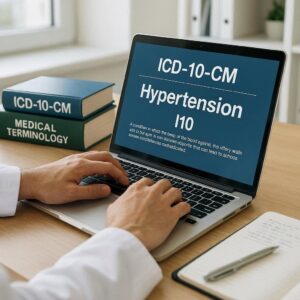
ICD-10-CM Coding for Hypertension
2. Understanding the Hypertension Landscape: A Clinical Primer
Before engaging with the codebook, a foundational understanding of the disease is essential. Hypertension is defined as a sustained elevation of systemic arterial blood pressure. The current guidelines (e.g., from the American College of Cardiology/American Heart Association) classify blood pressure into stages:
-
Normal: SBP <120 mmHg and DBP <80 mmHg
-
Elevated: SBP 120-129 mmHg and DBP <80 mmHg
-
Stage 1 Hypertension: SBP 130-139 mmHg or DBP 80-89 mmHg
-
Stage 2 Hypertension: SBP ≥140 mmHg or DBP ≥90 mmHg
Crucially, from a coding perspective, ICD-10-CM does not code based on these stages. The classification system focuses on the type of hypertension and the presence of associated conditions.
Key clinical concepts that directly impact coding include:
-
Essential (Primary) Hypertension: High blood pressure with no identifiable secondary cause. This accounts for 90-95% of cases.
-
Secondary Hypertension: Elevated blood pressure that is a direct result of an identifiable underlying condition (e.g., renal artery stenosis, primary aldosteronism, pheochromocytoma, sleep apnea).
-
Hypertensive Heart Disease: Hypertension with resulting cardiac involvement (e.g., left ventricular hypertrophy, heart failure).
-
Hypertensive Chronic Kidney Disease (CKD): Hypertension with resulting renal impairment. A critical coding challenge lies in determining the causal relationship—did hypertension cause the CKD, or did CKD cause the hypertension?
-
Hypertensive Crisis: A severe elevation in BP that can be categorized as either a hypertensive urgency (severely elevated BP without acute end-organ damage) or a hypertensive emergency (severely elevated BP with acute, progressive end-organ damage).
This clinical framework is the map we will use to navigate the ICD-10-CM coding terrain.
3. Deciphering the ICD-10-CM Framework: The I10-I16 Block
The ICD-10-CM codes for hypertension are neatly—but not always simply—contained within the block I10-I16, under the broader chapter for Diseases of the Circulatory System. The structure is hierarchical and relationship-driven.
The Core Hierarchy:
-
I10 – Essential (primary) hypertension. This is the default code when no associated heart or kidney disease is documented as being linked.
-
I11 – Hypertensive heart disease. This category is for when hypertension is linked to heart conditions. It requires additional codes to specify the type of heart involvement.
-
I12 – Hypertensive chronic kidney disease. This category is for when hypertension is linked to CKD. It requires additional codes to specify the stage of CKD.
-
I13 – Hypertensive heart and chronic kidney disease. This is a combined category for patients with hypertension affecting both the heart and kidneys.
-
I15 – Secondary hypertension. This is used when the hypertension is due to an underlying condition. The underlying condition must also be coded.
-
I16 – Hypertensive crisis. This is for acute, severe presentations and is subcategorized into urgency and emergency.
A fundamental rule, per the ICD-10-CM Official Guidelines for Coding and Reporting, is the “with” rule. When a causal relationship is stated (e.g., “hypertension with heart failure,” “hypertensive renal disease”), the provider’s documentation links the conditions. The coder must use a combination code from the I11-I13 categories. If the conditions are documented but not linked as related, they are coded separately. Documentation is paramount.
4. Deep Dive: Essential Hypertension (I10)
I10 is the most frequently used HTN code. It is assigned for benign, malignant, or unspecified essential hypertension. The term “essential” is key—it means no cause is identified, and it is not stated as being due to any other condition.
Coding Instructions & Pitfalls:
-
Unspecified Hypertension: If a provider simply documents “HTN” or “hypertension,” without specifying essential or secondary, ICD-10-CM defaults to I10. It is always preferable for documentation to specify “essential.”
-
Controlled vs. Uncontrolled: ICD-10-CM does not have codes to specify whether hypertension is controlled on medication. A patient with a long history of well-controlled HTN on a single drug is still coded as I10. However, if the provider documents “uncontrolled” or “poorly controlled,” an additional code from category Z91.89- (Other specified personal risk factors) may be considered, but I10 remains the primary diagnosis.
-
Elevated Blood Pressure Without Diagnosis: A reading of elevated BP in an office is not coded as hypertension. Codes R03.0 (Elevated blood-pressure reading, without diagnosis of hypertension) are used. Hypertension is a chronic diagnosis.
-
Hypertension in Pregnancy: Hypertension complicating pregnancy, childbirth, and the puerperium is coded from chapter 15 (O10-O16), not I10. This is a critical distinction.
5. Navigating Hypertensive Heart and Chronic Kidney Disease (I11, I12, I13)
This is where coding complexity increases significantly. The interplay between hypertension, heart disease, and CKD requires careful attention to documentation.
Category I11 – Hypertensive Heart Disease
This is used when the provider links hypertension to a cardiac condition.
-
I11.0 – Hypertensive heart disease with heart failure. This is a combination code. You must add an additional code from the I50.- series to specify the type of heart failure (e.g., I50.9, Heart failure, unspecified; I50.21, Acute systolic heart failure).
-
I11.9 – Hypertensive heart disease without heart failure. This includes hypertension with conditions like left ventricular hypertrophy (LVH) or coronary artery disease when a causal link is stated. An additional code may be used to specify the type of heart disease (e.g., I51.7, Cardiomegaly).
Category I12 – Hypertensive Chronic Kidney Disease
This is used when the provider links hypertension to CKD.
-
I12.0 – Hypertensive chronic kidney disease with stage 5 chronic kidney disease or end stage renal disease.
-
I12.9 – Hypertensive chronic kidney disease with stage 1 through stage 4 chronic kidney disease, or unspecified chronic kidney disease.
-
Crucial Requirement: For both I12.0 and I12.9, you must add an additional code from N18.- to identify the specific stage of CKD (e.g., N18.3, Chronic kidney disease, stage 3; N18.6, End stage renal disease).
Category I13 – Hypertensive Heart and Chronic Kidney Disease
This is a two-disease combination category for patients with both hypertensive heart and kidney disease.
-
I13.0 – Hypertensive heart and chronic kidney disease with heart failure and stage 1-4 CKD, or unspecified CKD.
-
I13.10 – Hypertensive heart and chronic kidney disease without heart failure, with stage 1-4 CKD, or unspecified CKD.
-
I13.11 – Hypertensive heart and chronic kidney disease without heart failure, with stage 5 CKD or ESRD.
-
I13.2 – Hypertensive heart and chronic kidney disease with heart failure and with stage 5 CKD or ESRD.
-
Requirement: For all I13 codes, additional codes are required for the type of heart failure (I50.-) and the stage of CKD (N18.-).
ICD-10-CM Hypertension Coding Matrix Based on Documentation
| Documentation Phrase (Example) | Primary ICD-10-CM Code | Required Additional Code(s) | Rationale |
|---|---|---|---|
| “Essential hypertension.” | I10 | None | Simple, uncomplicated HTN. |
| “Hypertension with systolic heart failure.” | I11.0 | I50.21 (Acute systolic HF) | “With” implies link. I11.0 covers both; I50.21 specifics type. |
| “Hypertensive renal disease; CKD stage 3.” | I12.9 | N18.3 (CKD, stage 3) | Link stated. I12.9 covers HTN+CKD; N18.3 specifics stage. |
| “HTN. CHF. CKD stage 4.” (No link stated) | I10, I50.9, N18.4 | None | Conditions documented separately without causal link. Code separately. |
| “Hypertensive heart and renal disease with CHF and ESRD.” | I13.2 | I50.9 (HF, unspec.), N18.6 (ESRD) | Complex combination affecting both organs with failure. |
| “Hypertension due to renal artery stenosis.” | I15.0 | I70.1 (Atherosclerosis of renal artery) | Clear secondary cause identified. |
| “Hypertensive emergency with encephalopathy.” | I16.1 | G93.41 (Metabolic encephalopathy) | Acute, severe HTN with acute end-organ (brain) damage. |
6. The Intricacies of Secondary Hypertension (I15)
Secondary hypertension (I15) is diagnosed when an underlying, identifiable condition is the direct cause of elevated BP. Coding requires two codes: one from I15 for the hypertension, and one for the underlying etiology.
-
I15.0 – Renovascular hypertension. Caused by renal artery stenosis. Code also the stenosis (e.g., I70.1).
-
I15.1 – Hypertension secondary to other renal disorders. Underlying cause is a renal parenchymal disease (e.g., chronic pyelonephritis, glomerulonephritis). Code also the renal disorder.
-
I15.2 – Hypertension secondary to endocrine disorders. Causes include pheochromocytoma (D35.00), Cushing’s syndrome (E24.9), hyperaldosteronism (E26.01). Code also the endocrine disorder.
-
I15.8 – Other secondary hypertension. Includes hypertension due to neurological disorders, medications, or other specific causes.
-
I15.9 – Secondary hypertension, unspecified. Rarely used if a secondary cause is identified but not specified.
Key Point: If a patient has both essential (I10) and secondary hypertension, both should be coded. The secondary code (I15) would be sequenced based on the reason for the encounter.
7. Hypertensive Crises: Urgency and Emergency (I16)
Category I16 is reserved for acute, severe elevations in blood pressure.
-
I16.0 – Hypertensive urgency. Severely elevated BP (e.g., >180/120) without evidence of acute, progressive end-organ damage. The patient may have symptoms like headache or shortness of breath, but no acute neurological, cardiac, or renal injury.
-
I16.1 – Hypertensive emergency. Severely elevated BP with acute, progressive end-organ damage (e.g., hypertensive encephalopathy, intracranial hemorrhage, acute left ventricular failure, aortic dissection, acute kidney injury). Additional codes are mandatory for the specific end-organ damage.
-
I16.9 – Hypertensive crisis, unspecified. Used only when the documentation does not specify urgency or emergency.
Important Sequencing: In an emergency encounter, the code for the specific end-organ damage (e.g., I61.9 for intracranial hemorrhage) is often the principal diagnosis, with I16.1 listed as a secondary diagnosis. Follow the Uniform Hospital Discharge Data Set (UHDDS) rules for principal diagnosis selection.
8. Documentation: The Cornerstone of Accurate Coding
A coder can only be as accurate as the documentation allows. Key phrases that trigger specific codes:
-
“Due to” or “Secondary to”: Points directly to I15 codes.
-
“With” or “Associated with”: Often indicates a causal link, requiring I11, I12, or I13 codes.
-
“Hypertensive”: As an adjective (e.g., hypertensive nephropathy), it links the condition to HTN.
-
“Uncontrolled” vs. “Poorly Controlled”: While not changing the base code (I10), this should be clearly documented and may support medical necessity for more intensive management.
-
Ambiguous Documentation: If the relationship is unclear (e.g., “HTN and CKD”), query the provider. Do not assume a link.
9. Common Clinical Scenarios and Coding Solutions
Scenario 1: A patient is admitted with acute pulmonary edema. The attending physician documents: “Acute systolic heart failure due to long-standing, poorly controlled hypertension.”
-
Coding: I11.0 (Hypertensive heart disease with heart failure), I50.21 (Acute systolic heart failure). The phrase “due to” creates the link.
Scenario 2: A diabetic patient with a history of HTN is seen in the clinic. The note states: “Type 2 DM with diabetic nephropathy, CKD stage 3. Also has essential hypertension.”
-
Coding: E11.22 (Type 2 diabetes mellitus with diabetic chronic kidney disease), N18.3 (CKD, stage 3), I10 (Essential hypertension). Here, the CKD is explicitly linked to diabetes, not hypertension. HTN is a separate, concurrent condition.
Scenario 3: A patient presents to the ER with a BP of 210/130, severe headache, and confusion. MRI shows findings consistent with posterior reversible encephalopathy syndrome (PRES). Diagnosis: “Hypertensive emergency with PRES.”
-
Coding: I67.83 (Posterior reversible encephalopathy syndrome), I16.1 (Hypertensive emergency). The acute end-organ damage (PRES) is sequenced first.
10. Compliance, Audits, and Risk Mitigation
Incorrect HTN coding is a major audit target. Risks include:
-
Upcoding: Using a combination code (I11, I12, I13) without provider documentation of a causal link.
-
Undercoding: Using only I10 when a combination code is supported, potentially impacting risk-adjusted metrics (like HCCs in Medicare Advantage) and understating patient complexity.
-
Mismatched Specificity: Not adding required codes for heart failure type or CKD stage.
-
Mitigation Strategies:
-
Ongoing coder education on guidelines.
-
Provider education on precise documentation.
-
Regular internal audits of HTN coding patterns.
-
Using compliant query processes to clarify documentation.
-
11. The Future of HTN Classification and Coding
As medicine evolves, so will coding. The potential transition to ICD-11 will bring changes, though its U.S. adoption (as ICD-11-CM) is likely years away. ICD-11 organizes hypertensive diseases differently (under “Diseases of the circulatory system” but with altered categories). Furthermore, the integration of more specific data from wearable devices and genetic profiling may one day demand more granular codes. The core principles of accurate documentation and adherence to guidelines will remain timeless.
12. Conclusion
Mastering ICD-10-CM coding for hypertension is an exercise in meticulous attention to detail, a deep understanding of clinical relationships, and an unwavering commitment to the language of documentation. From the straightforward I10 to the complex I13 and the acute I16, each code tells a story about the patient’s health status. By using this guide as a roadmap—leveraging official guidelines, engaging in proactive provider communication, and maintaining a focus on compliance—healthcare professionals can ensure that this story is told accurately, supporting optimal patient care, appropriate reimbursement, and reliable health data for generations to come.
13. Frequently Asked Questions (FAQs)
Q1: If a patient has hypertension and coronary artery disease (CAD), do I use I11.9?
A: Only if the provider specifically links them (e.g., “CAD due to hypertension” or “hypertensive CAD”). If they are listed as separate problems (e.g., “1. HTN. 2. CAD.”), code I10 and I25.10 separately.
Q2: How do I code “resistant hypertension”?
A: “Resistant hypertension” (BP uncontrolled on 3 or more medications) is still coded as essential hypertension (I10). You may use an additional code Z91.89 to reflect the “other specified personal risk factor” of treatment resistance, but I10 remains the foundation.
Q3: A patient has both essential (I10) and renovascular (I15.0) hypertension. Which is sequenced first?
A: Sequence according to the reason for the encounter. If the visit is primarily for management of the renovascular HTN, I15.0 would be first. If the patient is seen for routine follow-up of their essential HTN and the renovascular is a stable, chronic issue, I10 may be first. Both should be coded.
Q4: Is there a code for “white coat hypertension”?
A: No. This is typically not coded as a chronic condition. Office readings may be coded as R03.0 (elevated reading), but a diagnosis of “white coat hypertension” usually implies normal BP outside the clinical setting and may not be assigned a code. Follow provider guidance.
Q5: What is the most common HTN coding error you see?
A: The automatic use of combination codes (I11-I13) without documented linkage. This is often an over-assumption by coders. When in doubt, query or code separately.
14. Additional Resources
-
CDC ICD-10-CM Official Guidelines: https://www.cdc.gov/nchs/icd/icd-10-cm.htm (The definitive source).
-
American Health Information Management Association (AHIMA): https://www.ahima.org (For coding standards, education, and tools).
-
American Academy of Professional Coders (AAPC): https://www.aapc.com (For certification, training, and updates).
-
National Heart, Lung, and Blood Institute (NHLBI): https://www.nhlbi.nih.gov/health/high-blood-pressure (For clinical context and guidelines).
-
Current ICD-10-CM Code Books: (Purchase the most recent fiscal year edition from publishers like Optum, AMA, or Ingenix).
-
AHA Coding Clinic for ICD-10-CM/PCS: (Quart
Date: December 16, 2025
Author: Healthcare Coding Insights
Disclaimer: The information provided in this article is for educational and informational purposes only. It is not intended as medical advice, coding advice, or a substitute for professional consultation. Always refer to the latest official ICD-10-CM coding guidelines, payer-specific policies, and consult with certified coding professionals for accurate code assignment. The author and publisher are not responsible for any errors, omissions, or consequences resulting from the use of this information.