Hyponatremia, defined as a serum sodium concentration below 135 mmol/L, is not merely a laboratory aberration. It is the most common electrolyte disorder encountered in clinical practice, affecting approximately 15-30% of hospitalized patients. It lurks in emergency departments, medical wards, and outpatient clinics, often as a silent companion to formidable diseases like heart failure, cirrhosis, and pneumonia. Its presentation can be deceptively bland or dramatically life-threatening, with symptoms ranging from subtle malaise to catastrophic seizures and cerebral edema. In the world of medical coding, this complex clinical entity must be distilled into a precise, alphanumeric language that communicates patient acuity, drives appropriate reimbursement, and fuels critical healthcare analytics. This article embarks on a detailed exploration of that language: the ICD-10-CM code for hyponatremia. We will dissect not just the primary code E87.1, but the intricate web of etiology, manifestation, and complication codes that must accompany it to paint a complete and compliant picture. This journey is essential for coders, clinicians, billing specialists, and healthcare administrators who seek to navigate the nuanced intersection of medicine, data, and finance.
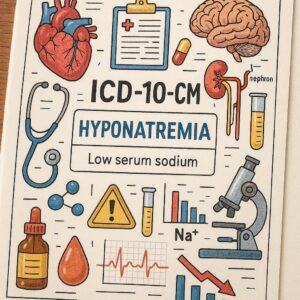
ICD-10-CM Code for Hyponatremia
Chapter 1: Understanding the Foe – What is Hyponatremia?
To code hyponatremia accurately, one must first understand its clinical soul. Sodium is the primary cation in the extracellular fluid and is the principal determinant of serum osmolality—the concentration of solutes in the blood. Its balance is tightly regulated by thirst, antidiuretic hormone (ADH, or vasopressin), and renal function.
Pathophysiology and Serum Osmolality
Hyponatremia represents an imbalance of water relative to sodium. It is crucial to classify it based on serum osmolality:
-
Hypotonic (Hypo-osmolar) Hyponatremia: The most common form. Here, there is an excess of water relative to sodium. This is the domain of code E87.1.
-
Isotonic or Hypertonic (Pseudohyponatremia): Occurs with normal or high osmolality, often due to massive hyperlipidemia or hyperproteinemia (isotonic) or hyperglycemia (hypertonic). These are not coded as E87.1 but rather to the underlying cause (e.g., E11.- for hyperglycemia in diabetes).
Hypotonic hyponatremia is further subdivided by the patient’s volume status—a critical clinical assessment that guides treatment and informs coding etiology.
-
Hypovolemic: Total body sodium and water are decreased, but sodium loss is greater. Causes include vomiting, diarrhea, diuretics, and adrenal insufficiency.
-
Euvolemic: Total body water is increased, but total body sodium is normal. The classic cause is the Syndrome of Inappropriate Antidiuretic Hormone (SIADH).
-
Hypervolemic: Both total body sodium and water are increased, but the water increase is proportionally greater. This is typical in states of effective arterial blood volume depletion like heart failure, cirrhosis, and nephrotic syndrome.
Clinical Spectrum
The symptoms are primarily neurological, due to water shifting into brain cells causing cerebral edema.
-
Mild/Moderate: Nausea, headache, confusion, lethargy, muscle cramps.
-
Severe: Disorientation, obtundation, seizures, coma, respiratory arrest, and brainstem herniation. The acuity and severity often dictate the sequencing of codes, especially if a complication like encephalopathy is present.
Chapter 2: The ICD-10-CM Coding System: A Primer for Specificity
The International Classification of Diseases, 10th Revision, Clinical Modification (ICD-10-CM) is a system of diagnosis codes used in the United States. Its core philosophy, compared to its predecessor ICD-9-CM, is specificity. It demands detail regarding laterality, etiology, manifestation, and stage of disease. For a condition like hyponatremia, this means moving beyond a simple “low sodium” code to a narrative that answers: Why is it low? What is it causing? How severe is it?
Chapter 3: The Core Code – E87.1 and Its Critical Hierarchy
At the heart of coding hyponatremia lies E87.1 Hypo-osmolality and hyponatremia. This code is found in Chapter 4: Endocrine, nutritional, and metabolic diseases (E00-E89), under the block E86-E87 for Disorders of fluid, electrolyte and acid-base balance.
Crucially, E87.1 is almost never a standalone code. It is inherently a manifestation of an underlying problem. The ICD-10-CM index and tabular list are replete with instructional notes that govern its use.
The Imperative of Causality: “Code First” and “Use Additional Code” Notes
When you look up “Hyponatremia” in the ICD-10-CM Alphabetic Index, it directs you to E87.1. However, immediately following this, you will find a critical instruction: “code, if applicable, associated underlying condition, such as:” followed by a list including adrenocortical insufficiency, cirrhosis, heart failure, etc.
In the Tabular List under E87.1, the official instruction is: “Code first underlying condition, such as:” This is a non-optional directive. It means that if the underlying cause of the hyponatremia is known and documented, that cause code must be sequenced before E87.1. The hyponatremia code is secondary.
Common Etiologies of Hyponatremia and Their Primary ICD-10-CM Codes
| Etiology/Underlying Condition | Primary ICD-10-CM Code (Sequenced First) | Clinical Context |
|---|---|---|
| Syndrome of Inappropriate ADH (SIADH) | E22.2 | Often due to malignancy, pulmonary disease, CNS disorders. The prototypical euvolemic cause. |
| Congestive Heart Failure | I50.- series (e.g., I50.23, I50.43) | A classic hypervolemic cause due to reduced effective arterial blood volume. |
| Cirrhosis of Liver | K74.60 (unspecified), K70.30 (alcoholic) | Hypervolemic cause from portal hypertension and ascites. |
| Chronic Kidney Disease (CKD) | N18.- series (e.g., N18.3, N18.9) | Impaired renal water excretion. |
| Adrenal Insufficiency (Addison’s) | E27.1, E27.2 | Hypovolemic cause from mineralocorticoid deficiency. |
| Diuretic Use | T50.1X5A (Adverse effect of loop diuretics, initial encounter) | Requires external cause codes from Chapter 20. A common hypovolemic cause. |
| Hypothyroidism | E03.9, E03.8 | Can be associated with euvolemic hyponatremia. |
| Psychogenic Polydipsia | F10.981 (if alcohol-induced), R63.1 (Polydipsia) | Water intoxication. |
Chapter 4: Navigating the Coding Labyrinth: Etiology is King
This chapter delves into the specific coding scenarios for the major causes listed in Table 1.
Syndrome of Inappropriate Antidiuretic Hormone Secretion (SIADH) – E22.2
SIADH is a diagnosis of exclusion. Coding requires:
-
E22.2: Syndrome of inappropriate secretion of antidiuretic hormone. This is sequenced first.
-
E87.1: Hypo-osmolality and hyponatremia. Sequenced second.
-
An additional code for the cause of SIADH, if known (e.g., C34.- for lung cancer, J18.9 for pneumonia, G93.2 for brain injury).
Hyponatremia in Heart Failure – I50.- Series
For a patient admitted with acute decompensated heart failure and severe hyponatremia:
-
I50.23: Acute on chronic systolic heart failure (or other specific type). Sequenced first.
-
E87.1: Hypo-osmolality and hyponatremia. Sequenced second.
The hyponatremia in this context is a direct manifestation and marker of severity of the heart failure.
Drug-Induced Hyponatremia
This is a critical category. It requires codes from two chapters:
-
Adverse Effect Code (T36-T50): Identifies the drug. The 5th or 6th character defines it as an “adverse effect” (underdosing, poisoning, etc.). E.g., T50.1X5A: Adverse effect of loop diuretics, initial encounter.
-
E87.1: Hypo-osmolality and hyponatremia, as the manifestation.
-
Code first the nature of the adverse effect, if applicable (e.g., R57.1 Prerenal azotemia from diuretic overuse). Always follow the Tabular instructions for the specific T code.
Chapter 5: The Documentation Crucible
Accurate coding is impossible without precise clinical documentation. The medical record must clearly state:
-
The Diagnosis: “Hyponatremia” or “low serum sodium.”
-
The Severity: The numerical value (e.g., Na 128 mmol/L).
-
The Etiology/Role: A causal statement linking it to the underlying condition. Phrases like “hyponatremia due to SIADH,” “hyponatremia secondary to heart failure,” or “diuretic-induced hyponatremia” are ideal.
-
The Clinical Impact: Any associated symptoms or complications (e.g., “hyponatremic encephalopathy”).
If the documentation is ambiguous, a provider query is a necessary and compliant tool to clarify the relationship.
Chapter 6: Case Studies in Code Application
Case 1: The Elderly SIADH Patient
An 80-year-old male with small cell lung cancer presents with confusion and nausea. Na is 118 mmol/L. Diagnosis: Severe symptomatic hyponatremia due to SIADH from lung cancer.
-
C34.90: Malignant neoplasm of unspecified part of unspecified bronchus or lung.
-
E22.2: Syndrome of inappropriate secretion of antidiuretic hormone.
-
E87.1: Hypo-osmolality and hyponatremia.
-
R41.0: Disorientation. (As a symptom)
Case 2: Hyponatremia in Acute Decompensated Heart Failure
A 65-year-old female with known CHF presents with SOB and leg edema. Na is 125 mmol/L. Echocardiogram shows low EF. Diagnosis: Acute on chronic systolic heart failure with associated hyponatremia.
-
I50.23: Acute on chronic systolic heart failure.
-
E87.1: Hypo-osmolality and hyponatremia.
-
I50.21: Acute systolic heart failure (if documented as the acute reason for admission).
-
R06.02: Shortness of breath.
Chapter 7: Complications and Associated Codes
If hyponatremia leads to a more severe diagnosed condition, that condition may need to be coded.
-
Hyponatremic Encephalopathy / Cerebral Edema (G93.6): This code, for “Increased intracranial pressure,” can be used for cerebral edema due to hyponatremia. In severe cases, if this is the primary reason for ICU admission or intervention, sequencing must reflect the medical decision-making.
-
Seizures: Code R56.9 (Unspecified convulsions) or a more specific code from the G40.- series if an epileptic disorder is present.
Chapter 8: Financial and Quality Implications
Correct coding transcends data collection. It directly impacts:
-
MS-DRGs (Diagnosis-Related Groups): A secondary diagnosis of E87.1, particularly with a major complication/comorbidity (MCC) etiology like heart failure, can change the DRG and significantly increase reimbursement.
-
Hierarchical Condition Categories (HCCs): Chronic conditions like I50.- (Heart failure) and N18.- (CKD) are HCCs. Accurately capturing hyponatremia as a manifestation supports the severity profile of these HCCs, impacting risk-adjusted payment models like Medicare Advantage.
-
Quality Metrics: Hyponatremia on admission may be a quality indicator. Accurate coding ensures proper risk adjustment in hospital comparison reports.
Conclusion
The ICD-10-CM code E87.1 for hyponatremia is a small alphanumeric representation of a vast clinical landscape. Its accurate application hinges on an unwavering commitment to specificity: code first the underlying etiology, whether it be E22.2 for SIADH, I50.23 for heart failure, or a T50.1X5A for an adverse drug effect. Mastery of this code requires collaboration between clinicians, who must document causal relationships clearly, and coders, who must navigate the intricate guidelines with precision. In doing so, the healthcare system ensures accurate reimbursement, robust data for research, and ultimately, a truer reflection of patient complexity and care.
Frequently Asked Questions (FAQs)
Q1: Can I code E87.1 by itself if the doctor just writes “hyponatremia”?
A: Only if the medical record provides no causal information and the provider cannot be queried. However, this is rare and not best practice. The default should be to look for and code the underlying cause.
Q2: How do I code asymptomatic vs. symptomatic hyponatremia?
A: ICD-10-CM does not have different codes for symptomatic vs. asymptomatic hyponatremia; both are E87.1. However, you should additionally code any documented symptoms (e.g., R41.0 Disorientation, R56.9 Seizure). The underlying cause and any complications drive DRG and severity.
Q3: The patient has both heart failure and SIADH. Which cause do I code first?
A: You must code both etiologies. Sequence the one that is most clinically responsible for the current encounter based on provider documentation. If both are equally responsible, either can be sequenced first. Code E87.1 after both etiology codes.
Q4: What is the code for hypertonic (e.g., hyperglycemic) pseudohyponatremia?
A: Do not use E87.1. Code the underlying cause of the high osmolality, such as E11.65 (Type 2 diabetes with hyperglycemia) or E87.0 (Hyperosmolality).
Q5: Where can I find the official coding guidelines?
A: The ICD-10-CM Official Guidelines for Coding and Reporting, published by the CDC and CMS, are the authoritative source. They are updated annually.
Date: December 18, 2025
Author: Clinical Coding Specialist
Disclaimer: This article is for informational and educational purposes only. It is not a substitute for professional medical advice, coding consultation, or the latest official coding guidelines. Always refer to the current ICD-10-CM code set and associated official resources for accurate coding.