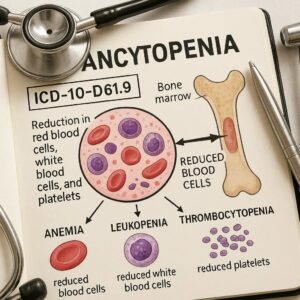
In the intricate world of modern medicine, where a single diagnosis can alter the course of a patient’s life and a single code can determine the financial viability of care, precision is paramount. Imagine a scenario: a patient presents with profound fatigue, recurrent infections, and unexplained bruising. The clinician, through a complete blood count (CBC), identifies a grim triad—low red blood cells (anemia), low white blood cells (leukopenia), and low platelets (thrombocytopenia). This is pancytopenia, not a disease in itself, but a ominous signpost pointing to a potential storm within the bone marrow. Is it a toxic reaction to chemotherapy? The first manifestation of a bone marrow failure syndrome like aplastic anemia? Or a sinister clue to an underlying leukemia or metastatic cancer?
The answer to that question is clinically urgent and, from an administrative and epidemiological standpoint, codified into a specific alphanumeric sequence in the International Classification of Diseases, Tenth Revision, Clinical Modification (ICD-10-CM). This article embarks on a comprehensive exploration of that code: D61.818, “Other pancytopenia.” We will journey beyond the mere memorization of a code, delving into the rich clinical context that gives it meaning, the precise guidelines that govern its use, and the profound implications of its accurate application for patient care, healthcare analytics, and institutional integrity. This is a story of how a five-character code encapsulates a complex medical narrative, demanding respect and understanding from all healthcare professionals.
ICD-10-CM code for pancytopenia
Chapter 1: Understanding Pancytopenia – A Clinical Deep Dive
Pancytopenia is defined as a reduction in all three major cellular components of the blood: erythrocytes (RBCs), leukocytes (WBCs), and thrombocytes (platelets). It is a laboratory diagnosis that serves as a critical alarm, indicating a failure of the hematopoietic system primarily within the bone marrow.
Pathophysiology: Where Does It Go Wrong?
The mechanisms leading to pancytopenia can be broadly categorized into three groups:
-
Bone Marrow Failure (Most Common): Direct damage or infiltration of the bone marrow, the blood cell production factory.
-
Aplastic Anemia: Immune-mediated destruction of hematopoietic stem cells.
-
Myelodysplastic Syndromes (MDS): Clonal disorders of ineffective hematopoiesis.
-
Infiltrative Diseases: Leukemias, lymphomas, multiple myeloma, or metastatic solid tumors (e.g., breast, prostate) crowding out normal marrow.
-
Myelofibrosis: Replacement of marrow with fibrous tissue.
-
Megaloblastic Anemia: Severe deficiency of Vitamin B12 or folate impairing DNA synthesis in rapidly dividing cells.
-
-
Peripheral Destruction/Sequestration: Rapid destruction or pooling of cells after they leave the marrow.
-
Hypersplenism: An enlarged spleen (splenomegaly) sequesters and destroys blood cells.
-
Severe Infections (e.g., Sepsis): Can consume and damage all cell lines.
-
-
Combined Mechanisms:
-
Chemotherapy/Radiation Therapy: The quintessential example, directly targeting rapidly dividing cells, including marrow progenitors.
-
Certain Medications: (e.g., antibiotics like chloramphenicol, antivirals, anticonvulsants).
-
Autoimmune Disorders: (e.g., Systemic Lupus Erythematosus – SLE).
-
Infections: Parvovirus B19, HIV, tuberculosis.
-
Clinical Presentation: The Patient’s Story
Patients with pancytopenia present with symptoms reflective of the deficiencies:
-
Anemia Component: Fatigue, weakness, pallor, shortness of breath, dizziness.
-
Leukopenia/Neutropenia Component: Increased susceptibility to infections, fever.
-
Thrombocytopenia Component: Easy bruising (ecchymoses), petechiae (pinpoint red spots), bleeding gums, prolonged bleeding from cuts.
Diagnostic Workup: The Detective Work
The evaluation is systematic and crucial for correct coding:
-
Detailed History: Medication review, toxin exposure, family history, recent illnesses.
-
Physical Exam: Looking for signs of bleeding, infection, splenomegaly, lymphadenopathy, or bone tenderness.
-
Laboratory Tests:
-
Complete Blood Count (CBC) with Differential: Confirms pancytopenia and provides morphology clues.
-
Reticulocyte Count: Low count suggests marrow production problem.
-
Peripheral Blood Smear: Examines cell shape and size; may show abnormal cells (blasts, immature forms).
-
-
The Definitive Test: Bone Marrow Aspiration and Biopsy. This is often the key to identifying the underlying etiology—cellularity, morphology, cytogenetics, and flow cytometry are analyzed.
Common Etiologies of Pancytopenia and Their Typical Bone Marrow Findings
| Etiology | Bone Marrow Cellularity | Key Features/Findings |
|---|---|---|
| Aplastic Anemia | Markedly hypocellular | Fatty replacement, few hematopoietic cells. |
| Myelodysplastic Syndrome | Usually hypercellular | Dysplastic changes in cell lines, ringed sideroblasts, cytogenetic abnormalities. |
| Acute Leukemia | Hypercellular, often packed | >20% blasts (myeloid or lymphoid). |
| Megaloblastic Anemia | Hypercellular | Megaloblastic erythropoiesis, giant metamyelocytes. |
| Myelofibrosis | Variable, often fibrotic | Reticulin/collagen fibrosis, teardrop cells on smear. |
| Chemotherapy Effect | Hypocellular | Correlated with timing post-treatment. |
| Hypersplenism | Normocellular or hypercellular | Diagnosis of exclusion after confirming splenomegaly. |
Chapter 2: The ICD-10-CM Coding System: A Primer for Specificity
Before we isolate D61.818, we must understand its ecosystem. ICD-10-CM replaced ICD-9-CM in 2015, bringing exponential increases in specificity. It uses 3-7 alphanumeric characters, where each character adds clinical detail.
-
First 3 Characters: The code category (e.g., D61 – Aplastic and other anemias and other bone marrow failure syndromes).
-
Characters 4-6: Provide etiology, anatomic site, severity, or other detail.
-
Character 7: An extension used primarily for encounters related to injuries or external causes.
This specificity allows for precise tracking of diseases, treatment outcomes, and public health trends, directly impacting reimbursement (via DRGs and HCC models) and research.
Chapter 3: Decoding D61.818 – The Pancytopenia Code
Located in Chapter 3: Diseases of the blood and blood-forming organs and certain disorders involving the immune mechanism (D50-D89), within the block D60-D64: Aplastic and other anemias and other bone marrow failure syndromes.
D61.818: Other pancytopenia
-
D61: Category for bone marrow failure states.
-
.81: Subcategory for “Other pancytopenia.”
-
.8: The final digit specifying this as “Other pancytopenia.”
Official Code Description: This code is used for pancytopenia that is not specifically named under other codes in this category (like aplastic anemia) and is not classified elsewhere.
Coding Guidelines & “Use Additional Code” Notes:
The power and complexity of ICD-10-CM lie in its instructions. For D61.818, the notes are critical:
-
“Code first, if applicable, the underlying cause” – This is the cardinal rule. Pancytopenia is almost always a manifestation. The coder MUST identify and sequence first the code for the causal condition, if known.
-
Common “Code First” Scenarios:
-
Adverse effect of drug: Code first the nature of the adverse effect (T36-T50 with fifth or sixth character 5), then D61.818, then the drug code.
-
Underlying disease: Code first the disease (e.g., C92.0- Acute myeloid leukemia, D46.9 Myelodysplastic syndrome, unspecified, D73.1 Hypersplenism).
-
Postprocedural state: Code first the complication of procedure.
-
-
Excludes1 Notes (NOT CODED TOGETHER):
-
Pancytopenia (due to) (with) aplastic anemia (D60.9, D61.09, D61.09) – If the pancytopenia is due to confirmed aplastic anemia, you code the aplastic anemia code, NOT D61.818. Aplastic anemia is a specific type of bone marrow failure causing pancytopenia.
-
Pancytopenia (due to) (with) bone marrow infiltration (D61.82) – This is a crucial distinction. If the pancytopenia is due to neoplastic infiltration (e.g., leukemia, lymphoma, metastatic cancer in marrow), you must use D61.82, “Pancytopenia due to antineoplastic chemotherapy,” only if it’s due to chemo. For the infiltration itself, you code the malignancy and potentially D75.89 or a different manifestation code. D61.818 is for non-neoplastic infiltrations or other causes.
-
Pancytopenia (due to) (with) myelodysplastic syndromes (D46.-) – Code the specific MDS.
-
Pancytopenia (due to) (with) other anemias (D50-D64) – If part of a named anemia, code that anemia.
-
-
Excludes2 Notes (CAN BE CODED TOGETHER if present): These are conditions that are not part of D61.818 but can coexist. E.g., neutropenia (D70.-) can be part of pancytopenia, but if isolated neutropenia exists, it can be coded additionally.
When is D61.818 Correct?
-
Drug-induced pancytopenia where the drug is not antineoplastic chemotherapy (e.g., antibiotic-induced).
-
Pancytopenia associated with autoimmune disease (like SLE) when not specified as aplastic anemia.
-
Pancytopenia due to certain infections (e.g., parvovirus, HIV) if it’s the primary hematologic issue.
-
Idiopathic pancytopenia (when no cause is found after workup).
-
Pancytopenia due to non-antineoplastic radiation.
Chapter 4: Extensive case studies contrasting D61.818 with D61.81 (pancytopenia due to antineoplastic chemo), D61.82, D64.89, and codes for aplastic anemia/MDS. Flowcharts for code selection.
Chapter 5: The vital role of clinician documentation—specific phrases like “pancytopenia due to,” “likely secondary to,” “post-chemotherapy,” and the need for clear etiology.
Chapter 6: Coding pancytopenia in pregnancy, neonates, and the elderly. Discussing codes like O99.82 (hematological complications of pregnancy) and P61.9 (neonatal hematological disorder).
Chapter 7: Impact on DRG assignment, HCC risk scores, quality metrics, clinical research data integrity, and billing audits.
Chapter 8: A look at ICD-11, where pancytopenia (3A00.0) is classified under “Decreased functions of the bone marrow,” and how its structure may further refine coding.
Conclusion
The ICD-10-CM code D61.818 for “Other pancytopenia” is a powerful tool that demands clinical acumen for accurate application. Its correct use hinges on identifying and sequencing the underlying etiology, adhering strictly to coding guidelines and excludes notes. Mastering this code ensures precise communication, supports optimal patient care pathways, and upholds the financial and ethical integrity of healthcare documentation. Ultimately, it represents a critical synapse where clinical medicine and health information management seamlessly connect.
Frequently Asked Questions (FAQs)
Q1: What is the direct ICD-10-CM code for pancytopenia?
A: The most general code is D61.818, “Other pancytopenia.” However, it is rarely used alone. You must first code the underlying cause if known (e.g., a specific drug, a disease like leukemia).
Q2: What is the difference between D61.818 and D61.81?
A: D61.81 is specifically “Pancytopenia due to antineoplastic chemotherapy.” If the pancytopenia is a known side effect of cancer chemotherapy, you must use D61.81, not D61.818. D61.818 is for pancytopenia from other causes.
Q3: How do I code pancytopenia in a patient with aplastic anemia?
A: You do not use D61.818. Pancytopenia is a defining feature of aplastic anemia. You code only the specific aplastic anemia code (e.g., D61.09 Constitutional aplastic anemia, D61.09 Drug-induced aplastic anemia). The “Excludes1” note mandates this.
Q4: Can I use D61.818 for pancytopenia caused by leukemia?
A: No. If the pancytopenia is due to bone marrow infiltration by leukemia (or lymphoma, etc.), you code the malignancy first (e.g., C92.00 Acute myeloid leukemia). Pancytopenia in this context is a symptom of the malignancy. D61.818 would be incorrect per Excludes1 notes.
Q5: Why is documentation so important for coding pancytopenia?
A: The coder relies entirely on the clinician’s notes. Phrases like “pancytopenia likely secondary to septic shock,” “drug-induced pancytopenia from linezolid,” or “pancytopenia status-post chemotherapy” provide the direct link to the correct code sequence and ensure accurate reimbursement and data collection.
Date: December 18, 2025
Disclaimer: This article is intended for informational and educational purposes only. It does not constitute medical advice, clinical coding advice, or replace the official ICD-10-CM coding guidelines. Always consult current coding manuals, clinical documentation, and qualified professionals for patient care and coding decisions.