Normocytic anemia—a condition where the patient has a reduced red blood cell count but the cells are of normal size—is not merely a laboratory finding. It is a clinical sentinel, a clue that whispers of underlying systemic illness, from the subtle inflammation of rheumatoid arthritis to the profound dysregulation of early bone marrow failure. For clinicians, diagnosing its cause is a detective story. For medical coders, accurately translating that diagnosis into an ICD-10-CM code is a critical act of precision that fuels healthcare analytics, determines appropriate reimbursement, and ensures quality patient care tracking.
This article delves deep into the nuanced world of ICD-10-CM coding for normocytic anemia. We will move beyond the simplistic default codes and explore the hierarchical, detail-oriented logic of the coding system. You will learn not just what codes to use, but why to use them, based on the richness of clinical documentation. Whether you are a seasoned coder, a medical resident, a practicing hematologist, or a healthcare administrator, understanding this interplay between medicine and code is essential in today’s data-driven healthcare environment.
ICD-10-CM code for normocytic anemia
2. Understanding Normocytic Anemia: A Primer on Pathophysiology
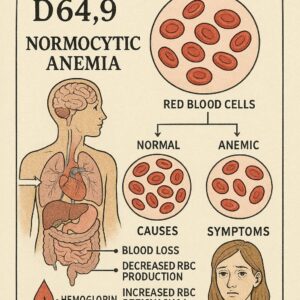
Anemia is defined by a reduction in the oxygen-carrying capacity of the blood, typically reflected by a decrease in hemoglobin concentration or hematocrit. The Mean Corpuscular Volume (MCV), which measures the average size of a red blood cell, classifies anemia into microcytic (low MCV), macrocytic (high MCV), and normocytic (normal MCV).
Normocytic anemia (MCV typically 80-100 fL) is particularly intriguing because it represents a state where the bone marrow is producing red cells of the correct size but in insufficient numbers. This can occur through three primary mechanisms:
-
Acute Blood Loss: The sudden loss of blood volume, as in trauma or a major gastrointestinal bleed, initially presents with normocytic cells before iron deficiency develops.
-
Increased Destruction (Hemolysis): The premature breakdown of red blood cells, as seen in autoimmune disorders or certain inherited conditions like hereditary spherocytosis.
-
Underproduction: This is the most common pathway for chronic normocytic anemia and is where coding becomes most complex. It includes:
-
Anemia of Chronic Disease (ACD)/Anemia of Inflammation: Cytokines released in chronic conditions (e.g., cancer, infection, autoimmune disease) disrupt iron metabolism and erythropoietin response.
-
Anemia of Chronic Kidney Disease (CKD): The kidneys produce inadequate erythropoietin, the hormone that stimulates red blood cell production.
-
Primary Bone Marrow Disorders: Aplastic anemia, myelodysplastic syndromes (MDS), and early stages of bone marrow infiltration (e.g., leukemia, lymphoma).
-
Endocrine Deficiencies: Hypothyroidism, hypopituitarism.
-
Understanding this pathophysiology is the first step to accurate coding, as the ICD-10-CM system is designed to capture this underlying etiology.
4. Decoding the Codes: Primary Codes for Normocytic Anemia
Selecting the correct code requires careful attention to the physician’s documentation. The following table outlines the primary codes and their applications:
Primary ICD-10-CM Codes for Normocytic Anemia
| ICD-10-CM Code | Code Description | Clinical Scenario & Usage Notes |
|---|---|---|
| D64.9 | Anemia, unspecified | Last Resort. Used only when the medical record documents “anemia” or “normocytic anemia” with no further specification regarding cause or type. Active auditing target. |
| D64.89 | Other specified anemias | The Go-To Code for “Anemia of Chronic Disease.” Used when the documentation specifies “anemia of chronic disease,” “anemia of inflammation,” or “normocytic anemia due to [a specified chronic condition]” where no more specific code exists. |
| D75.81 | Anemia in chronic kidney disease | Etiology-Specific. Used when the anemia is explicitly linked to CKD. Code first the underlying CKD (N18.-). This code acknowledges the unique pathophysiology of renal anemia. |
| D63.8 | Anemia in other chronic diseases classified elsewhere | “Use Additional Code” Directive. For anemia associated with chronic conditions other than CKD, such as rheumatoid arthritis (M06.9), HIV (B20), or cancer. The underlying disease is coded first, followed by D63.8. |
| D61.9 | Aplastic anemia, unspecified | Bone Marrow Failure. For confirmed primary bone marrow failure leading to pancytopenia and normocytic anemia. More specific codes exist for types of aplastic anemia. |
| D62 | Acute posthemorrhagic anemia | For Acute Blood Loss. Used for anemia resulting from immediate or recent major blood loss. |
5. The Art of Clinical Documentation: What Coders Need to Know
Accurate coding is impossible without precise documentation. Physicians can facilitate optimal coding by avoiding vague terms and embracing specificity.
-
Poor Documentation: “Patient has anemia. Will monitor.” (Forces coder to use D64.9)
-
Good Documentation: “Patient presents with normocytic anemia, likely secondary to their active rheumatoid arthritis (anemia of chronic disease).” (Allows for codes M06.9 followed by D63.8)
-
Excellent Documentation: “Patient with Stage 4 chronic kidney disease (CKD) presents with symptomatic normocytic anemia consistent with anemia of CKD. Hemoglobin is 9.5 g/dL, MCV 88 fL.” (Mandates codes N18.4 first, followed by D75.81)
Key phrases that trigger more accurate coding include: “anemia due to…,” “anemia secondary to…,” “anemia associated with…,” and “anemia in the setting of…”
6. Case Studies: Applying Codes in Real-World Scenarios
Case 1: A 68-year-old male with a 10-year history of Type 2 Diabetes and Stage 3b CKD (eGFR 35). Lab work reveals Hb 10.0 g/dL, MCV 89 fL. Diagnosis: “Anemia due to chronic kidney disease.”
-
Coding: N18.32 (Chronic kidney disease, stage 3b) followed by D75.81 (Anemia in chronic kidney disease).
Case 2: A 45-year-old female with poorly controlled Crohn’s disease presents with fatigue. Labs: Hb 11.2 g/dL, MCV 91 fL, elevated CRP. Diagnosis: “Normocytic anemia of chronic inflammation related to active Crohn’s disease.”
-
Coding: K50.914 (Crohn’s disease, unspecified, with complications) followed by D63.8 (Anemia in other chronic diseases classified elsewhere).
Case 3: Hospital admission for severe community-acquired pneumonia. Initial labs show Hb 14 g/dL. After 7 days of acute illness, repeat labs show Hb 10.5 g/dL, MCV 85 fL. Diagnosis: “Anemia, likely acute due to critical illness.”
-
Coding: J18.9 (Pneumonia, unspecified organism) and D64.89 (Other specified anemias). Note: While often called “anemia of inflammation,” in the acute setting and with this documentation, D64.89 is appropriate.
10. Conclusion
Accurate ICD-10-CM coding for normocytic anemia transcends simple data entry; it is a direct reflection of clinical understanding. Moving from the non-specific D64.9 to etiology-driven codes like D75.81 or D63.8 requires a synergistic effort between detailed clinical documentation and astute coding practice. This precision ensures proper reimbursement, enhances disease registry data, and ultimately supports higher-quality patient care and research. Mastery of these codes is a fundamental skill for ensuring the medical record tells the patient’s full and accurate story.
11. Frequently Asked Questions (FAQs)
Q1: Can I always use D64.9 for normocytic anemia?
A: No. D64.9 is a “unspecified” code and should be used only as a last resort when the medical record provides no clue as to the cause or type of anemia. Its overuse is a common audit finding.
Q2: What is the difference between D64.89 and D63.8?
A: D64.89 is a standalone code for “other specified anemias,” often used for Anemia of Chronic Disease when the underlying condition isn’t specified or doesn’t have a “use additional code” directive. D63.8 is explicitly for “anemia in other chronic diseases,” and coding rules instruct you to code the underlying disease (e.g., cancer, rheumatoid arthritis) first.
Q3: How do I code anemia in a patient with both CKD and another chronic disease like cancer?
A: This requires careful review of the documentation. If the physician attributes the anemia primarily to CKD, use N18.- and D75.81. If attributed to the cancer, use the cancer code (C00-C96) followed by D63.8. If both are contributing, you may code both sequences, but the physician’s documentation must support it.
Q4: Is there a specific code for “anemia of chronic disease”?
A: Not by that exact name. “Anemia of chronic disease” is typically mapped to D64.89 (Other specified anemias). However, if it is linked to a specific chronic condition, the combination of that condition’s code plus D63.8 is often more accurate.
Date: December 20, 2025
Author: Clinical Coding Specialist
Disclaimer: This article is for informational purposes only and is intended for healthcare professionals. It is not a substitute for clinical judgment, official coding guidelines, or the current ICD-10-CM code set. Always consult the most current official resources and your facility’s coding compliance department for definitive coding advice.