In the intricate world of healthcare administration, a code is never just a code. It is a story condensed into an alphanumeric cipher, a key that unlocks access to care, and a critical data point that shapes our understanding of public health. For Attention-Deficit/Hyperactivity Disorder (ADHD), one of the most common neurodevelopmental disorders affecting children and often persisting into adulthood, the correct application of its International Classification of Diseases, Tenth Revision, Clinical Modification (ICD-10-CM) code is a task of profound importance. The code F90 series carries weight far beyond the billing form; it encapsulates a patient’s challenges, validates a provider’s clinical assessment, and justifies necessary interventions, from behavioral therapy to educational accommodations.
This article delves into the nuanced, detailed, and professional landscape of ICD-10-CM coding for ADHD. Aimed at medical coders, healthcare providers, billers, students, and informed patients, this guide seeks to move past simplistic code look-ups. We will explore the clinical foundations of ADHD, the structure of the ICD-10-CM chapter that houses it, and the precise definitions of each sub-code. We will confront the real-world challenges of documentation, tackle the complexities of coding with comorbidities, and examine the billing ecosystem that depends on this accuracy. Furthermore, we will look to the horizon at the upcoming ICD-11 and consider the ethical dimensions of coding a condition often shrouded in misunderstanding. By the end, the goal is not merely to know that ADHD is coded as F90.9 but to understand the “why” and “how” behind every digit, ensuring that the story told by the code is as accurate and complete as the patient’s own.

ICD-10-CM Coding for Attention-Deficit/Hyperactivity Disorder
Table of Contents
Toggle2. Understanding the Foundation: What is ADHD?
Before assigning a code, one must understand the condition it represents. ADHD is not a simple matter of “being energetic” or “occasionally distracted.” It is a clinically validated, neurobiological disorder characterized by a persistent pattern of inattention and/or hyperactivity-impulsivity that interferes with functioning or development.
2.1 The Clinical Triad: Inattention, Hyperactivity, and Impulsivity
The core symptoms fall into two primary domains:
-
Inattention: This manifests as difficulty sustaining focus, easy distractibility, careless mistakes, seeming not to listen, forgetfulness in daily activities, avoidance of tasks requiring sustained mental effort, and organizational challenges.
-
Hyperactivity and Impulsivity: This includes fidgeting, leaving one’s seat inappropriately, running or climbing excessively (in adults, often feelings of restlessness), inability to engage quietly in leisure activities, talking excessively, blurting out answers, and difficulty waiting one’s turn.
Crucially, these symptoms must be:
-
Persistent: Lasting for at least 6 months.
-
Inconsistent with Developmental Level: More severe than typical behaviors for the individual’s age.
-
Pervasive: Present in two or more settings (e.g., home, school, work).
-
Impairing: Causing clear interference in social, academic, or occupational functioning.
-
Not Better Explained: The symptoms cannot be solely attributed to another mental disorder (e.g., mood disorder, anxiety disorder).
2.2 Subtypes and Presentations: A Shift in Understanding
Historically, ADHD was divided into “subtypes.” The current terminology, used in both DSM-5-TR and reflected in ICD-10-CM, refers to “presentations.” This acknowledges that how ADHD manifests can change over a person’s lifetime.
-
Predominantly Inattentive Presentation (F90.0): The individual meets the criteria for inattention but not fully for hyperactivity-impulsivity. This presentation is often identified later, especially in girls, and may be mislabeled as “daydreaming” or “laziness.”
-
Predominantly Hyperactive-Impulsive Presentation (F90.1): The reverse is true; criteria for hyperactivity-impulsivity are met, but not fully for inattention. This is less common and often seen in younger children.
-
Combined Presentation (F90.2): The most common presentation, where the individual meets the full criteria for both inattention and hyperactivity-impulsivity.
2.3 Etiology and Comorbidities: Untangling the Web
ADHD has a strong genetic component, with heritability estimated around 70-80%. Brain imaging studies show differences in the structure, function, and connectivity of networks involving the prefrontal cortex, responsible for executive functions. It is not caused by poor parenting, excessive sugar, or screen time, though these can exacerbate symptoms.
Comorbidities are the rule, not the exception. Accurate coding must account for this complexity. Common coexisting conditions include:
-
Specific Learning Disorders (e.g., in reading, writing, math)
-
Oppositional Defiant Disorder (ODD) and Conduct Disorder (CD)
-
Anxiety Disorders
-
Depressive Disorders
-
Autism Spectrum Disorder (ASD)
-
Tic Disorders/Tourette Syndrome
-
Sleep Disorders
3. The ICD-10-CM Ecosystem: Where F90 Fits
ICD-10-CM is a hierarchical system. Locating F90 requires navigating its structure.
-
Chapter V: Mental, Behavioral and Neurodevelopmental Disorders (F01-F99). This chapter covers the full spectrum of mental health conditions.
-
Block: Behavioral and emotional disorders with onset usually occurring in childhood and adolescence (F90-F98). This block groups disorders typically first diagnosed in youth, though they may persist.
-
Category: F90, Attention-deficit hyperactivity disorders. This is the parent code for all ADHD diagnoses.
4. Deep Dive into Code F90: Attention-Deficit Hyperactivity Disorders
Here we dissect each code in the F90 family. Precision is paramount, as the choice of code impacts clinical understanding and reimbursement.
ICD-10-CM Code Set for Attention-Deficit Hyperactivity Disorders (F90)
| ICD-10-CM Code | Code Description | Clinical Definition & Application Notes |
|---|---|---|
| F90.0 | Attention-deficit/hyperactivity disorder, predominantly inattentive presentation | Used when the individual meets the full diagnostic criteria for inattention but does not meet the full criteria for hyperactivity-impulsivity. Symptoms of hyperactivity-impulsivity may be present to some degree but are not predominant. |
| F90.1 | Attention-deficit/hyperactivity disorder, predominantly hyperactive/impulsive presentation | Used when the individual meets the full diagnostic criteria for hyperactivity-impulsivity but does not meet the full criteria for inattention. Some inattentive symptoms may be present. |
| F90.2 | Attention-deficit/hyperactivity disorder, combined presentation | Used when both the full criteria for inattention and the full criteria for hyperactivity-impulsivity are met for the past six months. This is the most frequently used code. |
| F90.8 | Attention-deficit/hyperactivity disorder, other type | A rarely used code for atypical presentations that meet the core ADHD diagnosis but do not fit neatly into the above categories. Documentation must specify why it is “other.” |
| F90.9 | Attention-deficit/hyperactivity disorder, unspecified type | Used when the provider diagnoses ADHD but does not specify the presentation (inattentive, hyperactive, or combined) in the documentation. This is often used for initial diagnoses pending further assessment or in broad administrative contexts. Note: This should not be a default due to lazy documentation. |
4.1 F90.0: The Overlooked Presentation
This code is critical for capturing individuals, often female or older, whose primary struggle is with focus, organization, and working memory, without significant hyperactive behavior. Their impairment is just as real but may lead to underachievement rather than disruption.
4.2 F90.1 & F90.2: The Classic Spectrum
F90.1 is more common in preschool-aged children. F90.2 represents the classic conception of ADHD and is the most prevalent presentation across all ages. Accurate differentiation relies entirely on the provider’s detailed symptom assessment.
4.3 F90.8 and F90.9: Use with Caution
F90.8 requires explicit justification. F90.9 is a necessary tool but is often overused. Coders cannot assume a presentation; if the documentation states “ADHD” without specification, F90.9 is correct. However, clinical best practice and coding integrity encourage providers to specify the presentation, allowing for the use of a more precise code.
5. The Critical Link: Documentation and Medical Necessity
The medical record is the source of all truth in coding. For ADHD, robust documentation is non-negotiable.
5.1 What Providers Must Document:
-
Symptom Enumeration: A clear list of observed and reported symptoms from both inattention and hyperactivity-impulsivity domains.
-
Duration and Onset: Note that symptoms have persisted for >6 months and onset was before age 12 (per DSM-5-TR; ICD-10-CM does not specify an age of onset).
-
Pervasiveness: Examples of impairment in at least two settings (e.g., “teacher reports difficulty staying seated in class; parent reports inability to complete homework without constant redirection”).
-
Severity and Impairment: Description of how symptoms impair academic, occupational, or social functioning (e.g., “failing math due to missing assignments,” “repeated workplace warnings for missing deadlines”).
-
Differential Diagnosis: A note ruling out other causes (e.g., anxiety, learning disability, situational stress).
-
Specified Presentation: The conclusive statement: “ADHD, Combined Presentation,” or “ADHD, Predominantly Inattentive Type.”
5.2 Linking Diagnosis to Treatment:
Documentation must create a clear “story” that links the diagnosed condition (F90.x) to the service provided. Why is this 90837 (psychotherapy) session medically necessary? Because it is treating the impulsivity leading to social conflicts documented under F90.2. Why is this 99214 (office visit) justified? Because it includes the management of medication for F90.0. The code justifies the service, and the documentation justifies the code.
6. Coding in Practice: Scenarios, Sequencing, and Comorbidities
Scenario 1: The Initial Diagnostic Evaluation
A 9-year-old is brought in for evaluation. The pediatrician completes a comprehensive assessment using parent and teacher rating scales and a clinical interview. The documentation concludes: “ADHD, Combined Presentation.” This is the first time this diagnosis is being made and treated by this provider.
-
Correct Coding: F90.2 (ADHD, combined), Z00.121 (Encounter for routine child health check with abnormal findings). Z00.121 is used because the encounter was for a “check-up” where the abnormal finding (ADHD) was identified.
Scenario 2: Established Patient with Comorbidities
A 25-year-old established patient with diagnosed F90.0 (ADHD, inattentive) presents for a follow-up medication management visit. They also have comorbid Generalized Anxiety Disorder, which is being monitored.
-
Correct Coding: F90.0 (Principal diagnosis, as it is the main reason for the visit—medication management), F41.1 (Generalized anxiety disorder, secondary).
Scenario 3: Unspecified Documentation
A progress note states: “Patient here for ADHD follow-up. Doing well on current dose of medication. Continue as prescribed.”
-
Analysis & Coding: The presentation is not specified. The coder cannot assume a previous encounter’s specification. Therefore, the correct code is F90.9 (ADHD, unspecified). This highlights a need for clinician education on documentation.
7. The Billing and Reimbursement Landscape
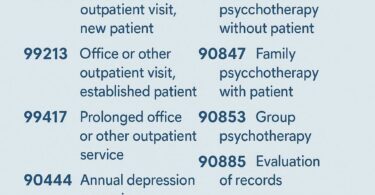
Correct coding is essential for clean claims. Common CPT® codes paired with ADHD diagnoses include:
-
Psychiatric Diagnostic Evaluation (90791, 90792)
-
Psychotherapy (90832, 90834, 90837) often with add-on code 90839 for crisis)
-
Pharmacological Management (99212-99215 for office visits, 99417 for prolonged services)
-
Psychological and Neuropsychological Testing (96130-96139)
Payers may have specific policies, such as requiring a specific presentation code (F90.0, .1, .2) over the unspecified F90.9 or mandating the use of specific assessment tools. Audits often target high-volume ADHD prescribing, making ironclad documentation linking severity, functional impairment, and medical necessity for treatment critical.
8. Beyond ICD-10-CM: DSM-5-TR and the Future with ICD-11
While ICD-10-CM is for coding and billing, the Diagnostic and Statistical Manual of Mental Disorders, Fifth Edition, Text Revision (DSM-5-TR) is the primary diagnostic guide used by clinicians in the US. Its criteria are more detailed and include the age-of-onset (before 12) requirement. Coders should understand the DSM-5-TR criteria to better interpret clinical documentation.
ICD-11, which the US is expected to adopt in the coming years, brings changes. ADHD is found under 6A05. It uses the same three presentations (now called “types”):
-
6A05.0 Attention deficit hyperactivity disorder, predominantly inattentive presentation
-
6A05.1 Attention deficit hyperactivity disorder, predominantly hyperactive/impulsive presentation
-
6A05.2 Attention deficit hyperactivity disorder, combined presentation
It also adds 6A05.Y Other specified and 6A05.Z Unspecified. The structure is more logical and digitally friendly, aligning closer with current clinical thinking.
9. Ethical Considerations and Stigma in Diagnosis and Coding
The code assigned becomes part of a patient’s permanent health record. Ethical coding demands:
-
Accuracy: Assigning the highest specificity supported by documentation.
-
Confidentiality: Protecting this sensitive diagnostic information.
-
Awareness of Stigma: Recognizing that a diagnosis of ADHD can be misused. The coder’s role is to accurately reflect the clinical truth, contributing to destigmatizing the condition by treating its coding with the same precision as any other medical diagnosis.
10. Conclusion: The Art and Science of Precision Coding
ICD-10-CM coding for ADHD is a critical intersection of clinical science, administrative accuracy, and ethical practice. Moving from the unspecified F90.9 to a precise F90.0, F90.1, or F90.2 is more than a billing optimization—it is a commitment to capturing the nuanced reality of a patient’s experience. As healthcare evolves towards greater integration and data-driven care, the precision embedded in these codes will only grow in importance, ensuring patients with ADHD receive the accurately documented, appropriately reimbursed, and effectively delivered care they require.
11. Frequently Asked Questions (FAQs)
Q1: Can I use an ADHD code for an adult patient? Absolutely.
A: Yes. The F90 series is ageless. While often first diagnosed in childhood, ADHD frequently persists into adulthood. The same diagnostic criteria and codes apply.
Q2: What is the difference between ICD-10-CM code F90.9 and DSM-5 diagnosis?
A: ICD-10-CM F90.9 is a billing and statistical code for “unspecified type.” The DSM-5-TR is the clinical manual providing the detailed criteria for diagnosis (e.g., needing 6+ symptoms, impairment in two settings). A provider uses DSM-5-TR to make a diagnosis; the coder uses ICD-10-CM to represent that diagnosis for administrative purposes. Ideally, the DSM-5-TR specification (inattentive, hyperactive, combined) leads to a specific ICD-10-CM code (F90.0, F90.1, F90.2).
Q3: When should I use code Z00.121 with an ADHD code?
A: Use Z00.121 only when the encounter is specifically for a routine well-child examination and during that routine exam, ADHD is newly identified or suspected. For all other encounters focused on evaluating, treating, or managing ADHD (even the first one if it’s a dedicated evaluation), use only the appropriate F90.x code as the principal diagnosis.
Q4: How do I code ADHD with a co-existing learning disability?
A: You must code both conditions. The sequencing depends on the reason for the encounter. If the visit is primarily for ADHD management, list the ADHD code first (F90.x), followed by the specific learning disorder code (e.g., F81.0 for reading disorder). If the visit is primarily for educational testing and planning related to the learning disability, that code may be sequenced first. Documentation must support the sequencing.
Q5: What is the biggest mistake coders make with ADHD?
A: The most common mistake is assuming specificity. If the documentation says only “ADHD,” the coder must use F90.9, not default to F90.2 (combined) because it’s most common. The second biggest mistake is not fully reviewing the record for documentation of the presentation, which might be noted in the assessment scales or history section, even if not in the final assessment line.
12. Additional Resources
-
Official: Centers for Medicare & Medicaid Services (CMS) ICD-10-CM Official Guidelines for Coding and Reporting: https://www.cms.gov/medicare/coding-billing/icd-10-codes
-
Clinical: American Psychiatric Association. (2022). *Diagnostic and Statistical Manual of Mental Disorders, Fifth Edition, Text Revision (DSM-5-TR)*.
-
Professional: American Academy of Professional Coders (AAPC) – Offers certifications and resources on medical coding: https://www.aapc.com
-
Advocacy & Information: Children and Adults with Attention-Deficit/Hyperactivity Disorder (CHADD): https://chadd.org
-
Upcoming System: World Health Organization (WHO) ICD-11 Implementation Tool: https://icd.who.int/en