The liver is the body’s indefatigable chemical plant, performing over 500 vital functions in silence. It rarely cries out in unmistakable pain until significant damage has occurred. Instead, it sends encoded signals into the bloodstream—signals we capture through Liver Function Tests (LFTs). An abnormal LFT panel is not a diagnosis; it is a biochemical SOS, a cryptic message demanding translation. In the modern healthcare ecosystem, this translation occurs in two parallel domains: the clinical, where physicians diagnose the underlying disease, and the administrative, where medical coders translate that diagnosis into the universal language of ICD-10-CM codes.
The code R74.0 – Elevation of levels of liver transaminase and lactic acid dehydrogenase [LDH] is the linchpin in this process for abnormal LFTs of unspecified origin. Yet, its apparent simplicity belies profound complexity. Misapplication of this code can distort patient records, impede clinical research, trigger audit flags, and result in significant financial ramifications for healthcare providers. This article serves as the definitive, exhaustive guide to mastering the nuances of ICD-10-CM coding for abnormal liver function tests. We will move beyond the basic code definition into the intricate landscape of differential diagnosis, clinical documentation, and ethical coding practices, empowering you to code with precision, confidence, and a deep understanding of the clinical story behind every lab value.
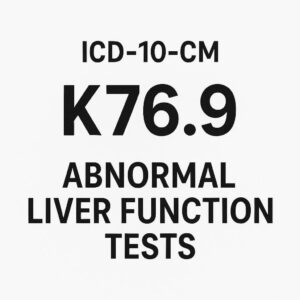
ICD-10-CM Code for Abnormal Liver Function Tests
Chapter 1: The Foundation – Understanding Liver Function Tests (LFTs)
Before a coder can accurately assign a code, a fundamental understanding of what is being coded is essential. LFTs are a cornerstone of diagnostic medicine.
1.1 The Liver’s Multifaceted Role
The liver processes nutrients, detoxifies harmful substances, produces vital proteins like albumin and clotting factors, stores glycogen and vitamins, and secretes bile for digestion. Damage to hepatocytes (liver cells) or obstruction of its biliary highways releases intracellular contents into the blood, which forms the basis of LFTs.
1.2 The Standard LFT Panel: Components and Clinical Significance
A standard panel measures:
-
Alanine Transaminase (ALT): Primarily liver-specific. Significant elevation suggests direct hepatocellular injury.
-
Aspartate Transaminase (AST): Found in liver, heart, muscle. Less specific than ALT.
-
Alkaline Phosphatase (ALP): Elevates with bile duct obstruction or bone disorders.
-
Gamma-Glutamyl Transferase (GGT): Very sensitive to biliary disease and alcohol use.
-
Total Bilirubin: A waste product; high levels cause jaundice. Fractionation into direct (conjugated) and indirect (unconjugated) is critical.
-
Albumin & Prothrombin Time (PT/INR): Measure the liver’s synthetic function. Low albumin or prolonged PT indicates severe, chronic impairment.
1.3 What Makes LFTs “Abnormal”? Interpreting Patterns
Clinicians don’t just see numbers; they see patterns that point to a type of injury:
-
Hepatocellular Pattern: Marked elevation in ALT/AST (e.g., 10x upper limit) with minimal ALP rise. Suggests viral hepatitis, DILI, ischemia.
-
Cholestatic Pattern: Predominant rise in ALP and GGT, with modest ALT/AST increase. Suggests biliary obstruction, primary biliary cholangitis.
-
Mixed Pattern: Elevations in both transaminases and ALP.
-
Isolated Hyperbilirubinemia: May point to Gilbert’s syndrome or hemolysis.
Common LFT Patterns and Their Clinical Correlations
| LFT Pattern | Primary Elevation | Typical ICD-10-CM Direction (if cause known) | Example Etiologies |
|---|---|---|---|
| Hepatocellular | ALT & AST >> ALP | K70.-, B15-B19, K71.-, K75.4 | Viral hepatitis (Acute/Chronic), Alcoholic hepatitis, Drug-induced injury, Autoimmune hepatitis |
| Cholestatic | ALP & GGT >> ALT/AST | K80.-, K81.-, K83.- | Gallstone obstruction (choledocholithiasis), Biliary stricture, Primary biliary cholangitis |
| Mixed | ALT, AST & ALP all significantly elevated | Depends on final diagnosis; often K71.- or complicated presentations | Severe drug-induced injury, Sepsis, Infiltrative diseases (e.g., metastasis) |
| Isolated Bilirubin | Total Bilirubin (especially indirect) | E80.4 (Gilbert’s syndrome), D59.- (Hemolytic anemias) | Gilbert’s syndrome, Hemolytic anemia |
| Synthetic Dysfunction | Low Albumin, Elevated PT/INR (often with other LFTs) | K74.- (Cirrhosis), C22.- (Malignancy) | Cirrhosis (decompensated), Advanced liver failure, Hepatocellular carcinoma |
This table is a simplified guide. Final coding must always be based on physician documentation of a confirmed diagnosis.
Chapter 2: The Heart of the Matter – ICD-10-CM Code R74.0
This is the essential, but often misunderstood, code for our discussion.
2.1 Code Definition and Official Description
R74.0 is categorized within Chapter 18: Symptoms, signs, and abnormal clinical and laboratory findings, not elsewhere classified > R70-R79: Abnormal findings on examination of blood, without diagnosis.
-
Official Long Description: Elevation of levels of liver transaminase and lactic acid dehydrogenase [LDH].
-
Commonly Used For: Abnormal liver enzymes; Elevated liver function tests; High ALT/AST/LDH.
2.2 Parent Code Notes and the ICD-10-CM Hierarchy
A crucial instruction under category R74 states: *”Excludes1: abnormal findings on antenatal screening of mother (O28.-)”*. This immediately directs us away from using R74.0 for pregnant patients; O28.- codes must be used instead.
2.3 Key Inclusions and Exclusions Under R74.0
-
Inclusions: The code is explicitly for elevation of transaminases (ALT, AST) and LDH. While used broadly for “abnormal LFTs,” it technically fits best when these specific enzymes are raised.
-
Critical Exclusions (Excludes1 Notes):
-
Hyperbilirubinemia NOS (R17) and Hyperbilirubinemia of the newborn (P55-P59). An isolated high bilirubin or neonatal jaundice gets a different code.
-
Specific diagnoses. This is the most important rule: R74.0 should NOT be used if a definitive diagnosis explaining the abnormality is established. If the physician documents “acute hepatitis B,” you code B16.9, not R74.0. The “Excludes1” note means these codes cannot be used together; the more specific code takes precedence.
-
Chapter 8: The Future – ICD-11 and the Evolution of Classification
The World Health Organization’s ICD-11, which is gradually being adopted, brings refinements. While the core concept remains, ICD-11 offers more granularity in some areas of liver disease. For example, it provides more specific codes for subtypes of non-alcoholic steatohepatitis (NASH). Coders must be prepared for this ongoing evolution, understanding that the principles of specificity and accurate clinical documentation will remain paramount, even as the code sets change.
Conclusion
Accurate ICD-10-CM coding for abnormal liver function tests transcends mere administrative task completion; it is an integral part of patient care integrity and healthcare data fidelity. The nonspecific code R74.0 serves as a crucial placeholder during the diagnostic journey but must yield promptly to precise etiological codes when available. Mastery requires a symbiotic understanding of clinical medicine patterns, unwavering adherence to physician documentation, and strict application of official coding guidelines. By embracing this holistic approach, the medical coder transforms from a data-entry specialist into an essential guardian of accurate health information.
Frequently Asked Questions (FAQs)
Q1: Can I use R74.0 as a primary diagnosis for an inpatient admission?
A: Yes, but only if the elevated LFTs themselves are the reason for admission for further workup, and no more specific cause is documented at the time of discharge. If the patient is admitted for chest pain and is found to have incidental elevated LFTs, R74.0 would likely be a secondary code.
Q2: The physician documents “abnormal LFTs” and “suspected NAFLD.” What do I code?
A: Code only what is confirmed. “Suspected,” “rule out,” and “probable” are not coded as confirmed diagnoses. You would code R74.0. A query to the physician for clarification on whether they are diagnosing NAFLD is appropriate.
Q3: How do I code elevated LFTs due to a known, chronic condition like stable cirrhosis?
A: If the patient is being seen for management of the cirrhosis, and the elevated LFTs are an expected feature of that disease, code only the cirrhosis (K74.60 for unspecified cirrhosis). The LFT abnormality is a symptom of the underlying disease, not a separate reportable issue in this context.
Q4: What is the difference between R74.0 and K76.89 (Other specified liver diseases)?
A: R74.0 is for a laboratory finding without a known cause. K76.89 is for a diagnosed liver condition that doesn’t have its own specific code. For instance, if a physician diagnoses “mild drug-induced hepatic steatosis” not specified elsewhere, K76.89 might be used based on documentation. R74.0 would be incorrect once that diagnosis is made.
Q5: The patient has both elevated LFTs (R74.0) and diagnosed gallstones (K80.20). How do I sequence them?
A: It depends on the reason for the encounter. If the encounter is to investigate the cause of the abnormal LFTs, and gallstones are confirmed as the cause, K80.20 is the principal/first-listed code. R74.0 may not even be necessary as it is inherent to the gallstone diagnosis, but it could be listed as a secondary code if it adds information. Always follow the Uniform Hospital Discharge Data Set (UHDDS) principal diagnosis definition.
Date: December 24, 2025
Author: The Clinical Coding Specialist
Disclaimer: This article is for educational and informational purposes only. It is not a substitute for official ICD-10-CM coding guidelines, physician advice, or clinical judgment. Always consult the most current official coding manuals, facility-specific policies, and the attending physician for definitive coding and patient care decisions.