The shoulder is a marvel of biomechanical engineering—the human body’s most mobile joint, a symphony of bones, muscles, tendons, and ligaments allowing for an immense range of motion. This very freedom, however, renders it uniquely vulnerable. Pain in the shoulder is a ubiquitous human experience, a leading cause of disability and a frequent entry point into the healthcare system. When that pain presents bilaterally, it transforms from a localized musculoskeletal complaint into a potentially complex clinical puzzle with far-reaching implications for diagnosis, treatment, and administrative classification.
For the medical coder, bilateral shoulder pain is not merely an entry in a chart; it is a narrative challenge. It sits at the crossroads of specificity and ambiguity. The ICD-10-CM code set, with its foundational mandate for precision, demands more than a simple translation of “hurts on both sides.” It requires a deep understanding of clinical terminology, coding conventions, and the intricate dance between provider documentation and classification rules. A code is not just a data point for billing; it is a critical piece of health information that influences population health statistics, research trajectories, reimbursement accuracy, and, ultimately, the quality of patient care.
This article is a definitive, exhaustive exploration of ICD-10-CM coding for bilateral shoulder pain. It will move beyond the basic code lookup to dissect the reasoning, the pitfalls, the clinical correlations, and the professional responsibilities inherent in this task. We will delve into the anatomy of the code itself, unravel the labyrinth of “Excludes1” notes, master the art of combination coding for systemic illnesses, and analyze real-world case studies. Whether you are a seasoned medical coder, a healthcare provider seeking to improve documentation, a student of health information management, or an administrator concerned with compliance, this guide aims to be your comprehensive resource. Our journey begins with understanding the language we must speak: the ICD-10-CM system itself.
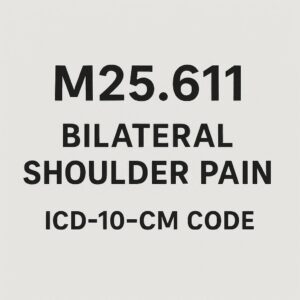
ICD-10-CM Code for Bilateral Shoulder Pain
Chapter 1: The Anatomy of a Code – Deconstructing the ICD-10-CM System
Before assigning a single character to bilateral shoulder pain, one must comprehend the architecture of the ICD-10-CM system. The International Classification of Diseases, Tenth Revision, Clinical Modification is more than a dictionary of diseases; it is a hierarchical, alphanumeric taxonomy designed for granularity.
The Structure of a Code:
-
Category (First three characters): The broad family of conditions. For shoulder pain, this leads us to M25, the category for “Other joint disorders.”
-
Etiology/Anatomic Specificity (Characters 4-6): These characters add crucial detail. The 4th character often specifies the type of disorder (.5 for “Pain in joint” – arthralgia). The 5th and 6th characters specify laterality and other qualifiers.
-
Laterality: This is a cornerstone of ICD-10-CM. Codes must reflect:
-
Right
-
Left
-
Bilateral (when a single code exists for both sides)
-
Unspecified (when laterality is not documented)
-
The “Unspecified” Conundrum: The code M25.519 (Arthralgia, unspecified shoulder) is not a “junk” code. It is a valid, necessary code for use when the clinical documentation does not support greater specificity. However, its overuse is a red flag for auditors, suggesting incomplete documentation or a lack of diagnostic effort. The push in modern healthcare is always away from “unspecified” when clinical information allows.
Official Guidelines for Coding and Reporting: These are the legal rules governing code application. They mandate sequencing priorities, define principal/first-listed diagnoses, and explain conventions like “Excludes1.” Ignoring these guidelines is a direct path to coding errors and compliance issues.
With this framework in mind, we can now zero in on the codes most central to our topic.
Chapter 2: The Primary Code – M25.519 (Arthralgia, Unspecified Shoulder)
At the heart of coding bilateral shoulder pain, when no more specific cause is identified, lies the code family M25.5 (Pain in joint). The most commonly encountered—and often misapplied—code for bilateral pain is M25.519 – Arthralgia, unspecified shoulder.
Deconstruction:
-
M25: Other joint disorders
-
.5: Pain in joint (arthralgia)
-
.51: Shoulder joint
-
.519: Unspecified shoulder
This code is to be used ONLY when the medical record explicitly states “bilateral shoulder pain” or “pain in both shoulders” but does not specify which shoulder is the primary site or if the pain is truly equal and symmetrical, or when the provider has not documented laterality at all. It is a catch-all for documented bilateral involvement without laterality-specific detail.
2.1: Specificity Matters: M25.511 (Right) and M25.512 (Left)
If the provider’s documentation specifies that the patient has pain in both the right shoulder and the left shoulder, ICD-10-CM coding convention requires you to code each side separately. You would assign:
-
M25.511 – Pain in right shoulder
-
M25.512 – Pain in left shoulder
This is a critical distinction. Using two codes provides a more accurate clinical picture and is often required for billing accuracy, especially if procedures or treatments are performed on one specific side.
2.2: The Critical Importance of “Unspecified”
The choice between M25.519 and the pair M25.511/M25.512 hinges entirely on documentation. Consider these examples:
-
Documentation: “Patient presents with bilateral shoulder pain, worse on the right.” Coding: M25.511 (Right, as it is specified and is the more severe), and M25.512 (Left).
-
Documentation: “Patient reports aching in both shoulders equally.” Coding: M25.511 and M25.512. The fact that they are “equal” does not negate the fact that both sides are involved; it still requires two codes.
-
Documentation: “Shoulder pain, bilateral.” Coding: M25.519. Here, bilateral is stated as a single, unspecified condition.
The coder must never assume laterality. If the note only says “shoulder pain,” you cannot default to bilateral or assign right/left codes. You are compelled to use M25.519 or, if the documentation is truly lacking, query the provider.
Chapter 3: The Foundation of All Coding – Clinical Documentation
The medical record is the source of all truth in coding. For bilateral shoulder pain, high-quality documentation is the only barrier to accurate, specific, and defensible code assignment.
3.1: The Elements of Perfect Documentation for Bilateral Pain
An ideal clinical note for a patient with bilateral shoulder pain should include:
-
Location: Explicitly “right shoulder,” “left shoulder,” or “bilateral.” If bilateral, is one side more affected?
-
Quality: Aching, sharp, burning, throbbing.
-
Severity: Often on a scale of 0-10.
-
Timing: Onset, duration, constant vs. intermittent.
-
Context: What aggravates it (overhead activity, lifting)? What relieves it (rest, ice)?
-
Associated Findings: Swelling, redness, warmth, instability, weakness, reduced range of motion, creptitus.
-
Etiology, if known: “Pain due to known osteoarthritis,” “pain following fall,” “pain associated with rheumatoid flare.”
-
Assessment/Diagnosis: The provider’s clinical impression (e.g., “Bilateral rotator cuff tendinopathy” or “Polyarthralgia, likely inflammatory in nature”).
3.2: Querying the Provider – A Necessary Collaboration
When documentation is ambiguous, incomplete, or conflicting, the coder has a professional obligation to query. A query is a formal, non-leading communication seeking clarification.
-
Poor Query: “Can we code bilateral pain?” (Leading).
-
Effective Query: “The note indicates the patient has right shoulder pain and also mentions left shoulder stiffness and discomfort. Can you clarify the presence and nature of symptoms in the left shoulder for accurate coding?”
A robust query process protects both the provider and the healthcare organization, ensuring the coded data reflects the true clinical scenario.
Chapter 4: Beyond Arthralgia – The Excludes1 Notes and Differential Diagnoses
This is where coding moves from technical to analytical. The ICD-10-CM tabular list for M25.5 contains vital Excludes1 notes. An Excludes1 note means “NOT CODED HERE.” The two conditions cannot be coded together because they are considered mutually exclusive. For M25.5, the key Excludes1 notes are:
-
Pain in hand (M79.64-)
-
Pain in fingers (M79.64-)
-
Pain in foot (M79.67-)
-
Pain in limbs (M79.6-)
-
Pain in joints of ankle and foot (M25.5-) (This is a hierarchy note)
-
Pain in joints of hand (M25.54-)
-
Pain in knee (M25.56-)
-
And most importantly: Pain in joint secondary to underlying disorder (code underlying disorder)
This last note is the most significant. If the shoulder pain is caused by a specific, diagnosed joint disorder, you must code that disorder instead of M25.5-. This is not an option.
4.1: Pain Due to Specific Shoulder Pathologies (Excludes1)
If the provider diagnoses a structural or inflammatory condition, you code that condition. M25.5- becomes irrelevant. Examples:
| Provider Diagnosis | Correct ICD-10-CM Code(s) | Why M25.5 is NOT Used |
|---|---|---|
| Bilateral Rotator Cuff Tear | S43.421A (Sprain of right rotator cuff capsule, initial encounter) & S43.422A (Sprain of left rotator cuff capsule, initial encounter) OR specific tear codes (M75.1-) | The pain is a symptom of the tear. The tear is the codable diagnosis. |
| Bilateral Adhesive Capsulitis | M75.01 (Adhesive capsulitis of right shoulder) & M75.02 (Adhesive capsulitis of left shoulder) | The pain is a symptom of the capsulitis. |
| Bilateral Osteoarthritis | M19.011 (Primary OA, right shoulder) & M19.012 (Primary OA, left shoulder) | The pain is a symptom of the osteoarthritis. |
| Bilateral Bicipital Tendinitis | M75.21 (Bicipital tendinitis, right shoulder) & M75.22 (Bicipital tendinitis, left shoulder) | The pain is a symptom of the tendinitis. |
Coding Specific Shoulder Disorders vs. Generalized Arthralgia
4.2: Pain as a Symptom of Systemic Disease
Bilateral shoulder pain is often a manifestation of a systemic illness. In these cases, coding becomes more complex, involving combination coding rules, which we will explore in Chapter 5. Examples include:
-
Rheumatoid Arthritis: An autoimmune disease causing symmetric polyarthritis.
-
Polymyalgia Rheumatica: Causes pain and stiffness in shoulders, neck, and hips.
-
Fibromyalgia: A centralized pain syndrome with widespread tender points.
-
Influenza or other viral illnesses: Often present with generalized myalgia and arthralgia.
-
Metabolic disorders: Like hypothyroidism.
Chapter 5: The Art of Combination Coding – Etiology and Manifestation
For systemic diseases where the shoulder pain is a direct symptom, we use a combination of codes, guided by the ICD-10-CM’s “Use additional code” and “Code first” notes.
5.1: The “Code Also” and “Use Additional” Instructions
Many codes for underlying diseases have instructions like “code also” the associated manifestation.
-
Example – Rheumatoid Arthritis: The code for Rheumatoid Arthritis of the shoulder, M06.011 (RA of right shoulder) and M06.012 (RA of left shoulder), already implies inflammation and pain. You would not additionally code M25.511/512. However, you must ensure you are using the most specific RA code (with laterality and involvement).
-
Example – Polymyalgia Rheumatica (PMR): The code for PMR is M35.3. There is no specific “PMR of shoulder” code. Here, you would code M35.3 first, and then you may use M25.511 and M25.512 to specify the location of the pain, if the documentation supports it and it adds useful information. This is per coding guidelines allowing symptom coding when not inherent to the disease.
5.2: Sequencing for Medical Necessity
Sequencing (which code is listed first) is driven by the reason for the encounter (the circumstance of the visit).
-
Encounter for Rheumatic Disease Flare: A patient with known RA presents for a flare causing severe bilateral shoulder pain. First-listed: M06.011 & M06.012. The shoulder pain is inherent and not listed separately.
-
Encounter for Pain of Unknown Origin: A patient presents with new bilateral shoulder pain. After workup, the provider suspects but cannot yet confirm PMR. First-listed: M25.519 (or M25.511/512). The symptom is the reason for the visit.
-
Encounter for Routine Management of Chronic Condition: A patient with stable fibromyalgia (M79.7) presents for a follow-up and mentions ongoing bilateral shoulder pain, which is part of their fibromyalgia. First-listed: M79.7. The shoulder pain is a routine symptom of the managed chronic condition.
Chapter 6: Case Studies in Complexity – From Clinic Note to Final Code
Case Study 1: The Overuse Injury
-
Note: “45-year-old painter presents with 2 weeks of progressive aching in both shoulders, right greater than left. Pain is worse at the end of the workday and with overhead brushing. Exam reveals tenderness over the bicipital grooves and painful arc. Impression: Bilateral bicipital tendinitis, right side predominant.“
-
Coding Analysis: A specific diagnosis is made. The pain is a symptom of the tendinitis. Laterality is specified (bilateral, right worse).
-
Final Codes: M75.21 (Bicipital tendinitis, right shoulder), M75.22 (Bicipital tendinitis, left shoulder).
Case Study 2: The Systemic Presentation
-
Note: “68-year-old female with sudden onset of severe pain and morning stiffness in both shoulders and hips over the past month. ESR elevated. Patient reports difficulty raising arms to brush hair. Impression: Probable polymyalgia rheumatica. Bilateral shoulder and hip girdle pain. Start prednisone trial.”
-
Coding Analysis: PMR (M35.3) is the suspected systemic cause. The bilateral shoulder pain is a primary manifestation.
-
Final Codes: M35.3 (Polymyalgia rheumatica), M25.511 (Pain in right shoulder), M25.512 (Pain in left shoulder). M35.3 is sequenced first as the defining diagnosis for this evaluative encounter.
Case Study 3: The Unclear Etiology
-
Note: “Patient complains of ‘aches and pains’ all over, including both shoulders. No specific injury. Exam non-focal. Labs pending. Will observe. Diagnoses: Generalized myalgia and arthralgia, bilateral shoulder pain.“
-
Coding Analysis: No specific cause identified. “Bilateral shoulder pain” is documented as a diagnosis. Myalgia (M79.1) is also documented.
-
Final Codes: M25.519 (Arthralgia, unspecified shoulder), M79.10 (Myalgia, unspecified site). M25.519 is sequenced first if the shoulder pain was the chief complaint.
Chapter 7: The Financial and Compliance Implications of Accurate Coding
Inaccurate coding for bilateral shoulder pain is not a victimless error. It has direct consequences.
7.1: Denials, Audits, and Risk Mitigation
-
Downcoding: Using M25.519 when M25.511/512 are supported can lead to downcoding if a payer’s policy requires maximum specificity for certain services.
-
Lack of Medical Necessity Denials: If a more specific code for a procedure (like an injection 20610- Arthrocentesis) is billed with only an unspecified M25.519, a payer may deny it as not medically necessary due to insufficient diagnostic specificity.
-
Audit Risk: Overuse of unspecified codes is a common audit target, potentially leading to recoupments and fines.
-
Risk Mitigation: Regular coder education, provider documentation training, and internal audits are essential.
7.2: Linking Diagnosis to Procedure (CPT® Codes)
The ICD-10-CM code must justify the CPT® procedure code. A claim for a bilateral shoulder MRI (CPT® 73221, 73222) billed with only M25.519 may be questioned. Billing it with specific codes like M75.11/M75.12 (Full-thickness rotator cuff tear) creates a strong, defensible link for medical necessity.
Chapter 8: The Future of Pain Coding – ICD-11 and Beyond
The World Health Organization’s ICD-11, which some countries have adopted, brings even greater specificity to pain classification. It introduces a dedicated chapter on “Symptoms, signs or clinical findings, not elsewhere classified” with enhanced detail for chronic pain conditions. While the US has not set a transition date from ICD-10-CM to ICD-11, understanding its direction is key. It emphasizes the biopsychosocial model of pain, potentially requiring codes for the duration (acute vs. chronic), underlying mechanism (nociceptive, neuropathic, nociplastic), and severity. This future state will demand even closer collaboration between clinicians documenting the pain experience and coders translating it into data.
Conclusion: More Than a Code – A Narrative of Care
Coding bilateral shoulder pain is a microcosm of modern medical coding. It requires technical mastery of a complex system, analytical skill to interpret clinical narratives, ethical fortitude to query when needed, and an understanding that each code tells a part of the patient’s story. From the generic M25.519 to the highly specific M06.012, these codes form the data backbone for clinical decision support, resource allocation, and medical research. Precision in coding is not a bureaucratic hurdle; it is a fundamental component of accurate healthcare communication and high-quality, data-driven patient care.
Frequently Asked Questions (FAQs)
Q1: Can I ever use M25.519 for bilateral pain?
A: Yes, but only when the provider’s documentation specifically uses the term “bilateral shoulder pain” as a single, unspecified diagnosis without detailing separate sides. If the note says “pain in right shoulder and left shoulder,” you must use M25.511 and M25.512.
Q2: What is the most common coding mistake for bilateral shoulder pain?
A: The two most common mistakes are: 1) Using only one unspecified code (M25.519) when documentation supports two lateralized codes, and 2) Coding M25.5- when a more specific shoulder disorder (like rotator cuff tear or osteoarthritis) has been diagnosed (an Excludes1 violation).
Q3: How do I code shoulder pain that is due to a past injury that has healed?
A: If the acute injury has healed but the patient has residual pain, the pain becomes the active diagnosis. Code M25.51- based on laterality. You may also code the old injury as a history (e.g., Z87.81- Personal history of (healed) traumatic fracture) if it is relevant to care.
Q4: A patient has fibromyalgia and bilateral shoulder pain. Do I code both?
A: It depends on the reason for the encounter. If the visit is specifically for managing the fibromyalgia and the shoulder pain is an integral part of that condition, M79.7 (Fibromyalgia) may be sufficient. If the shoulder pain is a new, distinct focus of examination or treatment during the visit, you may list M79.7 and add M25.511/512. Sequencing depends on the encounter’s focus.
Q5: Where can I find the official coding guidelines?
A: The *ICD-10-CM Official Guidelines for Coding and Reporting* are published annually by the Centers for Medicare & Medicaid Services (CMS) and the National Center for Health Statistics (NCHS). They are freely available on the CMS website.
Disclaimer: The information contained in this article is for educational and informational purposes only and is not intended as medical advice, coding advice, or legal counsel. While every effort has been made to ensure accuracy based on the 2025 ICD-10-CM code set, codes and guidelines are subject to change. Healthcare providers and coders must refer to the official ICD-10-CM code set, Official Guidelines for Coding and Reporting, and payer-specific policies for definitive coding and billing decisions. The author and publisher assume no liability for errors, omissions, or outcomes resulting from the use of this content.
Date: December 27, 2025
Author: The Medical Coding Specialist