Gastroesophageal Reflux Disease (GERD) is ubiquitous. It affects an estimated 20% of the population in Western societies, presenting as a familiar constellation of symptoms: heartburn, regurgitation, chest pain, and chronic cough. For patients, it’s a daily management challenge. For clinicians, it’s a common diagnostic and therapeutic pathway. But for the medical coder, biller, and healthcare administrator, GERD represents a critical nexus of clinical medicine, administrative data science, and financial integrity. The act of assigning an ICD-10-CM code for GERD—seemingly a simple task—is, in reality, a sophisticated exercise in clinical interpretation, regulatory compliance, and data analytics.
Choosing between K21.0 (GERD with esophagitis) and K21.9 (GERD without esophagitis) is not a trivial decision. It carries significant weight, influencing severity of illness indices, shaping hospital quality metrics, determining diagnosis-related group (DRG) assignments, and directly impacting reimbursement. In an era of value-based care and heightened audit scrutiny, inaccurate GERD coding can lead to claim denials, compliance risks, and skewed population health data. This article delves far beyond the basic code definitions. It provides a exhaustive, 360-degree exploration of ICD-10-CM coding for GERD, designed for professional coders, physicians, nurse practitioners, billing specialists, and healthcare students. We will dissect the clinical nuances that guide code selection, unravel the complexities of coding hierarchies, examine the symbiotic relationship between documentation and coding, and project into the future of disease classification. Our goal is to transform the simple act of coding GERD from a routine task into a deliberate, precise, and impactful component of quality healthcare delivery.
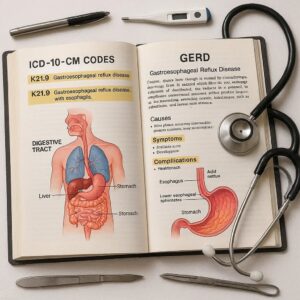
ICD-10-CM Code for GERD
2. Understanding the Disease: The Pathophysiology of GERD
To code accurately, one must first understand the disease. GERD is defined as a condition that develops when the reflux of stomach contents causes troublesome symptoms and/or complications. The key mechanism is the dysfunctional lower esophageal sphincter (LES)—a muscular valve that fails to maintain adequate tone, allowing gastric acid, pepsin, and sometimes bile to wash back into the esophagus.
Clinical Spectrum:
-
Non-Erosive Reflux Disease (NERD): The majority of GERD patients (60-70%) have symptomatic GERD but no visible esophageal mucosal breaks on endoscopy. This typically aligns with code K21.9.
-
Erosive Esophagitis (EE): Endoscopy reveals visible erosions or ulcers in the esophageal lining. Graded by the Los Angeles (LA) classification system (Grades A-D), this is captured by K21.0.
-
Barrett’s Esophagus (BE): A major complication where the normal squamous esophageal epithelium is replaced by metaplastic columnar intestine-type epithelium due to chronic acid exposure. This is a separate and distinct code (K22.7) and not subsumed under K21.0.
-
Extra-esophageal Manifestations: GERD can present atypically as chronic laryngitis (J37.0), asthma (J45.-), chronic cough (R05), or dental erosions. These require separate coding alongside the primary GERD code.
This clinical spectrum is the foundation of all ICD-10-CM coding decisions. The coder’s mission is to translate the documented clinical picture into the most specific code possible.
3. The ICD-10-CM Coding Framework: Chapter 11 – Diseases of the Digestive System
GERD codes reside in Chapter 11 of ICD-10-CM: Diseases of the Digestive System (K00-K95). The specific block is K20-K31: Diseases of Esophagus, Stomach, and Duodenum.
The structure is logical and hierarchical:
-
K21 is the parent category: Gastro-esophageal reflux disease.
-
K21.0 is the more specific child code: Gastro-esophageal reflux disease with esophagitis.
-
K21.9 is the child code for unspecified manifestation: Gastro-esophageal reflux disease without esophagitis.
The fourth digit provides the necessary specificity that was lacking in ICD-9-CM. The use of “unspecified” codes (like K21.9) is permitted when documentation does not support greater specificity, but they are often targets for audit and may not support medical necessity for certain procedures.
4. Core Code: K21.9 – Gastro-esophageal reflux disease without esophagitis
Code: K21.9
Description: Gastro-esophageal reflux disease without esophagitis.
Clinical Correlation: This code is used for patients with typical GERD symptoms (heartburn, regurgitation) in whom endoscopic evaluation either has not been performed, or has been performed and revealed no evidence of erosive esophagitis (i.e., NERD). It is also used when the physician’s documentation simply states “GERD” without specifying the presence or absence of esophagitis.
Documentation Key Phrases: “GERD,” “reflux without esophagitis,” “non-erosive reflux disease (NERD),” “symptomatic GERD,” “endoscopy negative reflux disease.”
Pitfall: Do not automatically assign K21.9 if an endoscopy report stating “no esophagitis” is present in the record. The coder must ensure the physician’s assessment links the diagnosis to that finding. The physician should document “GERD without esophagitis” or “NERD.”
5. The Esophagitis Spectrum: K21.0 and its Specificity
Code: K21.0
Description: Gastro-esophageal reflux disease with esophagitis.
Clinical Correlation: This code is assigned when the medical record explicitly documents that esophagitis is present as a direct result of GERD. Confirmation is often via endoscopy report describing erosions, ulcerations, or inflammation, with a pathology report possibly confirming reactive (reflux) changes rather than eosinophilic or infectious causes.
Documentation Key Phrases: “GERD with esophagitis,” “erosive esophagitis,” “reflux esophagitis,” “Los Angeles Grade A/B/C/D esophagitis,” “esophageal erosions secondary to reflux.”
Critical Distinction: K21.0 is for reflux-induced esophagitis. Other forms of esophagitis have distinct codes:
-
Eosinophilic esophagitis: K20.0
-
Candidal esophagitis: B37.81
-
Drug-induced esophagitis: K22.1
-
Other specified esophagitis: K20.8
The physician’s documentation must specify the etiology.
6. The Hierarchical Challenge: Code Also and Excludes Notes
ICD-10-CM is governed by a system of notes that are not suggestions—they are mandatory instructions.
Excludes1 Notes (Not Coded Here):
The K21 category carries an Excludes1 note: “Excludes1: newborn esophageal reflux (P78.83).” This means if the patient is a newborn with reflux, you must use P78.83 and cannot use K21.0 or K21.9. They are mutually exclusive.
Excludes2 Notes (May Be Coded Together):
There is no Excludes2 note under K21, meaning other related conditions can be coded simultaneously if documented. For example, a hiatal hernia (K44.9) is a common anatomical contributor to GERD but is a separate condition. Both K21.9 and K44.9 can be coded together if both are documented as active diagnoses requiring care.
Code Also Notes:
While not present under K21, the principle of “code also” applies to associated conditions. For instance, if a patient is treated for an ulcerative stricture of the esophagus (K22.2) caused by long-standing GERD, you would code both K21.0 (or K21.9 if no active esophagitis) and K22.2, sequencing based on the reason for the encounter.
7. Documenting for Specificity: The Physician’s Crucial Role
The coder’s accuracy is bound by the physician’s documentation. Vague terms lead to unspecified codes, which impact data quality and reimbursement.
Poor Documentation: “Patient has reflux. Continue PPI.”
Coder Action: Must assign K21.9 (unspecified).
Impact: Lower CC/MCC weight, potential denial for certain procedures.
Excellent Documentation: “Patient presents with ongoing heartburn despite medication. EGD performed today reveals Los Angeles Grade B erosive esophagitis in the distal esophagus, consistent with severe GERD. No Barrett’s is seen.”
Coder Action: Confidently assign K21.0.
Impact: Supports higher complexity, justifies continued treatment, and provides precise data.
Actionable Tip for Clinicians: In your assessment/plan, state the diagnosis with as much specificity as the evidence allows: “1. GERD with esophagitis (LA Grade B).” Link symptoms to findings.
8. GERD in Special Populations: Pediatric and Pregnancy Coding
Pediatrics: While GERD is common in infants, the ICD-10-CM index directs “reflux” in an infant to P78.83 (Newborn esophageal reflux). For older children, the standard K21 codes apply. Distinguishing between physiologic spitting up in an infant and pathologic GERD requires clinical judgment documented by the provider.
Pregnancy: GERD is extremely common in pregnancy due to hormonal changes and mechanical pressure. The correct coding sequence depends on the context of the encounter:
-
If the encounter is primarily for the GERD (e.g., a gastroenterology consult for severe reflux in pregnancy), the primary code would be K21.9, followed by a pregnancy code from Chapter 15 (O99.81-, Other specified diseases and conditions complicating pregnancy).
-
If the encounter is for routine obstetric care and the GERD is a minor or incidental issue, the pregnancy code (Z34.- or O09.-) would be primary, with K21.9 as secondary.
9. Complications and Comorbidities: Linking Codes Accurately
GERD rarely exists in a vacuum. Accurate coding involves painting a complete picture.
Common GERD-Related Conditions and Their ICD-10-CM Codes
| Condition | ICD-10-CM Code | Coding Relationship with GERD (K21.x) |
|---|---|---|
| Hiatal Hernia | K44.9 | Code also. Often a contributing factor. |
| Barrett’s Esophagus | K22.7 | Code instead of K21.0. It’s a complication, not esophagitis. |
| Esophageal Stricture | K22.2 | Code also if due to reflux. May be primary diagnosis if dilation is performed. |
| Reflux-induced Laryngitis | J37.0 | Code also. An extra-esophageal manifestation. |
| Asthma with GERD | J45.- (Asthma) | Code both. GERD can be a trigger (documented link needed). |
| Dyspepsia | K30 | May be coded also if documented as a separate symptom complex. |
| History of GERD | Z87.11 | Used when GERD is a past, resolved condition not being treated. |
Sequencing (Priority of Codes): The first-listed code (primary for outpatient, principal for inpatient) should be the condition chiefly responsible for the services rendered. For a visit solely for reflux management, K21.x is first. For an esophagogastroduodenoscopy (EGD) with dilation for a stricture caused by GERD, K22.2 might be first, followed by K21.0.
10. The DRG Impact: How GERD Coding Affects Reimbursement
In the inpatient setting, GERD codes play a role in determining the Diagnosis-Related Group (DRG). While K21.9 (without esophagitis) is typically a non-Complication/Comorbidity (non-CC), K21.0 (with esophagitis) is often a CC. This single digit of difference can move a case from a lower-paying DRG to a higher-paying one, especially in medical admissions for symptoms where GERD is a contributing factor. For example, an admission for chest pain (R07.9) with documented erosive esophagitis (K21.0) as the cause will yield a higher reimbursement than the same admission with only unspecified GERD (K21.9). This underscores the financial imperative of precise documentation and coding.
11. Common Coding Errors and Audit Risks
-
Assuming Esophagitis: Never assume esophagitis is present because an endoscopy was performed. Code only what is documented in the physician’s final diagnosis.
-
Confusing Barrett’s with Esophagitis: Coding K21.0 for Barrett’s Esophagus is incorrect. Barrett’s (K22.7) is a separate, more significant finding.
-
Ignoring Excludes1 Notes: Using K21.9 for a newborn is a clear coding violation.
-
Overlooking Associated Conditions: Failing to code a documented hiatal hernia or stricture alongside GERD creates an incomplete clinical picture.
-
Sequencing Errors: Incorrectly sequencing a symptom (like chest pain) before a definitive diagnosis (GERD with esophagitis) when the latter has been established.
These errors are prime targets for Recovery Audit Contractors (RACs) and other audit entities, leading to takebacks and penalties.
12. The Future of Coding: ICD-11 and Beyond
The World Health Organization’s ICD-11, adopted for implementation in many countries, offers even greater specificity for GERD. While the US has not set a transition date, understanding its structure is forward-thinking. In ICD-11, GERD is found under DA22 Gastro-oesophageal reflux disease, with extensions for:
-
DA22.0 Gastro-oesophageal reflux disease with oesophagitis
-
DA22.1 Gastro-oesophageal reflux disease without oesophagitis
-
DA22.2 Gastro-oesophageal reflux disease with stenosis
-
DA22.Y Other specified gastro-oesophageal reflux disease
-
DA22.Z Gastro-oesophageal reflux disease, unspecified
The addition of a code for “with stenosis” directly addresses a common complication, potentially allowing for more granular data capture and resource allocation. The transition to ICD-11 will demand even closer clinical-coder collaboration.
13. Conclusion
Accurate ICD-10-CM coding for GERD is a critical skill that sits at the intersection of clinical truth and administrative reality. Moving beyond the basic K21.9 to the specific K21.0, understanding the excludes notes, properly linking complications, and recognizing the DRG impact are all essential for coding integrity. This precision ensures correct reimbursement, safeguards against audits, and, most importantly, creates high-quality data that can be used to improve patient care pathways and outcomes. In the world of modern healthcare, a code is never just a code—it is a data point with profound implications.
14. Frequently Asked Questions (FAQs)
Q1: The endoscopy report says “mild gastritis and GERD.” The physician’s assessment only says “GERD.” What do I code?
A1: Code only what the physician has documented in their assessment. You would assign K21.9. The coder cannot independently diagnose esophagitis or assume linkage based on the procedure report alone. The physician must integrate the findings into their diagnostic statement.
Q2: How do I code “silent reflux” or laryngopharyngeal reflux (LPR)?
A2: “Silent reflux” is typically coded as GERD. If the documentation specifies LPR, you would still use the appropriate GERD code (K21.9 or K21.0). The laryngeal manifestations (e.g., laryngitis, J37.0) should be coded additionally if documented.
Q3: A patient has a history of GERD, had a fundoplication 5 years ago, and is now asymptomatic. What is the code for the current encounter?
A3: This would be coded as a history of GERD: Z87.11 (Personal history of diseases of the digestive system). Do not use an active K21.x code for a resolved, historical condition.
Q4: Can I code both GERD and dyspepsia?
A4: Yes, if the physician documents both as separate, coexisting conditions (e.g., “GERD with dyspepsia”), you can assign K21.9 and K30 (Functional dyspepsia). However, if dyspepsia is simply described as a symptom of the GERD, only the GERD code is assigned.
Q5: The physician documents “possible GERD” or “GERD to be ruled out.” Is this codeable?
A5: No. ICD-10-CM coding guidelines state that symptoms, signs, or “rule out” diagnoses are not coded as if established. Code the presenting symptoms (e.g., R12 Heartburn, R05 Cough) instead. A code from Chapter 18 (Symptoms) is used until a definitive diagnosis is made.
Disclaimer: The information contained in this article is for educational and informational purposes only and is not intended as medical or legal coding advice. Always consult the latest official ICD-10-CM coding manuals, payer-specific guidelines, and clinical documentation for definitive coding guidance. The author and publisher are not responsible for any errors, omissions, or consequences arising from the use of this content.
Date: December 29, 2025
Author: Medical Coding Insights Team