Pneumonia is not merely a clinical diagnosis; it is a narrative woven from patient history, physical exam findings, radiologic evidence, and laboratory results. In the realm of medical coding, particularly within the ICD-10-CM system, translating this complex narrative into a precise alphanumeric code—such as J18.9 or J15.211—is a task of profound importance. This code becomes the linchpin of the patient’s health record, influencing clinical decision support, population health statistics, quality metrics, and, undeniably, financial reimbursement. Yet, the path from a clinician’s diagnosis to the correct ICD-10-CM code is fraught with nuance, requiring a coder to be part detective, part linguist, and part regulatory expert.
This exhaustive guide aims to be the definitive resource for medical coders, auditors, students, and even clinicians seeking to understand the depth and breadth of ICD-10-CM coding for pneumonia. We will move beyond the simplistic “code J18.9” and delve into the intricate layers of the classification system, exploring how etiology, organism, laterality, and associated conditions dictate the final code. With over 12,000 words of detailed analysis, practical scenarios, and expert insights, this article will equip you with the knowledge to navigate the most challenging pneumonia coding cases with confidence and accuracy.
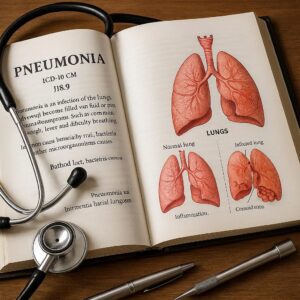
ICD-10-CM code for pneumonia
2. The Critical Importance of Accurate Pneumonia Coding
The assignment of an ICD-10-CM code for pneumonia extends far beyond administrative paperwork. Its accuracy resonates across the entire healthcare ecosystem.
-
Clinical Care and Analytics: Accurate codes feed into clinical decision support tools, helping identify infection trends, antibiotic resistance patterns (like MRSA or DRSP), and high-risk patient populations. They enable hospitals to track outcomes for conditions like sepsis stemming from pneumonia.
-
Reimbursement and Financial Integrity: Diagnosis codes directly determine Diagnosis-Related Groups (DRGs) under the Inpatient Prospective Payment System (IPPS). A nonspecific code like J18.9 (Pneumonia, unspecified organism) may map to a lower-weighted, less complex DRG compared to a specific code like J15.211 (Pneumonia due to Methicillin susceptible Staphylococcus aureus). This difference can translate to tens of thousands of dollars in lost revenue for a hospital. Conversely, incorrect “upcoding” can lead to audits, penalties, and allegations of fraud.
-
Quality Reporting and Public Health: Codes are vital for core quality measures such as the Severe Sepsis and Septic Shock Management Bundle (SEP-1), where the source of infection (e.g., pneumonia) must be identified. They are also reported to public health agencies for surveillance of outbreaks, such as influenza or novel viral pneumonias.
-
Research and Population Health Management: Epidemiologists rely on aggregated coded data to study the incidence, prevalence, and burden of different types of pneumonia. This research informs public health policies, vaccine development (e.g., pneumococcal, influenza), and resource allocation.
In essence, the humble pneumonia code is a critical data point that fuels modern healthcare’s clinical, financial, and public health engines.
3. A Brief Refresher: The Anatomy and Pathophysiology of Pneumonia
To code effectively, one must understand the disease. Pneumonia is an acute inflammatory condition of the lung parenchyma—the alveoli (air sacs) and interstitial tissue. It is characterized by the filling of alveoli with fluid (exudate), inflammatory cells, and fibrin, leading to the classic symptoms of cough, fever, chills, and shortness of breath, along with radiological findings of consolidation or infiltrates.
Pneumonia can be classified in several clinically relevant ways:
-
By Location Acquired: Community-acquired (CAP), Hospital-acquired (HAP), Ventilator-associated (VAP), Healthcare-associated (HCAP).
-
By Etiologic Agent: Bacterial (Streptococcus pneumoniae, Haemophilus influenzae, Staphylococcus aureus), Viral (Influenza, RSV, SARS-CoV-2), Fungal (Pneumocystis jirovecii), Aspiration.
-
By Anatomic Distribution: Lobar (affecting an entire lobe), Bronchopneumonia (patchy, around airways), Interstitial.
While ICD-10-CM does not have direct codes for CAP or HAP (these are captured via present-on-admission indicators and other data points), the system is exquisitely detailed for the etiologic agent, which is the primary driver of code selection.
4. The ICD-10-CM Framework: Chapter 10 (J00-J99)
All pneumonia codes reside within Chapter 10: Diseases of the Respiratory System (J00-J99). The blocks most relevant to pneumonia are:
-
J09-J18: Influenza and Pneumonia
-
J12-J18: Pneumonia
-
J15: Bacterial pneumonia, not elsewhere classified
-
J16: Pneumonia due to other infectious organisms, not elsewhere classified
-
J17: Pneumonia in diseases classified elsewhere
-
J18: Pneumonia, unspecified organism
A crucial coding instruction appears at the beginning of Chapter 10: “Use additional code to identify the infectious agent (B95-B97).” This is vital when the organism is known, but the pneumonia code itself is not organism-specific (e.g., using J18.0 with B95.62 for Klebsiella pneumoniae).
5. Decoding the Pneumonia Codes: A Hierarchical Approach
Navigating the pneumonia codes requires a logical, step-by-step approach.
5.1. The “Unspecific” Giant: J18 (Pneumonia, unspecified organism)
This category is the default when documentation lacks specificity regarding the causative organism. It should be a last resort, not a first choice.
-
J18.0: Bronchopneumonia, unspecified organism
-
J18.1: Lobar pneumonia, unspecified organism
-
J18.2: Hypostatic pneumonia, unspecified organism
-
J18.8: Other pneumonia, unspecified organism (e.g., necrotizing pneumonia)
-
J18.9: Pneumonia, unspecified organism (The most general code of all)
Important Note: If the physician documents a type (e.g., “lobar pneumonia”) but no organism, you must use the corresponding J18 code (e.g., J18.1), not J18.9.
5.2. The Bacterial Realm: J15 & Specific Organisms (J13, J14)
When a bacterial organism is identified, you must first check if it has its own dedicated code.
-
J13: Pneumonia due to Streptococcus pneumoniae (Pneumococcus). This is a single, specific code.
-
J14: Pneumonia due to Haemophilus influenzae. Also a single, specific code.
If the bacterium is not S. pneumoniae or H. influenzae, you proceed to the J15 category. This category requires a fifth or sixth digit for specificity.
Common Bacterial Pneumonia Codes in Category J15
| ICD-10-CM Code | Code Description | Key Documentation Requirements & Notes |
|---|---|---|
| J15.0 | Pneumonia due to Klebsiella pneumoniae | Must specify the organism. Use additional code from B95-B97 if more detail on the strain is available. |
| J15.1 | Pneumonia due to Pseudomonas | A common cause of HAP/VAP. |
| J15.20 | Pneumonia due to staphylococcus, unspecified | Used when the provider documents “Staph pneumonia” but does not specify MSSA or MRSA. |
| J15.211 | Pneumonia due to Methicillin susceptible Staphylococcus aureus | Critical specificity. Often associated with post-influenza complications. |
| J15.212 | Pneumonia due to Methicillin resistant Staphylococcus aureus | Critical specificity. Major impact on DRG, isolation protocols, and antibiotic choice. |
| J15.29 | Pneumonia due to other staphylococcus | For other Staph species (e.g., S. epidermidis). |
| J15.3 | Pneumonia due to Streptococcus, Group B | |
| J15.4 | Pneumonia due to other Streptococci (e.g., Group A) | Excludes S. pneumoniae (J13). |
| J15.5 | Pneumonia due to Escherichia coli | |
| J15.6 | Pneumonia due to other aerobic Gram-negative bacteria | (e.g., Acinetobacter, Proteus). |
| J15.7 | Pneumonia due to Mycoplasma pneumoniae | “Walking pneumonia.” Often requires additional code for associated conditions (e.g., J17.0). |
| J15.8 | Pneumonia due to other specified bacteria | (e.g., Legionella, Chlamydia). For Legionella, also consider A48.1. |
| J15.9 | Unspecified bacterial pneumonia | Only if the provider states “bacterial pneumonia” but does not name the organism. Preferable to J18.9. |
5.3. The Viral Arena: J12 and Influenza
Viral pneumonia codes are found in category J12 (Viral pneumonia, not elsewhere classified) and within the influenza block (J09-J11).
-
J12.0: Adenoviral pneumonia
-
J12.1: Respiratory syncytial virus (RSV) pneumonia
-
J12.2: Parainfluenza virus pneumonia
-
J12.3: Human metapneumovirus pneumonia
-
J12.8: Other viral pneumonia (e.g., Rhinovirus)
-
J12.9: Viral pneumonia, unspecified
A critical rule: If the viral pneumonia is due to influenza, you must code from the influenza categories J09, J10, or J11. You do not use J12.
-
J10.0: Influenza with pneumonia, seasonal influenza virus identified
-
J11.0: Influenza with pneumonia, virus not identified
You must also use an additional code from J09-J11 to identify the presence of other manifestations (e.g., acute respiratory distress syndrome, encephalopathy).
5.4. Aspiration Pneumonia: The Critical J69
This is a distinct and highly important category. Aspiration pneumonia results from the inhalation of oropharyngeal or gastric contents into the lower airways, leading to a chemical pneumonitis and often subsequent bacterial infection.
-
J69.0: Pneumonitis due to inhalation of food and vomit
-
J69.1: Pneumonitis due to inhalation of oils and essences
-
J69.8: Pneumonitis due to inhalation of other solids and liquids
Coding Clinic Guidance is clear: Code J69.0 should be assigned when the provider documents “aspiration pneumonia.” This code takes precedence over a bacterial pneumonia code unless the provider specifically links a bacterial organism to the aspiration event (e.g., “aspiration pneumonia due to Klebsiella“). Sequencing depends on the reason for admission.
5.5. Pneumonia in Diseases Classified Elsewhere (J17)
This category is for pneumonia that is a direct consequence or manifestation of another underlying disease. The underlying disease is coded first, followed by the appropriate J17 code.
-
J17.0: Pneumonia in bacterial diseases classified elsewhere (e.g., in Actinomycosis, Anthrax, Gonorrhea, Nocardiosis, Salmonellosis, Whooping cough)
-
J17.1: Pneumonia in viral diseases classified elsewhere (e.g., in Cytomegalovirus disease, Measles, Rubella, Varicella)
-
J17.2: Pneumonia in mycoses (e.g., in Aspergillosis, Coccidioidomycosis, Histoplasmosis) – *Note: Many fungal pneumonias are coded directly from Chapter 1 (A00-B99)*
-
J17.3: Pneumonia in parasitic diseases (e.g., in Toxoplasmosis)
-
J17.8: Pneumonia in other diseases classified elsewhere (e.g., in Q fever, Rheumatic fever, Spirochetal diseases like Lyme disease)
6. The Golden Rule: Specificity is King
The single most important principle in ICD-10-CM pneumonia coding is to code to the highest level of specificity documented by the provider. The journey from least to most specific might look like this:
Pneumonia (J18.9) → Bacterial Pneumonia (J15.9) → Staphylococcal Pneumonia (J15.20) → MRSA Pneumonia (J15.212).
A coder must never “assume” a more specific code. If the provider documents “pneumonia” and the sputum culture grows MRSA, but the provider does not link the two in the final diagnosis, the coder may only be able to assign J18.9 (with a query to the provider being the best course of action). The laboratory result alone does not constitute a reportable diagnosis.
7. Documentation: The Bedrock of Coding Accuracy
The coder’s universe is defined by the provider’s documentation. Key phrases and their impact:
-
“Clinical diagnosis of pneumonia” -> Likely supports a code from J18.
-
“Pneumonia, likely bacterial” -> May support J15.9, but a query for clarification is prudent.
-
“Pneumonia with positive sputum for MRSA” -> Query: “Can you confirm MRSA as the causative organism for the pneumonia?”
-
“Aspiration pneumonia” -> Code J69.0.
-
“Post-obstructive pneumonia” -> Code J18.2 (Hypostatic) or J18.8, but also code the underlying obstruction (e.g., malignant neoplasm of bronchus).
-
“Pneumonia due to…” -> This is the gold standard, directing you to the specific organism code.
8. Sequencing Pneumonia: The Role of Principal Diagnosis
The selection of the Principal Diagnosis (the condition chiefly responsible for the admission) is paramount in inpatient coding.
-
If a patient is admitted for treatment of severe MRSA pneumonia, then J15.212 is the principal diagnosis.
-
If a patient is admitted for a hip fracture (S72.00xA) and develops hospital-acquired aspiration pneumonia (J69.0) during the stay, the hip fracture remains the principal diagnosis. The pneumonia becomes a secondary diagnosis, impacting the DRG as a Complication or Comorbidity (CC) or Major Complication or Comorbidity (MCC).
-
If a patient with advanced HIV (B20) is admitted for Pneumocystis jirovecii pneumonia (B59), the pneumonia is the reason for admission and is sequenced first, with B20 as a secondary diagnosis.
9. Common Clinical Scenarios and Coding Solutions
Scenario 1: An 85-year-old female is admitted from her nursing home with fever, cough, and confusion. CXR shows left lower lobe infiltrate. Sputum culture returns with “heavy growth of Pseudomonas aeruginosa.” The discharge summary lists: “1. Sepsis due to pneumonia 2. Pseudomonas pneumonia 3. Altered mental status.”
-
Coding: A41.52 (Sepsis due to Pseudomonas) is sequenced first as the reason for admission, followed by J15.1 (Pneumonia due to Pseudomonas). The causal relationship is clearly documented.
Scenario 2: A 45-year-old male with a history of alcoholism is found unconscious. In the ED, he is diagnosed with aspiration. He is admitted to the ICU and develops bilateral pulmonary infiltrates and hypoxia. The provider documents “Aspiration pneumonitis.”
-
Coding: J69.0 (Pneumonitis due to inhalation of food and vomit) is the appropriate code. Do not assign a bacterial pneumonia code unless a specific bacterial infection is later documented as a separate process.
Scenario 3: A 60-year-old diabetic patient is treated as an outpatient for influenza-like illness. Three days later, she presents to the ED with high fever and respiratory distress. CXR shows dense right upper lobe consolidation. Sputum is positive for Staphylococcus aureus, sensitive to Methicillin. The provider states: “Pneumonia due to MSSA, likely a post-influenza complication.”
-
Coding: J15.211 (Pneumonia due to MSSA) is the principal diagnosis. Since the influenza virus is not identified at this encounter and is not the reason for admission, it is not coded. The history of recent influenza could be captured with Z86.19 (Personal history of other infectious and parasitic diseases) if desired.
10. The Pitfalls and Challenges: Where Coders Stumble
-
Assuming Laterality: Unlike some conditions, most pneumonia codes do not specify laterality (left/right). Do not add laterality unless the code explicitly allows it (e.g., some pleural effusion codes). A “right lower lobe pneumonia” is still coded to the appropriate organism or J18.1.
-
Mixing Pneumonia and Pneumonitis: While often used interchangeably clinically, ICD-10 sometimes makes distinctions. Follow the Alphabetic Index explicitly.
-
Overlooking “Excludes1” Notes: For example, under J15.9, an Excludes1 note for “Chlamydial pneumonia” directs you to J16.0. Ignoring these notes leads to incorrect coding.
-
Failing to Query: The single most powerful tool a coder has is the physician query. When documentation is unclear, conflicting, or lacks specificity, a respectful, non-leading query is the pathway to accuracy and compliance.
11. The Future of Pneumonia Classification: A Glimpse Ahead
As medicine evolves, so will coding. Future editions of ICD-10-CM or the eventual transition to ICD-11 may introduce greater detail, such as:
-
Direct codes for healthcare-associated pneumonia (HCAP).
-
More granularity for drug-resistant organisms beyond MRSA.
-
Integration with genomic data (e.g., pneumonia due to organism with specific resistance gene).
-
Greater emphasis on causal linkages in the code structure itself.
The trend is unequivocally towards greater specificity and data utility, reinforcing the need for strong clinical documentation and sophisticated coding expertise.
12. Conclusion: Synthesizing Knowledge for Precision
Accurate ICD-10-CM coding for pneumonia is a complex but masterable skill, demanding a deep understanding of both clinical medicine and coding guidelines. It requires moving from the nonspecific (J18.9) to the highly precise (J15.212), guided solely by provider documentation. By respecting the hierarchy of codes, understanding the critical distinction of aspiration (J69.0), and leveraging the physician query process, coders ensure data integrity, support optimal patient care, and secure appropriate reimbursement. In the intricate dance between clinician and coder, specificity remains the unwavering standard.
13. Frequently Asked Questions (FAQs)
Q1: What is the default pneumonia code?
A: J18.9 (Pneumonia, unspecified organism) is the most general code. However, if any detail is known (e.g., “bacterial,” “lobar”), a more specific code from the J15 or J18 series must be used.
Q2: How do I code “double pneumonia”?
A: “Double pneumonia” typically means bilateral pneumonia. Code to the specific organism identified. If no organism is specified, code to the type (e.g., J18.1 for lobar, J18.0 for bronchopneumonia). Do not assign two codes for laterality.
Q3: When do I use an additional code from B95-B97?
A: Use these codes in addition to the pneumonia code when the organism is known, but the pneumonia code itself does not identify it. For example, for pneumonia due to E. coli (J15.5), B96.20 is not needed because the organism is specified in the J15 code. However, for a bronchopneumonia due to E. coli, you would use J18.0 and B96.20.
Q4: Is “walking pneumonia” a specific code?
A: “Walking pneumonia” is a clinical term often referring to pneumonia caused by Mycoplasma pneumoniae. The correct ICD-10-CM code is J15.7 (Pneumonia due to Mycoplasma pneumoniae).
Q5: How is COVID-19 pneumonia coded?
A: Pneumonia due to COVID-19 is coded with U07.1 (COVID-19). Official guidelines state to code U07.1 alone for a confirmed case, and the pneumonia is implied. Do not use an additional code from J12-J18. However, if a secondary bacterial pneumonia is also present and documented, you would code both U07.1 and the specific bacterial pneumonia code (e.g., J15.211).
Date: December 29, 2025
Author: Healthcare Coding & Documentation Specialist
Disclaimer: This article is for informational purposes only and is intended for healthcare professionals and medical coders. It does not constitute medical or coding advice. Always consult the most current official ICD-10-CM coding guidelines, provider documentation, and clinical resources for accurate code assignment. The author and publisher assume no responsibility for errors or omissions.